





In modern construction, general contractors act as risk managers as much as builders. Since most on-site work is handled by subcontractors, project success depends heavily on their stability, performance, and safety.
A single subcontractor failure can trigger delays, cost overruns, safety issues, and contractual disputes. These problems often spread across the project, affecting multiple trades and putting both timelines and profit margins under pressure.
With tight margins and complex supply chains, relying on intuition is no longer enough. Contractors must take a proactive, data-driven approach to assess subcontractors’ financial health, safety records, and operational capacity before work begins.
Key Takeaways
|
Defining Subcontractor Risk Assessment in the Modern Era
Subcontractor risk assessment is the process of identifying, evaluating, and reducing risks linked to hiring third parties on construction projects. It goes beyond basic license checks and now considers a subcontractor’s financial stability and reliability.
The main objective is to determine whether a subcontractor can deliver the work on time, within budget, and without disrupting other trades. When risks are unclear or high, they must be measured and managed through controls.
This process is critical in construction, where profit margins are often tight. A single subcontractor failure can derail an entire project, leading to delays and legal disputes that quickly erode profitability.
The Pillar of Financial Risk: Beyond the Balance Sheet
Financial instability is the most common precursor to subcontractor default. However, many contractors make the mistake of looking only at the bottom line of a Profit and Loss (P&L) statement.
A subcontractor can show a profit-on-papers but still be cash-poor and unable to make payroll next week. A comprehensive financial assessment delves much deeper into liquidity and leverage.
1. Analyzing liquidity ratios
Liquidity refers to a company’s ability to meet its short-term obligations. When assessing a subcontractor, you must look at their current liquid assets ratio (current assets divided by current liabilities).
A ratio below 1.0 is a clear red flag, showing the company has more short-term liabilities than assets. A healthy range is usually between 1.2 and 2.0. The quick ratio goes further by excluding inventory and focusing only on cash.
2. The danger of overbilling and underbilling
Reviewing a subcontractor’s Work in Progress (WIP) schedule is vital. “Underbilling” (costs in excess of billings) often suggests that the subcontractor is managing the job poorly, facing unapproved change orders, or hiding losses.
Conversely, significant “Overbilling” (billings in excess of costs) might indicate they are “borrowing” from this job to pay for the last one, a classic Ponzi-style cash flow management technique that eventually collapses.
3. Credit history and supplier relationships
A subcontractor may hide internal issues, but payment problems often surface through their suppliers. Credit checks from agencies like Dun & Bradstreet can show whether they pay material vendors on time.
If a subcontractor is placed on credit hold by key suppliers such as concrete or steel providers, it signals serious cash flow issues. This can delay material deliveries and quickly translate into schedule overruns and increased project risk.
Safety Compliance: Protecting Life and Liability
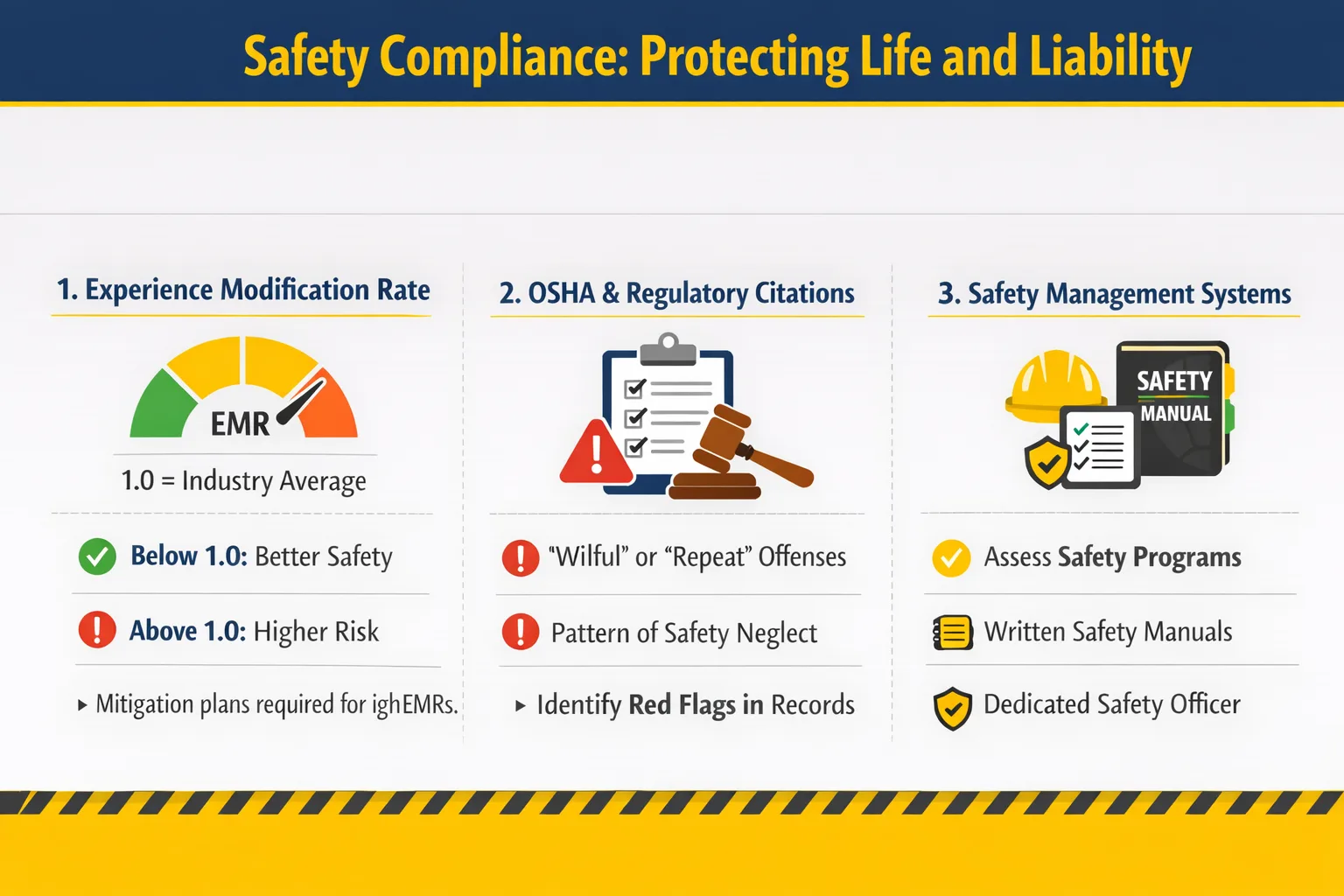
Safety risk is often viewed strictly through a humanitarian lens, but it is also a massive financial and reputational risk. An accident on site can lead to Stop Work Orders (SWO), heavy regulatory fines, increased insurance premiums, and lawsuits.
1. Experience Modification Rate (EMR)
EMR is a key safety benchmark, with 1.0 as the industry average. Scores below 1.0 reflect better-than-average safety, while higher scores indicate more frequent. Many general contractors require mitigation plans for subcontractors with EMRs above 1.0 or 1.2.
2. OSHA/Regulatory citations
Beyond the EMR, it is necessary to check public records for citations from regulatory bodies. A history of “Willful” or “Repeat” violations indicates a systemic disregard for safety protocols, which is a cultural issue that is difficult to police from the outside.
3. Safety management systems
Does the subcontractor have a written safety manual? Do they have a dedicated safety officer? During the prequalification phase, requesting documentation of their safety programs helps verify if safety is institutionalized or merely an afterthought.
Operational Capacity: The Risk of Overcommitment
A high-quality subcontractor can become a high-risk liability if they take on more work than they can handle. This leads to overcommitment, where the subcontractor spreads their workforce and equipment too thin.
1. Evaluating backlog vs. capacity
Assessing operational risk involves comparing the subcontractor’s current backlog against their historical revenue. If a company that historically performs $5 million in annual revenue suddenly has a backlog of $15 million.
Rapid expansion is a primary cause of business failure in construction because the infrastructure (cash flow, management, equipment) rarely grows as fast as the contract volume.
2. Manpower availability
Labor shortages are common in construction, so it’s critical to confirm that a subcontractor has enough qualified workers for your project timeline. This includes reviewing manpower plans and ensuring the key personnel listed in the bid will actually manage the job.
3. Equipment and supply chain
For trades that are project machinery-heavy (excavation, steel erection), the condition and availability of machinery are paramount. Reliance on rental equipment in a market with low inventory can lead to delays.
Legal and Contractual Risks
Legal risks often lie dormant until something goes wrong. These risks center around the contract terms and litigation history. A subcontractor who is constantly embroiled in lawsuits is a distraction and a liability.
1. Litigation history
A basic background check can reveal whether a subcontractor is highly litigious. A history of frequent lawsuits or liens signals elevated contractual risk and often points to an adversarial working relationship rather than a collaborative one.
2. Insurance verification
Collecting a Certificate of Insurance (COI) is standard, but proper analysis is essential. Coverage must match the scope of work, include adequate limits. Gaps, exclusions, or expired policies can expose the main contractor to serious third-party liability risks.
3. Indemnification clauses
The subcontract must clearly define who is responsible for what. Strong indemnification clauses protect the main contractor from damages caused by the subcontractor’s negligence.
Technology’s Role in Mitigating Risk
Traditionally, subcontractor risk assessment was done via spreadsheets, emails, and paper forms. This manual approach is slow, prone to error, and creates data silos. Today, technology plays a pivotal role in enforcing risk management protocols.
1. Centralized qualification platforms
Modern construction management software allows GCs to create a centralized database of prequalified subcontractors. Instead of emailing PDF forms, subcontractors log into a portal to upload their budget and performance data, safety records, and insurance certificates.
2. Real-time performance tracking
Risk assessment shouldn’t stop when the contract is signed. Digital tools allow site superintendents to rate subcontractors daily on safety compliance, schedule adherence, and quality.
This data feeds back into the central system, updating the subcontractor’s risk profile for future projects. If a sub consistently fails safety inspections on one job, the estimating team bidding on a new project should know about it immediately.
3. Automated compliance alerts
Managing COI expirations for 50 subcontractors across 10 projects is impossible manually. Enterprise Resource Planning (ERP) systems can automate this, sending alerts to both the project manager and the subcontractor 30 days before a policy expires.
Step-by-Step Guide to Implementing a Risk Assessment Program
For construction firms looking to formalize their risk assessment, a structured approach is necessary. This prevents the process from becoming a bureaucratic bottleneck and ensures it adds value.
Step 1: Establish Risk Tolerance Criteria
Before assessing subcontractors, a company should define its risk limits, such as maximum contract value and acceptable EMR. Clear go/no-go criteria guide teams and reduce subjective decisions.
Step 2: Create a Standardized Prequalification Form
Develop a comprehensive questionnaire that covers:
- General Information: Years in business, ownership structure, licensing.
- Financials: Audited financial statements, bank references, surety capacity.
- Safety: EMR history, OSHA logs, safety manual table of contents.
- Operations: Current WIP, largest completed projects, references.
- Quality: QA/QC programs, rework history.
Step 3: The Evaluation and Scoring System
Data without analysis is useless. Assign a weighted score to each section. For example, Financials might be weighted 40%, Safety 30%, and Operations 30%. This results in a quantifiable “Risk Score.”
Step 4: Continuous Monitoring and Feedback Loop
The assessment must be dynamic. Implement a post-project review where the project team evaluates the subcontractor’s actual performance against their pre-bid promises. This “Project Closeout Evaluation” is critical data for future risk assessments.
Strategies for Managing High-Risk Subcontractors
Sometimes, you have to use a high-risk subcontractor. Perhaps they are the only one with a specific skillset, or the client has nominated them. In these cases, risk mitigation replaces risk avoidance.
1. Subcontractor Default Insurance (SDI) vs. Surety Bonds
Performance and payment bonds provide traditional protection, with the surety covering subcontractor failures. Subcontractor Default Insurance (SDI or Subguard) offers faster resolution and more control but relies on a strong internal prequalification process.
2. Joint check agreements
If a subcontractor is financially shaky, a Joint Check Agreement can ensure their suppliers get paid. The GC writes a check payable to both the subcontractor and their supplier. This prevents the service provider from using the funds for other purposes.
3. Reduced scope and payment retainage
Another strategy is to split work into smaller contracts, award in phases and release the next only after successful completion. Higher retainage can also motivate subcontractors to finish properly.
Industry-Specific Use Cases
Risk assessment is not one-size-fits-all. Different sectors of construction face unique risks.
1. Commercial high-rise
In vertical construction, the schedule is king. The risk assessment here focuses heavily on manpower and logistics. A drywall contractor who cannot staff the job will delay the painters, flooring, and finish carpentry.
2. Heavy civil and infrastructure
Here, the risks are often environmental and equipment-based. Do they have the heavy machinery required? Financial capability is also crucial due to the large capital outlays required before the first progress payment arrives.
3. Industrial and manufacturing
Working in active refineries or pharmaceutical plants requires specialized safety certifications. A subcontractor with a poor safety record is an absolute non-starter, regardless of their price, because a safety incident could shut down the client’s production line.
Future Trends in Risk Management (2026 and Beyond)
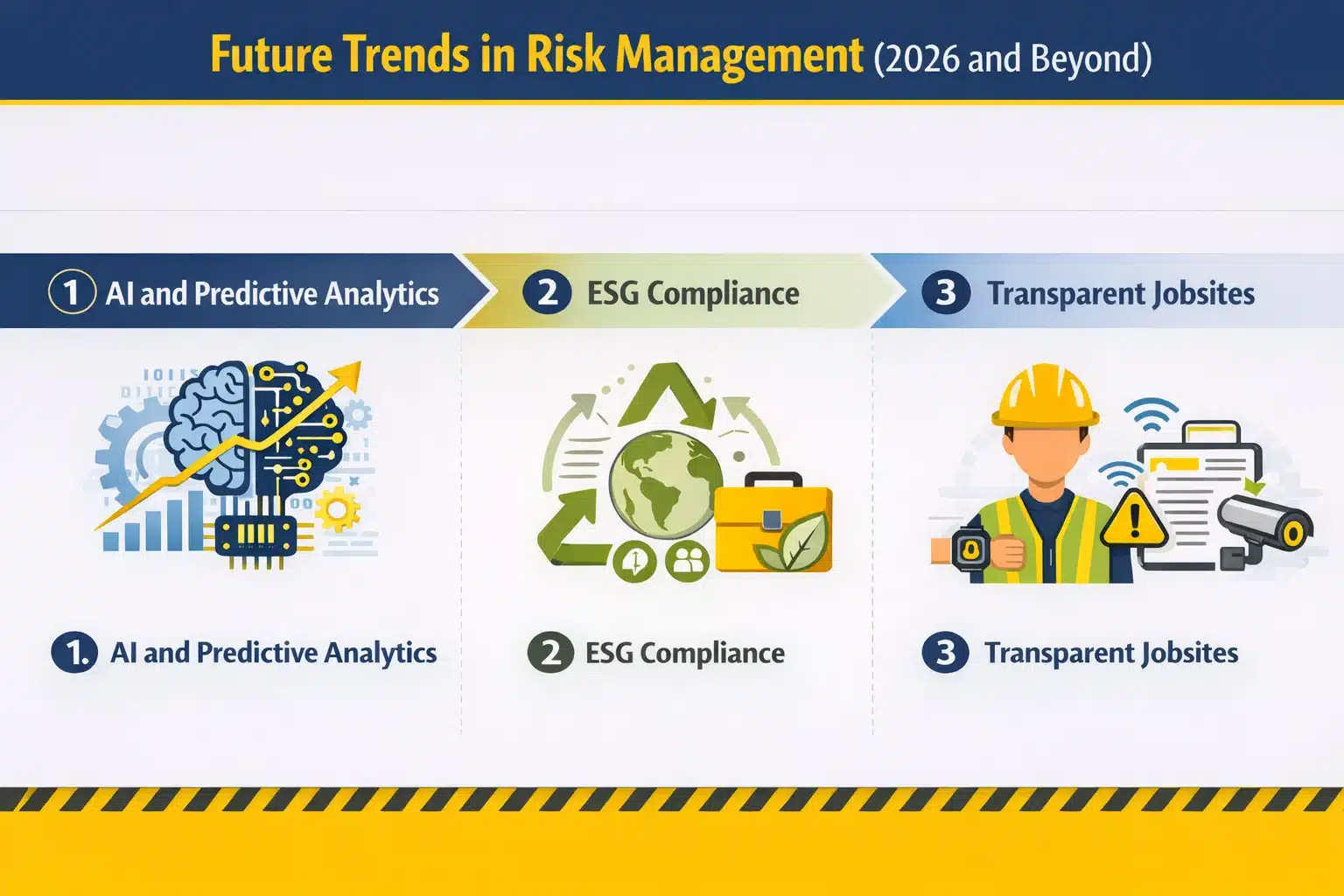
The future of risk assessment is predictive. We are moving away from looking at lagging indicators (what happened last year) to leading indicators (what is likely to happen next week).
1. AI and predictive analytics
Artificial Intelligence is beginning to analyze vast amounts of industry data to predict default. By correlating weather patterns, payment delays across the industry, and labor market trends, AI models can flag a subcontractor as “at-risk” months before they actually miss a payroll.
2. ESG compliance
Environmental, Social, and Governance (ESG) criteria are becoming part of the risk matrix. Clients are increasingly demanding that the entire supply chain adhere to sustainable governance for labor practices.
3. The rise of the “Transparent Jobsite”
With the integration of IoT sensors and wearables, safety risk assessment will become real-time. If a subcontractor’s workers are consistently bypassing safety zones or not wearing PPE, sensors will alert the GC immediately.
Cross-Industry Application: Managing Third-Party Risk Beyond Construction
While the construction sector is notorious for its reliance on subcontractors, the necessity for rigorous third-party risk management extends deeply into manufacturing, distribution, and retail.
1. Manufacturing: The Outsourced Component Risk
In the manufacturing sector, “subcontractors” often take the form of specialized fabrication shops, coating services, or component suppliers. The risk here is not just financial, but technical and logistical.
Use case: A machinery manufacturer uses ERP to track vendor certifications and capacity. By syncing production schedules, they spot bottlenecks early and shift work to pre-qualified vendors to avoid stoppages.
2. Distribution and logistics: the 3PL dependency
For distribution companies, subcontractors are often Third-Party Logistics (3PL) providers and last-mile delivery fleets. The risk profile here shifts toward brand reputation and service level agreements (SLAs).
Use case: A distributor uses risk management software to monitor carrier insurance and DOT safety ratings. Alerts block non-compliant carriers from new loads until issues are resolved.
3. Retail: installation and facility management
Retailers frequently employ subcontractors for store build-outs, HVAC maintenance, and “white glove” product installation for customers. Here, the risk is liability and customer safety.
Use case: A furniture retailer uses a vendor portal for subcontractors to upload background checks and insurance. The ERP links this to dispatch, blocking work orders for non-compliant technicians.
Implementation Steps: Building a Data-Driven Risk Program
Transitioning from a reactive, paper-based process to a digital risk management strategy requires a structured implementation plan. Simply buying software is not enough; processes must be re-engineered to leverage data effectively.
Phase 1: Standardization and Centralization
The first step is moving all subcontractor data into a single source of truth. Historically, financial data lived in accounting software, safety data in spreadsheets, and contracts in filing cabinets.
Actionable Step: Audit all current subcontractor data sources. Define a standard “Prequalification Packet” that every vendor must complete. This should include standardized fields for EIN, safety EMR ratings, and banking references.
Phase 2: Automated Workflow Integration
Once data is centralized, workflows must be established to enforce compliance. Risk assessment should not be a one-time event but a gatekeeper for critical project milestones.
Actionable Step: Configure the ERP to create “Hard Stops.” For example, the system should prevent the Accounts Payable department from cutting a check if the subcontractor’s insurance certificate has expired.
Phase 3: Defining Metrics and KPIs
To measure the success of a risk management program, organizations must track specific business performance metrics (KPIs). These metrics provide early warning signs of portfolio-wide risk.
- Subcontractor Default Ratio: The percentage of subcontractors who fail to complete their scope or require supplementation.
- Compliance Expiration Rate: The percentage of active vendors operating with expired or soon-to-expire documentation.
- Prequalification Cycle Time: The average time it takes to vet and approve a new subcontractor. A long cycle time may indicate bureaucratic inefficiencies that hamper agility.
- Safety Incident Frequency (Subcontractors): Comparing the accident rates of subcontractors against the main contractor’s internal benchmarks.
Common Pitfalls and Mitigation Strategies
Even with robust software, organizations often stumble due to behavioral or process errors. Recognizing these pitfalls is essential for maintaining a resilient supply chain.
1. The “Set and Forget” Mentality
The Pitfall: Many contractors perform a rigorous prequalification at the start of a relationship and then never check the subcontractor’s status again. A company that was financially healthy in 2021 may be on the brink of bankruptcy in 2024.
Mitigation: Implement a “Continuous Monitoring” protocol. Use ERP features that integrate with credit bureaus to provide push notifications whenever a subcontractor’s credit score drops or a lien is filed against them.
2. Ignoring the tier 2 risk
The Pitfall: Focusing solely on the direct subcontractor (Tier 1) while ignoring their subcontractors (Tier 2). If a mechanical subcontractor fails to pay their supplier for the chillers, that supplier can file a lien against the project.
Mitigation: Implement a rigorous lien waiver management process. Require unconditional lien waivers from Tier 1 subcontractors and conditional waivers from major Tier 2 suppliers before releasing payment.
3. The “paper shield” illusion
The Pitfall: Collecting documents just to “check the box” without analyzing the content. Possessing a safety manual does not mean the subcontractor follows it. Holding an insurance certificate does not guarantee the policy covers the specific risks of the project.
Mitigation: Employ subject matter experts or AI-driven document scanning tools to review the content of exclusions and policy limits. Ensure that the specific scope of work is covered by the insurance policy provided.
Advanced Best Practices: Predictive Risk Intelligence
Leading organizations are moving beyond compliance and into the realm of predictive analytics. By leveraging the historical data stored within their ERP and project management systems, they can forecast risk before it materializes.
1. Algorithmic risk scoring
Advanced systems assign a dynamic “Risk Score” to every subcontractor. This score is a weighted aggregate of financial health, safety performance, past project quality, and current workload.
If a subcontractor takes on three new large projects simultaneously, their capacity score drops. Project managers can use this score to make informed award decisions, perhaps choosing a slightly more expensive but lower-risk partner for critical path activities.
2. Collaborative capacity planning
Instead of treating subcontractors as commodities, best-in-class contractors engage in collaborative planning. They share their long-term project pipeline with key trade partners, allowing those subcontractors to plan their staffing and cash flow accordingly.
3. Integration of field data
True risk assessment incorporates real-time field data. Mobile apps used by superintendents to log daily reports and quality issues should feed directly into the vendor’s risk profile.
If a concrete subcontractor consistently receives “Correction Notices” for rebar placement across multiple job sites, the central system should flag this as a systemic quality risk, triggering a review before they are hired for the next high-rise project.

Conclusion
Subcontractor risk assessment isn’t about saying “no,” but about setting conditions to say “yes.” It helps contractors and subs address weaknesses early with measures like adjusted schedules, safety support, or payment arrangements.
In construction’s unpredictable environment, a thorough, data-driven risk assessment is essential. It protects the contractor’s capital, safeguards the workforce, and ensures that commitments to clients are met.
Financial health is crucial. Even profitable subcontractors can face cash flow issues from delayed payments. Evaluating ratios like Current and Quick Ratio ensures solvency, and companies can use a free consultation to review risks before awarding contracts.
Frequently Asked Questions
-
What are the most critical financial ratios to check in a subcontractor risk assessment?
The most critical ratios are the Current Ratio (measuring liquidity) and the Debt-to-Equity Ratio (measuring leverage). A Current Ratio below 1.0 suggests the subcontractor may struggle to pay immediate bills, while high leverage indicates they are heavily reliant on debt to operate.
-
How often should a general contractor perform risk assessments on their subcontractors?
Risk assessment should be continuous. While a major prequalification happens annually or before a new contract, financial health and safety performance should be monitored throughout the project lifecycle, especially when a subcontractor takes on significant new volume.
-
Why is the Experience Modification Rate (EMR) important in risk assessment?
The EMR is a benchmark of a company’s past cost of injuries and future chances of risk. An EMR of 1.0 is the industry average; a lower number indicates a better-than-average safety record, which often correlates with better overall management and lower insurance costs.
-
What is the difference between a surety bond and subcontractor default insurance (SDI)?
A surety bond is a three-party agreement where a surety company guarantees the subcontractor’s performance. Subcontractor default insurance (SDI) is a two-party insurance policy purchased by the general contractor that indemnifies them against costs resulting from a subcontractor’s default.