






Getting the right people to the right site at the right time is harder than it sounds. Construction workforce management is the process of planning, scheduling, tracking, and coordinating the people who build your projects, and when it breaks down, projects fall behind and costs blow out.
This guide covers the key challenges, functions, and strategies that help Australian construction businesses manage their workforce more effectively, from multi-site scheduling to real-time field visibility.
Key Takeaways
Construction workforce management is the system a business uses to plan, schedule, track, and coordinate its workers across projects, directly shaping project performance and labour costs.
Labour shortages, multi-site coordination, and WHS compliance are the three most persistent challenges construction businesses face in managing their workforce.
Scheduling, time tracking, field communication, and productivity tracking are the four functions that keep a construction workforce running efficiently across sites.
Real-time dashboards, mobile apps for field teams, and ERP integration give construction businesses the visibility and automation they need to prevent delays and control costs.

What Is Construction Workforce Management?
Construction workforce management is the system a construction business uses to plan, deploy, and monitor its workers across projects. It covers everything from labour forecasting and shift scheduling to time tracking and compliance monitoring.
Good workforce management connects office planning with field execution. Therefore, when a project manager changes the schedule or a worker calls in sick, the rest of the team adjusts without the entire project derailing.
Unlike desk-based industries, construction workforce management must account for variable job sites, fluctuating headcounts, subcontractors, and strict safety obligations. Managing complex site activities requires tools and processes that standard HR platforms rarely support.
Construction Workforce Management Challenges
Construction workforce management comes with pressures unlike almost any other sector. The combination of tight deadlines, physical work environments, and dispersed teams creates challenges that compound quickly when left unaddressed.
Below are the three most persistent issues that construction businesses deal with on a daily basis.
1. Labour shortages and skill gaps
Australia’s construction sector has faced chronic labour shortages for years, particularly in trades such as electrical, plumbing, and civil engineering. When skilled workers are hard to find, projects rely on a smaller pool of people working harder and longer.
Skill gaps compound the problem further. A crew that lacks specific certifications cannot legally perform certain tasks on site, which forces project managers to rearrange work sequences or bring in contractors at short notice.
2. Managing teams across job sites
Running multiple projects simultaneously means workers spread across sites that may be kilometres apart. Tracking attendance, progress, and task completion without centralised project supervision becomes difficult very quickly.
Miscommunication between site supervisors and the office is a common source of delays. Therefore, businesses that rely on phone calls and paper-based reporting often spend more time chasing updates than actually resolving problems.
3. Safety and compliance
Construction is one of Australia’s highest-risk industries for workplace injuries. Every site must comply with Work Health and Safety (WHS) legislation, and maintaining accurate records of inductions, certifications, and incidents is a legal obligation.
Non-compliance carries serious consequences, including fines, work stoppages, and legal liability. Consequently, tracking workforce compliance across multiple sites and shifting crews requires a system that updates in real time.
"Centralising our workforce management cut our payroll errors and gave site supervisors real-time visibility they never had before. "
Core Construction Workforce Management Functions
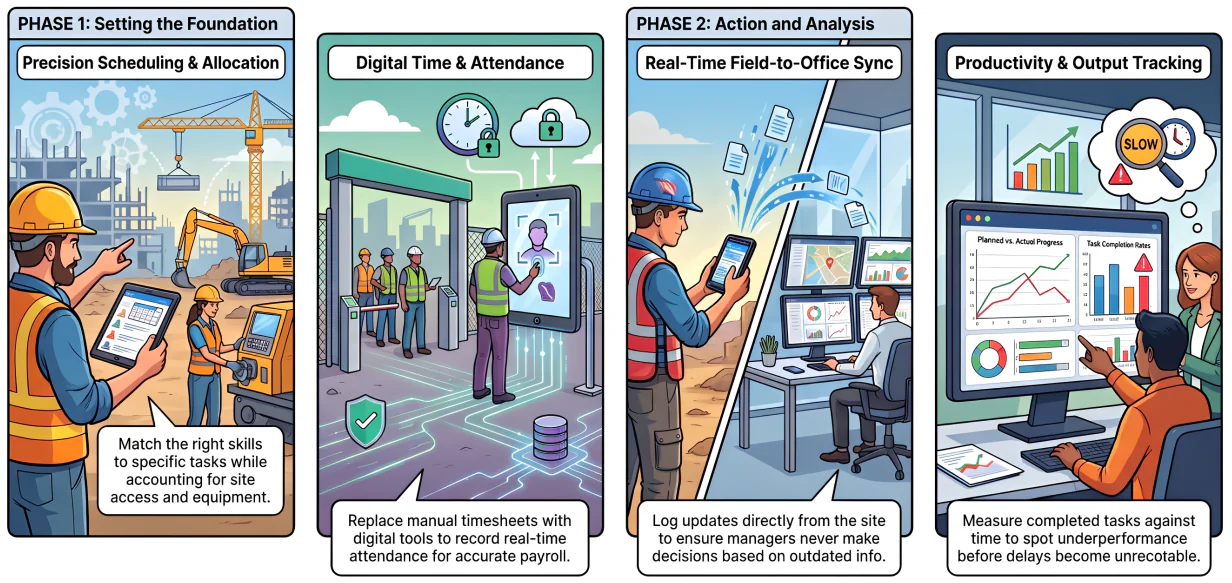
Effective construction workforce management depends on a set of interconnected functions working in sync. When each of these areas runs well, the workforce operates as a coordinated unit rather than a collection of separate crews.
Here are the four core functions that underpin strong workforce management in construction.
1. Workforce scheduling and allocation
Scheduling is the foundation of construction workforce management. It involves matching the right workers, with the right skills and certifications, to the right tasks at the right time.
Good scheduling accounts for subcontractor availability, equipment handover windows, and site access restrictions. Scheduling field workers efficiently keeps project timelines realistic rather than optimistic on paper but unworkable on the ground.
2. Time tracking and attendance
Accurate time tracking tells you who is on site, when they arrived, and how long they worked. This data feeds directly into payroll, cost reporting, and labour productivity analysis.
Manual timesheets introduce errors and create delays in payroll processing. Therefore, construction businesses increasingly use digital time tracking tools that record attendance in real time, often through mobile apps or biometric clocks installed on site.
3. Field and office communication
The gap between what a site supervisor knows and what the project manager hears is where many problems begin. Effective communication channels ensure that changes, incidents, and progress updates move quickly in both directions.
When field teams log updates directly into a shared system, the office sees the same information without waiting for an end-of-day call. This real-time flow reduces the risk of decisions being made on outdated information.
4. Productivity tracking
Productivity tracking measures how efficiently your workforce converts time into completed work. It goes beyond attendance and captures output: tasks completed, materials installed, and milestones reached per shift.
Productivity data allows project managers to spot underperforming areas early and adjust resourcing before a delay becomes unrecoverable. Furthermore, it builds a historical record that improves labour estimates for future projects.
Impact On Construction Project Performance
Strong construction workforce management does not just keep your crew organised. It directly shapes the outcomes your projects deliver, from delivery dates to safety records and client satisfaction.
Below are the three areas where the impact is most measurable.
1. Better labour planning
When you have accurate data on workforce availability, skills, and current utilisation, labour planning moves from guesswork to informed decision-making. Project managers can distribute workers across tasks based on real capacity rather than assumptions.
For example, if a civil project is running ahead of schedule, labour can be redeployed to a site that is behind rather than sitting idle. This flexibility reduces both overtime costs and project delays.
2. Higher workforce productivity
When workers know their tasks, have the right tools, and receive clear communication from supervisors, output improves. Removing the friction caused by last-minute schedule changes, unclear assignments, and poor coordination frees up productive time on every shift.
Research consistently shows that construction sites with structured workforce management programmes achieve higher output per labour hour than those relying on informal coordination. Therefore, the return on investing in workforce management is measurable and direct.
3. Improved safety and compliance
A well-managed workforce is a safer workforce. When site inductions, certification checks, and safety briefings are built into the scheduling process, compliance becomes routine rather than reactive.
Automated alerts that flag expired licences or missing inductions prevent non-compliant workers from accessing restricted areas. As a result, businesses reduce their exposure to WHS incidents and regulatory penalties at the same time.
Benefits of Digital Tools For Workforce Management
Paper-based processes and disconnected spreadsheets can only take a construction business so far. Integrated workforce coordination tools give project managers the speed and visibility they need to run sites efficiently.
1. Real-time workforce visibility
A real-time construction workforce management dashboard shows who is on which site, what tasks they are assigned to, and how actual hours compare to planned hours. This visibility allows project managers to identify problems while there is still time to act.
For instance, if a crew is consistently running behind on a critical path task, the dashboard surfaces this early rather than at the weekly progress meeting. Therefore, corrective action happens sooner and costs less.
2. Mobile tools for field teams
Field workers rarely sit at a desk, so workforce management tools must be mobile-first. Software supporting field operations allows crews to clock in, log progress, report hazards, and receive updated schedules from their phones, removing the need for paper-based reporting.
Mobile tools also support subcontractor management. When subcontractors use the same platform as your direct workforce, their attendance and output become visible in the same dashboard your project managers rely on every day.
3. System integration
A workforce management platform that connects to your project management, payroll, and ERP systems eliminates duplicate data entry and keeps information consistent across every department.
For example, when a time-tracking record flows automatically into payroll, the pay run becomes faster and more accurate. Similarly, when labour actuals feed into the project schedule, cost reporting updates without manual intervention.
Construction Workforce Planning and Scheduling

Long before a tool is lifted on site, construction workforce planning determines whether a project has the people it needs to succeed. Planning done well prevents the scrambling, subcontractor reliance, and overtime costs that erode margins.
1. Forecasting labour requirements
Labour forecasting estimates how many workers, in which trades, are needed at each point of a project. It draws on project schedules, scope documents, and historical productivity data to produce a realistic staffing plan.
Accurate forecasts prevent both under-staffing, which slows work, and over-staffing, which drives up costs. Therefore, investing time in upfront labour forecasting pays off across the full project lifecycle.
2. Allocating workers across projects
Construction businesses running multiple projects simultaneously must balance worker allocation carefully. Moving a skilled worker from one site to another affects both projects and requires careful timing to avoid creating new bottlenecks.
A centralised workforce view allows resource managers to see where capacity exists across the portfolio and make allocation decisions that benefit the business overall, not just the loudest project manager in the room.
3. Managing workforce availability
Workforce availability changes constantly due to leave, training, injury, and turnover. Keeping an accurate and current picture of who is available prevents scheduling conflicts and last-minute gaps that delay work.
Building leave calendars, certification renewals, and training commitments into your workforce management system gives you a realistic view of capacity at any point in the project. Consequently, you can plan around constraints rather than being caught off guard by them.
Best Practices For Workforce Management
The businesses that get construction workforce management right share a set of common habits. These practices apply whether you run a small residential builder or a large civil contractor.
1. Plan workforce needs early
The earlier you engage with workforce planning, the more options you have. Identifying skill gaps or labour shortages three months before a project starts gives you time to recruit, train, or engage subcontractors through proper channels.
Late-stage workforce gaps often result in rushed hiring decisions, higher contractor rates, and workers who are unfamiliar with your site systems. Therefore, workforce planning should begin at the same time as project planning.
2. Use data to optimise labour
Historical data from past projects is one of your most valuable planning assets. Labour productivity rates, shift patterns, and cost-per-trade benchmarks drawn from previous work make your estimates more accurate and your bids more competitive.
If your current system does not capture this data automatically, start collecting it manually for your most common work types. Even basic records improve over time and give your workforce planning a foundation it currently lacks.
3. Improve team communication
Clear, consistent communication between site and office reduces the misunderstandings that cause rework, delays, and safety incidents. Establishing daily check-ins, standardised progress reporting, and clear escalation paths gives your teams a reliable structure to work within.
Digital communication tools that keep all project conversation in one place reduce the risk of important information getting lost in a text thread or email chain. As a result, both site supervisors and project managers stay aligned on priorities throughout the project.
Once these best practices are in place, the next challenge is turning them into daily workforce decisions. Hashy AI helps project teams check worker availability, skills, site requirements, and task priorities before assigning crews across active projects.






WHS Compliance in Australian Construction Workforce Management
WHS compliance is a core part of construction workforce management, not a separate admin task handled after scheduling is complete. Every roster, site assignment, and subcontractor movement should account for safety duties, licences, inductions, fatigue risk, and high-risk work documentation.
1. Understanding WHS Duties on Australian Construction Sites
In Australian construction workforce management, WHS starts with understanding who holds the duty of care. Safe Work Australia explains that a PCBU is the primary duty holder for construction WHS and must manage risks, consult workers, and coordinate with other duty holders.
For construction teams, workforce decisions should reflect official WHS duties for construction work before a worker is ever sent to site.
Safe Work Australia also publishes a Model Code of Practice: Construction work which sets out practical guidance PCBUs can follow when managing site risk.
2. Managing Worker Inductions, Licences, and Site Access
Every worker should have the right induction, licence, certification, and site access permission before starting work. This becomes harder when crews and subcontractors move between projects with different site rules.
A centralised construction workforce management system helps supervisors check worker readiness before allocation. Businesses operating across states should also confirm local requirements with their state or territory WHS regulator.
3. Tracking Safe Work Method Statements for High-Risk Construction Work
High-risk construction work often requires a Safe Work Method Statement before the task begins. This document should explain the work activity, hazards, and controls that workers need to follow on site.
Safe Work Australia provides guidance on SWMS for high-risk construction work, which makes document control an important part of construction workforce management.
4. Monitoring Fatigue, Overtime, and Rostering Risks
Fatigue risk increases when workers take long shifts, move between distant sites, or carry repeated overtime across several weeks. In construction, that can affect judgement, reaction time, and safe task execution.
Workforce managers should track roster load, overtime patterns, and rest windows before assigning safety-critical tasks. Safe Work Australia treats fatigue in construction as a genuine WHS risk that rostering decisions need to account for, not just a productivity concern.
Overtime patterns add to that risk. Fair Work sets out when overtime and additional hours apply, which workforce managers should factor in before approving extended shifts.
5. Keeping Incident, Attendance, and Compliance Records in One System
Incident reports, attendance records, toolbox talks, licence checks, and SWMS acknowledgements should not sit in separate folders. When records are scattered, supervisors lose the full picture of who was on site, what they were cleared to do, and what happened during the shift.
Keeping these records inside one construction workforce management platform gives project managers a clearer audit trail. It also helps teams prepare for internal reviews, regulator queries, and future project planning.
6. How Workforce Management Software Supports WHS Compliance
Workforce management software supports WHS compliance by connecting scheduling decisions with actual worker readiness. If a licence expires, an induction is missing, or a worker is approaching unsafe overtime levels, the system can flag the issue before the roster is confirmed.
This turns construction workforce management into a proactive control process. Instead of discovering compliance gaps after work begins, project teams can prevent the wrong assignment from reaching the site in the first place.
Conclusion
Construction workforce management directly determines whether your projects finish on time, within budget, and without safety incidents. When scheduling, compliance, and communication all run through one system, your crews spend less time waiting and more time building.
HashMicro’s workforce management solutions give construction businesses real-time visibility across every site and every trade. Schedule a consultation with our experts today to see how it fits your operation.

Frequently Asked Question
Project management focuses on scope, budget, timeline, and deliverables for a specific project. Workforce management focuses on the people executing that work, covering scheduling, attendance, skills allocation, compliance, and productivity across one or more sites. Both disciplines depend on each other, but they address different layers of a construction operation.
The most effective approach combines a centralised workforce management platform with mobile tools for field teams. A single dashboard shows worker locations, assigned tasks, and actual hours across every site, so project managers can reallocate labour, spot delays, and maintain compliance without visiting each location in person.
Poor scheduling, unclear task assignments, late material deliveries, and communication breakdowns between site and office are the most common causes. Each one individually slows output, but they frequently occur together. Businesses that introduce structured daily check-ins, digital progress reporting, and real-time scheduling tools consistently recover significant productive hours per week.
A workforce management system can track worker inductions, certification expiry dates, and site access permissions automatically. When a certification lapses, the system flags it before the worker arrives on site rather than after an incident has occurred. This proactive approach reduces the risk of WHS breaches and keeps audit records accurate and current.
The tipping point for most construction businesses is when manual tracking, spreadsheets, and phone calls start causing missed shifts, payroll errors, or compliance gaps that affect project delivery. If your team manages more than two active sites or regularly deploys subcontractors, a dedicated workforce management platform will typically pay for itself within the first few months through recovered labour time and avoided penalties.