




Asset management system is the process of tracking, monitoring, and optimising a business’s physical, digital, or financial assets. It helps improve asset performance, reduce downtime, streamline maintenance, and support compliance throughout the asset lifecycle.
Across Australia, asset-intensive industries continue to face rising maintenance costs and stricter compliance requirements. According to industry reports, unplanned downtime alone can cost businesses thousands per hour, especially in sectors like manufacturing, construction, and utilities.
An asset management system helps Australian businesses address this by centralising asset data, improving maintenance planning, and supporting compliance with financial and regulatory standards. Instead of relying on fragmented records, companies gain a clearer, real-time view of asset performance and lifecycle value.
As operations scale, managing asset condition, depreciation, and servicing becomes more complex. A structured system allows businesses to reduce operational risk, improve cost control, and make more informed investment decisions based on reliable data.
Key Takeaways
Understand how an asset management system helps track, manage, and optimise assets across their lifecycle.
Discover the key benefits of an asset management system, from improving asset visibility to reducing maintenance costs.
Explore the different types of asset management systems to find the best fit for your business and asset tracking needs.
Learn how AI is strengthening asset management systems with predictive maintenance, automation, and smarter decision-making.

What Is an Asset Management System?
An asset management system is a strategic combination of software, processes, and policies platform that helps Australian businesses track, maintain, and optimise the lifecycle of physical and digital assets, from procurement through to disposal. It centralises asset data, supports depreciation tracking under AASB 116 and ATO requirements, schedules maintenance, and enables reporting aligned with ISO 55001 principles.
Compared with manual records or spreadsheets, modern systems provide a real-time, auditable view of asset condition, location, and value. Many platforms integrate barcode scanning, RFID, IoT sensors, and cloud access, making it easier for teams to monitor assets across multiple sites and update records instantly.
Beyond tracking, an asset management system plays a key role in financial control and compliance. It helps businesses manage depreciation schedules, maintain maintenance history for audits, and ensure asset records align with tax and reporting obligations.
By giving finance, procurement, and operations teams access to the same structured data, the system reduces errors, improves coordination, and supports better long-term decisions around asset utilisation, maintenance, and replacement.
Benefits of an Asset Management System
An asset management system helps businesses improve visibility, reduce operational risk, and maintain better control over maintenance, compliance, and asset-related costs across daily operations.
- Improved asset visibility: Teams can track asset condition, location, ownership, and maintenance history in real time across multiple sites.
- Lower maintenance costs: Preventive and predictive maintenance scheduling helps reduce unexpected breakdowns and costly emergency repairs.
- Stronger compliance and audit readiness: Centralised records support AASB, ATO, ISO 55001, and workplace safety compliance requirements more efficiently.
- Better lifecycle planning: Businesses gain clearer visibility into asset utilisation, depreciation, servicing, and replacement timing.
- Higher operational efficiency: Automated workflows reduce manual administration and improve coordination between finance, procurement, and maintenance teams.
- Improved financial control: Asset management systems support more accurate budgeting, depreciation tracking, and capital expenditure planning.
Types of Asset Management Systems

Different businesses need different levels of control, which is why asset management systems come in several forms. Each type of asset management system addresses a specific operational focus, from large-scale equipment oversight to financial asset tracking and digital file businesses.
Choosing the right asset management system helps a company improve visibility, simplify workflows, and align asset management with business goals. For businesses reviewing an asset management system in the Australian market, understanding these categories makes the selection process far more practical and effective.
1. Enterprise Asset Management (EAM)
An enterprise asset management system is a comprehensive platform that helps large, asset-intensive businesses manage physical assets throughout their lifecycle. It usually combines asset tracking, maintenance planning, procurement coordination, spare parts control, and compliance monitoring into a single connected environment.
This type of asset maintenance management system works especially well for industries such as manufacturing, energy, construction, and utilities, where one asset often affects the performance of many others. By giving teams deeper visibility into asset condition, usage, and maintenance needs, EAM helps reduce downtime, improve reliability, and support stronger long-term planning.
2. Fixed Asset Management System
A fixed asset management system focuses on long-term physical assets such as buildings, vehicles, machinery, computers, and office equipment. Its main role is to help businesses record ownership, monitor asset value, manage depreciation, and maintain accurate documentation for accounting and audits.
Compared with manual records, this type of asset management system provides finance teams with a clearer, more reliable way to track asset movement, disposal, and replacement. It is especially valuable for businesses that want cleaner financial reporting, stronger compliance, and better control over capital investments.
3. IT Asset Management (ITAM)
An IT asset management system helps businesses track and manage technology assets such as laptops, servers, software licences, cloud subscriptions, and network equipment. It gives IT teams better visibility into asset ownership, usage, lifecycle status, and renewal schedules.
For businesses managing large digital environments, ITAM improves software compliance, reduces unused licence costs, and strengthens cybersecurity oversight. Centralised tracking also helps simplify onboarding, asset allocation, and hardware replacement planning.
4. Digital Asset Management (DAM) System
A digital asset management system is designed to organize, store, and retrieve digital files, including images, videos, brand materials, contracts, and internal documents. It helps businesses avoid the common problem of scattered files across personal folders, local drives, and disconnected cloud storage.
Among modern asset management systems, DAM is especially useful for marketing teams, media companies, and businesses that handle large volumes of content and need version control. With centralized access, searchable metadata, and permission-based controls, this system helps teams work faster while protecting brand consistency and sensitive information.
5. Infrastructure Asset Management System
An infrastructure asset management system is designed for companies that manage large, public-facing assets such as roads, bridges, utilities, transit networks, and treatment facilities. It supports condition monitoring, lifecycle planning, maintenance prioritization, and budget allocation for assets spread across wide geographic areas.
This type of asset management system often works closely with mapping and location data, which helps decision-makers assess risk and plan improvements more accurately. For governments, utility providers, and engineering firms, it supports smarter investment decisions and helps maintain critical infrastructure more efficiently.
ERP vs EAM: What’s the Difference?
ERP manages broader functions like finance, procurement, inventory, and HR, while EAM focuses on asset performance and maintenance. An ERP with built-in EAM creates a platform for managing your assets, improving visibility and coordination.
To clarify the distinctions, consider the following comparison of their core attributes:
| Feature / Focus Area | Enterprise Resource Planning (ERP) | Enterprise Asset Management (EAM) |
| Primary Objective | Unify core business processes (finance, HR, supply chain) into a single database. | Maximize the operational lifespan and performance of physical equipment. |
| Depth of Functionality | Broad and horizontal; covers many departments with general functionality. | Deep and vertical; highly specialized for maintenance and reliability engineering. |
| Primary Users | C-suite executives, finance teams, HR professionals, supply chain managers. | Maintenance managers, reliability engineers, field technicians, facility managers. |
| Maintenance Capabilities | Basic; usually limited to recording financial costs of repairs. | Advanced; includes predictive maintenance, IoT integration, and work order management. |
| Financial Tracking | Comprehensive corporate accounting, budgeting, and overall profitability. | Focused on total cost of ownership (TCO) for specific pieces of equipment. |
Standalone EAM systems can work well, but they may result in disconnected data when asset information does not integrate with finance and procurement. An ERP with built-in EAM solves this by linking maintenance, inventory, purchasing, and financial records in a single system, improving visibility and decision-making.
How Does an Asset Maintenance Management System Work?
An asset maintenance management system helps businesses manage maintenance activities through a connected operational workflow. Asset data, maintenance schedules, work orders, and reporting are handled within one centralised system.
In practice, most asset maintenance management systems follow a structured process like this:
- Assets are registered: Businesses first record asset details such as serial numbers, locations, warranties, maintenance history, and operational status within the system.
- Maintenance schedules are configured: Preventive or predictive maintenance schedules are created based on time intervals, usage hours, or asset condition.
- Work orders are generated: When maintenance is required, the system automatically creates work orders and assigns tasks to maintenance teams or technicians.
- Maintenance activity is recorded: Technicians update inspection findings, repairs, spare parts usage, downtime, and maintenance notes directly into the platform.
- Reports and analytics are generated: The system converts maintenance data into reports and dashboards that help businesses monitor asset performance, maintenance costs, and operational trends.
By connecting maintenance workflows with inventory, procurement, and financial records, businesses gain better visibility into asset performance and long-term maintenance planning.
Key Features of an Enterprise Asset Management System

A strong enterprise asset management system does more than record asset data. It helps businesses turn day-to-day asset activity into clearer planning, faster maintenance response, and better operational decisions.
- Comprehensive lifecycle management: An asset management system supports asset stage management, helping businesses monitor assets from procurement to disposal so every stage stays visible and easier to control. This supports better usage planning, replacement timing, and long-term asset value.
- Real-time tracking with barcode or RFID: Modern asset management systems make it easier to update asset location, status, and condition in real time via barcode, QR code, or RFID scanning. This helps teams reduce manual errors and complete audits more quickly.
- Preventive and predictive maintenance scheduling: An asset maintenance management system helps businesses schedule servicing before issues affect operations. With the right setup, teams can reduce downtime, improve equipment reliability, and plan maintenance more proactively.
- Automated depreciation and financial tracking: A well-structured asset management system supports more accurate asset valuation, depreciation records, and reporting. This gives finance teams a clearer basis for budgeting, audits, tax preparation, and capital planning.
- Work order and spare parts management: An enterprise asset management system helps assign maintenance tasks, track completion, and manage spare parts in one connected workflow. This keeps maintenance teams better prepared and reduces delays caused by unavailable stock.
- Advanced reporting and analytics dashboards: Strong asset management systems provide dashboards that make asset performance, maintenance costs, and operational trends easier to understand. For companies evaluating an asset management system Australia businesses can rely on, this visibility supports more confident and data-based decisions.
Australian Compliance Standards for Asset Management in 2026
Australian businesses must manage assets in line with multiple regulatory frameworks that cover financial reporting, taxation, operational safety, and governance. A modern asset management system is expected to support these requirements through automation, structured data, and audit-ready reporting.
1. AASB 116 and asset valuation
AASB 116 requires businesses to properly recognise, measure, and depreciate property, plant, and equipment. Asset management systems help automate valuation tracking and ensure financial records remain accurate.
2. AASB 16 lease accounting requirements
For leased assets, AASB 16 requires companies to recognise right-of-use assets and lease liabilities. A structured system helps track lease terms, depreciation, and reporting obligations more efficiently.
3. ATO depreciation and tax compliance
The Australian Taxation Office requires businesses to apply appropriate depreciation methods such as diminishing value or prime cost. Asset management systems simplify this by maintaining accurate depreciation schedules and audit-ready reports.
The table below summarises key Australian standards and what asset management software must support to ensure compliance:
| Standard | Requirement | What Software Must Support |
|---|---|---|
| ISO 55001 | Asset lifecycle governance framework | Asset register, lifecycle tracking, KPI dashboards |
| AASB 16 (Leases) | Right-of-use asset recognition | Lease schedules, remeasurement, liability tracking |
| AASB 116 (PPE) | Asset valuation and depreciation | Multi-method depreciation, revaluation tracking |
| ATO Depreciation | Tax depreciation rules | Prime cost & diminishing value automation |
| WHS Regulations 2022 | Workplace safety compliance | Inspection schedules, incident logs, audit trails |
| NHVR (Chain of Responsibility) | Heavy vehicle compliance | Maintenance logs, driver linkage, fatigue tracking |
| Modern Slavery Act 2018 | Supplier due diligence | Asset traceability, compliance documentation |
| Australian Standards (AS 1210, AS 1418, AS 4041) | Equipment safety standards | Inspection records for plant & machinery |
How to Implement an Asset Management System
Implementing an asset management system works best when businesses follow a clear process instead of treating it as a one-time software setup. With the right steps, companies can help asset management systems deliver better visibility, stronger maintenance control, and smoother coordination across teams.
- Define your objectives clearly: Start by identifying what your business wants to improve, whether that is asset tracking, maintenance planning, compliance, or cost control. This helps you choose an asset management system that better matches your priorities.
- Review your current assets and data: List the assets you want to manage and check whether existing records are complete, accurate, and ready to migrate. A clean data foundation makes implementation easier and helps the system produce more reliable insights from the start.
- Choose the right solution for your needs: Different businesses need different levels of capability, so the best fit may range from a simple tool to a full enterprise asset management system. For companies that need stronger maintenance control and long-term operational visibility, HashMicro’s asset maintenance management system can enable more connected, scalable asset management.
- Set up workflows and responsibilities: Decide how assets will be recorded, who will update information, how maintenance requests will be handled, and which teams need access. This step helps asset management systems support daily operations more effectively and consistently.
- Train users and encourage adoption: A system delivers better results when employees understand how to use it confidently in their daily work. Clear training helps teams adapt faster and makes the asset management system more useful for Australian businesses across locations and departments.
- Monitor performance and improve over time: After launch, review system usage, maintenance results, and reporting quality regularly. This helps businesses refine processes, improve data accuracy, and get more value from their asset management system over time.
How to Develop a Strategic Asset Management Plan
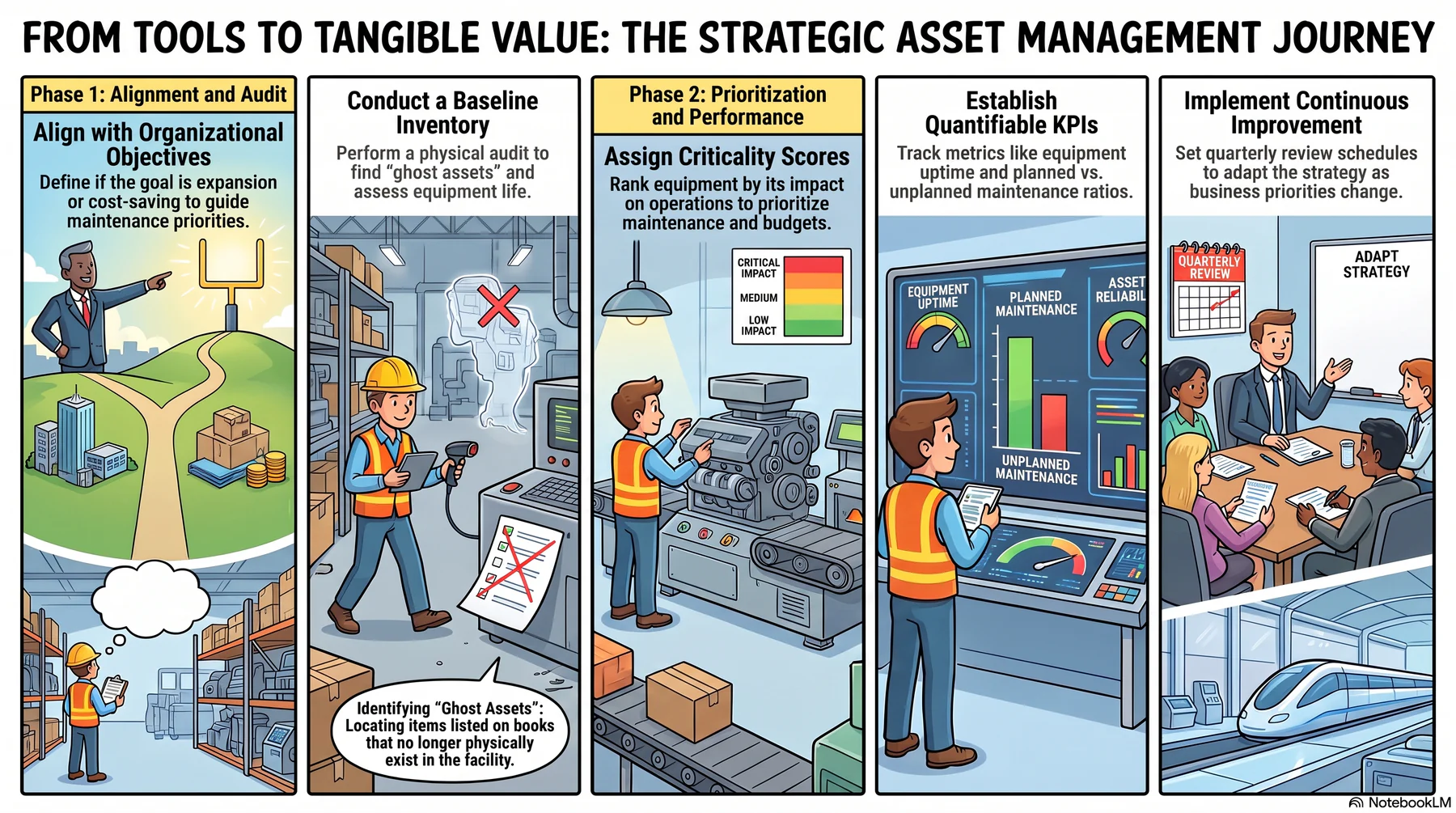
Acquiring software is merely purchasing a tool; developing a strategic plan ensures the tool is used to generate tangible business value. A Strategic Asset Management Plan (SAMP) serves as the foundational blueprint that aligns your resource management practices with your companie's overarching goals.
1. Define Organizational Objectives and Alignment
The first step is to understand the broader goals of the business clearly. Is the company focused on aggressive expansion, cost reduction, sustainability, or improving service quality? Your strategic plan must directly support these goals.
For instance, if the corporate objective is to reduce operational costs by 15% over the next two years, your plan should focus on optimizing preventive maintenance schedules to reduce emergency repair costs and extend the lifecycle of high-value equipment, thereby delaying capital expenditures.
2. Conduct a Comprehensive Baseline Inventory
You cannot manage what you do not know you have. Before implementing any new strategies, conduct a thorough, physical audit of your current inventory. This involves identifying every piece of equipment, recording its current location, assessing its physical condition, and estimating its remaining useful life.
This baseline data is critical; it highlights immediate areas of concern, identifies ghost assets (items listed on the books that no longer physically exist), and provides the foundational data necessary to populate your new software system.
3. Perform Risk and Criticality Assessments
Not all equipment is created equal. A strategic plan must classify resources based on their criticality to the businesses core operations. What happens if a specific conveyor belt fails? Will it halt the entire production line, or can operations continue smoothly?
By assigning a criticality score to each item, you can prioritize maintenance efforts, allocate budgets more effectively, and ensure that critical spare parts are always kept in stock for high-risk equipment. This risk-based approach ensures that resources are deployed where they will have the most significant impact on business continuity.
4. Establish Key Performance Indicators (KPIs)
To measure the success of your strategy, you must define clear, quantifiable metrics. Common KPIs include equipment uptime percentages, planned versus unplanned maintenance ratios, inventory turnover rates, and total cost of ownership.
Establishing these benchmarks allows management to objectively evaluate the performance of both the equipment and the maintenance teams, providing the data necessary to justify future budget requests and operational adjustments.
5. Implement a Cycle of Continuous Improvement
An effective asset management strategy should continue to adapt as business needs, asset conditions, and operational priorities change over time. Regular reviews help companies understand what is working well and where adjustments are needed.
Set a clear review schedule, such as quarterly or twice a year, to evaluate KPI results and assess current maintenance strategies. This approach helps businesses improve performance consistently and make better decisions over the long term.
How to Choose an Asset Management System (Buying Guide)
Choosing the right asset management system is not only about comparing features but also about finding a solution that fits how your business operates today and can support your growth tomorrow.
- Understand your business needs first: Start by identifying what assets you need to manage, how many assets you handle, and what problems you want the system to solve. This step helps you decide whether you need a simple asset management system, a dedicated asset maintenance management system, or a more advanced enterprise asset management system.
- Look for scalability and flexibility: The right platform should support business growth without forcing you to switch systems too soon. A flexible asset management system helps businesses add users, locations, asset categories, and workflows more easily as operations expand.
- Check integration capabilities: A system works better when it integrates smoothly with the company’s finance, procurement, HR, inventory, or ERP software. Strong integration helps asset management systems reduce duplicate work, improve data accuracy, and create a more connected operational flow.
- Review usability and mobile access: A system should be easy enough for daily use, especially for teams handling maintenance, audits, or on-site asset checks. For businesses reviewing an asset management system Australia providers offer, mobile access can make a major difference because teams often need to update asset data quickly from different locations.
- Choose the right deployment model: Cloud-based systems are usually faster to deploy, easier to access remotely, and more practical for businesses that want lower upfront costs. On-premise solutions may suit companies that need tighter internal control over infrastructure, data handling, or compliance requirements.
How AI Is Strengthening Asset Management Systems
AI helps businesses manage assets more efficiently by providing faster insights, automating tasks, and supporting proactive maintenance.
Predictive maintenance alerts: AI analyses asset data and maintenance history to predict potential failures before they happen, helping businesses reduce downtime and plan servicing earlier.
Real-time asset queries: AI provides instant access to asset details such as location, condition, and service history, reducing the need for manual searches.
Automated depreciation reporting: AI simplifies depreciation calculations and generates reports to support AASB 116 and ATO compliance requirements.
Anomaly detection across sites: AI identifies unusual asset performance, downtime patterns, or rising maintenance costs to help businesses address issues quickly.
Conversational reporting: AI allows teams to request asset insights through simple questions, making it easier to track utilisation, costs, and lifecycle performance.
While AI is transforming asset management in many ways, businesses also need an AI assistant that makes this technology accessible in everyday operations. Hashy, HashMicro's AI assistant, helps teams retrieve asset information instantly, simplify routine tasks, and gain actionable insights, making asset management faster, more accurate, and easier to manage.






Conclusion
An asset management system helps businesses manage assets with better visibility, stronger control, and more informed decision-making. With the right system, companies can improve maintenance planning, reporting, compliance, and long-term asset value.
As operations grow, a more connected approach becomes important to keep asset data, servicing, and costs well organized. An enterprise asset management system or asset maintenance management system helps businesses support efficiency and build a stronger operational foundation.
If you want to see how this can work in your business, HashMicro offers a free consultation to help you explore the right setup and features for your needs. It can be a practical first step to find a solution that fits your team and daily operations.

Frequently Asked Questions About Asset Management Systems
An asset management system is used to track, monitor, and manage assets throughout their lifecycle, helping businesses improve efficiency, reduce costs, and maintain accurate records.
Businesses can manage physical assets such as machinery, vehicles, and equipment, as well as digital assets like software licenses and IT infrastructure.
It centralises asset data, automates maintenance scheduling, and reduces manual tracking, allowing teams to make faster and more accurate decisions.
Yes, many asset management systems are scalable and can be adapted for small businesses to improve asset tracking and reduce operational risks.
An asset management system manages the full lifecycle of assets, including financial tracking, depreciation, and compliance. A CMMS focuses mainly on maintenance activities such as work orders, scheduling, and equipment repairs.
It is not mandatory, but aligning with ISO 55001 helps improve asset governance, risk management, and operational efficiency, especially for larger organisations.
The best software depends on the assets you manage, the number of users and locations, maintenance requirements, integrations, reporting needs, and budget. Common solutions appearing in Australian search results include IBM Maximo, SAP Asset Manager, HashMicro, Asset Panda, SafetyCulture, Atlassian, and other specialist platforms. Compare them using the same criteria rather than relying on a universal “best” ranking.
The five P’s are people, policy, process, plant, and performance. People define responsibilities, policies set governance rules, processes standardise asset activities, plant represents the physical assets being managed, and performance measures whether assets deliver the expected value.