









 Limited to 100 registrants

Inventory forecasting helps businesses in predicting future customer demand with greater accuracy. It turns historical sales data, market signals, and operational insight into clear stock plans that support growth and stability.
Customer demand shifts quickly, supply chains face frequent disruption, and margins remain tight. Therefore, businesses that rely on inventory forecasting make faster, more confident decisions and avoid costly stock issues. When done well, this approach keeps shelves full without tying up excess cash.
Rather than guessing future sales, inventory forecasting gives companies a structured way to plan procurement, production, and replenishment. As a result, teams reduce risk and maintain consistent service levels across changing conditions.
Key Takeaways
Inventory forecasting allows businesses to anticipate demand instead of reacting to shortages or excess stock after they occur.
By aligning stock levels with real demand, forecasting reduces overinvestment in inventory and frees cash for growth.
Effective forecasting combines historical data, market insight, and operational limits to guide purchasing and replenishment.
Regular monitoring, cross-team collaboration, and adjustment help forecasts stay accurate as demand and supply conditions change.

What Is Inventory Forecasting?
"Inventory forecasting replaces guesswork with confidence, allowing businesses to grow without sacrificing cash flow or customer trust."
Inventory forecasting is the process of estimating how much stock a business will need to meet future customer demand within a defined period. It combines data analysis with market insight to project expected sales volumes.
This is often done with the help of an end-to-end stock control systems that simplifies and automates the processes involved in forecasting inventory levels.
Unlike basic replenishment, which reacts to past sales, inventory forecasting looks ahead. It allows companies to plan purchasing and production before demand occurs, which improves control over stock levels.
This method considers several variables, including sales history, promotions, seasonality, and economic conditions. The goal is to hold enough inventory to meet demand while avoiding unnecessary holding costs.
Inventory forecasting applies across the supply chain. Manufacturers focus on raw materials and components, while retailers plan finished goods. Even so, the underlying principle remains the same: reduce uncertainty and support informed decisions.
Why Forecasting Drives Inventory Decisions
Inventory decisions depend heavily on forecast accuracy. Without reliable projections, businesses respond too late to demand changes and absorb avoidable costs.
1. Balancing stock availability and cost
Every business faces a trade-off between availability and cost. Holding too much stock increases storage and capital costs, while holding too little risks missed sales.
Inventory forecasting provides clarity. By predicting and tracking stock movements, businesses can reduce excess stock while maintaining service levels. This balance prevents capital from sitting idle in slow-moving items.
Accurate forecasts also support better ordering schedules. When teams align deliveries with expected demand, inventory moves faster through the supply chain and improves overall profitability.
2. Reducing stockouts and excess inventory
Stockouts and overstocking often result from poor forecasting. When demand exceeds expectations, customers leave without buying. Over time, this damages trust and brand loyalty.
Overestimating demand creates a different problem. Excess stock ties up cash and may require heavy discounting, especially for seasonal or time-sensitive products.
Inventory forecasting reduces both risks. By using data-driven projections, businesses order with confidence and avoid decisions based on fear or guesswork.
3. Improving cash flow planning
Inventory represents a major investment for most companies. As a result, forecasting plays a key role in financial planning and liquidity management.
When businesses know future stock requirements, finance teams can plan cash outflows more accurately. This predictability frees up capital for growth, marketing, or system improvements.
Strong forecasting also improves credibility with lenders and suppliers. Consistent alignment between stock and sales signals disciplined management and lowers perceived risk.
How Inventory Forecasting Works in Practice
Inventory forecasting turns historical data into practical stock decisions that support daily operations and long-term planning. While tools may differ, the core logic stays consistent because businesses analyse past sales, identify demand patterns, and align projections with supply constraints.
Using historical sales data
Historical sales data forms the base of most forecasting models, with records tracked by product, location, channel, and time period. Teams clean and normalise this data to remove distortions from promotions, stock shortages, or supply disruptions.
Identifying demand patterns and trends
Once data is prepared, teams analyse baseline demand, long-term trends, seasonality, and random variation. This separation helps businesses respond to true demand drivers rather than short-term noise.
Translating forecasts into stock decisions
A demand forecast alone does not define purchasing decisions, as teams must also consider lead times and operational limits. Minimum order quantities, transport capacity, and storage space shape final order volumes.
Key Factors That Influence Forecast Accuracy

Forecast accuracy depends on how well a business accounts for internal decisions and external conditions. Understanding these influences helps teams adjust assumptions and reduce error over time.
Seasonality and market trends
Seasonal demand shifts as consumer preferences and economic conditions change. Businesses must monitor market signals alongside historical data to keep forecasts relevant.
Promotions and pricing changes
Promotions can rapidly change demand when teams are not aligned. Forecasts should factor in sales lift and post-promotion slowdowns to avoid stock imbalances.
Supplier lead times and constraints
Supplier delays and capacity limits can disrupt even accurate demand projections. Sharing forecasts and allowing for lead time variability helps maintain service levels.
Common Inventory Forecasting Approaches
Different products require different forecasting approaches, which is why many businesses apply multiple methods. The right approach improves accuracy without adding unnecessary complexity.
Data-Based forecasting models
Data-based models use historical sales and statistical techniques for products with stable demand. Methods such as averages and trend models offer consistency and scalability.
Qualitative forecasting methods
When data is limited, businesses rely on judgement and market insight. Sales input, customer feedback, and competitor analysis guide early demand estimates.
Industry-Specific Use Cases for Inventory Forecasting
Inventory forecasting looks different across industries. Each sector faces unique demand drivers and operational constraints. Understanding these differences helps businesses tailor their approach.
Retail and e-commerce
Retail demand changes quickly due to trends, promotions, and external events. Forecasts must adapt in near real time to avoid missed sales. Short product lifecycles require frequent updates and strong reliance on point-of-sale data.
Manufacturing and assembly
Manufacturers forecast both finished goods and component demand. Errors disrupt production schedules and increase downtime costs. Supplier coordination and lead time planning play a central role in forecast success.
Food and beverage
Perishable stock increases risk. Forecasting must balance availability with waste reduction. Weather patterns, local events, and expiry dates all influence demand planning in this sector.
Guide to Implementing Inventory Forecasting
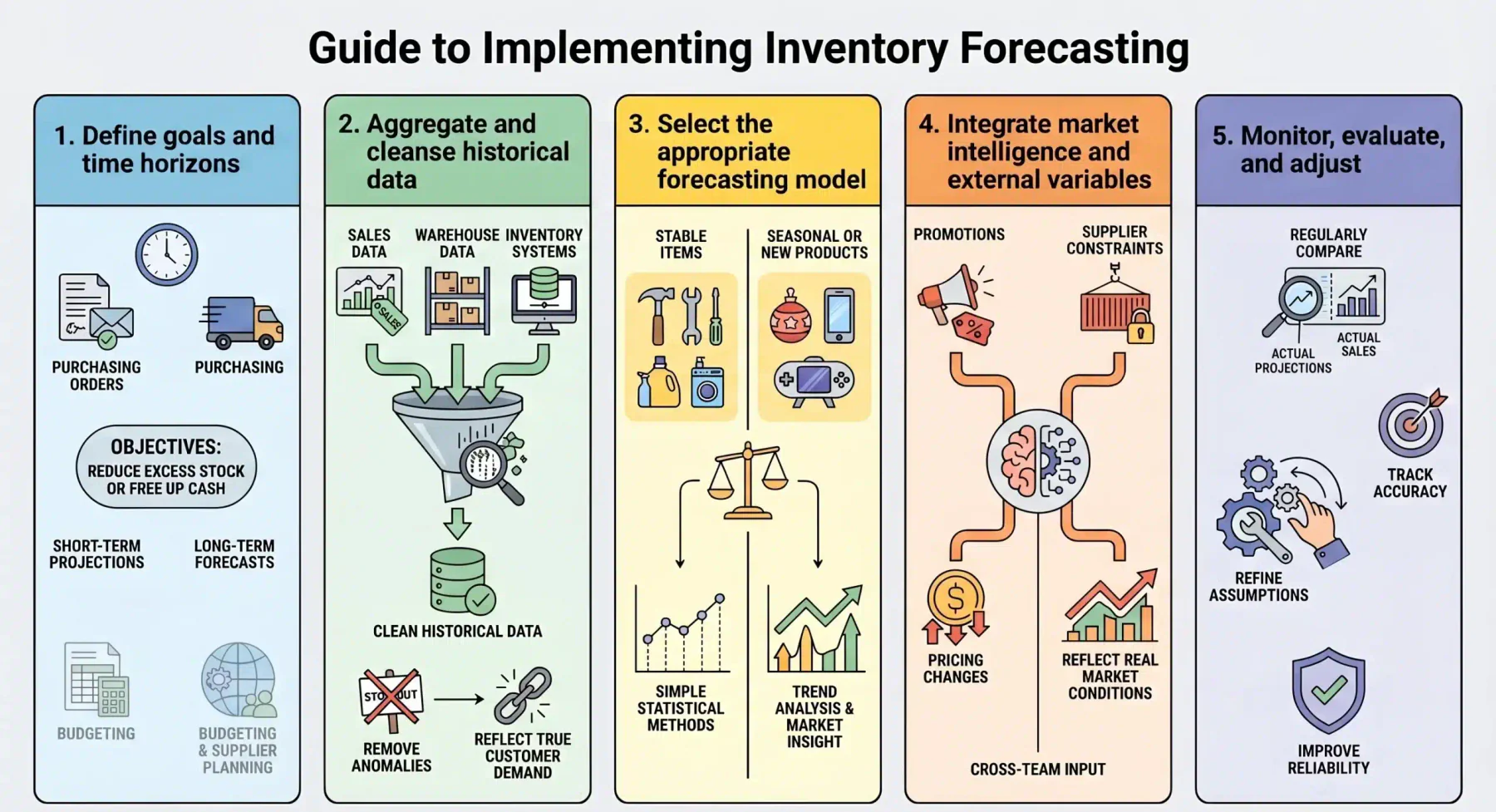
Moving from reactive purchasing to proactive inventory forecasting requires a clear and disciplined approach. The list below outlines how businesses can build reliable forecasts that support stock planning and long-term decisions.
1. Define goals and time horizons
Start by clarifying what the business wants to achieve, such as reducing excess stock, improving fulfilment, or freeing up cash. Then set clear forecasting horizons so short-term projections guide purchasing while longer forecasts support budgeting and supplier planning.
2. Aggregate and cleanse historical data
Accurate forecasting depends on clean historical data pulled from sales, warehouse, and a smart stock control system. Teams should remove anomalies caused by stockouts, disruptions, or one-off events so forecasts reflect true customer demand.
3. Select the appropriate forecasting model
Different products require different models based on sales stability and seasonality. Stable items suit simple statistical methods, while seasonal or new products rely more on trend analysis and market insight.
4. Integrate market intelligence and external variables
Historical data alone is not enough, so forecasts should include upcoming promotions, supplier constraints, and pricing changes. Cross-team input ensures projections reflect real market conditions rather than past performance only.
5. Monitor, evaluate, and adjust
Forecasting works best when businesses review results regularly and compare projections with actual sales. Tracking accuracy helps teams refine assumptions and improve future forecasts.
Common Pitfalls in Inventory Forecasting
Even with the right tools, forecasting can fail due to avoidable mistakes. The list below highlights common issues and how businesses can reduce their impact.
The silo effect
Poor communication between teams often leads to inaccurate forecasts and sudden stockouts. Regular alignment between sales, marketing, finance, and supply teams helps maintain a single, shared demand view.
Ignoring lead time volatility
Supplier lead times rarely stay consistent, especially during disruption. Forecasts should allow for delivery variability and include buffer stock to protect service levels.
Poor data quality
When system records do not match physical stock, forecasts become unreliable. Regular cycle counts and scanning processes help maintain accurate inventory data.
Over-Complicating models too early
Advanced analytics can overwhelm teams without strong data foundations. Businesses should start with simple, transparent models and add complexity as forecasting maturity improves.
Advanced Practices Shaping Inventory Forecasting
Forecasting continues to evolve as technology and data access improve. The approaches below show how leading businesses improve accuracy and responsiveness.
Artificial intelligence and machine learning
Machine learning analyses large datasets and identifies complex demand patterns that traditional models miss. Over time, these systems refine forecasts by learning from new data.
Demand sensing
Demand sensing uses near real-time sales and inventory data to adjust short-term forecasts quickly. This allows businesses to respond faster to sudden changes in customer behaviour.
Collaborative planning with supply partners
Sharing forecasts and stock data with suppliers improves visibility across the supply chain. This collaboration reduces overreaction and supports more stable replenishment.
Probabilistic inventory optimisation
Instead of relying on a single demand estimate, probabilistic models forecast a range of outcomes. This helps planners balance risk and service levels when setting safety stock.
Choosing the right inventory software
The right software brings these practices together. When evaluating inventory tools worth considering, look for platforms that support demand forecasting, real-time tracking, and supplier integration.






Conclusion
Inventory forecasting gives businesses clarity in an unpredictable environment. By turning historical data and market insight into structured demand plans, teams reduce uncertainty and make faster, smarter inventory decisions.
When forecasting is applied consistently, businesses protect cash flow, maintain service levels, and stay resilient through demand shifts and supply disruptions. For tailored guidance, book a free complimentary consultation today.

Frequently Asked Question
Inventory forecasting is the process of estimating future product demand to plan stock levels accurately.
It helps businesses reduce stockouts, avoid excess inventory, and improve cash flow through proactive planning.
Forecasting uses sales history, seasonality, promotions, lead times, and market trends.
Forecasts should be updated regularly, especially when demand patterns or supply conditions change.
Yes, even simple forecasting methods help small businesses reduce risk and make confident inventory decisions.