






A business can look “fine” in the bank account and still be underperforming operationally. That usually happens when the numbers are telling you more about when cash moved than when value was created.
The risk is real. A U.S. Bank study has been widely cited for finding that 82% of small business failures are tied to poor cash flow management or poor understanding of cash flow. When reporting is built only on cash in and cash out, it’s easy to miss slow-paying customers, rising cost commitments, or margin erosion until the damage is already visible.
Accrual accounting solves that blind spot by recording revenue when it’s earned and expenses when they’re incurred, giving a clearer picture of performance for the period you’re trying to evaluate. This guide breaks down how accrual accounting works, shows practical examples, and helps you judge when switching makes sense as your operations grow.

Key Takeaways
Accrual accounting is an accounting method that records revenue when earned and expenses when incurred, regardless of when cash is received or paid.
Accrual accounting records revenue and expenses when they occur to reflect actual business performance, while cash accounting records transactions only when cash is received or paid.
Accounting System provides an integrated solution that automates accrual-based bookkeeping, from invoicing to financial reporting, ensuring accuracy and compliance.
What Is Accrual Accounting?
Accrual accounting is a method that records revenue and expenses when the business activity happens, not when cash is received or paid. In simple terms, you recognize revenue when you deliver the product or service, even if the customer pays later.
It also records related costs in the same period as the revenue they support. This “matching” approach makes financial statements reflect actual performance for that period, so profitability and cost control are clearer and less misleading than cash-only tracking.
Fundamental Differences Between Accrual vs. Cash Accounting
Choosing between accrual and cash accounting affects how a business measures performance. To clearly understand how these two methods differ, the comparison below highlights their key distinctions, including their impact on the balance sheet and overall financial reporting.
| Aspect | Accrual Accounting | Cash Accounting |
| Timing of Recording | Records revenue when earned and expenses when incurred, regardless of cash movement. | Records revenue and expenses only when cash is received or paid. |
| View of Financial Performance | Reflects true profitability by matching income with related costs in the same period. | Shows cash position only, which can misrepresent actual business performance. |
| Financial Statements | Produces complete financial reports, including accounts receivable and payable. | Lacks insight into outstanding obligations or expected income. |
| Suitability | Ideal for growing businesses, inventory-based operations, and long-term projects. | Suitable for very small businesses with simple, immediate transactions |
| Complexity | More complex, requiring structured bookkeeping and accounting knowledge. | Simple and easy to maintain with minimal accounting expertise. |
| Compliance & Standards | Required under GAAP and IFRS for most corporations and funded businesses. | Generally not accepted for formal reporting, audits, or investor requirements. |
Practical Application of Accrual Accounting
Imagine a marketing agency completing a $10,000 client project in March but receiving payment in April due to Net 30 terms. This scenario highlights how accrual accounting records financial activity differently from the cash method, including how revenue and expenses affect tax deduction timing.
Under accrual accounting, the $10,000 revenue and related project expenses are recorded in March when the work is completed, with accounts receivable reflected on the balance sheet. When payment arrives in April, it clears the receivable without impacting revenue, unlike cash accounting, which records the income only when cash is received.
Why Is Accrual Accounting Important for Your Business?
Accrual accounting plays a critical role in helping businesses move from short-term cash tracking to long-term financial control. The benefits below explain why this method is essential for accurate reporting, better planning, and sustainable growth.
- Delivers a clearer profitability picture
Accrual accounting matches revenue with the expenses incurred to generate it, providing a realistic view of business performance in each period. This prevents misleading conclusions caused by delayed payments or advance cash receipts. - Strengthens strategic decision-making
By recognizing revenue when earned, businesses can accurately evaluate sales performance and marketing effectiveness. This clarity allows leaders to allocate resources, adjust pricing, and refine strategies based on reliable financial data. - Improves budgeting and financial forecasting
Accrual-based records make revenue and expense trends more predictable and consistent. This supports better financial planning and forecasting when paired with the best business budgeting software. - Ensures compliance and credibility
Accrual accounting aligns with major standards such as GAAP and IFRS, which are required for most incorporated businesses. It also increases credibility with investors, lenders, and auditors when seeking funding or financial approval.
Challenges in Implementing Accrual Accounting
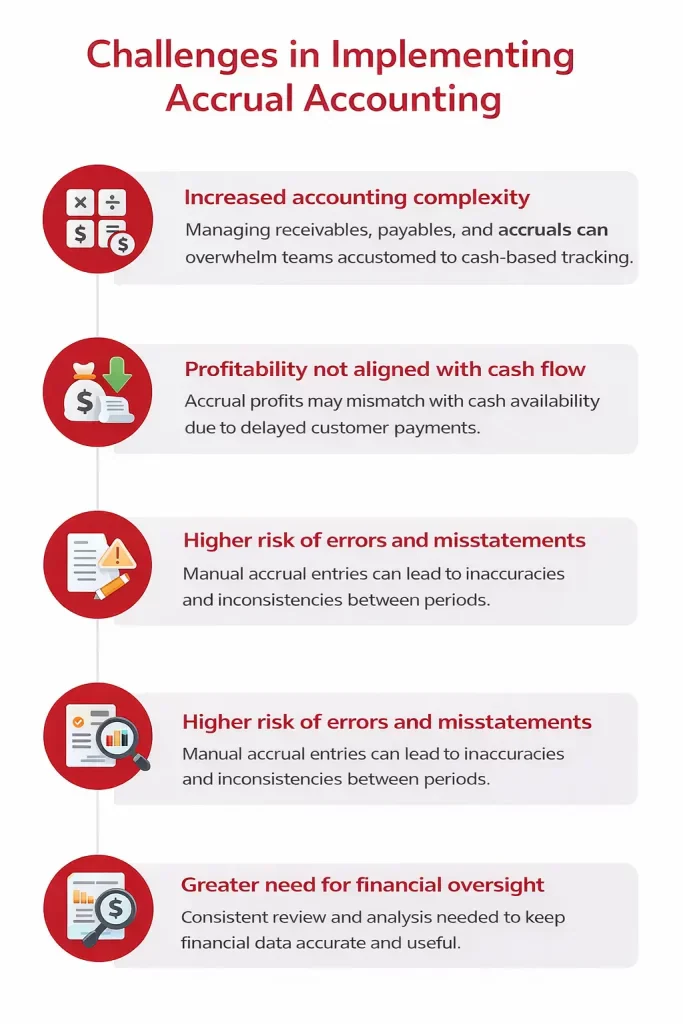 Implementing accrual accounting brings valuable insights, but it also introduces new operational and financial challenges. Understanding these obstacles and how to address them helps businesses adopt the method more effectively and sustainably.
- Increased accounting complexity
Accrual accounting requires managing accounts receivable, accounts payable, accrued expenses, and deferred revenue, which can overwhelm teams used to cash-based tracking. This challenge can be overcome by using accounting software that automates journal entries and by providing basic accounting training for staff. - Profitability not aligned with cash flow
Businesses may appear profitable on paper while struggling with cash shortages due to delayed customer payments. To overcome this, companies should closely monitor cash flow statements, set clear credit terms, and implement consistent invoicing and collection processes. - Higher risk of errors and misstatements
Manual accrual entries increase the risk of posting errors or inconsistent records across periods. This risk can be reduced by standardizing accounting procedures, performing regular reconciliations, and leveraging automated systems to maintain accuracy. - Greater need for financial oversight
Accrual accounting demands more frequent reviews and financial analysis to ensure data remains accurate and actionable. Establishing monthly closing routines and clear financial controls helps businesses maintain reliability and confidence in their reports.
When Should a Business Switch to Accrual Accounting?
There is no single moment when the switch becomes mandatory, but there are clear signs that cash accounting is starting to hold your business back. If any of these situations feel familiar, it might be time to make the move.
- Your business is growing faster than your books can keep up
When transactions start piling up, tracking finances based purely on cash in and cash out gets messy fast. Accrual accounting brings order to the chaos by recording what you owe and what others owe you, so your financial picture stays clear even as things scale. - You are carrying inventory
If you buy products now but sell them later, cash accounting can make your profits look wildly inconsistent. Accrual accounting fixes this by matching the cost of goods with the revenue they generate, giving you a much more honest view of how your business is actually performing. - You let customers pay later
The moment you start offering credit terms, cash accounting creates blind spots. You made the sale, but the money has not arrived yet, so where does it show up? Accrual accounting logs the revenue when the sale happens and keeps tabs on outstanding payments through accounts receivable. - You need to impress a bank or investor
When it is time to seek funding, financial statements prepared on a cash basis usually will not cut it. Lenders and investors expect accrual based reporting that follows standards like GAAP or IFRS. Making the switch before you need it puts you in a stronger position when the opportunity comes.
Automating the Accrual Accounting Process with the Right Software
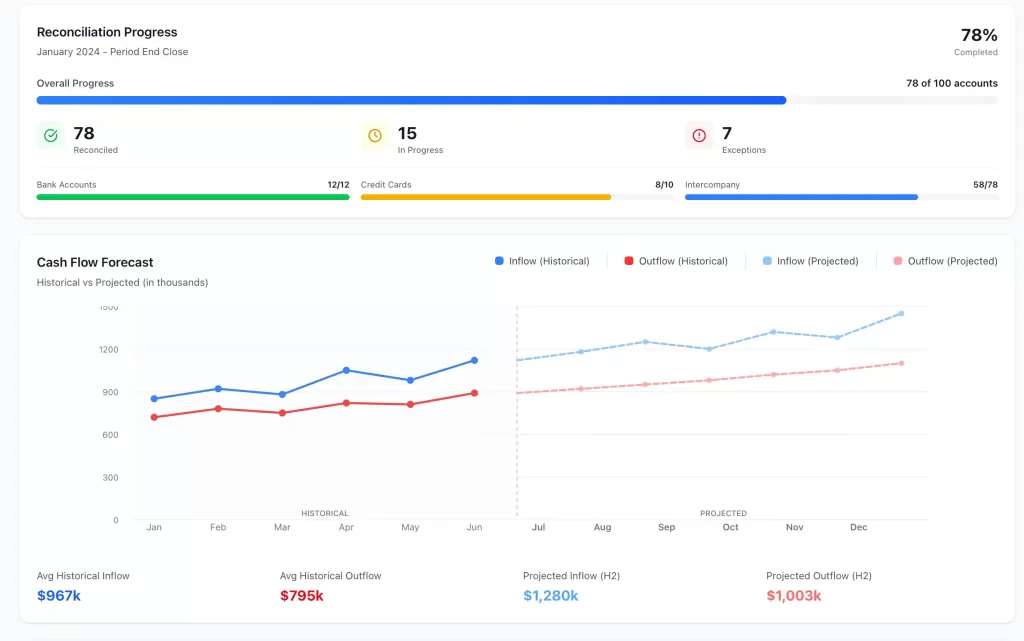 Managing accrual accounting manually works for a while, but the repetitive tasks pile up fast. The right accounting software handles transaction processing, catches errors early, and gives you real-time financial data without the extra legwork.
What really makes a difference is integration. When your accounting connects directly with inventory, sales, and purchasing, data flows automatically across departments. No duplicate entries, no chasing updates from other teams.
Key Features to Look for in Accounting Software:
- Auto Reconciliation: Matches your transactions with bank statements automatically, cutting hours of manual work.
- Multi-Level Analytical Reporting: Breaks down financial data by project, branch, or department for clearer decision making.
- Automated Invoicing: Generates invoices based on sales orders or milestones to speed up the payment cycle.
- Cash Flow Forecasting: Predicts future cash needs using historical data so you can plan ahead with confidence.
- SAK and PSAK Compliance: Keeps your reports aligned with Indonesian accounting standards, making audits smoother.
If spreadsheets and manual processes are slowing you down, trying a free demo of an integrated accounting system is a good place to start.
Conclusion
Accrual accounting remains the gold standard for businesses seeking a clear, realistic view of financial performance. By matching revenue and expenses at the right time, it supports better decision-making, forecasting, and long-term financial control.
Accounting Software simplifies the adoption of accrual accounting through automation and real-time reporting. With integrated financial features, it helps businesses reduce errors, improve visibility, and manage finances more strategically as they scale.
To experience these benefits firsthand, you can explore how accrual accounting works in practice using a modern system. Try a free demo to see how smarter financial reporting can support more confident business decisions.
FAQ About Accrual Accounting
For most incorporated companies, accounting standards like GAAP and IFRS mandate the use of the accrual basis. While not always required for sole proprietorships, it is highly recommended for any business planning to scale or seek external funding.
Absolutely. With user-friendly accounting software available today, even small businesses can easily implement the accrual method from an early stage to gain superior financial insights and build a strong foundation for future growth.
Accrued expenses are costs that have been incurred but not yet paid or recorded. A common example is employee salaries for the last week of a month that will be paid in the next month; this cost is still recognized as an expense in the current period.
Taxes are calculated on taxable income. With the accrual method, you might pay taxes on revenue you have not yet received in cash. It is vital to consult with a tax professional to understand the specific implications, especially concerning tax deduction strategies.