








Oracle NetSuite ERP offers a broad set of tools for managing finances, tracking inventory, and overseeing business operations within a unified system. But how well does it perform in practice, and is its feature set worth the investment? For companies weighing their ERP options, looking beyond the product’s advertised capabilities can reveal whether it genuinely matches their workflows and growth plans.
A closer look at NetSuite’s functionality, drawbacks, and implementation process can help clarify what businesses should expect before committing. This review breaks down the platform’s key advantages and limitations, while also considering other ERP systems that may offer a more suitable combination of features, flexibility, and cost for different business needs.
Key Takeaways
Oracle NetSuite is one of the ERP vendors well-known among businesses in Singapore, featuring a variety of advanced functionalities in its class.
Oracle NetSuite helps businesses streamline operations and enhance efficiency, but it has its own pros and cons.
One tip to avoid choosing the wrong ERP is to use a vendor with extensive experience, reliability, and notable clients.
One of the best ERP vendors in Singapore is HashMicro. Along with 1,750+ other clients, you have the opportunity to face business challenges successfully.
What is Oracle NetSuite ERP?
Oracle NetSuite provides a cloud-based ERP (Enterprise Resource Planning) platform with various payroll, HR, CRM, and e-commerce applications. It uses a software-as-a-service (SaaS) model, ideal for businesses looking for scalability without the added burden of new infrastructure and staff.
Based on my experience, its extensive selection of modules and customization options help companies enhance efficiency and cut costs, regardless of your business size or industry. It helps you streamline your business processes, like production, distribution, and accounting.
Also read: Oracle NetSuite ERP Review 2024: Features, Pros & Cons
Features of Oracle NetSuite ERP
Oracle ERP for business optimization offers comprehensive features designed to simplify business operations and boost efficiency across various sectors. Here are some of its features:
- Project management: Supports efficient project execution through tools for planning, resource allocation, and collaboration, ensuring projects meet deadlines and stay within budget.
- Financial management: Automates essential financial operations like accounting and asset management while providing tools for real-time financial reporting and compliance.
- Inventory and supply chain management: NetSuite’s inventory tracking tools help manage inventory effectively, covering tracking, demand planning, and distribution, reducing costs and preventing inventory issues.
- Customer relationship management: Integrates CRM to manage customer interactions, sales processes, and service management, improving customer satisfaction and loyalty.
- Human resources management: Simplifies HR processes with features for payroll, benefits, and employee management, ensuring compliance and enhancing employee engagement.
- Analytics and reporting: Provides powerful analytics and customizable dashboards for real-time insights into business operations, helping in strategic decision-making.
I recommend Oracle NetSuite because its scalability and cloud-based deployment make it an effective solution for businesses of all sizes looking to enhance operational efficiency.
Pros and Cons of Oracle NetSuite ERP
Oracle NetSuite ERP is a comprehensive tool that helps businesses streamline operations and enhance efficiency, but it has its own strengths and weaknesses, incorporating insights from Forbes and PCMag:
Pros:
- Extensive ERP features: The ERP features are extensive and adaptable to various business sectors, providing comprehensive tools for financial management, inventory control, and operational planning.
- Comprehensive integration: NetSuite integrates ERP, CRM, human capital management (HCM), and e-commerce capabilities into one system, reducing the need for multiple separate systems and improving data consistency.
- Cloud-based flexibility: NetSuite allows remote access, enhancing operational flexibility without requiring extensive on-premise infrastructure.
- Simple reporting: NetSuite provides straightforward reporting tools that allow users to generate reports with relevant data quickly, simplifying the process of data evaluation and sharing.
Cons:
- The help system can be more intuitive: I and many users have reported that the help system can be confusing and less intuitive, which may hinder resolving issues or learning new functionalities.
- Configuration complexity: Setting up the system to cater to specific roles within a company can be challenging, requiring significant time and effort to ensure it meets the exact business needs.
- Complex feature set: While the feature set is comprehensive, its complexity can be daunting. Users might find it overwhelming to fully utilize all the available tools without extensive training or experience.
These insights provide a view of Oracle NetSuite ERP, highlighting its potential as a transformative business tool and the practical considerations businesses must manage.
How to Avoid Choosing the Wrong ERP
Mistakes that lead to losses are a nightmare for every business, especially if you are about to buy an ERP system that directly affects the company’s workflow and cash flow, like Oracle Netsuite ERP. Therefore, here I provide tips or ways to prevent choosing the wrong ERP. Here are the steps.
-
Analyze your business needs
You do not have to buy a complete ERP package at a high price. If your business needs only optimized financial workflows, you just need to purchase the best accounting module. Make sure you buy ERP based on features that you can use optimally.
-
Conduct thorough reviews, including of Oracle Netsuite ERP
Read customer reviews on open survey pages or reviews from business colleagues who have used a particular ERP product. You can also try a free demo to understand better how the ERP system will operate in the future without incurring costs.
-
Prioritize important modules
After understanding your business needs, prioritize the important supporting modules in their implementation. For example, your business may need financial planning and performance management, but in the process, your company’s finances are heavily connected with procurement or retail activities. Then, you can discuss with your team or the vendor which module can optimally support the company’s workflow.
-
Use ERP localized for the system in Singapore
Each country certainly has its own regulations related to business. Singapore itself has several criteria and rules that are mainly concerned with reporting. This usually involves invoices and accounting reports.
Therefore, it is important for you to use an ERP that is locally based in Singapore. For example, find the features that integrate the accounting system with government tax bills.
Of course, this feature is important so that you do not have to do double the work, and the ERP report can really be used optimally and professionally.
-
Ensure your ERP can be customized according to company criteria
Customization might sound tricky for some entrepreneurs. Why? Because if the vendor does excessive customization, the output usually makes the company’s system severely lag.
Therefore, you need to understand the primary business needs and find and choose the best ERP vendor that prioritizes the operational comfort of your business.
-
Use ERP that entrepreneurs trust
Experience does not lie about the quality of products and services available from an ERP vendor. The number of clients served, satisfaction reviews, and which clients entrust their business to the vendor are things you must know to avoid losses and deception. Speaking of which, you should get acquainted with ERP from HashMicro. Why? Here are the reasons.
Also Read: Best ERP Software Recommendations – Explore the best software options available this year and find the right fit for your business needs.
HashMicro as an ERP Software Alternative
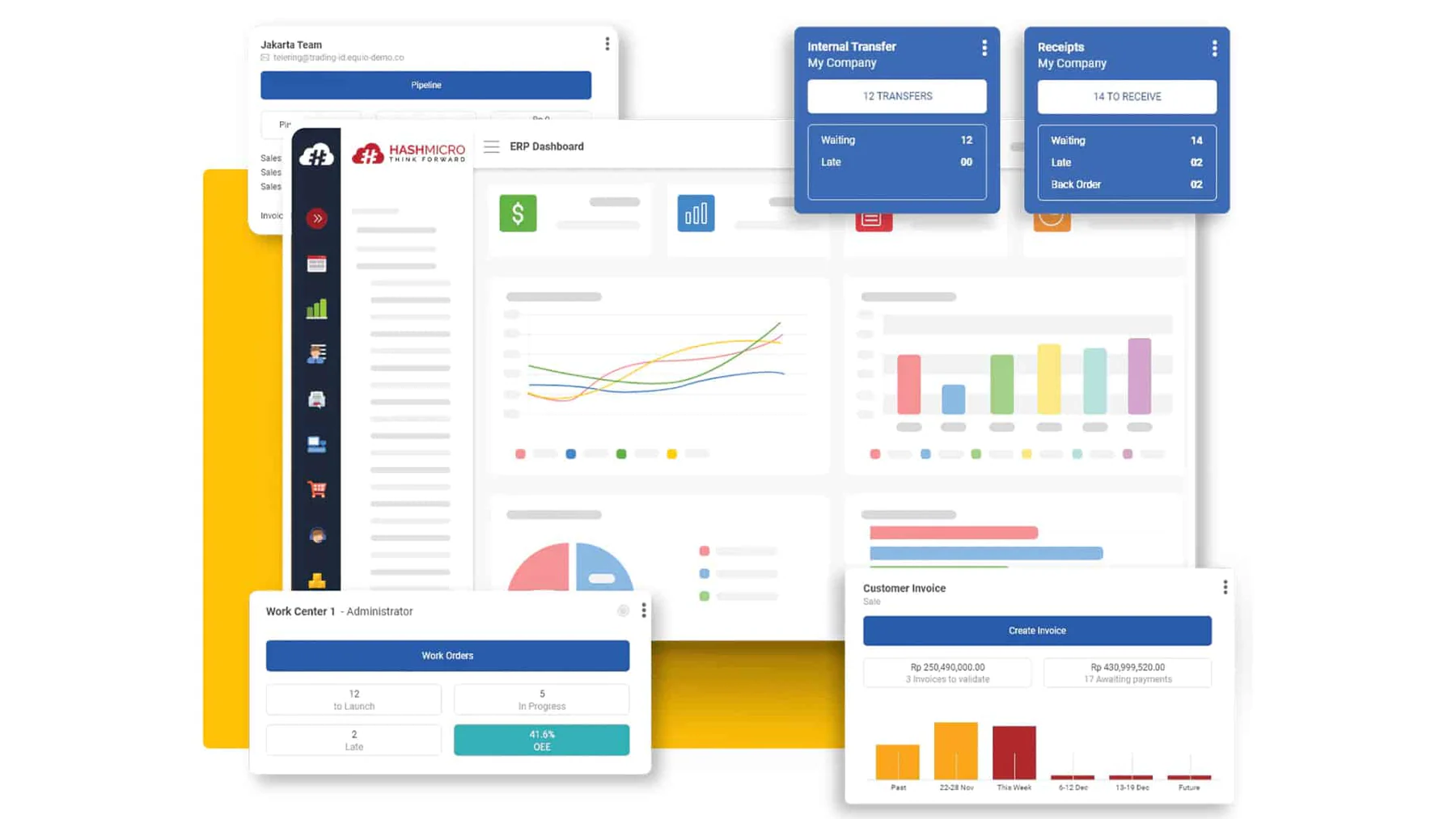
HashMicro is a leading ERP vendor in Singapore, serving over 1,750 clients across different industries. Its notable clients include Changi Airport Group, Brinks, and Bank Mega. From what I found, they use HashMicro ERP for various needs like accounting, procurement, POS, retail, construction, mining, and manufacturing.
The diversity of these features supports existing customer satisfaction. In brief, here are the advantages if you use ERP from HashMicro:
- The system is easy for you to understand and use, even if you are not an IT expert;
- Free to add users without additional costs;
- HashMicro has passed ISO certification to optimize employee performance;
- Integration with many business modules that you can adjust to business needs;
- HashMicro ERP is based in Singapore, making it suitable for local businesses;
- HashMicro ERP can integrate any number of business branches you have into one monitoring system;
- HashMicro products are ready to use without a long waiting period;
- HashMicro’s customer service is fast and always responsive in addressing your business challenges; and
- The migration of company data into the ERP happens quickly.
The advantages mentioned above are guaranteed by HashMicro and are not commonly possessed by many other ERP vendors, allowing you the freedom to use them as a Singaporean business.
Conclusion
Oracle Netsuite ERP is one of the ERP vendors among Singaporean businesses. Oracle Netsuite offers various advanced features that can automate company processes for efficiency.
The good news is that you can still run business automation using ERP with another vendor alternative, HashMicro. HashMicro has become a smart solution for businesses that want an effective, secure, and easy-to-use company system.
I encourage you to unlock the benefits of digitalization with up to 70% funding support from the CTC Grant. Experience a free demo to discover how HashMicro’s ERP solution can streamline and strengthen your business operations.
Frequently Asked Questions About Oracle NetSuite ERP
Oracle NetSuite is priced by quote rather than a fixed public rate. The subscription usually combines a base licence, the modules you choose, and the number of users, with implementation and support costs on top. Request a written breakdown and compare it against other vendors on the same scope.
NetSuite is aimed mainly at small and mid-sized growing businesses, but its depth can be more than a very small team needs. Businesses with a few simple processes may find a lighter system easier to adopt, while those with multiple entities, inventory, and reporting needs are the typical fit.
Timelines depend on the number of modules, users, integrations, and how much data needs migrating. A simpler rollout can take a few months, while a multi-entity deployment with custom workflows can take considerably longer. Ask your implementation partner for a plan with clear milestones.
Both are cloud ERP products from Oracle. NetSuite is generally positioned for small and mid-sized, fast-growing businesses, while Oracle Fusion Cloud ERP is aimed at larger enterprises with more complex global requirements. Compare them against your company size, number of entities, and budget.
Yes. NetSuite connects with other systems through built-in connectors, APIs, and marketplace apps, covering areas such as payment gateways, e-commerce platforms, and banking. Confirm which integrations are native and which need custom work or extra licences before you commit.