













Warehouse operations move fast, and the smoothest sites usually have one thing in common. Everyone knows what to do next, and tasks flow without constant follow-ups. That’s where a warehouse execution system (WES) comes in.
Have you ever wondered why picking, packing, and shipping can still feel messy even when the warehouse layout and planning look right on paper?
In this article, I’ll break down what a WES is, how it works day to day, and why it helps teams coordinate people, processes, and automation more cleanly to keep orders moving on time.
Key Takeaways
|
What Is a Warehouse Execution System (WES)?
A Warehouse Execution System (WES) acts as a real-time bridge between your management software and control systems. It dynamically orchestrates workflows to ensure that every order is processed with maximum speed and accuracy.
Its primary function is to organize tasks such as picking and packing based on immediate resource availability within a logistics ERP. This system directs workers and automation simultaneously to maintain a continuous flow of goods.
The Core Differences: WES vs. WMS vs. WCS
Understanding the distinctions between WES, WMS, and WCS is crucial for optimizing your tech stack. The table below outlines the specific roles and focuses of each system in the warehouse hierarchy.
| Aspect | WMS (Management) | WCS (Control) | WES (Execution) |
|---|---|---|---|
| Primary Focus | Inventory planning, tracking, and storage management (Macro-level). | Direct, low-level control of automated equipment and machinery. | Real-time optimization and orchestration of all tasks on the warehouse floor (Micro-level). |
| Operational Horizon | Long-term (days, weeks, months). Manages overall inventory strategy. | Immediate (milliseconds). Executes specific machine commands. | Real-time (seconds, minutes). Dynamically adjusts to current conditions. |
| Key Function | Provides visibility and data on what is in the warehouse and where it is. | Tells automated equipment how to move and perform a specific action. | Decides who (or what machine) should do a task, when, and in what sequence for maximum efficiency. |
| Decision Making | Based on predefined rules and batch processing (waves). | Follows direct commands from a higher-level system; no independent optimization. | Dynamic and algorithmic, using real-time data to make adaptive decisions (waveless). |
How Does a Warehouse Execution System Work?
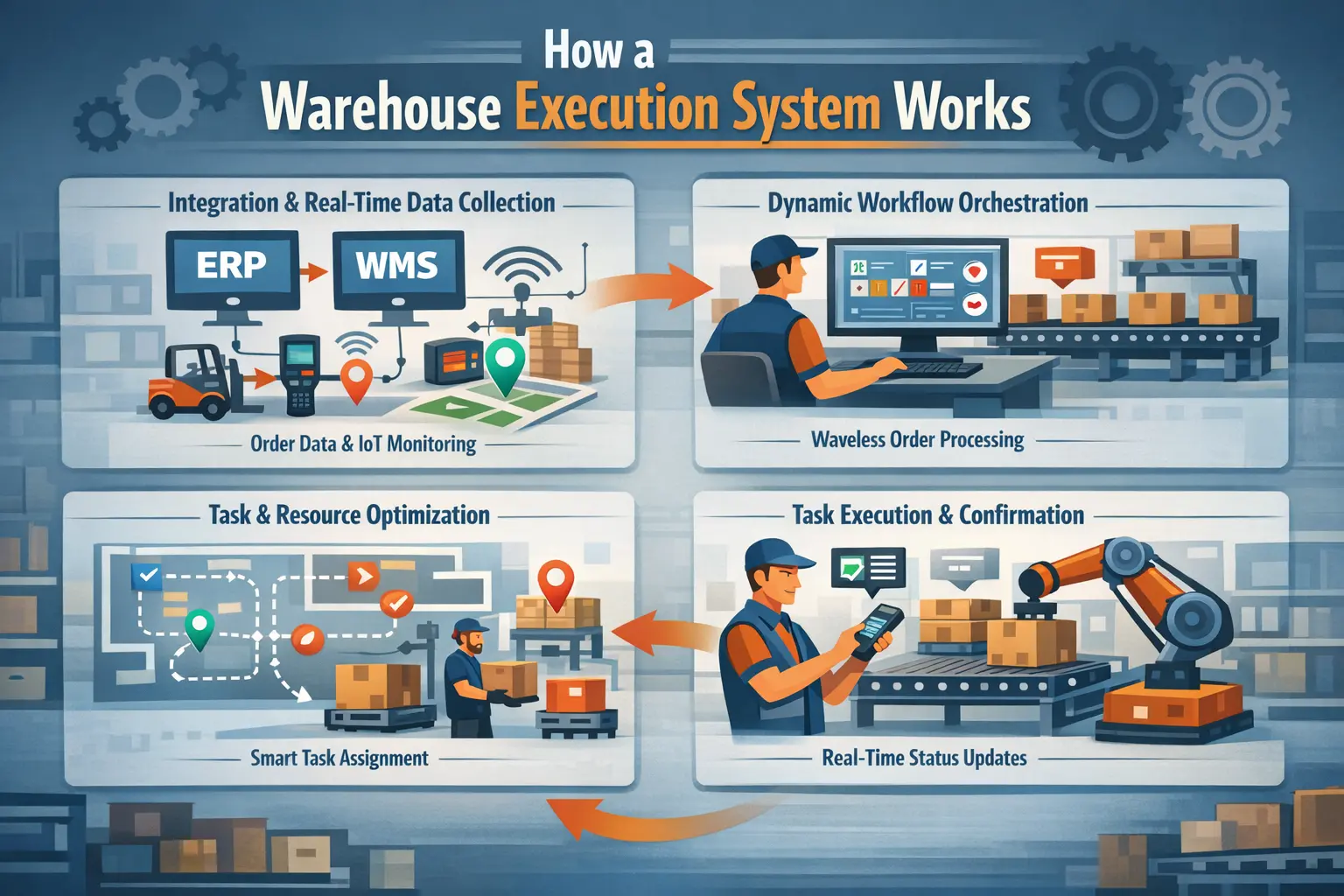
A WES operates through a continuous cycle of data collection and decision-making to manage floor activities. Here is the step-by-step process of how the system orchestrates tasks from start to finish.
- Integration and Real-Time Data Collection
The system connects with ERP and Warehouse Management Software platforms to pull order data while simultaneously reading status updates from IoT devices. It gathers real-time information on worker locations and equipment availability to form an operational picture. - Dynamic Workflow Orchestration
Instead of releasing large batches, the algorithm uses a waveless approach to release tasks based on current capacity. It sequences orders dynamically to ensure a smooth flow of work without creating bottlenecks. - Task and Resource Optimization
The software calculates the most efficient path and assigns the task to the nearest available resource. It considers variables like travel distance and worker skill level to allocate specific duties instantly. - Task Execution and Confirmation
Instructions are sent directly to handheld scanners or machine control systems for immediate action. Once the worker or machine completes the action, the system updates the order status in real-time.
Must-Have Features of a Modern WES

To effectively manage complex operations, a modern WES relies on specific capabilities that drive its intelligence. These core features enable the system to control and coordinate every aspect of the warehouse for logistics operations.
- Smart Order Management
This feature releases orders to the floor continuously based on real-time constraints rather than grouping them into static batches. - Labor Management
The system tracks individual worker activity and assigns tasks to specific employees based on their current location and availability. - Integration with Automation Systems
It communicates directly with hardware controls to send commands to conveyors, sorters, and robotics systems without manual intervention. - Real-Time Analytics Dashboard
The platform aggregates data from all connected devices to display current operational metrics and performance statuses on a central screen.
Benefits of Implementing a WES
Implementing this technology offers significant advantages that go beyond simple task management. Here are the key benefits businesses realize by adopting a dynamic execution system.
- Increased Throughput and Productivity
The system optimizes workflows to process a higher volume of orders within the same timeframe. For example, eliminating idle time between tasks allows workers to complete more picks per hour. - Full Operational Visibility
Managers gain a comprehensive view of all floor activities and asset statuses in real-time. This allows for immediate identification of issues, such as spotting a jammed conveyor before it stops production. - Reduced Order Cycle Time
By orchestrating steps efficiently, the software minimizes the time from order receipt to final shipment. This ensures that urgent orders, like same-day deliveries, move through the facility without delay. - Improved Asset and Labor Utilization
The system intelligently distributes work to keep warehouse storage capacity balanced, so assets are used effectively. This prevents some workers from being overwhelmed while others wait.
How to Choose the Right Warehouse Execution System?
Selecting the appropriate solution requires a careful analysis of your specific operational requirements. Follow these steps to ensure you choose a system that aligns with your business goals.
- Analyze Your Warehouse Operational Needs
Conduct a detailed audit of your current processes to identify bottlenecks and specific pain points. Documenting your workflows helps determine which problems the new software must solve immediately. - Evaluate System Integration Capabilities
Ensure the potential solution connects seamlessly with your existing ERP and WMS platforms. You must verify that the vendor provides open APIs to facilitate data exchange between systems. - Consider Scalability and Flexibility
Assess whether the system architecture can handle increased transaction volumes as your business grows. You need a solution that adapts to higher user counts without requiring a complete overhaul. - Check Vendor Support and Track Record
Investigate the provider’s reputation and their history of technical support in similar industries. Asking for references ensures you partner with a vendor who offers reliable assistance during implementation.
Future Trends in Warehouse Execution Systems
Emerging technologies are rapidly expanding the capabilities of execution systems in the logistics sector. These future trends highlight how software is becoming smarter and more autonomous.
- Integration with AI and Machine Learning
Algorithms analyze historical data to predict potential bottlenecks and optimize task paths autonomously. For instance, the system learns traffic patterns to route workers away from congested aisles. - Utilization of IoT Technology
Sensors placed on racks and equipment transmit continuous status updates directly to the central system. This technology allows the WES to track the precise location of every pallet in real-time. - Collaboration with Advanced Robotics (AMR)
The software integrates deeply with Autonomous Mobile Robots (AMR) to manage mixed fleets of humans and machines. It coordinates hand-offs where a robot transports goods to a stationary packer.
Read more: How Warehouse Software Helps You Manage Inventory
Optimize Your Warehouse Operations with an Integrated System
An integrated warehouse management system helps streamline logistics by keeping inventory, task allocation, and order movement aligned in one workflow, so daily execution feels more controlled and easier to monitor.
Most modern systems also support real-time stock updates across locations, faster pick-pack-ship with digital pick lists, traceability through lot and serial tracking, and clearer reporting to spot bottlenecks and improve accuracy over time.
For example, a warehouse stock management system on HashMicro can help teams reduce manual checks during receiving and dispatch, speed up fulfillment, and keep stock data consistent across warehouse zones, so decisions don’t rely on scattered updates.
Conclusion
A Warehouse Execution System helps your warehouse run more smoothly by coordinating floor tasks in real time, so picking, packing, and shipping stay connected instead of working in silos.
In this article, we covered where WES sits compared to WMS and WCS. A WMS focuses on inventory planning and visibility, a WCS controls automation equipment, and a WES makes sure people and machines execute work in the right order based on what’s happening right now.
Before choosing one, map your bottlenecks and integration needs, then consult your operational requirements to shortlist the right setup.

FAQ About Warehouse Execution System
-
Can a WES completely replace a WMS?
Not always. While some modern WES have overlapping functionalities, their primary roles differ. A WMS excels at strategic planning and long-term inventory management, while a WES focuses on real-time execution. In many large operations, combining a WMS and a WES provides the most comprehensive solution.
-
Which industries benefit the most from a WES?
Industries with high order volumes and fast delivery demands, such as e-commerce, retail, pharmaceutical distribution, and 3PLs, benefit the most. These industries require the ability to respond quickly to demand fluctuations and manage thousands of orders with diverse SKUs daily.
-
Is a WES suitable for a manual warehouse?
Yes, a WES can provide significant value even in a mostly manual warehouse. By optimizing tasks for the human workforce, such as determining the shortest picking routes and balancing workloads, a WES can drastically increase productivity and provide a strong foundation for adopting automation in the future.
-
How long does it take to implement a WES?
Implementation time varies depending on the complexity of warehouse operations and the level of customization required. A project can take anywhere from a few months to over a year. It is important to work with the vendor to create a realistic project plan.