




Singapore’s position as a regional food hub (with over 90% of food imported) makes cold storage infrastructure critical to national food security.
Yet operating a cold storage facility here means navigating strict SFA regulations, managing energy costs in tropical conditions, and maintaining compliance documentation that satisfies both local audits and international food safety standards.
This guide covers what Singapore businesses need to know about cold storage operations: from SFA temperature mandates and HACCP requirements to selecting the right warehouse management solution for compliance automation.
Key Takeaways
|

What Is a Cold Storage Warehouse and Why Is It Critical for Your Business?
Cold storage refers to temperature-controlled warehousing used to preserve the quality, safety, and shelf life of perishable goods such as food, pharmaceuticals, and biologics.
In Singapore, its role extends beyond operational convenience. Cold storage is a critical component of national supply resilience, regulatory compliance, and cross-border trade efficiency.
Because Singapore functions as both an import-reliant consumer market and a regional distribution hub, cold storage facilities must support rapid turnover, strict traceability, and consistent temperature control across multiple product categories.
Any lapse in storage integrity can affect not only product quality, but also regulatory standing and downstream distribution.
Singapore’s Food Import Dependency and the Role of Cold Chain
Singapore imports over 90% of its food supply, including fresh produce, meat, seafood, and frozen goods. This dependency places significant pressure on cold chain infrastructure to maintain product integrity from port entry to final delivery.
Cold storage facilities act as the stabilizing layer between international suppliers and domestic distribution. They buffer supply disruptions, enable compliance with Singapore Food Agency (SFA) temperature and handling requirements, and support extended shelf life for imported products that travel long distances.
For businesses operating in food distribution, retail, or foodservice, effective cold storage is less about scale and more about precision. It’s maintaining consistent conditions across storage, handling, and dispatch.
SFA Requirements for Cold Storage Operations
Cold storage operations in Singapore fall under direct oversight of the Singapore Food Agency (SFA). Compliance is not limited to physical infrastructure; it also covers temperature control, food safety systems, staff competency, and long-term documentation.
For operators handling imported or locally distributed perishables, these requirements form the baseline for legal operation and audit readiness.
Temperature Standards by Product Type
| Product Category | Storage Temperature | Transport Core Temp | Examples |
|---|---|---|---|
| Chilled Foods | 0°C to 4°C | Not exceeding 7°C | Fresh dairy, raw meat, salads |
| Frozen Foods | -18°C or below | Not exceeding -12°C | Seafood, poultry, frozen meals |
| Ice Cream | -20°C or below | — | Ice cream, frozen desserts |
| Pharmaceuticals | 2°C to 8°C (standard) -20°C to -80°C (specialty) |
Per product specification | Vaccines, biologics, reagents |
| ⚠️ Temperature Danger Zone: 5°C to 60°C: Food must not remain in this range for more than 2 hours cumulatively | |||
Licensing and HACCP Requirements
Any business operating a cold storage facility for food must hold a valid SFA licence. Licensing approval depends on both facility design and operational readiness.
Key requirements include:
-
Built-in chillers and freezers suitable for the intended product mix
-
Clear separation between cold storage, defrosting/unboxing areas, and processing zones
-
Segregated storage for food and non-food items such as chemicals or cleaning agents
-
Mandatory implementation of a HACCP-based food safety system
In addition, food handlers working within cold storage environments must complete the relevant WSQ Food Safety Course, and businesses are expected to maintain training records as part of compliance documentation.
Under the SAFE (Safety Assurance for Food Establishments) framework, SFA evaluates establishments based on track record over time. Facilities with strong compliance histories may qualify for longer license validity periods, reducing renewal frequency.
Documentation and Traceability Mandates
Singapore requires full traceability across the cold chain, particularly for imported food. Cold storage operators must maintain accurate, retrievable records that demonstrate control from receipt to dispatch.
Mandatory documentation typically includes:
-
Product lot or batch records
-
Country-of-origin information for imported goods
-
Temperature monitoring logs
-
HACCP records and corrective action logs
Records must be retained for a minimum of 12 months, and longer retention may be expected depending on product type or contractual obligations.
Many operators also align their practices with Singapore Standard SS 668 (Cold Chain Management). While certification is voluntary, SS 668 provides a structured framework for managing cold chain risks and is increasingly recognized by retailers, distributors, and foodservice clients as a quality benchmark.
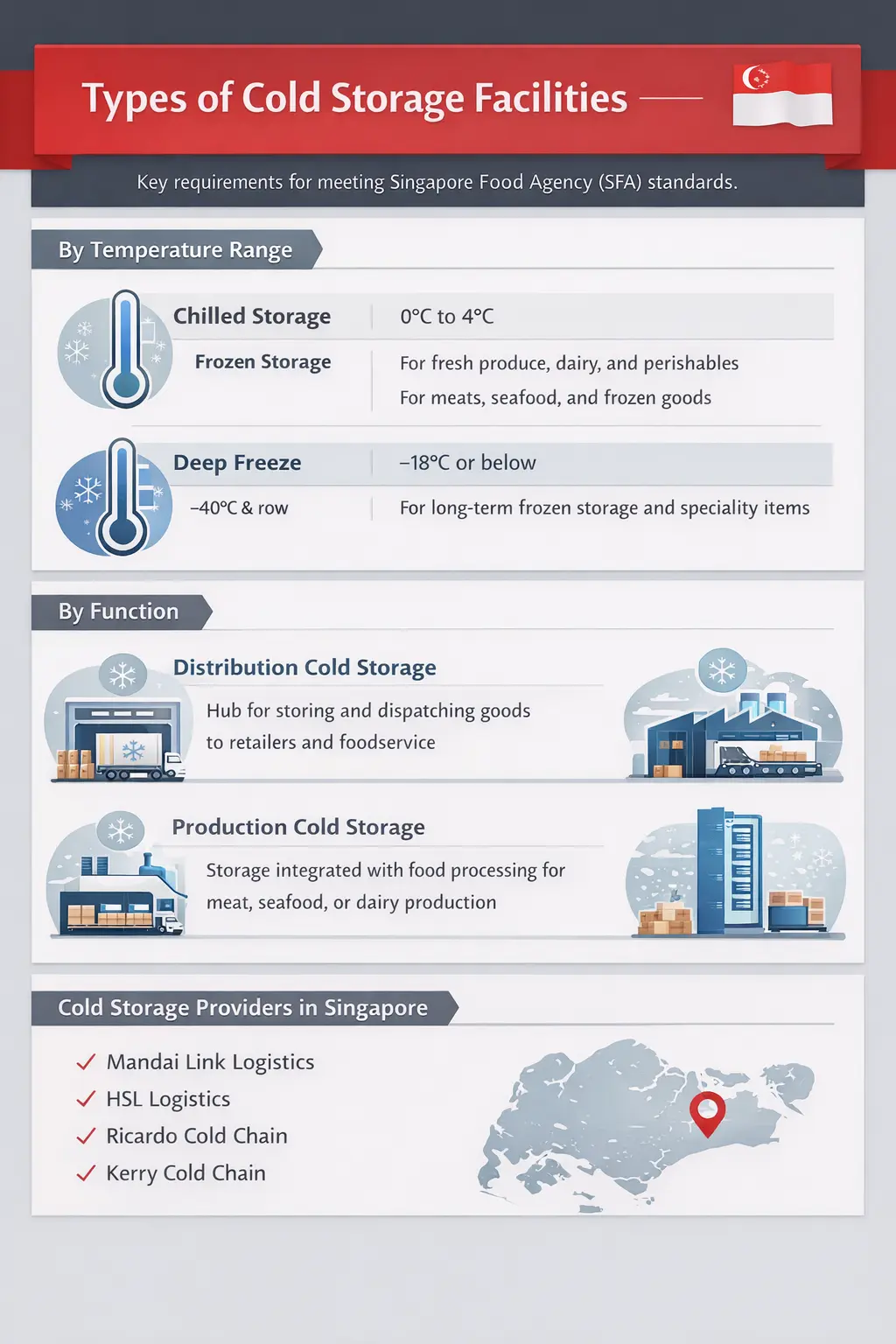
Types of Cold Storage Warehouses
Choosing the right facility type depends heavily on specific product characteristics and operational volume. Here are the standard classifications used across industries to ensure optimal preservation.
Key Components of an Effective Cold Storage Warehouse
Constructing an efficient facility requires meticulous attention to components that work together to maintain stability. Let’s examine the essential elements that ensure reliability and energy efficiency.
- Thermal insulation systems
Thermal insulation panels in walls and roofs prevent external heat from infiltrating the cooled space. Underfloor insulation is also installed to avoid freezing ground and structural damage, such as frost heave. - Industrial refrigeration systems
The industrial refrigeration system absorbs internal heat and expels it outside using compressors and evaporators. This setup must be calculated precisely based on room volume to ensure consistent cooling performance. - Airtight doors
High-speed doors open and close rapidly to minimize the time the interior is exposed to ambient air. This mechanism significantly reduces temperature fluctuations and lowers the energy load on cooling systems. - Racking systems
Racking systems maximize storage density while allowing cold air to circulate freely around the palletized goods. Materials used for these racks are typically galvanized steel to resist corrosion in damp environments. - Temperature monitoring technology
IoT sensors placed throughout the facility continuously monitor temperature and humidity in real time. These devices send data to a central system, which triggers alerts when conditions deviate from predefined parameters.
Challenges in Singapore Cold Storage Operations
Managing a cold facility presents unique hurdles that can erode profitability if not addressed proactively. Below are the primary challenges managers face and the strategic solutions to overcome them.
1. Energy Costs in a Tropical Climate
Cold storage facilities operate 24/7 in a consistently hot and humid environment, making electricity one of the largest operating expenses. Inefficient insulation, poor temperature zoning, or frequent door openings can quickly push energy costs beyond sustainable levels.
Strategic response:
Operators typically focus on tighter temperature zoning, real-time monitoring of energy consumption per chamber, and preventive maintenance of refrigeration systems. Measuring energy cost per pallet or per cubic meter helps management identify inefficiencies early and prioritize upgrades with the highest return.

2. Land Scarcity and Rental Premiums
Singapore’s limited industrial land drives high rental costs, especially for cold-capable warehouses. Idle pallet positions or poor space utilization directly translate into lost revenue potential.
Strategic response:
High-performing facilities optimize vertical storage, improve pallet turnover rates, and track storage utilization at zone level. Regular analysis of pallet turns per month and revenue per square meter helps ensure space is allocated to the highest-value inventory.
3. Compliance and Documentation Requirements
Cold storage operators must maintain detailed records for audits, including temperature logs, traceability documents, and hygiene controls. Manual or fragmented record-keeping increases the risk of missing data during inspections.
Strategic response:
Best practices include standardizing documentation formats, centralizing records, and conducting internal compliance checks before official audits. Monitoring retrieval time for audit documents is often used as an internal KPI to assess readiness.
4. Labour Constraints and Automation Pressure
Cold environments increase physical strain on workers, while Singapore’s tight labour market and rising wage costs make productivity gains essential. Manual processes can quickly become bottlenecks as volume grows.
Strategic response:
Facilities increasingly focus on clear task allocation, measurable productivity benchmarks per shift, and selective automation for repetitive activities such as putaway and picking. Tracking labour cost per pallet and accuracy rates helps balance efficiency with workforce sustainability.
Industry Insight: Cold Storage Operations in Singapore
A frozen food distributor supplying hotels and catering businesses in Singapore found that operational strain did not come from demand alone, but from limited visibility across temperature records, stock movements, and storage zones.
By standardizing cold storage workflows and consolidating inventory and temperature data through a warehouse management software, the operations team reduced audit preparation time and gained clearer control over energy-intensive zones.
The improvement came not from expanding capacity, but from tighter documentation, traceability, and day-to-day operational discipline, factors increasingly critical under SFA inspections.
Trends and Technological Innovations in the Cold Storage Industry
The industry is evolving with technologies that enhance efficiency and meet rising sustainability demands. Understanding these innovations helps businesses plan future investments to stay competitive.
- Automation and robotics
Automated Storage and Retrieval Systems (AS/RS) use robotic cranes to handle pallets in freezing conditions. This technology operates tirelessly in sub-zero environments where human efficiency typically declines. - Internet of Things (IoT)
Advanced sensors on forklifts and pallets track movement and equipment health in real-time. This data flows into a central platform to predict maintenance needs and prevent downtime. - Sustainability focus
New facilities are adopting natural refrigerants like ammonia which have a lower global warming potential. Solar panels are also being installed on rooftops to generate renewable electricity for operations. - Predictive analytics
Artificial intelligence analyzes historical data to forecast demand fluctuations and optimize storage layouts. This process enables systems to predict maintenance requirements before equipment failure.
Conclusion
Cold storage operations in Singapore sit at the intersection of food security, regulatory compliance, and cost efficiency. Beyond maintaining low temperatures, operators must manage documentation discipline, energy performance, space utilization, and workforce productivity under strict SFA oversight.
Facilities that treat cold storage as a controlled system are better positioned to meet audits, protect product integrity, and sustain long-term operations in a land- and energy-constrained environment.

FAQ Cold Storage Warehouse
-
What is the ideal temperature for a cold storage?
The ideal temperature depends heavily on the product. Generally, chilled temperatures range from 0°C to 10°C for fresh goods, while frozen temperatures are -18°C or lower. Specific pharmaceuticals may require ultra-low temperatures down to -80°C.
-
What is the main difference between a cold storage and a regular warehouse?
The main difference is in construction and systems. A cold storage has heavily insulated walls, roofs, and floors, along with an active refrigeration system to control the temperature. A regular warehouse’s temperature fluctuates with the ambient environment.
-
How can you improve energy efficiency in a cold storage?
Efficiency can be improved by ensuring perfect insulation and door seals, performing regular maintenance on cooling systems, using high-speed doors to minimize temperature leakage, and implementing energy management software to monitor and optimize electricity use.