











 Limited to 100 registrants

Warehouse performance is no longer measured only by how much stock a business can store, but also by how quickly and accurately it can move it. In a market where customer expectations shift quickly, teams need systems that keep pace without slowing operations down.
SaaS WMS is a cloud-based warehouse management system that runs on a subscription model and is hosted online, so authorised users can access it anywhere with an internet connection. Instead of managing heavy infrastructure, businesses can focus on execution on the floor while keeping inventory and order workflows visible in real time.
This guide explains what SaaS WMS is, the key benefits it brings, the critical features to prioritise, and how it compares with traditional WMS. The goal is to help decision-makers choose a solution that fits their operating model and growth plans.
Key Takeaways
SaaS WMS is a cloud-based warehouse management system that runs on a subscription model, enabling teams to manage warehouse operations remotely with flexible access and scalable capacity.
Businesses adopt SaaS WMS to gain agility and cost control, while also benefiting from easier scaling and stronger security practices than many on-premises setups.
A strong SaaS WMS should include real-time inventory visibility, process automation for picking/receiving/shipping, and smooth integration with existing tools so data stays accurate across systems.
The right SaaS WMS choice comes from matching operational needs and budget with the provider’s customization options, implementation support, and long-term reliability as the business grows.
What is SaaS WMS and How Does It Work?

SaaS WMS is a cloud-based warehouse management system that operates on a subscription model. Unlike traditional WMS, which requires on-premises infrastructure and extensive IT resources, SaaS WMS is hosted on the cloud, allowing users to access the system from anywhere with an internet connection.
This flexibility is a significant advantage for businesses in Singapore and beyond, as it reduces the need for heavy upfront investments in hardware and software. The core function of SaaS WMS is to streamline warehouse operations, from inventory management to order fulfillment.
By leveraging cloud technology, Cloud-Based WMS offers real-time data visibility, enabling businesses to monitor and optimise their warehouse processes efficiently. This system is particularly beneficial for companies that operate multiple warehouses or have dynamic business needs, as it can scale quickly and adjust to changing demands.
Key Benefits of Adopting a SaaS WMS Solution
Adopting a SaaS WMS brings numerous advantages that can transform your warehouse operations, offering greater efficiency, scalability, and cost savings. Understanding these benefits is crucial for businesses looking to stay competitive in today’s dynamic market.
However, recognising these benefits is just the first step. To fully leverage the potential of a SaaS WMS, it is equally important to understand the key features that make it truly effective.
1. Enhanced agility and cost efficiency
SaaS WMS helps teams react faster in a dynamic market because it can be deployed in weeks and adjusted without long infrastructure lead times. This reduces the operational drag that usually accompanies on-premises upgrades, maintenance, and manual patching.
Its subscription model also makes spending more predictable, since companies pay based on usage rather than committing to high upfront costs. As a result, improvements in picking, receiving, and inventory accuracy can translate into cost savings sooner, not after a long IT cycle.
2. Scalability and flexibility for dynamic business needs
SaaS WMS makes scaling easier when order volumes spike, new SKUs are introduced, or additional sites go live, without requiring a full system overhaul. This is especially relevant for warehouse management system singapore use cases, where multi-location visibility and fast rollout can be a competitive advantage.
It also supports smoother integration with ERPs, CRMs, and marketplaces, so operations, finance, and sales work off the same data. For businesses running bonded warehouses, this flexibility helps them adapt processes and reporting without rebuilding workflows from scratch whenever requirements change.
3. Improved security and compliance
SaaS WMS typically strengthens security by using encryption, structured access controls, and vendor-managed continuous security updates. This reduces the risk of outdated protections that can happen when internal teams are stretched, and patching falls behind.
Many platforms also provide audit logs and compliance-friendly controls that make it easier to meet industry and internal governance requirements. In practice, this means teams can maintain operational speed while still meeting data protection and compliance expectations.
Critical Features to Look for in a SaaS WMS

These features will determine how well the system integrates with your existing operations, how effectively it scales with your business, and how much value it ultimately delivers. Let’s delve into the essential features to keep on your radar when selecting a Cloud-Based WMS.
Real-Time Inventory Tracking
Real-time inventory tracking is a vital feature of any modern warehouse management system.
SaaS WMS allows businesses to monitor inventory levels across multiple locations in real time, providing accurate data to optimise stock levels and reduce the risk of stockouts or overstocking. This feature is particularly useful for businesses in Singapore that manage complex supply chains or have high inventory turnover rates.
Automation of Core Warehouse Processes
Automation is at the heart of SaaS WMS, enabling businesses to streamline various warehouse processes.
From order picking and packing to shipping and receiving, automation reduces the need for manual intervention, minimising errors and increasing efficiency. This not only improves the speed of operations but also enhances accuracy, leading to better customer satisfaction.
Seamless Integration with Existing Systems
A SaaS WMS should not operate in isolation. Seamless integration with existing systems, such as ERP, CRM, and transportation management systems, is essential for ensuring smooth operations. By integrating these systems, businesses can achieve a single source of truth for their data, improving decision-making and operational efficiency.
Cloud WMS solutions are particularly well-suited for this, as they offer flexible APIs and integration capabilities. Integrating a Cloud-Based WMS with your existing ERP, CRM, and transportation management systems offers numerous benefits, including seamless data flow and improved operational efficiency.
Choosing the right software isn’t only about features; it’s also about finding a solution that fits your budget and supports a measurable return on investment. Understanding how warehouse management software pricing is structured helps you make a more informed, realistic decision.
SaaS WMS vs. Traditional WMS: A Comparative Analysis
When considering a warehouse management system, it’s essential to compare SaaS WMS with traditional WMS. Traditional systems require significant upfront investments in hardware and software, as well as ongoing maintenance and IT support.
In contrast, SaaS WMS operates on a subscription model, reducing capital expenditure and enabling more predictable operating costs.
To further clarify the differences, here’s a comparative table:
| Feature | SaaS WMS | Traditional WMS |
| Deployment | Quick deployment, usually within days or weeks. | Longer deployment time, often months. |
| Cost Structure | Subscription-based (pay-as-you-go), with lower upfront costs. | Requires significant upfront investment in hardware and software. |
| Scalability | Highly scalable, easily adjusts to business growth. | Scaling requires additional investment and system upgrades. |
| Maintenance | Managed by the provider, with regular updates and support included. | Requires internal IT resources for maintenance and updates. |
| Flexibility | Easily integrates with other cloud-based systems like ERP and CRM. | Limited flexibility, with more complex integration processes. |
| Security | Enhanced security measures with regular updates and compliance features. | Security depends on internal resources, often requiring additional investments. |
| Innovation | Continuous updates and innovations from the provider. | Innovation depends on the capacity of internal IT teams and the willingness to invest in upgrades. |
In terms of deployment, traditional WMS systems can take months to implement, whereas SaaS WMS can be up and running in days or weeks. This faster time-to-value is a significant advantage for businesses looking to improve their warehouse operations quickly.
Moreover, SaaS WMS offers ongoing innovation and updates, ensuring that the system remains at the cutting edge of technology. This continuous improvement is particularly important in a rapidly changing business environment, where staying ahead of technological trends can provide a competitive advantage.
Warehouse and Business Profiles That Benefit Most from SaaS WMS
Not every warehouse gets the same uplift from SaaS WMS. The clearest gains appear when operations are complex enough that spreadsheets, basic inventory tools, or manual controls begin to create daily friction. Use the profiles below to see whether your warehouse model is naturally positioned to quickly capture ROI.
- E-commerce fulfilment and high-SKU distribution: SaaS WMS delivers immediate impact when picking speed and accuracy decide customer experience. Fast-moving, high-SKU environments benefit from guided picking, real-time inventory visibility, and structured returns workflows so stock can be resellable faster, and errors don’t snowball into refunds and re-shipments.
- 3PL and contract logistics: 3PL warehouses often operate multiple client rules within a single facility. SaaS WMS works well here because it can support client-specific workflows, different service levels, and chargeable activities (storage, handling, value-added services) without turning operations into a patchwork of manual exceptions.
- Multi-site operators: If stock moves across multiple locations, visibility becomes a leadership problem, not just a warehouse problem. SaaS WMS provides a single inventory view and consistent operating standards across sites, enabling teams to allocate inventory more effectively, reduce transfer noise, and report performance in one place.
- High-value goods where traceability affects SLA costs: electronics, luxury items, and other high-value inventory require tight control. SaaS WMS helps by strengthening traceability and scan discipline, reducing shrinkage, mis-picks, and investigation time, cost drivers that often directly drive SLA penalties and claims.
- Warehouse characteristics that amplify ROI:
Even within the same industry, certain operating conditions magnify the payoff:
- High throughput, where small time savings compound every day
- Tight space where slotting and replenishment discipline directly affect pick speed
- Labour pressure where overtime becomes the default “solution” during peaks
- Frequent slotting changes driven by promotions, seasonality, or shifting demand
- Heavy reliance on scanning and mobile workflows where execution consistency matters more than “tribal knowledge”.
If your warehouse frequently relies on “asking around” to find stock, or supervisors spend time firefighting exceptions, those are strong signals that a structured WMS layer will quickly pay off.
- Compliance-heavy profiles that need extra clarity: Businesses handling regulated or sensitive data should add a governance layer to the evaluation. In Singapore, teams should clearly map PDPA responsibilities, identify who in the organisation is making decisions about personal data, and specify who acts as a data intermediary, so that cloud roles, access controls, retention rules, and audit logs are defined upfront.
- Cases that may need a hybrid approach
SaaS WMS is still a strong contender for many advanced operations, but some environments benefit from a phased or hybrid plan:
- Highly specialised automation stacks (custom conveyors, robotics, bespoke PLC logic) where integrations need careful sequencing
- Niche validation rules are unique to your operation and require deeper configuration and testing
- Legacy integrations where ERP, marketplaces, and warehouse processes are tightly coupled and need a longer migration runway
In these cases, the winning strategy is often to start with high-impact workflows (receiving, picking, cycle counting) while planning integration and automation in controlled stages.
Quick Self-Check
SaaS WMS is usually a strong fit when you need faster deployment, multi-site standardisation, and consistent scan-driven execution across teams and locations.
If your environment is heavily customised with deep legacy dependencies, it can still work; just plan a phased migration that prioritises stability over speed.
SaaS WMS Selection Checklist and Red Flags to Watch
This section helps Singapore business leaders screen SaaS WMS vendors early with practical checks, so the contract doesn’t turn into hidden costs, delays, or compliance gaps after signing.
What to verify early
- Security and PDPA alignment: Confirm the split of responsibilities between your organisation and the vendor, especially for access control, audit logs, incident response, and data retention. If they can’t explain this clearly in writing, treat it as a risk.
- Integration depth: Ask beyond “we have APIs” by checking API coverage, event/webhook support, and proven connectors for your ERP, marketplaces, and shipping stack. Strong integration prevents manual rework and keeps inventory and order status consistent.
- Operational capability: Validate that the system supports your real warehouse flows, including mobile workflows, barcode scanning, cycle counting, wave/batch picking, and returns. A clean UI demo is not enough if exception handling is weak on the floor.
- Local compliance needs: If your workflows involve permits or e-invoicing, confirm early that TradeNet/NTP and InvoiceNow are ready. This prevents compliance retrofits that typically slow go-live and add cost.
Red flags to watch
Treat these as deal-breakers unless the vendor can fix them through the contract. Watch for unclear pricing components, paid “basic” support, weak migration tooling, missing SLA targets, limited sandbox/testing, references that don’t match your operating model, and long lock-ins without clear exit and data-export terms.
High-signal questions
Ask questions that force real proof, not marketing claims. For example, request a live demo of exception handling, ask what happens when integration fails, confirm how role-based access and audit trails work, and clarify the go-live support model for the first 30–60 days.
"Use one consistent scoring lens when shortlisting SaaS WMS vendors, so the comparison stays fair and decision-ready. Prioritise vendors that can prove security governance, integration depth, operational fit, and transparent commercial terms with SLAs and clear exit paths."
Strategic Decision Matrix: Is SaaS WMS Right for Your Singapore Operations?
This section helps operations leaders decide whether a SaaS WMS fits their current warehouse maturity and risk appetite, not just whether “cloud is modern.” The goal is to avoid two common traps: moving too slowly and bleeding margin through errors and overtime, or moving too fast and getting stuck with integration and compliance gaps that delay go-live.
Identifying the ideal fit
A SaaS WMS is often the best option when your operation is highly variable and changes quickly. It works especially well for teams dealing with volatile order volumes, frequent promo peaks, rapid SKU growth, or multi-site expansion, where you need new locations running in weeks rather than months.
It also fits companies that want enterprise-grade capabilities without carrying a heavy in-house infrastructure burden. Instead of spending cycles on servers, patching, and upgrades, the team can focus on process control, data accuracy, and execution discipline.
Critical decision inputs
Use real friction points and measurable KPIs, not gut feel. The strongest signals that a WMS upgrade is urgent usually show up in three areas:
1. Service risk
- Picking error rate rising, more returns and re-shipments
- Missed cut-off times, late dispatch, or frequent backorders
2. Cost pressure
- Excessive overtime hours and weekend catch-up work
- Labour-intensive processes in receiving, putaway, picking, and cycle counts
3. Capacity constraint
- Storage layout not optimised, poor slotting, or low space utilisation
- Slow replenishment flow causing pickers to wait for stock
Then sanity-check whether you can reach value fast by prioritising systems that integrate cleanly with your existing stack. If your ERP, marketplaces, POS, or TMS are disconnected, a “great WMS” can still fail due to a weak data pipeline.
Singapore-specific compliance checkpoints
For Singapore operations, the “right fit” also means the platform won’t create regulatory friction later.
1. Trade compliance readiness
If you handle import/export/transhipment workflows, confirm support for trade declaration workflows that connect with the Networked Trade Platform (NTP) and TradeNet so permit declarations can be handled efficiently.
2. E-invoicing and tax reporting trajectory
Validate that finance workflows can align with InvoiceNow, which runs on the Peppol standard.
Note that IRAS has published phased requirements for GST-registered businesses to transmit invoice data using InvoiceNow-ready solutions for certain registrant groups, so your systems and vendors should be future-proof for this direction.
3. GST auditability
Ensure the system can produce audit-ready trails that support the current 9% GST rate in Singapore, effective from 1 Jan 2024, including clean transaction timestamps and document links.
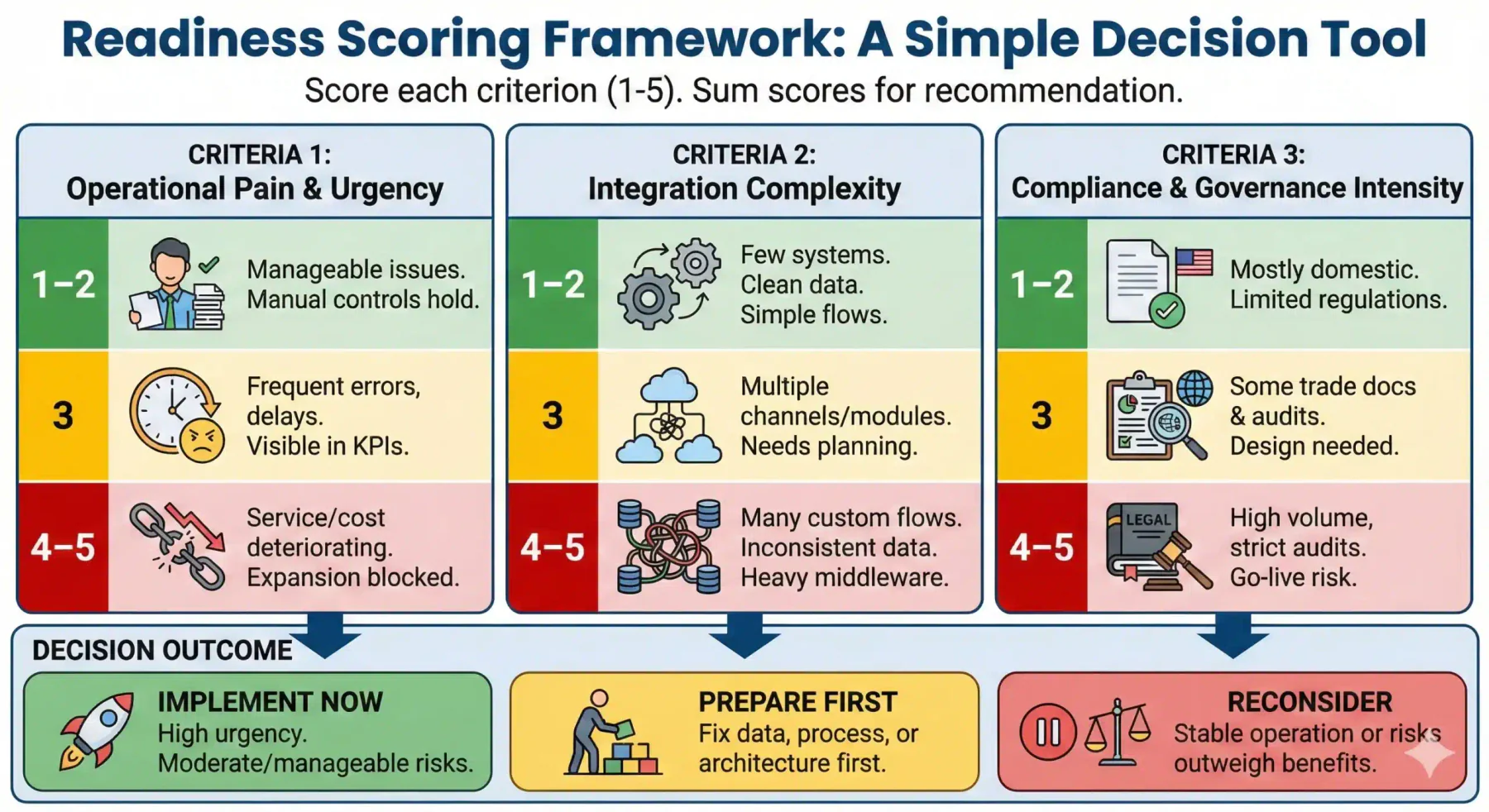
Readiness scoring framework
Use a simple scoring approach so this becomes a decision tool, not a discussion loop:
Your execution strategy
To reduce risk and shorten time-to-value, run implementation like an operational rollout, not an IT installation.
1. Two-week diagnostic
- Baseline KPIs (inventory accuracy, pick accuracy, OT hours, order cycle time, dock-to-stock time)
- Map process exceptions (returns, partial picks, substitutions, damaged stock, rush orders)
2. Integration-first design
- Define the “source of truth” for item master, UOM, locations, pricing rules, and order status
- Prioritise minimal viable integrations first, then expand
3. Pilot then scale
- Pilot one site or one workflow lane (e-commerce, B2B wholesale, or cross-dock)
- Lock SOPs, train supervisors, then replicate to other sites
4. Compliance validation
- Confirm trade declaration and e-invoicing readiness early if relevant, so compliance does not become a late-stage blocker.
Conclusion
Adopting a SaaS WMS can improve warehouse operations by supporting agility, scalability, and stronger security controls. By mapping your business needs and prioritising the features that matter most, you can select a solution that supports long-term efficiency and growth.
As cloud-based WMS continues to evolve, it is likely to play an increasingly important role in warehouse management, especially in fast-moving markets like Singapore. More teams are moving toward systems that provide real-time visibility, easier integrations, and faster process standardisation across sites.
If you want to optimise inventory accuracy and reduce manual work, consider exploring a warehouse management platform that fits your workflows and existing tools. For a clearer view of what would work best for your operation, you can click here to request a free consultation.
Frequently Asked Questions
There are four main types of Warehouse Management Systems (WMS) designed to meet various business needs: Standalone, ERP Modules, Cloud-Based, and Supply Chain Modules. Each type offers different features, integration options, and is suited for specific industries and business sizes.
SaaS (Software as a Service) refers to cloud-based services that handle the deployment and management of software by third-party providers. SaaS encompasses a variety of platforms, including CRM, marketing automation, storage solutions, and cloud data warehousing. Cloud data warehouses, like other SaaS platforms, are managed in the cloud, providing scalable and accessible solutions for storing and analyzing large volumes of data.
While SaaS is typically a subset of cloud services, not all SaaS models are inherently built in the cloud. Some SaaS applications can be developed on local infrastructure and then deployed to a cloud-based server, where they are accessed via a web browser. This means that while SaaS generally relies on cloud technology, the underlying architecture can vary.