





Many warehouses often remain underutilized due to poor layout decisions, leading to rising storage costs, limited floor space, and slower putaway.
To reverse this, block stacking can help you improve your warehouse’s productivity by increasing storage density, especially for uniform SKUs stored in high volumes. Academic research on block stacking shows that a well-designed layout can reduce operational costs by up to ~10% through space optimization.
This page will tell you everything you need to know about block stacking, from its definition to industry best practices. We will also present its pros and cons and compare block stacking with the racking system for warehousing.
Key Takeaways
|
What Is Block Stacking?
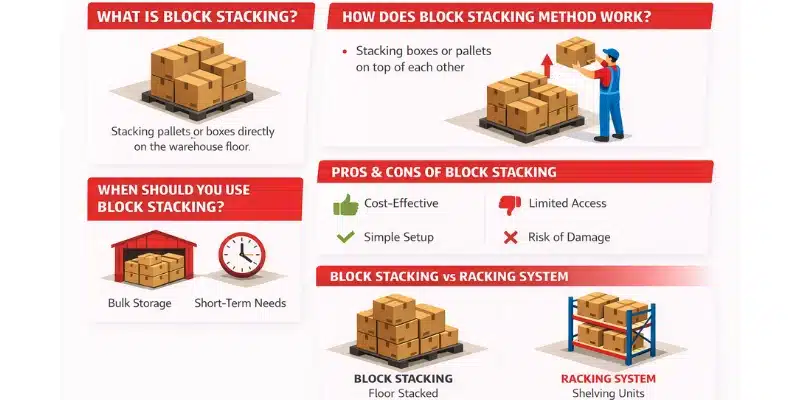
Block stacking is a warehouse storage method where pallets, bins, or products are stacked directly on the floor in dense blocks or deep rows, often multiple levels high. It avoids steel racking, making it one of the most cost-effective ways to maximize cubic space for high-volume, uniform SKUs.
This method typically follows a Last-In, First-Out (LIFO) inventory flow because the most recently placed pallet is the easiest to access first. Its biggest advantages are flexible layout changes and lower setup and maintenance costs than those of fixed racking systems.
How Does the Block Stacking Method Work?
Block stacking is more than just stacking pallets in every available space. It can only work through proper layout planning and adequate rules.
- Layout determination and block design
Start by mapping floor zones, deep lanes, and access aisles based on SKU volume and turnover. Use clear floor markings and ensure aisle width supports safe forklift movement without sacrificing density. - The pallet stacking process
Operators place pallets from the back of a lane and build upward into aligned, stable stacks. Stack height is set by load strength, pallet condition, product weight, and ceiling clearance to prevent crushing and instability. - Goods retrieval and stock rotation
Picking follows LIFO, meaning the front or top pallets must be removed first before accessing deeper stock. The method runs most efficiently when each lane holds a single SKU and is fully emptied before refilling. - LIFO-based inventory management
Inventory control requires consistent lane discipline, so putaway and picking do not break the LIFO flow. A Warehouse Management Software (WMS) helps track lane contents in real time and reduces errors that cause lost stock and honeycombing.
Pros and Cons of Block Stacking
Block stacking is not inherently good and comes with multiple considerations to weigh.
Pros of Block Stacking
Block stacking remains popular because it delivers high storage density without the heavy upfront investment of fixed racking. When the SKU profile and handling flow match, it can improve space efficiency and lower the cost per pallet position.
- Maximum cost efficiency
Block stacking reduces capex because you do not need steel racking, installation, or ongoing structural maintenance. With forklifts and pallets as the main requirements, it keeps storage costs low and improves the cost per pallet position. - Vertical and horizontal space utilization
Removing racking uprights frees more floor area for storage lanes and increases overall density. Pallets can be stacked vertically up to safe limits, maximizing cubic space for bulk, uniform inventory. - Warehouse layout flexibility
Without fixed structures, you can reconfigure lanes quickly to match changing inventory levels or seasonal demand. This makes it easier to adapt the warehouse layout without downtime from dismantling and reinstalling racking. - Simple and fast implementation
Implementation is mainly floor planning and marking, so the warehouse can become operational faster than a racking-based setup. Training is also simpler because stacking and retrieval follow familiar forklift handling routines.
Cons of Block Stacking
Block stacking can deliver high density and low storage cost, but it also introduces access, safety, and space-loss risks if the operation is not disciplined. The good news is that most of these issues can be reduced with the right SKU selection, layout rules, and optimal storage management controls.
- Limited product accessibility (LIFO principle)
Because block stacking follows LIFO, accessing pallets deeper in a lane often causes double handling and delays. Reduce the impact by dedicating lanes to one SKU, aligning putaway with dispatch priorities, and using a WMS to direct operators to the best lanes. - Risk of product damage due to stacking
Tall stacks can crush lower cartons and become unstable if the packaging, pallets, or load quality is inconsistent. Set maximum stack height/weight limits, use strong pallets and uniform unit loads, and enforce forklift handling SOPs to protect goods and people. - Emergence of the honeycombing effect
Partially emptied lanes create trapped empty space that lowers density and cancels out the main benefit of block stacking. Prevent this by replenishing in full-lane quantities, consolidating leftovers into designated “mix” lanes, and using WMS rules to trigger consolidation at thresholds. - Limitations on stacking height
Stacking height is constrained by load capacity, ceiling clearance, and safety requirements, leaving vertical space unused. Optimize by selecting products suitable for higher stacks, standardizing pallet patterns, and using a WMS-supported slotting plan to place heavy/fragile loads in safer, lower blocks.
When Should You Use Block Stacking?
Block stacking works best when your inventory profile matches its strengths: dense storage, simple handling, and low setup cost. Use it when the savings and space gains outweigh the trade-offs of LIFO access and consolidation work.
- For uniform and homogeneous products
Block stacking works best for products with consistent size, weight, and packaging because stacks stay stable and predictable. This reduces the risk of damage and allows safer stacking to higher levels. - When stock volume is high with limited SKUs
It performs best when you store large volumes of the same SKU, so each lane can be dedicated to one product. This simplifies handling, reduces reshuffling, and minimizes LIFO friction. - For non-time-sensitive goods
Because retrieval is typically LIFO, block stacking suits items that do not require strict FIFO rotation. It works well for goods shipped in batches where the pick order does not affect quality or compliance. - As a temporary or seasonal storage solution
Block stacking is ideal for overflow storage during peak seasons because it can be set up quickly with minimal infrastructure. Once demand normalizes, the space can be cleared and repurposed without racking changes.
Block Stacking vs. Racking System

One of the most fundamental decisions in warehouse design is choosing between the low-cost flexibility of block stacking and the rigidity of the warehouse metal racking system. This side-by-side analysis provides a practical framework for determining the optimal storage strategy for your warehouse.
| Criterion | Block Stacking | Racking System |
| Initial Cost | Very low. No investment in steel structures is required. | High. Requires significant capital investment for racks, installation, and permits. |
| Space Utilization | Excellent density for low SKU counts but prone to honeycombing. Vertical height is limited by product stability. | Good density with full vertical space utilization. Less prone to wasted space. |
| Accessibility & Selectivity | Very low. Operates on a Last-In, First-Out (LIFO) basis with no direct access to individual pallets. | Excellent. Provides direct access to every pallet, allowing for First-In, First-Out (FIFO) rotation. |
| Product Suitability | Best for uniform, non-crushable, non-perishable products with high volume and few SKUs. | Suitable for a wide variety of product types, sizes, and weights, including those requiring FIFO. |
| Flexibility | Extremely high. The layout can be reconfigured quickly to adapt to changing inventory needs. | Low. The layout is fixed and requires significant effort to modify. |
| Risk of Damage | Higher risk of product crushing and damage from forklift collisions due to deep lanes. | Lower risk, as each pallet is supported by a steel structure, preventing crushing. |
Best Practices for Implementing Block Stacking in a Modern Warehouse
Block stacking performs best when clear rules, consistent handling, and strong operational discipline support it. With the proper setup, you can protect inventory, reduce wasted space, and keep workflows efficient even in high-density areas. It is also ideal to implement supporting systems, such as a Warehouse Management System (WMS), to streamline processes optimally.
- Conduct in-depth product analysis
Review each SKU’s weight, dimensions, and packaging strength to confirm it can be stacked safely. Use the findings to set safe stack heights per SKU and prevent crushing or unstable loads. - Design an efficient aisle layout
Mark lanes and aisles clearly so operators follow a consistent flow and blocks stay organized. Set lane depth based on turnover to limit honeycombing and reduce double handling. - Implement safe stacking height rules
Define maximum stacking heights by product type, pallet condition, and standardized safety standards, then enforce them consistently. Post the limits in the storage zone and train operators regularly to prevent collapses and damage. - Integrate with a Warehouse Management System (WMS)
Use a WMS to guide putaway and picking so LIFO lanes stay accurate and easy to manage, while providing real-time visibility into pallet locations, lane occupancy, and SKU movement. A WMS also helps track lane utilization, trigger consolidation, and optimize layout decisions over time. It’s best to conduct thorough research before deciding which is the best WMS for your business.

FAQ About Block Stacking
-
How do you calculate a safe stacking height for block stacking?
Safe stacking height is determined by analyzing product weight, packaging strength, pallet condition, and stability. Always consult manufacturer guidelines and industry safety standards, and never exceed the load capacity of the bottom pallet.
-
What is the best strategy to minimize the honeycombing effect?
To minimize honeycombing, dedicate entire lanes to a single SKU and aim to deplete the lane completely before replenishment. A WMS can also help by tracking lane utilization and suggesting consolidation of partially empty lanes to create full, usable spaces.
-
What equipment is needed to implement block stacking effectively?
The essential equipment for block stacking is minimal. You primarily need high-quality pallets suitable for stacking and appropriate material handling equipment, such as a forklift or pallet stacker, capable of safely lifting loads to the required height.
-
Is block stacking suitable for cold storage warehouses?
Yes, block stacking is very suitable for cold storage. Since racking can be expensive and obstructs airflow, block stacking maximizes storage density and allows for more efficient temperature control, reducing energy costs.