








Manual invoices, delayed approvals, or frequent data errors when processing invoices? If you manage finance or operations, these issues likely slow your daily work and cloud visibility.
Many businesses now turn to AI invoice processing software to reduce manual work, improve accuracy, and speed up payment cycles. According to the Singapore Digital Economy Report 2024 by IMDA, AI adoption among large enterprises jumped from 16.7% in 2018 to 44% in 2023.
Faster processing, cleaner data, and better control are no longer future goals but current expectations. And this is how invoice processing benefits from AI.
Key Takeaways
AI invoice processing software automates data extraction and validation, reducing errors and speeding up workflows. It enhances efficiency and accuracy in financial management.
This software uses OCR and automation to extract, validate, and route invoices for approval. It streamlines payments, reduces errors, and enhances efficiency.
One of the benefits of invoice processing software that uses AI is increased accuracy and efficiency. AI reduces errors, prevents duplication, and speeds up financial flows.
The Overview of AI Invoice Processing Software
AI Invoice Processing software uses artificial intelligence technologies, such as machine learning (ML) and natural language processing (NLP), to automate invoice handling. This includes tasks like data extraction, validation, and payment tracking. With AI, time-consuming, error-prone processes can be completed quickly, accurately, and efficiently.
Unlike traditional methods that rely on manual data entry, AI-powered systems can read, interpret, and process invoices with minimal human intervention, especially when integrated with an IRAS-approved accounting application. For example, AI can extract key details like invoice numbers, dates, and amounts from scanned documents or PDFs, regardless of format.
This technology is not just about automation but also about accuracy and efficiency. By reducing human errors and speeding up processing times, AI in invoice processing helps businesses save time and money while improving overall financial management.
What Are the Technologies Used in AI-Driven Invoice Processing?
AI-powered invoice processing uses cutting-edge technologies to boost accuracy, efficiency, and automation in financial workflows. Below are the core technologies:
1. Optical Character Recognition (OCR)
OCR plays a crucial role in AI-driven invoice processing by converting scanned or digital invoices into machine-readable text. This eliminates manual data entry, allowing businesses to extract essential details such as invoice numbers, dates, amounts, and vendor information.
When a cloud-based accounting system is integrated with AI, OCR can also adapt to various invoice formats, making it a highly efficient tool for simplifying invoice management.
2. Machine Learning (ML)
Machine Learning (ML) is a fundamental component of AI invoice processing. It enables systems to recognize patterns, adapt to diverse invoice formats, and refine accuracy over time. ML algorithms can automatically extract key information, identify discrepancies, and enhance validation with minimal human involvement.
3. Natural Language Processing (NLP)
Natural Language Processing (NLP) allows AI invoice processing systems to interpret and analyze text across different formats and languages. By identifying crucial details like vendor names, invoice numbers, and payment terms, NLP enhances data extraction accuracy while reducing the need for manual input.
Incorporating these advancements helps businesses optimize invoice management, minimize errors, and enhance overall financial operations.
How Does Invoice Processing Automation Using AI Work?
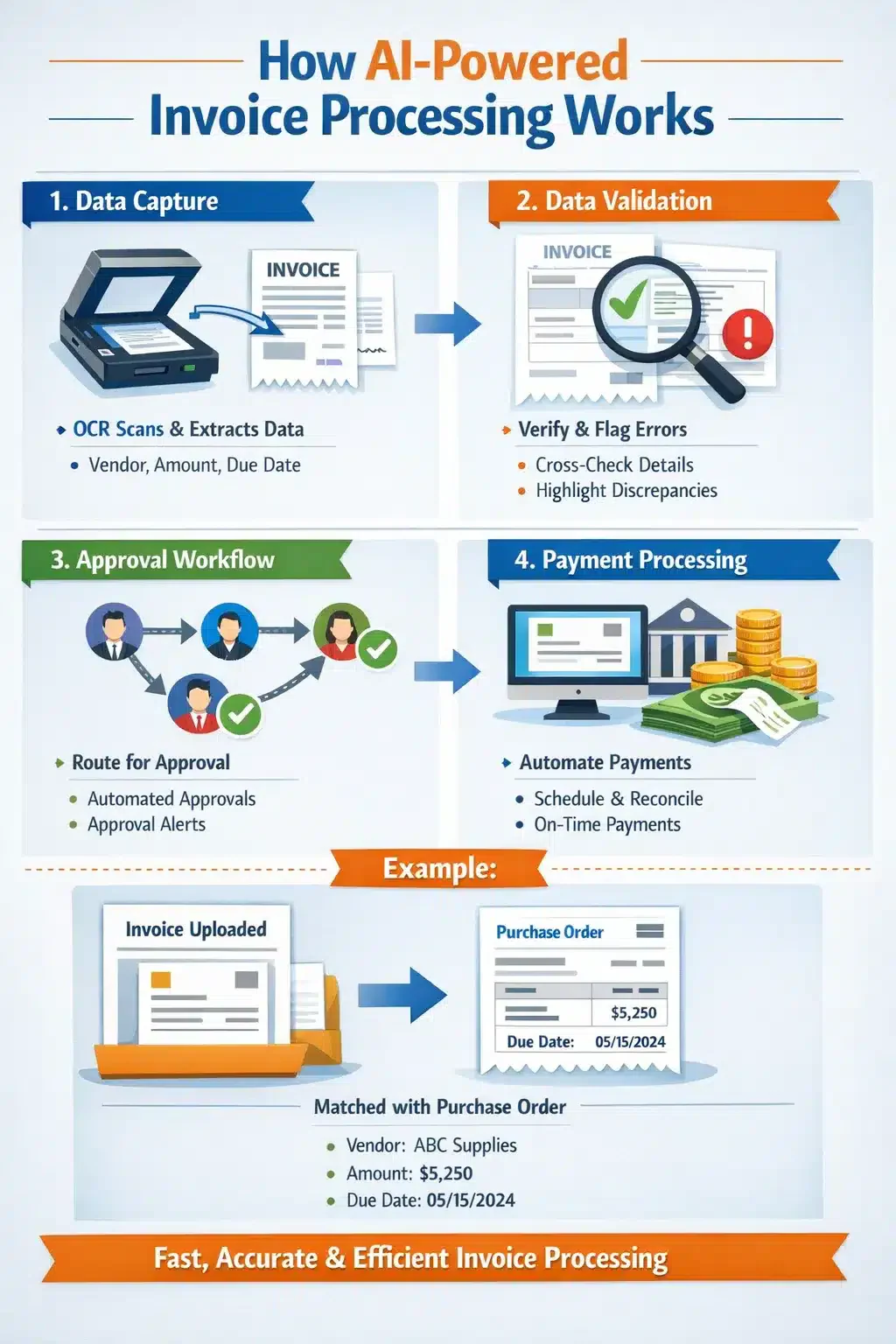
Understanding how AI works in invoice processing is essential to automating and streamlining the entire invoicing workflow. Here’s how the process works:
- Data capture
AI uses Optical Character Recognition (OCR) to extract data from invoices, whether paper or digital. It can handle various formats and layouts, pulling details like vendor names, dates, and amounts. This eliminates manual data entry, saving time and reducing errors. - Data validation
The system cross-checks extracted data against predefined rules or databases to ensure accuracy. It flags discrepancies, like mismatched amounts or missing details, for review. This step ensures only accurate data moves forward, preventing errors and overpayments. - Approval workflow
AI automates routing invoices to the right approvers based on predefined rules. For example, high-value invoices go to senior managers, while lower amounts are approved by junior staff. Automated reminders ensure timely approvals, speeding up the process. - Payment processing
Once approved, AI initiates payments automatically through integrated systems. It schedules payments based on due dates, avoiding late fees, and reconciles payments with invoices. This ensures timely payments and simplifies financial records.
For example, if an invoice is uploaded, the AI solution can instantly extract the vendor’s name, invoice amount, and due date, then match it with the corresponding purchase order. This eliminates the need for manual data entry and reduces the risk of errors.
To understand better, take a look at this infographic.
What are the Applications of AI for Invoice Processing?
AI invoice processing software has many applications that streamline the invoicing workflow, from receiving and verifying invoices to approving and paying them. It also enhances accounts payable processes through automation and intelligent decision-making. Here are some key use cases:
- Automated general ledger coding: AI invoice automation integrates with generative AI models to streamline invoice categorisation, ensuring accurate and efficient ledger coding without manual intervention.
- Detection of discrepancies between invoices and purchase orders: AI-powered systems identify mismatches and flag inconsistencies for further validation to prevent financial discrepancies.
- Duplicate invoice prevention: AI in procurement helps businesses save money by detecting and preventing duplicate payments or duplicate invoices. It alerts accounts payable staff if an invoice has already been paid, ensuring suppliers aren’t paid twice for the same service or product.
- OCR invoice capture with data extraction: Automated invoice processing AI leverages OCR to extract data from various invoice formats, converting unstructured documents into usable digital information.
- AI-powered chatbots for financial insights: Integrating generative AI, like ChatGPT, into accounts payable software enables real-time expense analysis, improving financial decisions and management.
- Smart invoice approval routing: AI automates invoice approval workflows by analyzing historical data and predicting the appropriate approvers for each invoice. This eliminates delays and optimizes the approval process.
What are the Benefits of AI Invoice Processing?

AI-based invoice processing offers numerous benefits for businesses looking to streamline financial operations. Manual invoicing processes are often prone to errors, delays, and inefficiencies, leading to increased operational costs and payment discrepancies. This automation improves accuracy and prevents payment discrepancies.
Integrating AI billing software enables businesses to automate repetitive tasks, reducing the need for manual intervention and minimizing human errors. With machine learning algorithms, AI can analyze invoice data, detect inconsistencies, and ensure compliance with financial regulations.
This enhances accuracy and helps prevent fraud and duplicate payments, leading to better financial control and cash flow management. To maximize the benefits of automation, businesses must first develop a strong system for financial reporting to choose the right solution for their specific needs.
Summary of AI Invoice Processing Benefits
- Improved accuracy through the reduction of human errors in invoicing.
- Faster processing by automating tasks and reducing delays.
- Cost reduction through eliminating inefficiencies and operational costs.
- Prevention of payment discrepancies by ensuring accurate invoices.
- Fraud prevention through AI detection of inconsistencies in data.
- Prevent duplicate payments by identifying and blocking duplicates.
- Enhanced compliance with financial regulations through automated checks.
- Optimized cash flow management by improving financial control.
- Reduced manual intervention by automating repetitive tasks.
- Scalability with AI-driven invoicing for handling larger transaction volumes.
- Increased efficiency by streamlining the entire invoicing process.
- Real-time data analysis for better decision-making.
Singapore E-Invoicing Compliance
Singapore’s e-invoicing framework is designed to standardize how businesses issue, exchange, and report invoices while meeting GST and regulatory requirements. Understanding these rules helps companies stay compliant, reduce manual errors, and prepare for wider adoption of InvoiceNow and Peppol-based e-invoicing.
Invoice Format Requirements for GST Compliance
For GST-registered businesses in Singapore, invoice format is not just an admin detail. It impacts GST reporting accuracy, audit readiness, and whether input tax claims hold up, based on IRAS rules outlined in IRAS tax invoice requirements.
Key GST invoice format requirements you must meet:
- Clear identification as a tax invoice
The document must be clearly labelled as a “Tax Invoice” so it can be easily distinguished from quotations, pro-forma invoices, or receipts. - Supplier’s business details and GST registration number
The invoice must include the supplier’s legal business name, address, and GST Registration Number (GST Reg No.), which IRAS uses to validate GST claims. - Unique invoice number and issue date
Each tax invoice must have a unique serial number and an invoice date to support traceability and audit checks. - Description of goods or services supplied
Line items should clearly describe the goods or services provided, including quantities where applicable, so the nature of the supply is unambiguous. - GST breakdown and totals
The invoice must show the GST rate, the GST amount, the subtotal before GST, and the total amount payable including GST. - Simplified tax invoice rules (when applicable)
If the total amount payable (including GST) does not exceed SGD 1,000, a simplified tax invoice may be issued with fewer required details. - Structured format for InvoiceNow submissions
Under the GST InvoiceNow Requirement, GST-registered businesses will be required to submit invoice data to IRAS using InvoiceNow-Ready solutions, which rely on structured formats such as Peppol BIS or PINT-SG, rather than unstructured PDFs.
How to Send E-Invoices Through the Official Network
To send e-invoices correctly in Singapore, use the official network rather than emailing PDFs back and forth. The process is straightforward once you understand how InvoiceNow works in Singapore, including Peppol IDs and the role of InvoiceNow-Ready solutions.
To start using InvoiceNow:
- Ensure your software is InvoiceNow-ready: Adopt an accounting or finance solution listed as InvoiceNow-Ready by IMDA or work with an accredited Access Point Provider.
- Register for a Peppol ID: Register your business in the Singapore Peppol Directory and obtain a unique Peppol ID that serves as your e-invoicing address.
- Transmit invoices via the network: With an enabled InvoiceNow solution, you can send and receive structured e-invoices with trading partners and, for GST-registered businesses, transmit invoice data to IRAS by the required deadlines.
Best Practice to Use AI Invoice Processing
Integrating AI into your invoice processing workflow is a smart move to improve efficiency and accuracy in financial management. AI can automate manual tasks, such as invoice data extraction, validation, and payment approval, using machine learning, OCR (Optical Character Recognition), and RPA (Robotic Process Automation).
Choosing the right invoicing software is crucial for businesses looking to optimize operations. By understanding the system for invoice making, you can find the best recommendation for your business needs. The right solution automates routine tasks and integrates with existing financial systems to improve efficiency.
How Brinks Optimizes Invoice Processing with Artificial Intelligence
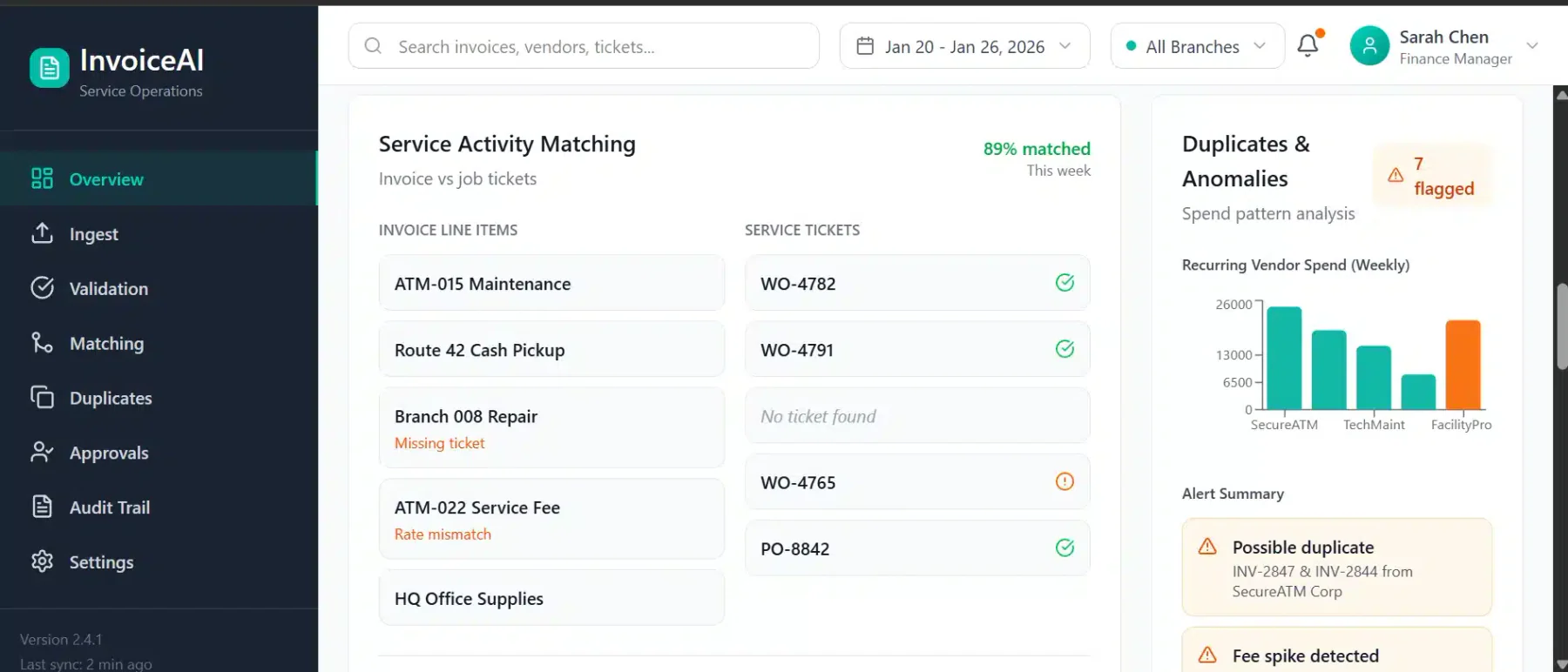
Brinks runs a service-heavy operation. They move and manage cash, support ATMs, and operate across many branches, routes, and daily service visits. That creates a steady flow of invoices tied to specific locations, jobs, and recurring supplier costs, so speed and accuracy matter. This is how AI-supported invoice processing software helps them.
- Captures invoice details fast, even at high volume
Brinks likely receives invoices from many vendors, across many sites. AI helps pull key fields like vendor name, invoice number, date, and line items, so the team does not retype the same data all day. - Sorts invoices by service type and location automatically
In a route-and-branch model, the “where” matters as much as the “what.” AI can tag invoices to the right branch, route, ATM activity, or service category so costs land in the right bucket from the start. - Checks invoices against real service activity
A lot of Brink’s spending is tied to work performed, like pickups, maintenance, repairs, or ATM service calls. AI can help compare invoice line items to job tickets, service logs, or contract terms, then flag anything that does not line up. - Finds duplicates and unusual charges in recurring spend
When the same vendors bill repeatedly, duplicate invoices and repeated fees can slip through. AI can spot patterns that look off, like the same invoice appearing twice or a charge that suddenly jumps above the normal range. - Routes approvals to the right person without the back-and-forth
In distributed operations, invoices often stall because no one knows who should approve what. AI can route invoices based on branch, cost type, vendor, or past approval behaviour, so reviews move faster, and fewer invoices sit in limbo. - Keeps records clean for audits and disputes
In a high-trust business, you need clear proof of what was billed, what was approved, and why. AI invoice processing helps keep the trail complete by saving extracted data, checks performed, and approval steps in one place.
"AI invoice processing software automates AP by capturing, validating, and routing invoices with OCR and machine learning, reducing errors and speeding up approvals and payments."
Key Takeaways for Finance Teams
AI-driven invoice processing transforms business financial management, making operations faster, more accurate, and cost-effective. By leveraging advanced technologies like machine learning and OCR, companies can reduce human errors, streamline approvals, and optimize cash flow.
In today’s fast-paced business environment, adopting AI is essential for staying competitive. To experience the benefits of AI invoice processing, consult our experts to assess your workflow and recommend the right automation approach.

Questions About AI Invoice Processing
Yes, Power Automate can read invoices using AI tools like OCR. It automates data extraction, validation, and approval routing. For advanced features like ML-based validation, AI invoice software is recommended.
One effective strategy to improve invoice processing is automation through AI-powered tools. By implementing AI solutions, businesses can automate data capture, validation, and approval workflows, reducing manual effort and errors.
Use AI-driven invoicing software to automatically generate, send, track, and reconcile invoices, ensuring timely payments and reduced manual effort.
AI models for invoices use OCR (Optical Character Recognition) and machine learning to extract, validate, and categorize invoice data for automation.