














Have you ever wondered why your business looks profitable on paper but still feels short on cash? Many companies face this exact problem—strong sales but weak cash flow—because too many invoices go unpaid for too long. Without clear visibility into who owes you money and for how long, outstanding receivables can quietly pile up and turn into serious financial pressure.
In today’s competitive business landscape, managing cash flow isn’t just an accounting task—it’s essential for survival and growth. When businesses lack control over accounts receivable, they risk delayed supplier payments, stalled investments, and even payroll issues. The real problem isn’t always sales volume, but the absence of a structured system to track, analyze, and collect outstanding invoices.
This is where receivable aging becomes indispensable. By organizing unpaid invoices into time-based categories, businesses gain a strategic view of their receivables. It enables finance teams to prioritize collections, identify credit risks early, and make smarter decisions that protect financial stability. This guide will walk you through what receivable aging is, why it matters, and how to use it effectively to strengthen your cash flow.
Key Takeaways
|
Table of Contents
What Is Receivable Aging?
Receivable aging, also known as an accounts receivable aging report, is a fundamental accounting tool used to categorize and analyze a company’s outstanding invoices from customers. Its primary function is to classify receivables based on the length of time an invoice has been outstanding. This classification provides a snapshot of the financial health of a company’s credit and collection processes. Instead of viewing all outstanding money as a single lump sum, an aging report breaks it down into time-based categories, offering a more nuanced and actionable perspective. It is not merely a list of debts but a diagnostic instrument that helps businesses gauge the effectiveness of their credit policies and the efficiency of their collection efforts.
The report typically organizes receivables into columns representing different time intervals, such as 0-30 days, 31-60 days, 61-90 days, and over 90 days. Each customer’s outstanding balance is allocated to the appropriate column based on the age of their unpaid invoices. This structured format makes it easy to identify which customers are current with their payments and which are falling behind. Ultimately, the receivable aging report serves as a critical document for financial management, enabling businesses to proactively address potential cash flow issues and minimize the risk of bad debt.
Defining receivable aging
At its core, receivable aging is the process of sorting unpaid customer invoices by their due dates. This method allows a business to understand the composition of its accounts receivable and identify how long specific invoices have remained unpaid. The underlying principle is that the longer an invoice goes unpaid, the lower the probability of its collection. By categorizing these debts, companies can better assess the quality of their receivables and take targeted actions. It is a key component of financial analysis that provides insights into customer payment behavior and the overall effectiveness of the company’s credit management.
The receivable aging report
A receivable aging report is the tangible output of this process, typically presented in a tabular format. This report lists each customer with an outstanding balance and distributes their unpaid invoices across various time-sensitive columns. For instance, an invoice that is 45 days past due would fall into the 31-60 day category. The report is crucial for finance departments as it helps prioritize collection efforts, focusing on older, more delinquent accounts that pose a higher risk. Furthermore, auditors and financial analysts frequently use this report to estimate the allowance for doubtful accounts, which is a vital part of maintaining accurate financial statements and ensuring financial compliance.
Why Is Receivable Aging Crucial for Business?
Understanding the importance of receivable aging is the first step toward proactive and strategic financial management. This powerful tool offers insights that extend far beyond simple numbers on a balance sheet, empowering business leaders to make informed and timely decisions. An aging report acts as an early warning system, highlighting potential liquidity issues before they escalate into critical problems. It provides a clear and objective measure of how well a company is managing one of its most significant assets: the money it is owed. For any business that extends credit to its customers, ignoring receivable aging is akin to navigating without a map, risking financial instability and missed growth opportunities.
Every business, regardless of its size or industry, must prioritize the analysis of its receivable aging to maintain a healthy cash flow and a strong financial foundation. The insights derived from this report are instrumental in shaping credit policies, refining collection strategies, and forecasting future revenue streams with greater accuracy. By regularly reviewing their aging reports, companies can identify trends in customer payments, single out high-risk accounts, and take corrective actions to mitigate potential losses. In essence, receivable aging is not just an accounting task but a strategic imperative that directly impacts a company’s profitability and long-term sustainability.
Predicting and managing cash flow
One of the most significant benefits of receivable aging is its ability to enhance cash flow forecasting. By analyzing how quickly customers typically pay their invoices, a business can create more accurate projections of incoming cash. For example, if the report shows that a large portion of receivables is consistently collected within 30 days, that cash can be reliably factored into short-term financial planning. Conversely, if a significant amount is aged over 90 days, the company knows it cannot depend on that money for immediate operational needs. This foresight allows for better budget management, informed investment decisions, and a reduced likelihood of cash shortages.
Identifying credit risk and potential bad debt
The aging report is an invaluable tool for risk management. It clearly highlights customers who are chronically late with payments, allowing the company to reassess their credit terms or even cease extending credit to them altogether. The longer a receivable remains unpaid, the higher the probability that it will become a bad debt, an uncollectible amount that must be written off as a loss. By monitoring the ’90+ days’ column, businesses can proactively identify these high-risk accounts and intensify collection efforts or begin the process of estimating their allowance for doubtful accounts. This proactive stance helps protect the company’s bottom line from unexpected losses.
Evaluating the effectiveness of credit policies
A receivable aging report serves as a report card for a company’s credit policies. If a large percentage of receivables consistently falls into the older categories, it may be a strong indicator that the current credit terms are too lenient or that the screening process for new customers is inadequate. For example, offering 60-day payment terms may not be sustainable if it consistently leads to delayed cash flow. By analyzing these trends over time, management can make data-driven adjustments to their credit policies, such as shortening payment windows, requiring deposits, or implementing stricter credit checks, to improve overall collection performance.
Improving the efficiency of the collection process
With a clear, prioritized list of outstanding invoices, the collections team can focus its efforts far more effectively. Instead of treating all unpaid invoices equally, they can concentrate on the oldest and largest balances first, as these pose the greatest risk to the company’s financial health. An aging report allows for a segmented approach to collections. For instance, accounts in the 31-60 day category might receive automated email reminders, while those over 90 days may require a personal phone call or intervention from a collection agency. This targeted strategy optimizes the use of resources and significantly increases the chances of successful debt recovery.
Key Components of a Receivable Aging Report
To effectively read and analyze an aging report, it is essential to understand each component within it. Every column and row of data serves a specific purpose, collectively providing a holistic view of the company’s accounts receivable status. This detailed breakdown transforms a simple list of numbers into a powerful analytical tool. Understanding these components allows finance teams to quickly diagnose the health of their receivables, identify specific issues with customer accounts, and communicate financial insights clearly to other stakeholders in the organization. Let’s dissect the key components that constitute a comprehensive and functional receivable aging report.
A well-structured aging report is intuitive and packed with actionable information. From identifying the customer to categorizing the age of their debt, each element is designed for clarity and ease of use. The true power of the report lies not in any single component but in how they work together to tell a story about the company’s financial relationships with its clients. By familiarizing yourself with these fundamental building blocks, you can unlock the full strategic potential of your receivable aging analysis and turn data into decisive action.
Customer List
This is the most straightforward component, listing the names of all customers who currently have outstanding balances. Each customer is typically listed on a separate row, making it easy to see individual account statuses at a glance. This allows for a quick assessment of which clients owe money and serves as the primary identifier for tracking and communication. In more advanced reports, this section might also include customer contact information or an account manager’s name to streamline the collection process.
Total Unpaid Invoice Amount
Next to each customer’s name, the report shows the total amount they owe across all their unpaid invoices. This figure provides a quick summary of each customer’s total liability. It is particularly useful for identifying high-balance accounts that may require immediate attention, regardless of the age of the individual invoices. Summing this column gives the company’s total accounts receivable, a key figure for the balance sheet.
Invoice Due Dates
While not always displayed for every single invoice in a summary report, the underlying data is driven by the due date of each invoice. The age of a receivable is calculated from its due date, not its issue date. This distinction is critical for accuracy. Knowing the specific due dates helps in understanding the context of the delinquency and is essential for communicating with customers about their payment obligations.
Age Category Columns (0-30, 31-60, 61-90, 90+ days)
These columns are the heart of the receivable aging report. The total amount owed by each customer is broken down and allocated into these time-based buckets. For example, if a customer owes $5,000 from two invoices, one 20 days old ($2,000) and one 50 days old ($3,000), the report will show $2,000 in the ‘0-30 days’ column and $3,000 in the ’31-60 days’ column. These categories immediately draw attention to older, riskier debts, enabling a prioritized approach to collections.
How to Create and Calculate Receivable Aging
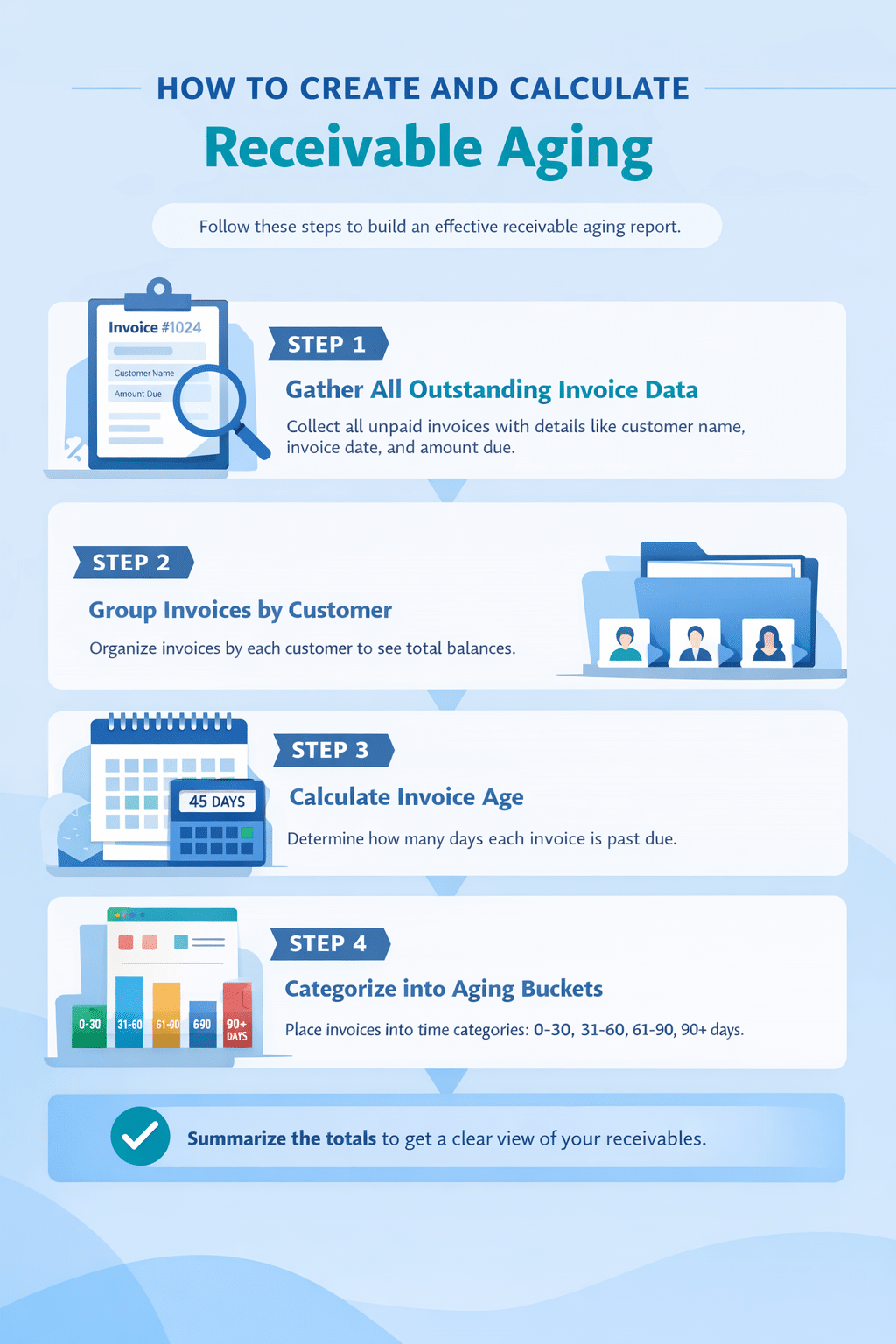
Creating a receivable aging report can be done either manually with spreadsheets or automatically using accounting software. While both follow the same core process—gathering, categorizing, and presenting invoice data—their efficiency and accuracy differ greatly. Manual methods take more time and are prone to errors, whereas automated systems generate real-time, reliable reports with minimal effort.
No matter the approach, accuracy is essential because the value of an aging report depends entirely on the quality of its data. The process starts with collecting all unpaid invoices and ends with sorting them into time-based categories. Understanding these steps not only helps businesses build useful reports but also highlights why automation is the smarter, more scalable solution.
Step 1: Gather All Outstanding Invoice Data
The first step is to compile a complete list of all unpaid invoices. This requires gathering essential information for each invoice, including the customer’s name, the invoice number, the invoice date, the payment terms, and the total amount due. This data forms the foundation of the report, so it is crucial to ensure that no invoices are missed and all details are recorded accurately. This comprehensive collection is the starting point for all subsequent calculations.
Step 2: Group Invoices by Customer
Once all the invoice data is collected, the next step is to organize it by customer. This involves creating a list where each customer is listed once, with all of their respective unpaid invoices grouped under their name. This organization helps in calculating a total outstanding balance for each customer and provides a clear, consolidated view of each account. It simplifies the report and makes it easier to analyze customer-specific payment patterns.
Step 3: Calculate the Age of Each Invoice from Its Due Date
This is the most critical calculation in the process. For each invoice, determine the number of days it is past due. This is calculated by subtracting the invoice’s due date from the current date. For example, if the current date is October 31st and an invoice was due on October 1st, the invoice is 30 days past due. It is essential to be consistent with this calculation for every invoice to ensure the integrity of the report.
Step 4: Place the Data into the Appropriate Aging Categories
With the age of each invoice calculated, you can now slot the invoice amounts into the corresponding aging columns. Using the standard categories (e.g., 0-30, 31-60, 61-90, 90+), place each invoice’s value in the correct bucket. After categorizing all invoices for a customer, sum the amounts in each column to get a total for each aging period for that customer. Finally, sum the totals for all customers to get a company-wide view of the accounts receivable aging.
Strategies to Optimize Receivables Management Based on an Aging Report
A receivable aging report is not a static document intended merely for review; it is a dynamic roadmap for strategic action. The data presented within it provides powerful signals about the immediate steps a company must take to accelerate cash inflows and mitigate credit risk. Treating it as such transforms it from a simple accounting exercise into a vital component of proactive financial management. By implementing strategies directly informed by the report’s insights, businesses can significantly improve their financial health. Below are several practical strategies that you can implement based on a thorough analysis of your aging report.
The true value of an aging report is realized when its data is used to drive decision-making. From refining credit policies to automating communications, the opportunities for optimization are numerous. These strategies are not mutually exclusive and can be combined to create a comprehensive and robust collections process. By moving beyond simple data collection and into strategic implementation, your company can ensure that its accounts receivable are managed efficiently, helping to maintain a strong and steady cash flow that supports sustainable business growth.
Adjust credit policies for new and existing customers
The aging report provides valuable feedback on your credit policies. If you notice that a particular customer segment consistently has high balances in the 60+ day categories, it may be time to tighten their credit terms. For new customers with no payment history, you might implement stricter policies, such as requiring partial payment upfront or offering shorter payment windows. For existing customers with a history of late payments, you could reduce their credit limit or move them to cash-on-delivery (COD) terms until their payment behavior improves.
Prioritize collection efforts based on age and amount
Not all outstanding debts are created equal. Use the aging report to apply the Pareto Principle to your collection efforts by focusing 80% of your time on the 20% of accounts that pose the biggest risk. This typically means prioritizing invoices that are both large in value and old in age. Your collections team should have a clear action plan: accounts in the 31-60 day range might get a firm but friendly follow-up call, while accounts over 90 days may warrant escalation, potentially involving senior management or a third-party collections agency.
Automate the delivery of payment reminders
Manually sending reminders for every overdue invoice is incredibly time-consuming and prone to oversight. Implementing an automated reminder system is a highly effective strategy. You can configure the system to send a friendly reminder a few days before an invoice is due, another on the due date, and a series of increasingly firm notices once it becomes overdue. According to a report by Forbes, automation can significantly reduce the time spent on manual collections tasks, freeing up your team to focus on more complex and high-value accounts.
Offer discounts for early payment
To incentivize prompt payment and improve cash flow, consider offering a small discount for customers who pay their invoices early. A common practice is to offer terms like “2/10, n/30,” which means the customer can take a 2% discount if they pay within 10 days, otherwise the full amount is due in 30 days. While this reduces the total amount received slightly, the benefit of receiving cash faster and reducing the risk of non-payment often outweighs the small discount. This strategy can be particularly effective for encouraging faster payments from large, reliable customers.
Challenges in Managing Receivable Aging Manually
While using spreadsheets to manage receivable aging may seem like a straightforward and cost-effective solution, this manual approach harbors numerous hidden challenges that can negatively impact a business in the long run. Relying on manual processes for such a critical financial function introduces significant risks and inefficiencies that can stifle growth and strain resources. Understanding these drawbacks is the first step toward recognizing the need for a more modern, efficient, and accurate solution. The limitations of manual management become increasingly apparent as a business scales and its volume of transactions grows.
The appeal of manual methods often fades when companies experience the real-world consequences of data errors, wasted time, and a lack of real-time visibility. These challenges are not just minor administrative headaches; they have direct financial implications, leading to delayed cash flow, increased bad debt, and poor strategic decision-making. As we explore these challenges in detail, it becomes clear that the initial cost savings of avoiding specialized software are often eclipsed by the long-term costs of inefficiency and risk associated with manual receivable aging management.
High risk of human error in data entry
Manual data entry is inherently prone to human error. A simple typo when entering an invoice amount, a mistake in a due date, or accidentally placing a payment in the wrong customer’s account can lead to a cascade of problems. These errors can result in inaccurate aging reports, causing the collections team to chase the wrong invoices or, worse, contact a customer who has already paid. Such mistakes not only waste time but can also damage customer relationships and the company’s reputation for professionalism.
Time-consuming and resource-intensive process
Manually creating and updating a receivable aging report is a laborious task. It requires a dedicated team member to spend hours, or even days, each month compiling data from various sources, calculating invoice ages, and organizing the information into a spreadsheet. This is a significant drain on valuable human resources that could be better spent on more strategic activities, such as analyzing payment trends, negotiating with delinquent customers, or improving credit policies. The process is not a one-time effort; it must be repeated constantly to keep the report current.
Lack of real-time data visibility
A manually created aging report is only accurate at the moment it is generated. It becomes outdated almost immediately as new invoices are issued and payments are received. This lack of real-time visibility means that the collections team is always working with slightly old data. A customer might be contacted for an invoice they paid just hours earlier, leading to frustration and confusion. Furthermore, management cannot get an up-to-the-minute view of the company’s cash position, which hampers agile decision-making.
Difficulty in generating in-depth analytical reports
While spreadsheets can perform basic calculations, generating sophisticated analytical insights is challenging and cumbersome. For example, tracking metrics like Days Sales Outstanding (DSO) over time, analyzing payment patterns for specific customer segments, or identifying the root cause of payment delays requires complex formulas and manual data manipulation. This difficulty means that many businesses using manual methods miss out on the deeper strategic insights that a receivable aging analysis can provide, limiting their ability to proactively manage their financial health.
Automating Receivable Aging with Accounting Software
In today’s fast-paced digital economy, relying on manual processes for a function as critical as receivables management is an unnecessary risk. Technology, and specifically integrated accounting software, offers a smarter, faster, and more accurate way to handle receivable aging. Automation transforms this task from a tedious administrative burden into a dynamic strategic tool. By leveraging software, businesses can eliminate the inherent flaws of manual tracking and unlock a new level of efficiency and insight in their financial operations, enabling them to stay competitive and financially resilient.
HashMicro’s Accounting Software provides a comprehensive solution designed to automate the entire receivable aging process. The system automatically generates accurate, real-time aging reports, completely removing the risk of human error and saving your finance team countless hours. With intuitive analytical dashboards, you can gain immediate insights into your cash flow and credit risk, enabling faster and more informed decision-making. Features such as automated payment reminders and seamless integration with CRM modules ensure that your collection process is not only efficient but also highly coordinated, improving both your finances and customer relationships.
Conclusion
Frequently Asked Question
Receivable aging is a detailed report categorizing unpaid invoices by age, while DSO is a single metric that calculates the average number of days it takes to collect payments. The aging report provides the data needed to calculate DSO.
Most businesses should generate a receivable aging report at least once a month. However, companies with high transaction volumes or tight cash flow may benefit from running it weekly or even daily.
Generally, invoices in the 90+ days category are considered high-risk and have a significantly lower probability of being collected. At this stage, more aggressive collection strategies are often required.
Yes, modern accounting software, like the one from HashMicro, can be configured to automatically send customized payment reminders to customers based on the age of their outstanding invoices.
Auditors use the receivable aging report to verify the accounts receivable balance on the balance sheet and to assess the adequacy of the company's allowance for doubtful accounts, ensuring the financial statements are accurate.