





Imagine a factory where AI in manufacturing allows machines to predict maintenance needs before failures occur and intelligent cameras detect microscopic defects in real time. What once seemed futuristic is now part of modern production environments.
AI is transforming manufacturing by enabling systems to analyze large volumes of data, learn from patterns, and support faster decisions. Instead of relying only on manual supervision or fixed automation rules, manufacturers can operate more efficiently.
As operations grow more complex, AI manufacturing helps reduce downtime, improve quality control, and optimize resource usage, reshaping how factories compete in today’s industrial landscape.
Key Takeaways
|
The Evolution of Manufacturing: From Automation to Intelligence
Traditional automation differs from AI in how machines operate. In traditional automation, equipment is programmed to perform repetitive tasks exactly as instructed, such as a robotic arm welding the same joint repeatedly.
Artificial Intelligence introduces learning and adaptability into manufacturing processes. Instead of simply following fixed instructions, AI systems analyze data from sensors, cameras, and historical records to make real-time adjustments.
This shift is possible due to several technological advances. More affordable sensors and data storage allow manufacturers to collect detailed operational data, while stronger computing power enables faster processing.
Core Technologies Powering AI in Manufacturing
AI is not a single technology but a collection of capabilities that, when combined, create a smart manufacturing environment. Understanding these core components is essential for any operational manager.
1. Machine Learning (ML)
Machine Learning is the backbone of most industrial AI applications. It involves algorithms that improve automatically through experience and data usage. In manufacturing, ML is primarily used to find correlations in vast datasets.
For example, an ML algorithm might analyze temperature, vibration, and pressure data to determine the optimal operating conditions for a plastic injection molding machine, thereby reducing waste and energy consumption.
2. Deep learning and neural networks
A subset of machine learning, deep learning uses layered neural networks to mimic the human brain’s decision-making process. This technology is particularly adept at processing unstructured data, such as images and sound.
Deep learning is the engine behind advanced computer vision systems that can identify surface scratches on a smartphone screen or irregularities in a textile weave during production timeline management.
3. Computer vision
Computer vision grants machines the ability to “see” and interpret visual information. High-resolution cameras capture images of products on the assembly line, and AI algorithms analyze these images instantly against a database of “perfect” and “defective” examples.
This technology operates at speeds and consistency levels that human inspectors cannot match. As a result, manufacturers can detect defects earlier in the process, reduce waste, and maintain consistent product standards without slowing down operations.
4. Natural Language Processing (NLP)
While often associated with chatbots, NLP has a significant role in manufacturing. It allows operators to interact with machinery using voice commands and enables systems to parse through thousands of pages of maintenance logs, manuals, and safety reports.
This capability democratizes access to information, allowing junior technicians to quickly access the collective knowledge of the entire organization and resolve issues more efficiently.
Predictive Maintenance: The Killer App of Industrial AI
If there is one application of AI that offers the most immediate Return on Investment (ROI), it is predictive maintenance (PdM). Traditional maintenance strategies usually fall into two categories: reactive (fix it when it breaks) or preventive (fix it on a schedule).
Both have significant downsides. Reactive maintenance leads to costly unplanned downtime, while preventive maintenance often results in unnecessary replacement of perfectly good parts.
Predictive maintenance uses AI to predict precisely when a machine is likely to fail. By analyzing real-time data streams from vibration sensors and thermal cameras, AI models can detect the subtle precursors to failure weeks before a breakdown occurs.
The benefits of this approach are quantifiable and substantial. Manufacturers can schedule repairs during non-productive hours, order spare parts only when needed, and extend the lifespan of their equipment management.
Research indicates that implementing predictive maintenance can reduce maintenance costs by up to 30% and eliminate breakdowns by up to 70%. This shift transforms maintenance from a cost center into a strategic function that guarantees production continuity.
Revolutionizing Quality Assurance with AI
Quality assurance (QA) has traditionally been a bottleneck in manufacturing. Manual inspection is slow, labor-intensive, and prone to human error. Statistical Process Control (SPC) helps, but it typically relies on sampling rather than 100% inspection.
AI-driven visual inspection systems change this dynamic by enabling the inspection of every single item produced. Cameras installed at critical points in the production line capture images of each unit.
AI algorithms compare these images against a “golden master” or a trained dataset of acceptable variations. The system can detect defects such as cracks, paint errors, or missing components with accuracy rates often exceeding 99%.
By correlating the timing of a defect with process parameters, such as a spike in oven temperature or a drop in hydraulic pressure, the system can alert operators to the specific upstream issue causing the quality drop.
Generative Design and Product Development
AI is moving upstream from the factory floor to the engineering department through generative design. In this process, engineers input design goals into AI software along with parameters such as materials, manufacturing methods, and cost constraints.
This approach often produces organic and non-intuitive shapes that human designers might never imagine. The resulting structures can be lighter, stronger, and more material-efficient while still meeting performance optimization requirements.
For example, in the automotive and aerospace industries, generative design helps create components that maintain structural integrity while reducing weight. AI can also simulate the manufacturing process to ensure the component can be produced efficiently.

Digital Twins: Bridging the Physical and Virtual Worlds
A Digital Twin is a virtual replica of a physical asset, process, or system. In manufacturing, this could be a digital model of a single motor or an entire factory. AI breathes life into these models by feeding them real-time data from the physical counterpart.
Operational managers use digital twins to run simulations and “what-if” scenarios without risking physical assets. For instance, a manager could simulate the impact of increasing line speed by 15% or changing a raw material supplier.
Moreover, digital twins are instrumental in commissioning new plants. Engineers can design, test, and debug a factory layout virtually before pouring a single cubic meter of concrete.
AI in Supply Chain Management
The modern manufacturing supply chain is a complex web of global dependencies, susceptible to disruptions ranging from weather events to geopolitical shifts. AI provides the visibility and predictive capability needed to navigate this complexity.
Advanced algorithms analyze market trends, social media sentiment, weather forecasts, and economic indicators to predict demand with high precision. This allows manufacturers to optimize warehouse stock control levels, reducing the capital tied up in stock while ensuring raw materials.
AI also optimizes logistics. Algorithms can route shipments in real-time to avoid weather delays or port congestion, and in the warehouse, AI-powered robots optimize picking routes to maximize throughput.
Collaborative Robots (Cobots) and Human Augmentation
AI is moving upstream from the factory floor to the engineering department through generative design. In this process, engineers input design goals into AI software along with parameters such as materials, manufacturing methods, and cost constraints.
This approach often produces organic and non-intuitive shapes that human designers might never imagine. The resulting structures can be lighter, stronger, and more material-efficient while still meeting performance requirements.
For example, in the automotive and aerospace industries, generative design helps create lighter components without sacrificing structural strength. After a design is chosen, AI can simulate production to ensure it can be manufactured efficiently.
Generative AI: The New Frontier
While analytical AI focuses on interpreting data, Generative AI (GenAI) focuses on creating new content. In manufacturing, GenAI is emerging as a powerful tool for knowledge management and code generation.
The system can synthesize information from manuals, past maintenance logs, and forum discussions to provide a step-by-step repair guide. GenAI is being used to write and debug code for Programmable Logic Controllers (PLCs), significantly speeding up the deployment of automated manufacturing process logic.
Overcoming Implementation Challenges
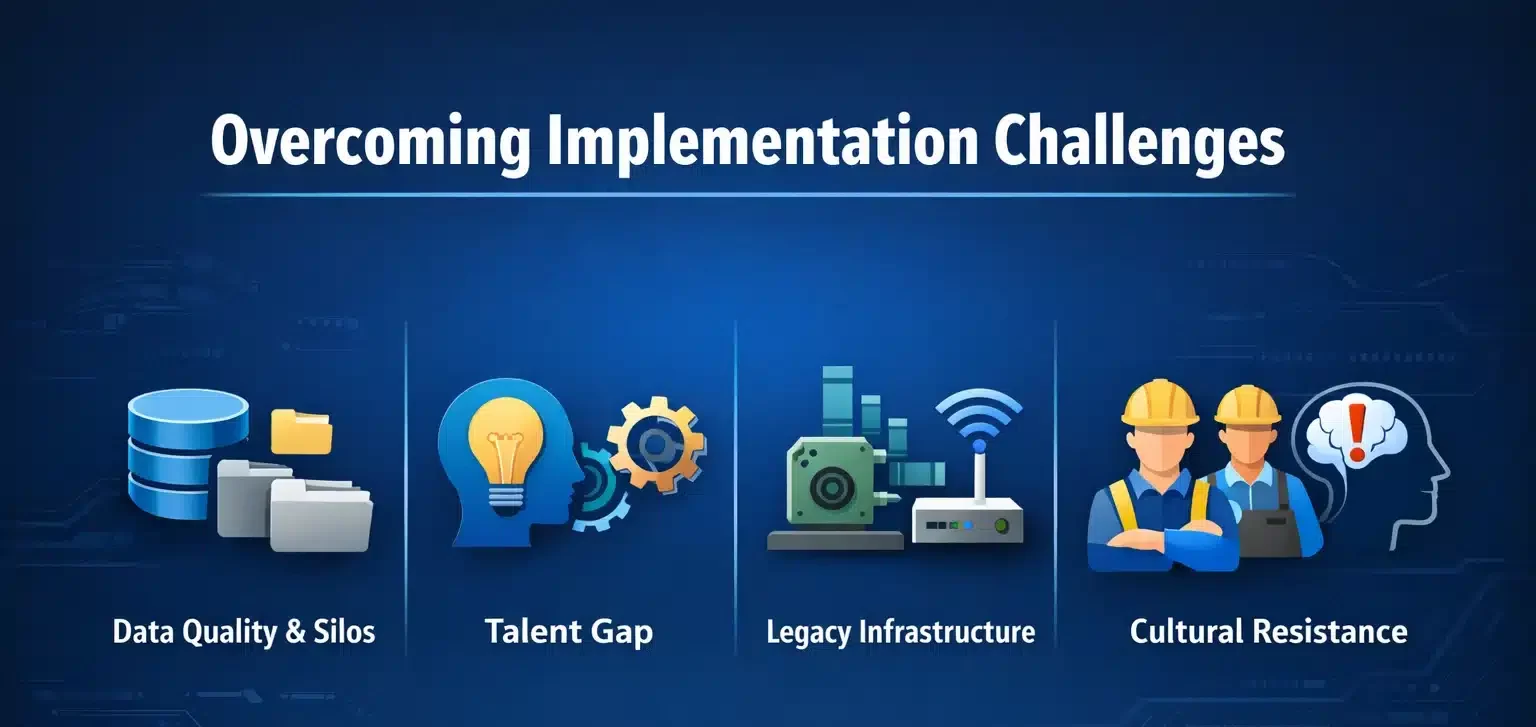
Despite the clear benefits, the path to AI adoption is fraught with challenges. Business leaders must navigate these hurdles to ensure a successful digital transformation.
1. Data quality and silos
AI is only as good as the data it is fed. Many manufacturers struggle with data silos, where information remains trapped in disconnected legacy systems such as ERP, MES, and SCADA.
Before deploying AI, companies must build a unified data architecture by cleaning data, standardizing formats, and ensuring different systems can communicate effectively.
2. The talent gap
There is a shortage of data scientists and AI engineers with manufacturing domain expertise. To overcome this, companies are adopting “low-code” or “no-code” AI platforms that allow process engineers to build models without deep programming knowledge.
3. Legacy infrastructure
Many factories run on equipment that is decades old. Retrofitting these machines with modern sensors and connectivity (IoT gateways) is often more cost-effective than replacing them.
This “brownfield” approach allows manufacturers to collect data from legacy machines and apply AI insights without major capital investment. It helps improve equipment visibility and support gradual digital transformation.
4. Cultural resistance
Technology implementation is often a human problem. Workers may fear job displacement or distrust algorithmic decision-making. Successful leaders address this by framing AI as a tool for augmentation, not replacement.
A Strategic Roadmap for AI Implementation
For organizations ready to embark on this journey, a structured approach reduces risk and accelerates value realization.
- Define the Business Problem: Do not adopt AI for the sake of novelty. Identify specific pain points, is it unplanned downtime, or inventory bloat? Define clear Key Performance Indicators (KPIs) for success.
- Assess Data Readiness: Audit your current data landscape. Do you have the necessary sensors? Is the data accessible? Establish a data governance framework to ensure quality and security.
- Start Small (Pilot Projects): Choose a specific use case with a high probability of success and manageable scope. For example, implement predictive maintenance on a single critical conveyor belt rather than the whole plant.
- Select the Right Partners: Few manufacturers can build AI solutions entirely in-house. Partner with in-store technology solutions vendors who understand the nuances of the manufacturing sector. Look for platforms that offer scalability.
- Scale and Integrate: Once the pilot proves value, scale the solution to similar assets. Integrate the AI insights into broader workflows; for instance, link the predictive maintenance alerts directly to the work order system in your ERP.
- Continuous Monitoring: AI models can drift over time as machinery ages or process conditions change. Establish a process for MLOps (Machine Learning Operations) to continuously monitor and retrain models to maintain accuracy.
Industry-Specific Use Cases
Different sectors within manufacturing apply AI in unique ways to address their specific challenges.
1. Automotive
The automotive industry is a pioneer in AI robotics. Beyond assembly, car manufacturers use AI for “lights-out” manufacturing, where sections of the factory operate autonomously. Additionally, AI analyzes telematics data from connected cars on the road to inform future design improvements.
2. Pharmaceuticals
In pharma, compliance and precision are paramount. AI is used to monitor batch processes in real-time, ensuring that temperature and chemical composition remain within strict regulatory limits. AI also accelerates drug discovery and optimizes the complex supply chain required.
3. Electronics and semiconductors
Semiconductor manufacturing involves nanometer-level precision. AI is critical for defect detection on wafers, identifying flaws that would ruin a chip early in the process. This prevents value-added work from being performed on defective units, saving significant costs.
4. Food and Beverage (FMCG)
For high-volume consumer goods, AI helps in waste reduction. Imaging systems analyze food products for size, color, and ripeness, sorting them automatically. AI also predicts consumer flavor trends, helping companies launch successful new products faster.
The Future Landscape: Manufacturing in 2026 and Beyond
Looking ahead, the role of AI in manufacturing will only deepen. We are moving toward the concept of the “Autonomous Factory,” where AI systems not only predict issues but autonomously execute the solutions, ordering parts and adjusting schedules.
Edge AI will become ubiquitous, with even the smallest sensors possessing onboard processing capabilities. This will reduce latency and bandwidth inventory storage expenses, enabling real-time decision-making in milliseconds.
Sustainability will also drive AI adoption. As carbon reporting becomes mandatory, AI will play a pivotal role in tracking and optimizing energy usage across the entire product lifecycle, helping manufacturers meet net-zero targets while reducing operational costs.
Sector-Specific Applications: Tailoring AI to Industry Needs
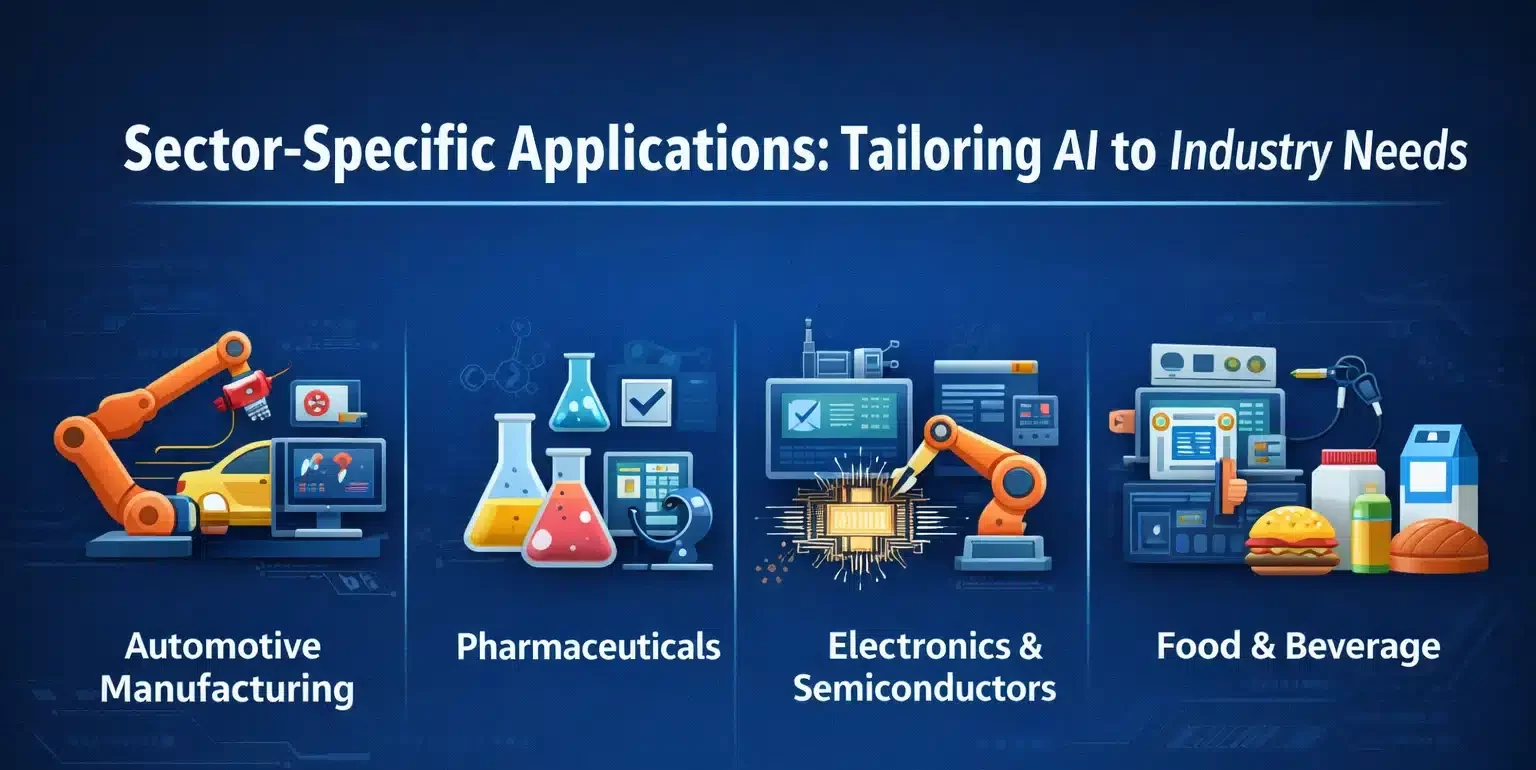
While the fundamental principles of AI apply across the board, the specific application of these technologies varies significantly depending on the manufacturing vertical. A “one-size-fits-all” approach rarely yields the highest return on investment.
1. Automotive manufacturing: precision at scale
In the automotive sector, where margins are tight and recall costs are astronomical, AI is primarily deployed for precision robotics and visual inspection. Modern assembly lines utilize “cobots” (collaborative robots) equipped with computer vision.
Furthermore, AI algorithms analyze paint jobs and chassis welds in real-time, detecting micron-level inconsistencies that a human inspector might miss due to fatigue, ensuring that every vehicle meeting the end of the line adheres to strict safety standards.
2. Pharmaceuticals: compliance and batch integrity
For pharmaceutical manufacturers, the priority is regulatory compliance and batch consistency. AI systems here are integrated directly into the ERP and production equipment to monitor chemical formulations in real-time.
By analyzing variables such as temperature, pressure, and mixing speeds against historical “golden batch” data, AI can predict if a batch is deviating from the standard before it is ruined.
3. Electronics and semiconductors: yield optimization
The semiconductor industry faces the challenge of extremely complex manufacturing processes where a single dust particle can destroy a chip. AI is utilized here for yield optimization.
Advanced machine learning models analyze data from hundreds of process steps to identify the root causes of yield drops. If a specific etching machine shows a drift in performance that correlates with higher defect rates three steps later in the process, the system flags it immediately.
4. Food and beverage: demand forecasting and safety
In the food and beverage industry, shelf-life is the critical constraint. Here, AI bridges the gap between manufacturing and distribution. By integrating ERP data with external signals, AI models can predict demand surges with high accuracy.
This allows manufacturers to adjust production schedules to prevent overproduction (spoilage) or underproduction (missed revenue). Additionally, visual AI systems are used to inspect food items for foreign objects or packaging defects at high speeds.
A Strategic Implementation Roadmap: From Pilot to Scale
Implementing AI is not a plug-and-play operation; it requires a structured approach to ensure that technology serves business goals rather than becoming an expensive experiment. Below is a phased implementation roadmap designed to mitigate risk and demonstrate value.
Phase 1: Data Sanitization and Infrastructure
Before deploying algorithms, manufacturers must ensure their data is accessible and clean. AI models trained on bad data will produce bad decisions.
- Action Step: Audit current data sources (sensors, ERP, MES). Eliminate data silos by integrating these systems into a unified data lake or a modern ERP with API capabilities.
- Key Metric: Data Completeness Ratio (percentage of assets effectively logging usable data).
Phase 2: The Targeted Pilot
Choose a specific, high-pain problem to solve, such as a machine with a high failure rate or a bottleneck in the quality assurance process. Do not attempt to overhaul the entire factory floor at once.
- Action Step: Deploy a predictive maintenance model on critical assets or a vision system on one production line. Run this in parallel with existing processes to validate accuracy.
- Key Metric: Model Accuracy Rate (percentage of correct predictions vs. false positives) and Pilot ROI.
Phase 3: Operational Scaling and Integration
Once the pilot proves value, scale the solution across similar assets and integrate the insights into daily workflows. The AI output should trigger automatic work orders in the Microsoft cloud ERP system.
- Action Step: Train operators on interpreting AI dashboards. Automate the link between AI detection (e.g., “bearing failure imminent”) and action (e.g., “schedule maintenance technician”).
- Key KPI: Overall Equipment Effectiveness (OEE). A successful AI implementation should directly improve availability, performance, or quality scores.
- Key KPI: Mean Time Before Failure (MTBF). AI should extend the operational life of machinery by preventing catastrophic breakdowns.
Navigating the Risks: Common Pitfalls and Mitigation Strategies
Despite the hype, many industrial AI projects stall. Understanding the common failure points allows leaders to navigate around them.
1. The “black box” problem
Pitfall: If operators and plant managers do not understand why an AI model is making a specific recommendation, they will ignore it. Trust is the currency of the factory floor.
Mitigation: Prioritize “Explainable AI” (XAI). Ensure the software vendor or internal data science team provides interfaces that show the contributing factors to a decision (e.g., “Vibration alert triggered because sensor A exceeded threshold by 15% for 10 minutes”).
2. Overlooking change management
Pitfall: Viewing AI as purely a technical challenge rather than a cultural one. Workers may fear that AI is intended to replace them, leading to resistance or sabotage of data inputs.
Mitigation: Frame AI as a “Co-pilot” or augmentation tool. Involve floor staff in the design phase. Show them how the technology eliminates tedious tasks (like manual data entry or visual sorting) and allows them to focus on higher-level problem solving.
3. Data droughts and quality issues
Pitfall: realizing too late that historical data is insufficient to train machine learning models.
Mitigation: If historical data is sparse, start with “unsupervised learning” models that detect anomalies without needing labeled history, or implement synthetic data generation to bootstrap the training process.
Advanced Best Practices: Digital Twins and Beyond
For organizations that have successfully implemented foundational AI, the next frontier involves the creation of Digital Twins. A Digital Twin is a virtual replica of the physical manufacturing process, updated in real-time with sensor data.
By applying AI to a Digital Twin, manufacturers can run simulations to test “what-if” scenarios without disrupting actual production. For example, a plant manager could simulate the impact of a 20% increase in raw material speed on the longevity of the conveyor belts.
The AI predicts the outcome based on physics and historical data, allowing for risk-free optimization. This convergence of simulation and artificial intelligence represents the pinnacle of modern manufacturing strategy, turning the factory floor into a constantly learning.
Conclusion
Artificial intelligence in manufacturing is no longer just an innovation trend; it is becoming essential for improving efficiency, quality, and operational visibility. AI helps manufacturers make faster decisions, reduce downtime, and adapt to changing production demands.
Successful adoption requires not only technology but also strong data management and a clear implementation strategy. Companies that combine digital intelligence with operational expertise can build more resilient and competitive production systems.
As manufacturing continues to evolve, exploring AI adoption can be a valuable next step. Consider starting with a free consultation to identify the most relevant opportunities for your operations.

Frequently Asked Questions
-
What are the main benefits of AI in manufacturing?
The primary benefits include reduced operational costs through predictive maintenance, improved product quality via computer vision inspection, enhanced safety for workers, and optimized supply chains that respond to demand in real-time.
-
How does predictive maintenance work?
Predictive maintenance uses AI algorithms to analyze data from sensors (vibration, temperature, etc.) on machinery. It identifies patterns that indicate potential failures before they happen, allowing maintenance to be scheduled only when necessary.
-
What is the difference between automation and AI in manufacturing?
Automation involves machines performing repetitive, pre-programmed tasks. AI involves machines using data to learn, adapt, and make decisions in real-time without being explicitly programmed for every scenario.
-
Is AI in manufacturing only for large enterprises?
No, while large enterprises were early adopters, cloud-based AI solutions and affordable sensors have made the technology accessible to Small and Medium-sized Enterprises (SMEs) looking to solve specific pain points like quality control or inventory management.