











In today’s hyper-connected and rapidly evolving global market, the concept of a resilient supply chain has transitioned from a theoretical ideal to an absolute necessity. Over the past few years, businesses worldwide have witnessed firsthand how fragile traditional logistics networks can be when faced with unprecedented disruptions. From global health crises and geopolitical tensions to natural disasters and sudden shifts in consumer demand, the vulnerabilities of highly optimized, lean supply networks have been exposed.
Modern strategy is shifting from simple cost-cutting to building long-term resilience. By moving from a reactive mindset to proactive foresight, businesses don’t just survive disruptions—they turn stability into a competitive edge, capturing new opportunities while others are still recovering.
Key Takeaways
|
Building a resilient supply chain requires more than just a shift in strategy; it demands the right technological foundation. Executing these pillars across a complex, global network is nearly impossible when relying on siloed data and manual spreadsheets. To achieve true end-to-end visibility and automate your operational agility, you need a centralized digital control tower.
What Is a Resilient Supply Chain and Why Does It Matter?
For a long time, businesses ran their supply chains as lean as possible. The idea was simple: order only what you need, keep stock low, and cut every unnecessary cost. This approach, known as Just-In-Time (JIT), worked well when everything ran smoothly.
But here is the problem. The moment something goes wrong, a shipment arrives late, a supplier shuts down, or orders suddenly spike, there is nothing to fall back on. No buffer. No backup plan. The whole operation stops.
A resilient supply chain is built differently. It accepts that disruptions will happen. Not if, but when. So instead of optimizing purely for efficiency, it also prepares for uncertainty. That means having backup suppliers, keeping some safety stock, and building systems that can flex when things do not go as planned.
Transitioning from a purely lean model to a resilient one requires a paradigm shift in corporate culture and strategic planning. It involves recognizing that efficiency and resilience are not mutually exclusive, but rather two sides of the same coin. While building resilience may require upfront investments in technology, diversified sourcing, and buffer inventory, these costs are ultimately dwarfed by the potential losses incurred during a major operational failure.
The Root Causes of Supply Chain Disruptions
To build a truly resilient network, you first need to understand the forces actively trying to destabilize it. Supply chain shocks come in various scales—some cause temporary delays, while others can bring global operations to a grinding halt. Identifying and categorizing these threats is the critical first step in turning operational vulnerability into a strategic advantage.
| Disruption Level | Threat Type | Examples / Causes | Impact & Strategic Mitigation |
|---|---|---|---|
| Macro-Level (Large-scale, systemic, beyond single-organization control) |
Natural Disasters & Extreme Weather | Earthquakes, hurricanes, floods, wildfires. | Devastates infrastructure and transport arteries. Expected to increase due to climate change. |
| Geopolitical Tensions & Trade Wars | Tariffs, embargoes, border closures, international conflicts. | Instantly disrupts the flow of goods. Highly dangerous for companies with single-region reliance. | |
| Global Health Crises | Pandemics and widespread disease outbreaks. | Causes labor shortages and plunging demand. Requires robust contingency plans and diversified footprints. | |
| Micro-Level (Localized, affecting specific nodes or suppliers) |
Supplier Bankruptcies & Failures | Critical supplier going out of business or failing quality standards. | Halts production lines entirely. Creates a single point of failure if sourcing is not diversified. |
| Transportation & Logistics Failures | Port congestion, driver shortages, vessel delays, labor strikes. | Impedes movement of goods. Requires deep visibility to reroute shipments flexibly. | |
| Cybersecurity Breaches | Ransomware, data breaches, system hacks. | Cripples automated processes and compromises data. Protecting digital infrastructure is now critical. |
Why Building a Resilient Supply Chain is Non-Negotiable
The imperative to build a resilient supply chain extends far beyond mere risk mitigation. In the modern business landscape, resilience is a fundamental driver of sustainable growth, customer loyalty, and long-term profitability. Organizations that fail to prioritize resilience are essentially gambling with their future, leaving themselves exposed to potentially ruinous consequences.
Protecting Financial Stability
Resilience directly safeguards your bottom line by minimizing the heavy costs associated with disruptions—such as expedited shipping, idle production, and lost sales. By maintaining steady cash flow and market share during crises, organizations protect their profit margins and long-term shareholder value
Enhancing Customer Satisfaction and Brand Reputation
Today’s customers expect fast, reliable delivery; when a supply chain falters and products disappear, trust is lost. Resilience ensures consistent availability even during a crisis, fostering the long-term loyalty and dependable reputation that sets you apart from less-prepared competitors.
Gaining a Competitive Advantage
Resilience is a powerful offensive tool, not just a defense. When disruptions hit, while competitors struggle, resilient companies adapt quickly to secure supplies and maintain service. This agility allows them to capture market share and solidify their leadership while others are still in recovery mode.
Facilitating Innovation and Growth
A resilient supply chain provides a stable foundation, freeing leaders from constant “firefighting” to focus on innovation and strategic expansion. This operational stability gives companies the confidence to experiment with new products and enter unfamiliar markets, knowing their underlying network can support ambitious growth.
Key Pillars of Supply Chain Resilience
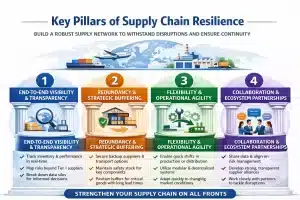
Constructing a resilient supply chain is a multifaceted endeavor that requires a holistic approach to network design, process execution, and relationship management. While the specific strategies will vary depending on the industry and organizational context, there are four foundational pillars that underpin every highly resilient supply network.
1. End-to-End Visibility and Transparency
True resilience depends on real-time visibility across your entire network, from raw materials to final delivery. By tracking inventory levels, monitoring performance, and mapping risks beyond Tier 1 suppliers, businesses break down data silos and shift from reactive firefighting to a proactive strategy that stops bottlenecks before they hit the bottom line.
2. Redundancy and Strategic Buffering
Resilience evolves the “lean” philosophy by adding strategic redundancy as a necessary shock absorber. Rather than simply bloating inventory, this involves intelligently positioning safety stock for critical, long-lead-time items and securing backup manufacturing or transport routes. By maintaining secondary supplier relationships, businesses create the breathing room needed to recover from sudden disruptions without triggering a total system failure.
3. Flexibility and Operational Agility
Flexibility is your supply chain’s physical capacity to adapt, while agility is the organizational speed to execute those changes. By adopting modular manufacturing to switch production lines on the fly and decentralized distribution to move inventory closer to customers, you eliminate the risk of relying on a single, vulnerable warehouse. This structural setup allows your business to pivot instantly, turning sudden obstacles into strategic opportunities.
4. Collaboration and Ecosystem Partnerships
True resilience is a team sport, no organization can survive in isolation. By sharing critical data, aligning goals, and developing joint risk management protocols with partners—including suppliers and even competitors—you create a unified front against disruptions. This transparent approach, such as sharing demand forecasts to mitigate the bullwhip effect, ensures faster problem-solving and smarter resource allocation for everyone in the network.
Strategic Frameworks to Build Supply Chain Resilience in Malaysia

Moving from theory to practice, Malaysian businesses need clear strategies to strengthen their supply chains. Here are the key approaches that are most relevant to today’s business landscape in Malaysia.
Supplier Diversification and Multi-Sourcing
Many Malaysian businesses, especially in the palm oil and manufacturing sectors, still rely heavily on a single supplier or a single country for their raw materials. When that one source gets disrupted, as seen with fertilizer suppliers from the Middle East in early 2026, everything stops.
Multi-sourcing means qualifying multiple suppliers for the same materials, ideally from different countries. Yes, it adds some administrative work. But for Malaysian businesses that import over 60% of their key raw materials, having backup suppliers is no longer optional. The cost of managing multiple suppliers is far smaller than the cost of a production halt.
Nearshoring, Reshoring, and Friendshoring
The decades-long trend of offshoring manufacturing to distant, low-cost regions is increasingly being reevaluated in light of recent global disruptions. Long, complex supply chains are inherently more vulnerable to transportation delays, geopolitical tensions, and communication breakdowns. As a result, many organizations are adopting strategies to bring production closer to their end markets.
- Reshoring: This involves bringing manufacturing operations back to the company’s home country. Reshoring reduces transit times, simplifies logistics, and provides greater control over production processes.
- Nearshoring: Nearshoring involves moving production to neighboring or geographically closer countries. This strategy offers many of the benefits of reshoring, such as shorter supply lines and reduced transportation costs, while often maintaining access to more cost-effective labor markets.
- Friendshoring: This emerging concept involves shifting supply chain networks to countries that are political and economic allies. Friendshoring aims to reduce exposure to geopolitical risks and trade disputes by building networks based on shared values and stable diplomatic relationships.
By shortening supply lines and regionalizing their operations, companies can significantly improve their responsiveness, reduce transportation-related risks, and enhance overall supply chain resilience.
Dynamic Inventory Optimization
The days of running purely on just-in-time inventory are becoming increasingly difficult for Malaysian distributors and manufacturers. With Red Sea disruptions adding 10 to 14 days to delivery timelines, relying on stock arriving exactly when needed is a significant risk.
Dynamic inventory management means adjusting stock levels based on real-time data, not fixed schedules. High-risk items get higher safety stock. Low-risk items stay lean. Malaysian businesses that implement a proper warehouse management system or supply chain software can automate this balancing act, reducing both stockouts and unnecessary holding costs.
Proactive Risk Management and Scenario Planning
Most Malaysian businesses only react when something goes wrong. A more resilient approach is to plan ahead by simulating what would happen if a key supplier stopped delivering, if a major port faced congestion, or if a new tariff suddenly increased import costs.
Running these scenarios does not need to be complex. Even a quarterly review of your top three supply chain risks, paired with a clear contingency plan for each, puts your business in a far stronger position than most competitors. The goal is to move from firefighting to forecasting.
Overcoming Common Logistics and Operational Challenges
The path to a resilient supply chain is fraught with practical challenges. Transforming theoretical strategies into operational reality requires navigating complex logistics networks, overcoming internal resistance to change, and aligning disparate systems and processes.
Addressing Transportation Bottlenecks
As the physical lifeblood of the supply chain, transportation is highly vulnerable to port congestion and volatile rates. Building a diversified portfolio such as mixing ocean, air, rail, and road that ensures you always have a fallback if one mode is compromised. By moving beyond spot markets to foster long-term relationships with multiple carriers, you gain the agility to reroute shipments and maintain flow even during a crisis.
Breaking Down Organizational Silos
Supply chain resilience fails when departments like procurement, finance, and logistics operate in isolation, leading to fragmented data and delayed decisions. By fostering cross-functional leadership and using integrated platforms, teams align on shared goals and strengthen the entire value chain. This unified approach replaces siloed efforts with a coordinated, rapid response that protects the business during disruptions.
Managing the Complexity of Global Networks
Expanding globally makes supply chains a maze of thousands of suppliers and complex regulations, often hiding risks and hurting quality. To stay on top, organizations need robust Supplier Relationship Management (SRM) and standardized processes across their entire network. By using clear performance metrics, regular audits, and digital platforms for data sharing, you can cut through the noise and build a more resilient, transparent global operation.
Optimizing Physical Operations for Maximum Resilience
While strategic planning and digital technologies are crucial, the physical execution of supply chain operations must also be optimized for resilience. This involves designing warehouses, distribution centers, and manufacturing facilities in a way that maximizes efficiency, flexibility, and responsiveness.
Intelligent Warehouse Design and Automation
Traditional, manual warehouses are too rigid to handle sudden volume surges or changing fulfillment needs. True resilience requires intelligent design and automation, utilizing modular storage, autonomous robots (AMRs), and advanced WMS to boost throughput while reducing vulnerability to labor shortages. This approach allows for the rapid reconfiguration of storage and picking areas, ensuring your operations can pivot instantly as inventory profiles and strategies evolve.
Leveraging Cross-Docking Strategies
To increase velocity and reduce holding times, companies are utilizing a cross-dock warehouse. By transferring incoming shipments directly to outbound vehicles with minimal storage, this method slashes handling costs and accelerates delivery—especially for perishables and fast-moving goods. Ultimately, streamlining these distribution nodes builds a more responsive and resilient supply chain.
Decentralized Distribution Networks
Relying on one massive hub creates a dangerous single point of failure—one local disaster or strike can paralyze your entire network. By transitioning to a decentralized network of strategically located centers, you get closer to your customers while building in vital redundancy. If one site goes down, others pick up the slack, ensuring continuous service despite the added operational complexity.
Implementation Steps for Building a Resilient Network
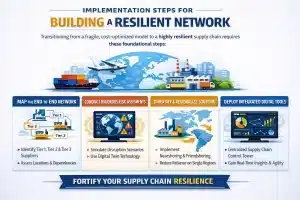
Transitioning from a fragile, cost-optimized model to a highly resilient supply chain requires a structured, deliberate approach. Organizations should follow these foundational implementation steps to fortify their networks:
- Map the End-to-End Network: True resilience begins with comprehensive visibility. Organizations must map out not just Tier 1 suppliers, but Tier 2 and Tier 3 vendors as well. Understanding the geographical locations, financial health, and dependencies of your entire supplier ecosystem is critical for identifying hidden vulnerabilities before they trigger a cascade of failures.
- Conduct Rigorous Risk Assessments: Regularly stress-test your supply chain against various disruption scenarios, such as natural disasters, port closures, or cyberattacks. Utilize digital twin technology—a virtual replica of your physical supply chain—to simulate these shocks and evaluate how your network would perform under extreme pressure.
- Diversify and Regionalize Sourcing: Move away from a single-point-of-failure sourcing strategy. Implement nearshoring or “friendshoring” tactics to bring critical manufacturing closer to the end consumer. This not only reduces transit times but also limits exposure to international trade disputes and transoceanic shipping delays.
- Deploy Integrated Digital Tools: Invest in a centralized supply chain control tower. By integrating data from ERP systems, supplier feeds, and external market signals, decision-makers gain real-time, actionable insights to pivot operations instantly when a disruption is detected.
Frequently Asked Questions About Supply Chain Resilience
-
How do you measure supply chain resilience?
Organizations measure resilience using specific risk metrics, most notably Time to Survive (TTS) and Time to Recover (TTR). TTS measures how long the supply chain can continue functioning without a disrupted node, while TTR measures the exact time required to restore full operational capacity. Tracking these KPIs helps quantify vulnerability.
-
What is the exact difference between supply chain resilience and agility?
While often used interchangeably, they are distinct. Agility is about speed—how quickly a company can react to short-term market changes, day-to-day fluctuations, or sudden customer demands. Resilience is a broader structural capability; it is the ability to anticipate, absorb, endure, and fully recover from severe, long-term systemic shocks.
-
How does Artificial Intelligence (AI) contribute to resilience?
AI and machine learning process massive global datasets to predict disruptions before they happen. Cognitive supply chains use AI to monitor external signals (like weather patterns or news of geopolitical shifts), automatically detect anomalies, and autonomously recommend alternative shipping routes or supplier switches in real-time.
-
Does building a resilient supply chain conflict with sustainability goals?
No, they actually complement each other. While resilience might require slightly more buffer stock, it heavily emphasizes reducing waste, optimizing transport routes for efficiency, and selecting ethical, stable suppliers. Sustainable, circular supply chain practices naturally reduce long-term operational risks.
-
What exactly is a Supply Chain Control Tower?
A supply chain control tower is a centralized, cloud-based digital dashboard that integrates data from your ERP, suppliers, and logistics partners. Instead of siloed data, it provides a single source of truth, offering end-to-end visibility so decision-makers can monitor global operations and execute coordinated responses from one screen.