







Are you still relying on outdated and manual methods to manage your warehouse inventory? Paper counts and disconnected spreadsheets can hide stock discrepancies, slow order processing, and weaken decision-making. Modern warehouse management needs real-time data, clear workflows, and systems that support accurate inventory control.
According to a study by Festejo and Pendon (2026), inventory accuracy received the lowest operational score among the Philippine warehouse respondents. The study also found a strong relationship between warehouse efficiency and operational performance, while technology utilization significantly predicted performance.
Modern businesses in the Philippines are staying competitive by using advanced cloud inventory systems. If you're serious about scaling your operations, it's time to adopt these best practices for 2026. Read on to discover how!
Key Takeaways
Warehouse inventory management tracks, stores, and controls stock to improve order accuracy, streamline logistics, and meet customer demand efficiently.
Its key processes cover receiving, storage, real-time tracking, picking and packing, shipping, replenishment, cycle counting, and reporting.
Best practices such as cycle counting, demand forecasting, organized layouts, and stock monitoring reduce waste, prevent stockouts, and improve warehouse efficiency.
What is Warehouse Inventory Management?

Warehouse inventory management is more than just storing goods. It covers the tracking, auditing, and control of stock at every stage. Using a modern inventory management system helps your business meet customer demands, reduce costs, and prevent stock issues before they happen.
The main goals are to keep the right stock levels, improve warehouse efficiency, and track inventory accurately. Businesses also aim to reduce obsolete stock and fulfill orders correctly to keep customers satisfied.
With real-time tools for forecasting and analysis, these systems streamline restocking and improve overall operations. A well-run inventory system strengthens omni-channel fulfillment, reduces waste, and keeps your business competitive in a fast-moving market.
Why Warehouse Inventory Management Makes or Breaks Your Operations
Warehouse inventory management keeps logistics running smoothly by improving order accuracy and helping teams pick, pack, and ship more reliably. When inventory data is reliable, daily workflows stay predictable, and customers receive the right items on time.
It also supports faster deliveries by using inventory aging to spot slow-moving stock and rebalance levels before items sit too long. Better forecasting and tighter storage control help businesses reduce waste, avoid overstocking or stockouts, and free up cash for growth.
Techniques for Warehouse Inventory Management
These techniques build on the concepts covered earlier in this guide. Each one targets a specific challenge in warehouse inventory management, from reducing holding costs to handling demand uncertainty. Use them together to improve stock rotation, prevent stockouts, and increase order accuracy.
| Technique | Description |
|---|---|
| ABC Analysis | Categorizing inventory into three groups: high-value (A), medium-value (B), and low-value (C) items. |
| Perpetual Inventory Management | Provides real-time updates on stock levels, allowing businesses to maintain accurate inventory counts. It prevents stockouts and overstock. |
| Economic Order Quantity (EOQ) | EOQ calculates the optimal order size to minimize total inventory costs and balance ordering and holding costs. |
| Safety Stock Inventory | Keeping extra stock as a buffer helps manage uncertainties like supply chain disruptions or unexpected demand spikes. |
| Batch Tracking | Monitors the movement of inventory batches, enabling efficient product recalls when necessary. |
| Dropshipping | Eliminating the need for storage and handling by shipping directly from suppliers to customers. |
| FIFO and LIFO | Manage stock rotation. FIFO (First In, First Out) is crucial for perishable items. LIFO (Last In, First Out) can be beneficial for tax purposes. |
| Just-in-Time Management | JIT focuses on receiving goods only when needed, minimizing holding costs, reducing waste, and improving cash flow. |
| Cross Docking | Goods are quickly transferred from incoming to outgoing trucks, bypassing storage. Minimizing warehouse time and cost. |
Effective warehouse inventory management is key to better operations and lower costs. Using these methods can boost your inventory accuracy and order fulfillment. Warehouse inventory management also helps your financial health.
Warehouse Inventory Management Processes
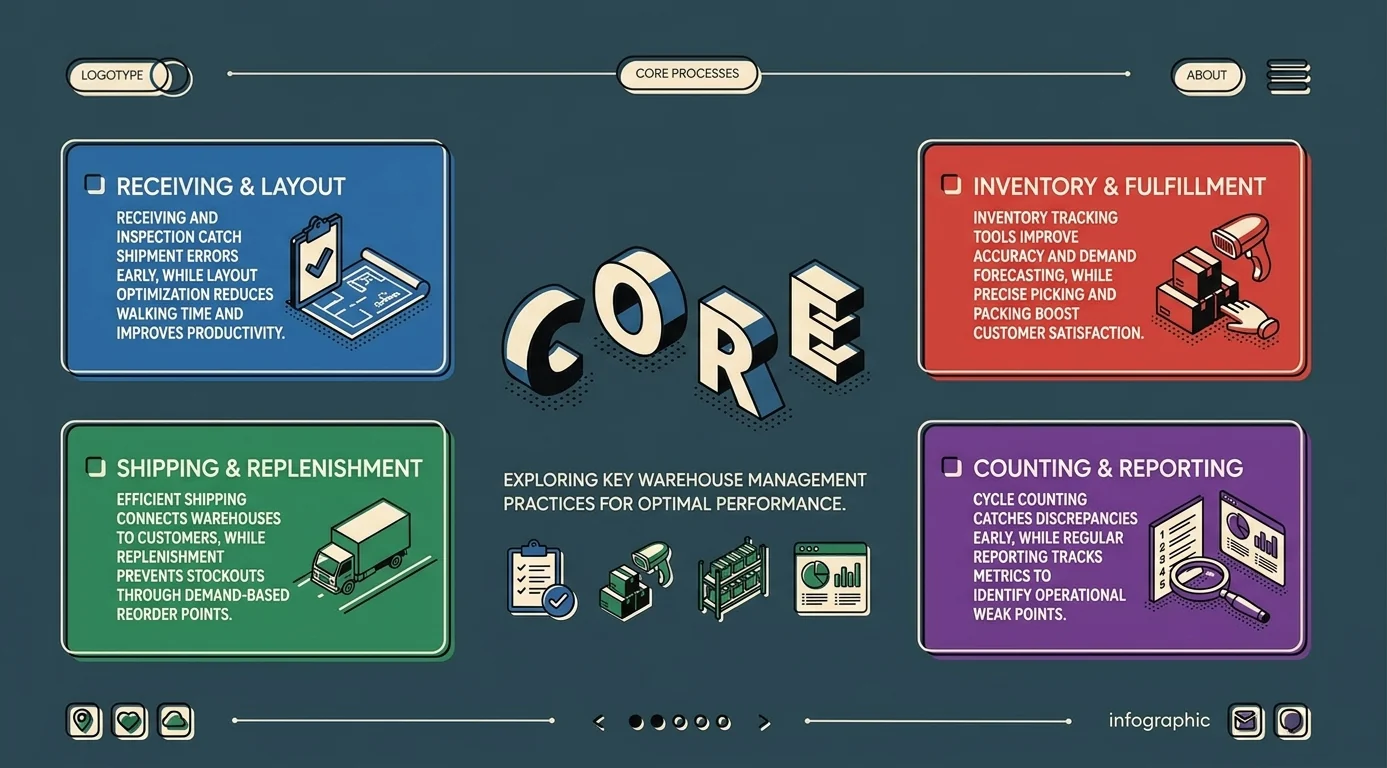
Effective warehouse inventory management is crucial for smooth operations and success in the Philippines. A well-managed warehouse boosts productivity and enhances customer satisfaction by ensuring timely and accurate service. Each process below connects to the next, so a weak step early on creates errors further down the line.
These are the 8 warehouse inventory processes you can follow:
1. Receiving and Inspection
Every warehouse cycle starts the moment goods arrive from your suppliers. Staff count each delivery against the purchase order, check condition and quality, then record the accepted quantities in the system. Catching a short shipment or damaged carton at this stage prevents inaccurate stock records later.
2. Warehouse Layout Optimization
A well-organized layout improves workflow by making goods easy to locate. Assign storage zones based on SKU, item size, weight, and how often each product moves. Use the ABC method to place frequently picked items in accessible spots reduces walking time and boosts productivity.
3. Warehouse Inventory Control Tracking and Recording
Accurate inventory tracking is essential for minimizing errors and improving demand forecasting. Tools like barcode scanners and RFID systems help ensure real-time, precise counts. Clear visibility into stock levels and locations also keeps your team from overselling items that are not actually available.
4. Picking and Packing
Precise picking and packing are vital for customer satisfaction. Strategies like zone picking, batch picking, and handheld scanners can speed up the process and increase accuracy. Packers then secure each order with the right materials so products survive transit without damage.
5. Shipping and Dispatch
Efficient shipping connects the warehouse to customers. Staff verify order contents, generate shipping labels, and coordinate pickup schedules with carriers. Advanced software helps manage carriers, track shipments, and ensure timely, accurate deliveries.
6. Inventory Replenishment
Replenishment keeps stock at the level your demand actually requires. Set reorder points using demand forecasts, supplier lead times, and a safety stock buffer for delays. Automating this step through your system prevents stockouts without tying up cash in excess inventory.
7. Cycle Counting and Inventory Audits
Counting a small group of items on a rotating schedule catches discrepancies before they grow. Full physical audits then reconcile your counted stock against system records at set intervals. Both practices reduce shrinkage and keep your inventory data trustworthy.
8. Reporting and Optimizing
Regular reporting provides insights into warehouse operations, allowing for continuous improvements and problem-solving. Track metrics such as order accuracy, picking speed, and stock turnover to spot weak points. This keeps operations efficient and cost-effective.
By prioritizing these key areas, your warehouse management will improve overall efficiency, reduce costs, and enhance customer satisfaction. Strong inventory control and optimized processes will help your business stay competitive and thrive in the Philippine market.
Managing all eight processes manually strains any growing team. Exploring the best warehouse management systems available in the market automates receiving, storage assignment, real-time tracking, picking, and replenishment in one platform. It cuts manual errors and keeps accurate stock records across every warehouse.
Challenges You Should Expect in Managing a Warehouse
These challenges often overlap and can quickly cause delays, higher costs, and lower order accuracy. Combine stronger processes with barcode scanning, real-time dashboards, and a WMS. This supports accurate inventory valuation, keeps stock data reliable, and keeps operations moving.
| Challenge | What It Means | Impact | Quick Fix | Example |
|---|---|---|---|---|
| Data Inaccuracy | Inventory records don’t match physical stock. | Wrong picks, stockouts, overstocking, and order delays. | Barcode/RFID scanning + cycle counts | Mobile scanning + cycle count schedule |
| Lack of Visibility | No real-time view of stock location and movement. | Slow decisions, bottlenecks, higher operating costs. | Real-time inventory dashboard | Live bin-level stock view |
| Warehouse Layout Issues | Poor slotting and inefficient storage flow. | Longer travel time, slower picking, higher labor spend. | Slotting (fast-movers near packing) | ABC slotting + route optimization |
| Manual Documentation | Paper forms and spreadsheets for daily tasks. | More errors, slower processing, weak traceability. | Digital workflows + mobile scanning | Receiving/putaway via handheld devices |
| Emerging Risks | Demand swings, shipping delays, labor shortages, hazmat handling. | Disruptions, compliance risk, service level drops. | Safety stock + backup plans | Reorder points + multi-carrier setup |
Best Practices for Warehouse Inventory Management

These eight warehouse inventory management practices can improve accuracy, reduce delays, and support faster fulfillment. They combine process discipline with modern technology. Use them to control stock levels, organize storage, reduce waste, and strengthen warehouse performance across every operating shift.
1. Minimize Manual Input
Reducing manual tasks lowers data-entry errors and improves inventory accuracy. Use barcode scanners, RFID systems, mobile devices, and methods like perpetual inventory to update stock records as transactions occur. This approach speeds up warehouse management and reduces repeated work.
2. Implement Cycle Counting
Cycle counting checks small inventory groups without interrupting daily operations. Schedule counts by product value, movement frequency, or risk level. Frequent checks help teams correct discrepancies early and avoid large variances during annual physical audits. Understanding cycle stock in inventory management also helps teams align replenishment with routine demand.
3. Ensure Popular Products Are Easy to Reach
Place high-demand products near packing and dispatch areas. This reduces walking time and helps employees pick orders faster. Review item movement regularly because demand changes can make yesterday’s best location inefficient.
4. Organize Your Floor Plan
An organized warehouse layout maximizes available space and supports smoother movement. Use vertical storage systems, shelving, or carousels when they fit your operation. Clear aisles and logical zones help employees locate goods quickly and reduce handling delays.
5. Utilize Demand Forecasting
Accurate demand forecasting helps maintain suitable stock levels. Analyze sales history, seasonal patterns, and lead times to prevent overstocking and stockouts. Combine forecasts with EOQ calculation to set order quantities and balance purchasing costs with storage needs.
6. Keep a Close Eye on Expiration Dates
Monitor expiration dates to reduce product waste and protect customer safety. Apply First In, First Out (FIFO) when older stock should move first. For regulated or perishable goods, combine FIFO with lot tracking and regular date checks.
7. Implement Quality Control
Quality control confirms that products meet required standards before shipment. Inspect incoming goods, damaged items, and picked orders at defined checkpoints. Clear quality benchmarks help prevent defective products from reaching customers and protect your brand reputation.
Food warehouses in the Philippines must also secure a local health and sanitary permit before operations begin, the LGU uses it to verify that your storage facility meets hygiene standards at the municipal or city level.
8. Train Your Staff
Well-trained employees support accurate and efficient warehouse operations. Provide regular training on inventory procedures, scanning tools, safety rules, and system updates. Confident staff use technology correctly, resolve exceptions faster, and maintain consistent warehouse management standards.
Consistent warehouse inventory management depends on accurate data, clear workflows, and tools that support every process. HashMicro’s Warehouse Management System helps your team centralize stock control, improve visibility, and scale operations with fewer manual tasks. Explore how it can support your warehouse goals.

How a Warehouse Management System Improves Inventory Accuracy and Efficiency
Good software improves warehouse management accuracy by centralizing stock data, warehouse tasks, and movement records. Real-time visibility helps teams pick orders correctly, reduce delays, and respond faster to inventory changes across receiving, storage, fulfillment, and shipping operations each day.
By applying these practices and using a comprehensive WMS, businesses can improve productivity, accuracy, and customer satisfaction. A just-in-time inventory management approach can also reduce excess stock when demand and supplier lead times remain predictable. Together, these methods support stronger warehouse performance and business growth.
Conclusion
Warehouse inventory management is essential for operational efficiency and customer satisfaction. Modern practices improve inventory accuracy and reduce costs. These practices include automated tracking, optimized layouts, cycle counting, and demand forecasting. They help businesses fulfill orders while keeping operations organized.
For businesses ready to improve warehouse management, HashMicro’s Warehouse Management System supports real-time tracking, organized workflows, and scalable operations. Its customizable tools help teams manage inventory accurately, reduce manual work, and adapt processes as business needs change.

FAQ About Warehouse Inventory Management
Inventory is managed by tracking stock levels, organizing layouts, and using systems like barcode scanners or WMS. Automation helps streamline processes, improving accuracy and reducing errors.
Effective management ensures the right stock is available to meet customer demands on time. It reduces costs, prevents stockouts, and boosts operational efficiency.
Warehouse inventory management oversees stock tracking, auditing, and optimizing storage for efficient operations. It ensures accurate orders, timely deliveries, and cost-effective processes.