




Last mile delivery, the final leg of a product’s journey from a distribution hub to the customer’s door is the most operationally complex and expensive phase of the supply chain. Despite covering a relatively short distance, it concentrates the greatest number of variables: traffic, failed deliveries, labor costs, and the customer’s direct experience of the brand.
For supply chain professionals, mastering this phase is both a cost management challenge and a customer experience imperative. Understanding how it works, what drives its costs, and how to optimize it is essential for building competitive, resilient logistics operations.
Key Takeaways
|
Table of Contents
What is Last Mile Delivery?
Last mile delivery refers to the final stage of the supply chain, the movement of goods from a distribution hub or fulfillment center to the end customer’s address. Despite its name, the “last mile” rarely measures exactly one mile; it represents the entire final leg of a product’s journey, from routing and dispatching to the physical handover of goods.
For businesses, this phase is simultaneously the most visible touchpoint for the customer and the most expensive segment of the logistics chain. Industry estimates consistently put last mile delivery at up to 53% of total shipping costs, a figure driven by the loss of economies of scale that make long-haul freight efficient.
The Evolution of Last Mile Delivery
The term ‘last mile’ originated in telecommunications, where it described the challenge of connecting individual homes to trunk network lines. The same dynamic applies to physical logistics: moving goods between major distribution hubs is efficient, but branching those shipments out to thousands of individual addresses introduces exponential complexity.
Historically, consumers completed the final mile themselves by visiting retail stores. The rise of mail-order catalogs in the late 19th century began shifting delivery responsibility to sellers, and the explosion of e-commerce in the late 1990s made direct-to-consumer delivery the standard expectation.
The ‘Amazon Effect’ accelerated this shift dramatically when two-day shipping became the baseline expectation, supply chains restructured around it. Warehouses moved closer to urban centers, networks decentralized, and individual parcel volumes surged. Today, omnichannel strategies routinely repurpose brick-and-mortar stores as micro-fulfillment hubs to support localized delivery.
Why Last Mile Delivery is the Most Critical Supply Chain Phase
The final mile carries disproportionate weight in determining whether a supply chain succeeds or fails. It sits at the intersection of cost management, operational efficiency, and the customer’s direct brand experience and weaknesses here cannot be offset by gains made elsewhere in the chain.
The Ultimate Driver of Customer Satisfaction
For the modern consumer, the delivery experience is the brand experience. They do not interact with the manufacturer, the freight carrier, or the warehouse, the delivery driver or the parcel on the doorstep is their only physical touchpoint. Studies consistently show that a significant share of consumers will abandon a brand entirely after a single poor delivery experience.
The Financial Impact on the Bottom Line
The financial stakes are equally significant. Industry estimates put the final mile at up to 53% of total shipping costs, a consequence of losing the economies of scale that make long-haul freight efficient. A long-haul truck moves thousands of items to a single hub; a local delivery van might spend an entire day dropping off a few dozen individual parcels.
Brand Differentiation in a Crowded Market
In highly commoditized markets where product quality and pricing are largely similar, delivery speed and reliability have emerged as primary competitive differentiators. Companies that can offer faster, more precise delivery windows such as specific one-hour time slots, gain a distinct advantage over competitors who only offer vague, multi-day delivery estimates. The ability to provide real-time tracking, proactive notifications, and flexible delivery options (like rerouting a package in transit) transforms the logistics operation from a backend cost center into a frontline sales and marketing asset.
The Core Mechanics: How the Final Mile Actually Works
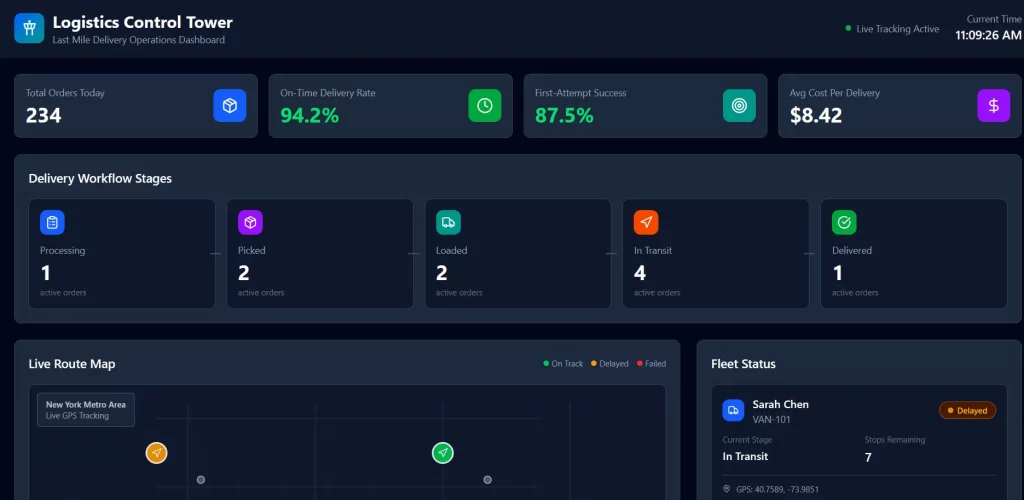
Executing thousands of deliveries daily requires a highly orchestrated sequence of events. While the exact processes can vary depending on the industry, the size of the operation, and the technological maturity of the logistics provider, the core mechanics of last mile delivery generally follow a standardized workflow.
1. Order Processing and Routing
The process begins the moment a customer clicks “buy.” The order management system processes the request and locates the inventory at the fulfillment center closest to the delivery destination. Advanced routing software then takes over, analyzing thousands of data points to determine the most efficient delivery sequence. This involves grouping orders by geographic proximity, calculating the optimal route based on historical traffic patterns, and assigning the route to the appropriate vehicle type and driver.
2. Warehouse Picking and Packing
Simultaneously, warehouse personnel or automated robotics systems pick the required items from the shelves. The items are packed into appropriate parcels, labeled with standardized barcodes or RFID tags, and sorted into specific staging areas based on their assigned delivery routes. Efficiency at this stage is critical; any delay in sorting directly impacts the time the delivery vehicles can leave the depot.
3. Loading and Dispatching
Once the parcels are sorted, they are loaded onto the delivery vehicles. The physical loading process is highly strategic. Packages are typically loaded in reverse order of the delivery sequence—meaning the last package to be delivered is loaded first, and the first package to be delivered is loaded last, closest to the doors. This “First-In, Last-Out” (FILO) methodology minimizes the time the driver spends searching for packages at each stop. Once loaded, the driver is dispatched with a digital manifest on their mobile device.
4. Transit and Real-Time Tracking
During the transit phase, the driver navigates the planned route. Modern telematics and GPS tracking systems continuously monitor the vehicle’s location, speed, and fuel consumption. This data is fed back to the central dispatch office and is often exposed to the end customer via a tracking link. If unexpected delays occur, such as a severe traffic accident or sudden road closure, dynamic routing algorithms can recalculate the driver’s path in real-time to mitigate the delay.
5. The Handover and Proof of Delivery (POD)
The final step is the actual handover of the goods. Depending on the delivery requirements, the driver may simply leave the package in a secure location, or they may need to obtain a physical or electronic signature. Proof of Delivery (POD) is captured via a handheld device, often accompanied by a photographic record of where the package was left. The moment the POD is submitted, the system updates the order status to “Delivered,” triggering an automated confirmation email or SMS to the customer.
Major Challenges in Last Mile Logistics

Despite significant advancements in technology and infrastructure, last mile delivery remains fraught with complex challenges. Logistics managers must constantly navigate a landscape of unpredictable variables that threaten to derail delivery schedules and inflate operational costs.
Urban Congestion and Route Density
One of the most persistent hurdles is navigating densely populated urban environments. Heavy traffic congestion, lack of available parking, narrow streets, and strict municipal regulations regarding commercial vehicles severely limit delivery speed. A delivery driver in a major metropolitan area might spend more time circling a block looking for a legal parking space than they do actually driving between stops. While high route density (many stops in a small area) is generally favorable for efficiency, the physical constraints of the urban landscape often negate these benefits.
The Friction of Rural Deliveries
Conversely, rural deliveries present the opposite problem: low route density. In rural areas, a driver may have to travel several miles between individual stops. This vast distance dramatically increases fuel consumption and labor costs per package. Furthermore, rural addresses are often poorly marked, and GPS mapping data can be inaccurate or outdated, leading to lost drivers and delayed deliveries.
Failed Deliveries and Customer Unavailability
A significant pain point in logistics is the failed delivery attempt. This occurs when an order requires a signature or a secure drop-off location, but the customer is not home. Failed deliveries are incredibly costly because they require the logistics provider to absorb the cost of the initial trip, store the package temporarily, and attempt a second or even third delivery on subsequent days. This not only doubles or triples the cost of fulfilling that specific order but also disrupts the routing schedules for the following days.
Porch Piracy and Package Theft
As e-commerce volumes have surged, so too has the phenomenon of “porch piracy.” Packages left unattended on doorsteps are highly vulnerable to theft. When a package is stolen, the retailer or the logistics provider is often forced to bear the cost of replacing the item and shipping it a second time. This not only erodes profit margins but also damages the customer’s trust in the delivery process, even if the logistics provider executed the delivery flawlessly.
Unpredictable Weather and Force Majeure
Supply chains operate in the physical world, making them highly susceptible to environmental factors. Severe snowstorms, hurricanes, floods, and even extreme heat can bring delivery operations to a grinding halt. While weather forecasting allows for some proactive planning, sudden localized weather events can render optimized routes useless, forcing dispatchers to scramble to ensure driver safety while managing customer expectations regarding delays.
Understanding the True Cost of Last Mile Delivery

To effectively manage and optimize the final leg of the supply chain, organizations must have a granular understanding of where their money is going. The costs associated with this phase are multifaceted and can quickly spiral out of control if not strictly monitored.
Labor and Driver Compensation
Human capital represents the single largest expense in last mile logistics. Unlike long-haul trucking, where a driver might drive for hours without stopping, local delivery is highly labor-intensive. Drivers are constantly starting and stopping the vehicle, walking to doorsteps, and interacting with customers. Furthermore, the logistics industry frequently faces acute driver shortages, which drives up wages, signing bonuses, and retention costs. Factoring in benefits, insurance, and overtime pay during peak seasons (like the holidays), labor costs require meticulous management.
Fuel and Energy Consumption
The start-and-stop nature of local delivery is inherently inefficient from a fuel consumption standpoint. Idling in traffic, accelerating from stoplights, and leaving the engine running while dropping off a package all contribute to massive fuel expenditures. For large fleets, even a minor fluctuation in global oil prices can have a multi-million dollar impact on the annual logistics budget. As fleets begin to transition to electric vehicles (EVs), the cost structure shifts from liquid fuel to electricity and charging infrastructure, which requires significant upfront capital expenditure.
Vehicle Acquisition and Maintenance
Maintaining a fleet of delivery vehicles is a constant financial drain. Delivery vans endure tremendous wear and tear due to the demanding nature of urban driving. Frequent brake replacements, tire rotations, suspension repairs, and engine maintenance are unavoidable. Additionally, as vehicles age, they become less fuel-efficient and more prone to breakdowns, necessitating a continuous cycle of fleet renewal and capital leasing.
Reverse Logistics (The Cost of Returns)
Often overlooked in the discussion of delivery costs is the massive expense of reverse logistics. E-commerce inherently carries a high return rate, particularly in apparel and electronics. When a customer initiates a return, the supply chain must run in reverse. The logistics provider must retrieve the item, transport it back to a processing center, inspect it, and restock it. This process is often more complex and costly than the initial outbound delivery, further straining the profitability of the final mile.
Key Strategies for Last Mile Optimization
Given the immense costs and challenges, logistics professionals employ a variety of strategic initiatives to optimize their delivery networks. The goal is always to maximize route density, minimize miles driven, and ensure a high rate of first-attempt delivery success.
Advanced Route Optimization and Dynamic Dispatching
Static routing where drivers follow the same predetermined path every day is entirely obsolete in modern B2C logistics. Today, optimization relies on solving complex algorithmic puzzles, akin to the classic “Traveling Salesman Problem.” Modern routing software utilizes artificial intelligence to calculate the most efficient sequence of stops, taking into account delivery time windows, vehicle capacity, driver shifts, and real-time traffic data. Dynamic dispatching takes this a step further by allowing dispatchers to inject new, expedited orders into a driver’s route while they are already on the road, recalculating the optimal path on the fly.
Micro-Fulfillment Centers (MFCs) and Dark Stores
To reduce the physical distance between the warehouse and the consumer, retailers are increasingly investing in micro-fulfillment centers. Instead of relying on massive, million-square-foot distribution centers located on the outskirts of major cities, businesses are utilizing smaller, highly automated facilities located directly within dense urban neighborhoods. Similarly, “dark stores”, retail locations that have been closed to the public and converted entirely into localized fulfillment hubs allow companies to offer ultra-fast, same-day delivery by drastically shortening the final transit distance.
Crowdsourced Delivery and the Gig Economy
To handle extreme fluctuations in order volume, particularly during peak holiday seasons, many logistics networks now rely on crowdsourced delivery models. Similar to ridesharing applications, these platforms allow independent contractors to use their personal vehicles to deliver packages. This model provides organizations with highly elastic capacity, allowing them to scale their delivery workforce up or down instantly without the fixed costs associated with purchasing new vehicles or hiring full-time employees.
Alternative Delivery Locations (BOPIS and PUDO)
To combat the inefficiencies of home delivery, retailers are heavily incentivizing alternative delivery methods. Buy Online, Pick Up In-Store (BOPIS) allows customers to secure their items digitally but handles the final mile themselves. Similarly, Pick-Up and Drop-Off (PUDO) networks utilize secure smart lockers or partnered local retail shops (like convenience stores or pharmacies) as centralized delivery hubs. By delivering fifty packages to a single locker bank instead of fifty individual homes, logistics providers achieve massive gains in efficiency and completely eliminate the risk of porch piracy and failed deliveries.
The Role of Technology in Transforming the Final Mile
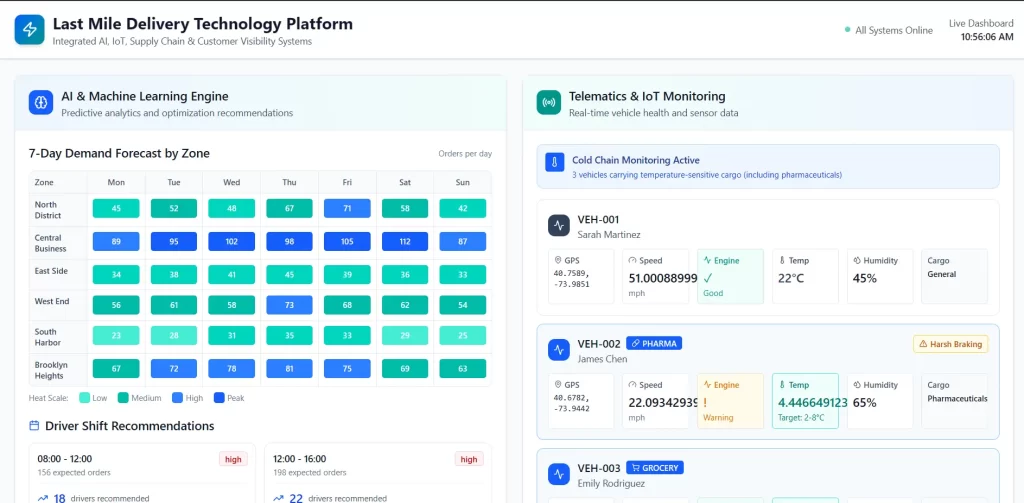
The modern supply chain is fundamentally driven by data. The physical movement of goods is now entirely dependent on the digital flow of information. Technology is the primary enabler of every optimization strategy currently deployed in the logistics industry.
Artificial Intelligence and Machine Learning
AI and Machine Learning are revolutionizing how logistics companies predict demand and allocate resources. By analyzing vast datasets of historical order volumes, weather patterns, and local events, ML algorithms can accurately predict where and when delivery spikes will occur. This predictive capability allows managers to proactively position inventory in regional hubs and schedule driver shifts ahead of time, ensuring that capacity meets demand without overspending on idle resources.
Telematics and Internet of Things (IoT)
Telematics systems installed in delivery vehicles provide a wealth of real-time data. These systems monitor everything from GPS location and vehicle speed to harsh braking, rapid acceleration, and engine diagnostics. This data is crucial for fleet managers to enforce safe driving behavior, reduce fuel consumption, and schedule preventative maintenance before a vehicle breaks down. Furthermore, IoT sensors placed inside the cargo area can monitor temperature and humidity, which is absolutely critical for the last mile delivery of pharmaceuticals, groceries, and other cold-chain perishables.
Centralized Supply Chain Platforms
Managing the data flows generated by modern delivery networks requires robust enterprise software. Comprehensive supply chain platforms provide the centralized visibility needed to coordinate order management, warehouse operations, and transportation from a single system — eliminating data silos and enabling logistics teams to make faster, more informed decisions in real time
Customer-Facing Interfaces and Visibility Tools
Technology has also transformed the customer experience. The days of providing a customer with a vague “delivery between 8 AM and 8 PM” window are gone. Modern logistics platforms utilize automated SMS and email notifications to provide customers with precise, narrowed delivery windows. Live map tracking allows the customer to see exactly where the driver is and how many stops remain before their delivery. This level of transparency dramatically reduces inbound customer service calls (WISMO – “Where Is My Order?”) and increases overall satisfaction.
Measuring Success: Essential Last Mile Delivery KPIs
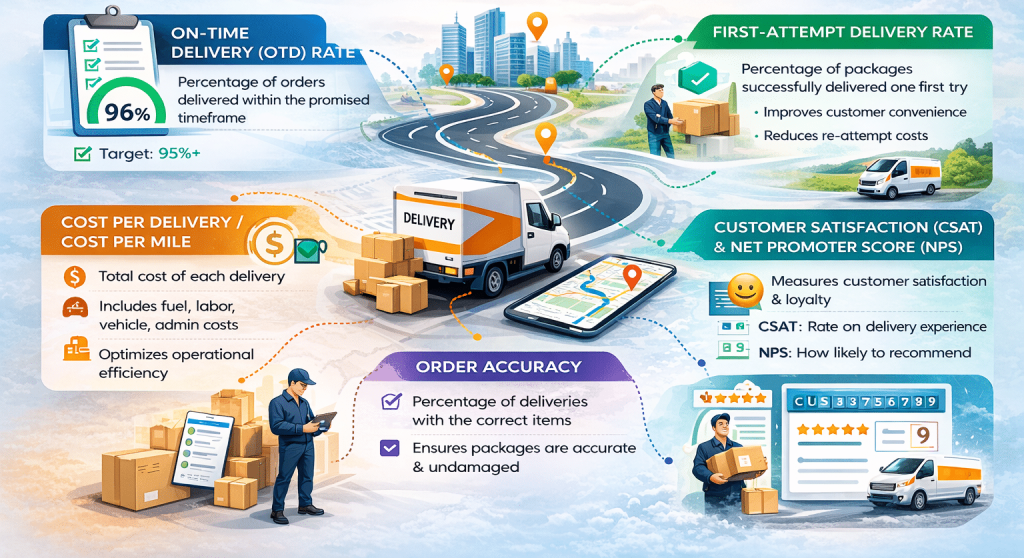
Continuous improvement in last mile operations depends on tracking the right metrics. Without objective performance data, it is impossible to identify bottlenecks, measure the impact of new investments, or set meaningful targets for delivery teams.
On-Time Delivery (OTD) Rate
The OTD rate is the foundational metric of delivery success. It measures the percentage of orders that are delivered to the customer within the promised timeframe. A consistently high OTD rate (typically targeting 95% or higher) is indicative of accurate routing, efficient warehouse operations, and reliable drivers. A dropping OTD rate is usually the first warning sign of systemic issues within the supply chain.
First-Attempt Delivery Rate
‘Failed delivery attempts are one of the most costly inefficiencies in last mile logistics. The First-Attempt Delivery Rate measures how often a package is successfully handed over or securely dropped off on the very first try. Improving this metric often involves better communication with the customer, offering flexible delivery time slots, and utilizing alternative delivery locations like smart lockers.
Cost Per Delivery / Cost Per Mile
Financial oversight requires tracking the exact cost of executing each delivery. The Cost Per Delivery takes into account fuel, labor, vehicle depreciation, and administrative overhead, divided by the total number of packages delivered. Monitoring this metric over time allows logistics managers to see if their optimization strategies (like increasing route density) are actually translating into bottom-line savings.
Customer Satisfaction (CSAT) and Net Promoter Score (NPS)
Operational efficiency means nothing if the end consumer is unhappy. CSAT and NPS surveys sent immediately after a delivery provide qualitative feedback on the driver’s professionalism, the condition of the package, and the accuracy of the tracking information. High customer satisfaction scores correlate directly with brand loyalty and repeat business.
Order Accuracy
Delivering a package on time is irrelevant if it is the wrong item. Order accuracy measures the percentage of deliveries that contain the exact items the customer ordered, without damage. While this metric is heavily dependent on the warehouse picking and packing phase, the final mile driver is ultimately the one who hands the incorrect package to the customer, making it a shared responsibility across the supply chain.
Industry-Specific Use Cases in Last Mile Delivery
While the fundamental mechanics of the final mile remain consistent, the application of these logistics varies wildly depending on the sector. Understanding these nuances is critical for businesses looking to tailor their supply chain strategies.
- E-commerce and Apparel: Here, the focus is heavily on brand experience, speed, and reverse logistics. Customers expect real-time tracking, branded packaging, and an effortless returns process. The ability to seamlessly loop reverse logistics into the forward delivery network is essential for customer retention.
- Healthcare and Pharmaceuticals: This sector prioritizes compliance, strict chain of custody, and temperature control. Cold chain logistics are vital to ensure life-saving medications, vaccines, and biologics reach patients and healthcare facilities on time and within strict regulatory guidelines.
- Food and Beverage: Grocery and meal delivery must balance ultra-fast, on-demand delivery windows with perishable inventory management. This industry relies heavily on localized micro-fulfillment centers and hyper-efficient dispatching to ensure goods remain fresh upon arrival.
Strategic Implementation Steps for Last Mile Optimization

Building or upgrading a last mile delivery network requires a methodical, data-driven approach. Organizations should follow a structured path to ensure seamless integration:
- Assess Current Capabilities: Begin by auditing your existing infrastructure, carrier contracts, delivery success rates, and cost-per-delivery metrics to identify specific bottlenecks.
- Deploy Advanced Technology: Implement a robust Transportation Management System (TMS) equipped with dynamic routing algorithms, automated dispatching, and real-time customer notification capabilities.
- Diversify Carrier Networks: Relying on a single national carrier is a recipe for disruption. Integrate regional carriers, local courier services, and crowdsourced delivery fleets to create a flexible, multi-carrier strategy that ensures delivery continuity even when one partner faces disruptions.
- Decentralize Inventory: Transition from relying solely on massive, centralized warehouses to establishing Micro-Fulfillment Centers (MFCs) or dark stores. Positioning high-velocity inventory closer to the end consumer dramatically reduces transit times and last mile delivery costs.
Conclusion
Last mile delivery is where the entire supply chain either wins or loses the customer. Getting it right means balancing cost efficiency with reliability and speed across urban and rural routes, through seasonal demand spikes, and with an increasingly high expectation of real-time visibility from the consumer side. The strategies, technologies, and metrics covered here form the operational foundation for any business looking to improve this phase.
For businesses evaluating how to strengthen their delivery operations, understanding which platforms and tools best support last mile execution is a practical starting point. A comparison of the leading logistics and supply chain management software available today can help teams identify solutions that fit their scale, route complexity, and operational requirements.
FAQ Around Last Mile Delivery
-
What is last mile delivery?
Last mile delivery is the final stage of the supply chain, the movement of goods from a distribution hub or fulfillment center to the end customer’s address. Despite covering a relatively short distance, it is the most complex and expensive phase of logistics, typically accounting for up to 53% of total shipping costs.
-
Why is last mile delivery so expensive?
Last mile delivery is expensive because it loses the economies of scale that make long-haul freight efficient. Instead of moving thousands of items to a single destination, a delivery driver makes dozens of individual stops, each requiring time, fuel, and labor. Urban congestion, failed delivery attempts, and the high cost of driver wages further drive up the per-package cost.
-
What are the biggest challenges in last mile delivery?
The most common challenges include urban traffic congestion, low route density in rural areas, failed delivery attempts when customers are unavailable, package theft (porch piracy), and weather disruptions. Each of these inflates costs or reduces the first-attempt delivery success rate, which is one of the most critical efficiency metrics in last mile logistics.
-
How can businesses improve their last mile delivery?
Key strategies include implementing advanced route optimization software, establishing micro-fulfillment centers closer to customers, offering BOPIS (Buy Online, Pick Up In-Store) and PUDO (Pick-Up and Drop-Off) alternatives, and tracking performance metrics such as on-time delivery rate and cost per delivery. Building strong, diversified carrier networks also reduces vulnerability to disruptions.