







Fellow entrepreneur! Have you ever felt frustrated by stock shortages, overstocking, or missed sales due to inventory errors? Not automating your inventory cycle can lead to these common problems, causing disruptions in operations, inaccurate data, and increased costs.
However, by taking control of your stock, you can prevent these costly issues. One effective way to do this is by doing an inventory cycle count. This strategic approach to managing stock efficiently without halting operations. By continuing to read this article, you will discover how this can elevate your business, so read on!
Key Takeaways
Regular cycle counts offer flexibility, early issue detection, and optimized stock management, enhancing overall operational performance.
To implement cycle count effectively, you need to make a robust system with clear priorities and roles.
Inventory software can automate the cycle counting process, provide real-time updates, and advanced reporting for better decision-making.
What is Inventory Cycle Count?

Cycle counting is a targeted process where a subset of inventory is counted on a scheduled day. This method allows Filipino businesses to regularly verify inventory accuracy without shutting down operations, unlike full physical inventories.
Cycle counts are scheduled throughout the year, ensuring that all items are verified multiple times. This process helps maintain accurate inventory records and enables quicker identification of discrepancies, which is crucial for meeting customer demands in the Philippines. Understanding cycle stock can also help businesses distinguish between inventory held to meet regular demand and stock that requires closer monitoring.
Through cycle counting, companies can enhance inventory management and improve stock data accuracy, supporting better financial reporting and decision-making, essential for long-term business success.
Advantages of Inventory Cycle Counting
Inventory cycle counts offer several key advantages that can significantly improve warehouse management and operational efficiency for Filipino businesses. By regularly implementing this method, businesses can maintain better control over their stock and processes.
Here are the main benefits of inventory counting:
- Non-Disruptive to Operations: Cycle counts verify stock without interrupting daily warehouse operations, ensuring productivity while maintaining accuracy.
- Greater Flexibility: Cycle counts offer flexibility in scheduling, aligning with your warehouse’s workflow, unlike traditional inventory audits that often disrupt operations.
- Increased Accuracy: Regular cycle counts identify and correct errors promptly, helping to maintain high levels of inventory accuracy over time.
- Early Detection of Issues: By conducting frequent cycle counts, businesses can detect problems like theft or misplacement early, allowing for immediate corrective actions.
- Better Data for Decision Making: Reliable data from regular cycle counts supports better forecasting, purchasing decisions, and overall inventory optimization.
This approach ultimately helps to optimize performance and boost profitability. Don’t forget that the Bureau of Internal Revenue (BIR) requires an inventory list submission. Ensure your receipts and invoices comply with the inventory list BIR regulations.
"Quality means doing it right when no one is looking."
Physical Count vs Cycle Count
To understand which stock-checking method fits your operations, you need to compare how physical count and cycle count work in practice. Although both help businesses verify inventory accuracy, they differ in frequency, operational impact, and long-term value for inventory control.
| Feature | Physical Count | Cycle Count |
|---|---|---|
| Frequency | Annually or semi-annually | Monthly or quarterly |
| Disruption | High; halts operations | Low; minimal disruption |
| Scope | Entire inventory | Specific parts of inventory |
| Accuracy | Snapshot: quickly outdated | Ongoing accuracy |
| Error Handling | Post-count corrections | Immediate corrections |
| Resource Allocation | More staff and time | Utilizes existing staff |
| Strategic Value | Infrequent insights | Continuous insights |
When businesses compare both methods, cycle counting often offers better day-to-day control, while physical counting works better for periodic verification and audit purposes. By choosing the right approach or combining both, companies can improve inventory accuracy, reduce errors, and maintain smoother warehouse operations.
Types of Inventory Cycle Count Methods
Various cycle count methods cater to different business needs, and Filipino businesses can benefit from choosing the one that best fits their operations. Here are some of the most common methods:
- Control Group Counting: Involves frequently counting a fixed set of items, helping to identify and address systemic errors in the inventory process.
- ABC Analysis: Categorizes inventory into classes (A, B, C) based on their value. High-value items (Class A) are counted more frequently to ensure accuracy.
- Random Sample Counting: Selects items at random for counting, providing an overall view of inventory accuracy without focusing on specific categories.
- Cycle Counting by Usage: Prioritizes items based on their usage rate, with frequently used stock being counted more often to prevent shortages.
- Hybrid Method: Combines elements of other methods to create a tailored approach that suits specific business requirements.
Choosing the right cycle count method helps businesses maintain accurate lean inventory, reduce errors, and optimize their stock management processes efficiently.
How to Implement Cycle Count Effectively

A cycle count helps businesses check inventory accuracy without shutting down warehouse operations. Instead of counting all items at once, your team reviews selected stock on a fixed schedule. This method keeps data cleaner, helps staff catch errors earlier, and supports better inventory decisions. When you apply the right cycle count process, you can improve stock visibility, reduce manual mistakes, and keep warehouse activities running smoothly.
1. Group Your Inventory by Priority
Start your cycle count process by grouping inventory based on value, movement, and risk. Count fast-moving, high-value, or frequently misplaced items more often because they create the biggest impact on stock accuracy. This step helps your team focus on the products that need the most attention instead of treating all inventory the same way.
2. Build a Realistic Cycle Count Schedule
Set a cycle count schedule that matches your warehouse activity and item volume. For example, count critical items every week, medium-priority stock every month, and low-risk items every quarter. A clear schedule keeps the process consistent and prevents your team from relying only on annual physical counts that often disrupt operations.
3. Assign Clear Roles to Your Team
A successful cycle count needs clear ownership. Assign staff to handle counting, checking, reviewing, and approving adjustments. When each person knows their role, the process becomes faster and more accurate. At the same time, create simple count rules so everyone records quantities the same way and handles damaged, missing, or misplaced stock correctly.
4. Count Actual Stock Before Checking the System
Ask your team to perform the cycle count by checking physical inventory first. Do not let them look at system records before they count the items. This approach gives you a more honest result and helps expose real gaps between actual stock and recorded stock. It also makes it easier to spot issues in receiving, picking, putaway, or data entry.
5. Compare Count Results with Inventory Records
After the cycle count, compare the physical quantity with the stock data in your inventory system. Record every variance clearly, whether it involves missing units, extra stock, or wrong item placement. This step turns a simple stock check into a useful inventory control activity because it shows where your process starts to break down.
6. Investigate the Cause of Every Discrepancy
Do not treat a cycle count discrepancy as just a number mismatch. Trace the issue back to the root cause. In many cases, the problem comes from receiving errors, wrong labeling, picking mistakes, supplier shortages, or poor shelf organization. When you investigate the cause, you fix the process behind the error instead of repeating the same correction later.
7. Update Records and Improve the Workflow
Once your team confirms the result of the cycle count, update the inventory records and improve the workflow where needed. You may need to tighten receiving checks, improve bin labeling, or adjust storage procedures. These small fixes strengthen stock accuracy over time and help your warehouse run with fewer interruptions and less rework.
8. Review Cycle Count Results Regularly
Track your cycle count results over time and look for repeated error patterns. If the same item, location, or process keeps causing problems, address it immediately. Regular review helps your business maintain accurate stock data, improve warehouse discipline, and make faster decisions based on reliable inventory information.
Best Practices for Inventory Cycle Count
To ensure a successful implementation of inventory cycle counting, Filipino businesses should follow these best practices to optimize their inventory management. Here are the key practices to consider:
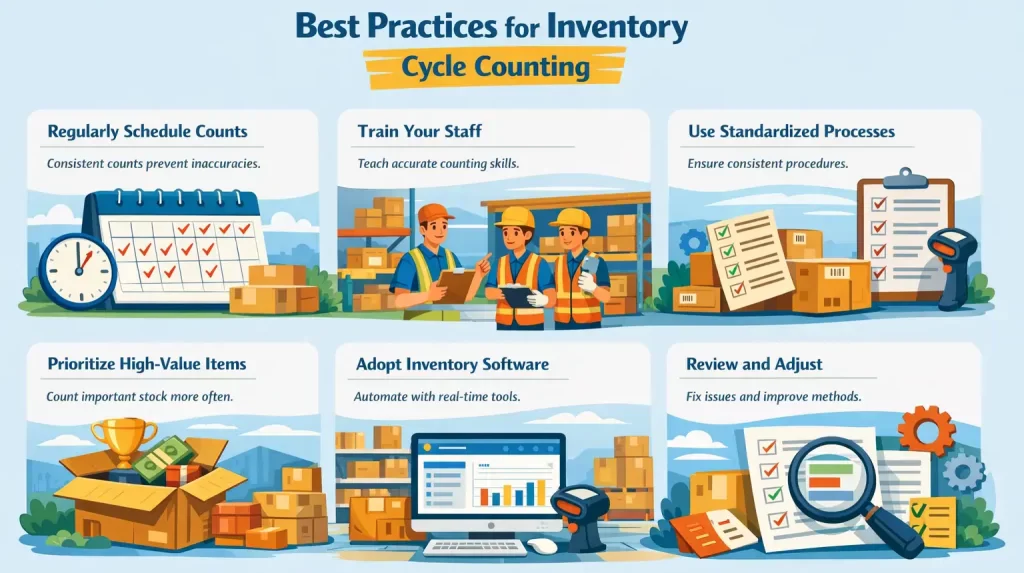
- Regularly Schedule Counts: Maintain a consistent schedule for cycle counting to prevent inaccuracies and ensure up-to-date inventory reports.
- Train Your Staff: Well-trained staff is crucial for maintaining accuracy and identifying discrepancies in the counting process.
- Use Standardized Processes: Implementing standardized forms and procedures ensures consistency and reliability in data collection.
- Prioritize High-Value Items: High-value or fast-moving items should be counted more frequently to avoid potential shortages or inaccuracies.
- Adopt Inventory Management Software: Automate the process with advanced software to provide real-time updates and minimize manual errors.
- Review and Adjust: Regularly evaluate the counting process to address any recurring discrepancies and improve efficiency.
By following these best practices and implementing other related software, businesses can maintain accurate inventory records, enhance operational efficiency, and make informed decisions that benefit their bottom line.
How Inventory Management Software Supports Inventory Cycle Counting
Inventory management software helps businesses automate cycle counting and improve stock accuracy without disrupting daily operations. Instead of relying on manual checks alone, companies can use digital tools to track stock movement, schedule routine counts, and detect discrepancies faster. This approach helps warehouse teams maintain cleaner records, reduce counting errors, and support more consistent inventory control.
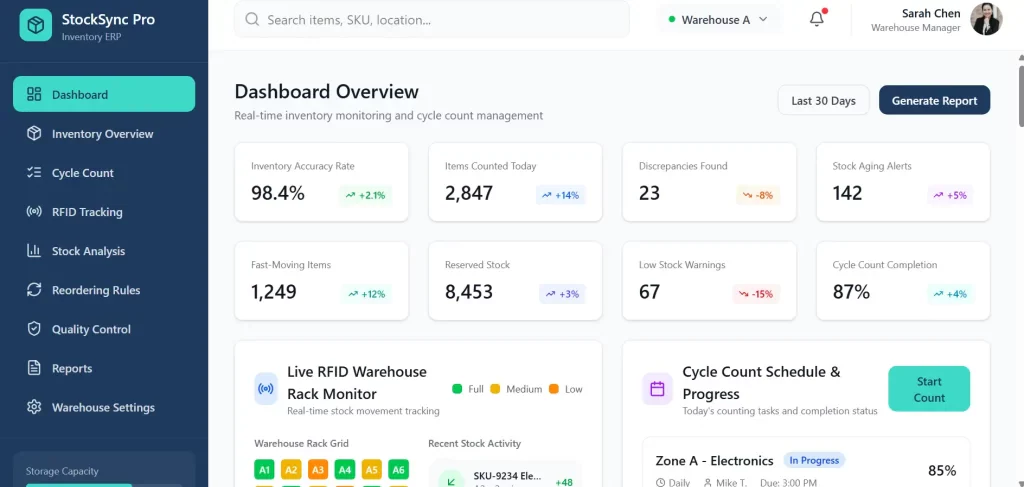
Here are some features that support a more effective cycle count process:
- RFID warehouse rack stock in-out automation: Tracks stock movement in real time, making it easier to perform cycle counts without stopping warehouse activity.
- Packaging management and fast-moving slow-moving stock analysis: Helps teams group items by packaging type and movement speed, so they can prioritize which stock to count more often.
- Run rate reordering rules and stock reservations reporting: Supports better count scheduling and stock planning based on usage patterns and operational needs.
- Quality control management and error detection: Identifies stock discrepancies, damaged items, and counting issues early, allowing teams to take corrective action faster.
- Advanced reporting and stock aging analysis: Gives businesses better visibility into inventory condition, count history, and aging stock for more informed decisions.
With these capabilities, inventory management software makes the cycle count process more structured, accurate, and efficient. As a result, businesses can improve stock visibility, reduce manual workload, and maintain better control over inventory across day-to-day operations.
Conclusion
Inventory discrepancies can be a significant challenge for Filipino businesses, but adopting cycle counting offers an effective solution. By using this method, businesses improve inventory accuracy, optimize operations, and make better decisions.
As inventory becomes more complex, businesses need more than manual checks to keep cycle counts accurate and efficient. That is why many companies now use top ERP systems to automate stock tracking, flag variances faster, and support better inventory cycle control across daily operations.
Frequently Asked Questions
Cycle count is a stock management method that regularly counts a portion of inventory, avoiding the need for a full shutdown. This approach ensures continuous accuracy. Moreover, it assists businesses in maintaining current inventory records and promoting seamless operations.
Cycle counts should be tailored to business needs, occurring typically monthly or quarterly. High-value or frequently used items might need more frequent assessments. This strategy preserves accuracy and boosts inventory management effectiveness.
Cycle counts are highly accurate when performed regularly and systematically. They provide more consistent inventory accuracy compared to annual physical counts, as errors are identified and corrected promptly.
The 80/20 rule for cycle counting means businesses focus most of their counting effort on the small group of items that create the biggest inventory impact. In many cases, around 20% of stock items account for 80% of inventory value, movement, or risk. Companies usually count these high-priority items more often to improve accuracy and reduce costly errors.>
You calculate cycle count by comparing the physical quantity of selected items with the quantity recorded in your inventory system. After that, you measure the variance to see whether the stock matches. A common formula is: >Cycle Count Accuracy = (Number of items with no variance / Total items counted) × 100. This helps businesses track how accurate their inventory records are over time.>