













Without a unit of measure, a business won’t be able to track, buy, store, and sell its physical goods. Whether a company is dealing with raw materials measured in metric tons or finished consumer electronics counted by the unit, establishing a standardized system for quantifying stock is essential.
Supply chains would quickly descend into chaos without a clear and universally understood measurement framework, leading to significant financial discrepancies, severe stockouts, and strained vendor relationships. For that reason, it is necessary to not only understand but also know how to properly configure and manage these measurement standards, which you will learn below.
Table of Contents
Key Takeaways
|
What is the Unit of Measure in Inventory Management?
A standardized single unit is always needed for transactions, from ancient agrarian societies to the contemporary globalized supply chain. A unit of measure (UoM) gives inventory numbers meaning by defining how businesses count, track, and value stock. Instead of leaving quantities vague, it tells teams whether they handle pieces, kilograms, boxes, or pallets. This standard helps businesses make accurate decisions in purchasing, storage, production, and sales.
UoMs do more than label stock; they tell teams how to allocate space, calculate carrying costs, and pick the right quantity without costly errors. While many businesses follow SI or Imperial standards, they often create custom units, such as a box of 12 or a display case, to match real packaging needs. That is why clear UoM definitions act as the core language of inventory control from the very beginning.
Why Accurate Units of Measure Are Critical for Business Operations

Accurate inventory measurement units are an integral part of a business’s operations. When measurement units are misaligned, the consequences ripple outward, affecting procurement, accounting, warehouse efficiency, and ultimately, customer satisfaction. Understanding why accuracy is critical helps organizations prioritize data governance in their inventory systems.
1. Financial Accuracy and Valuation
Inventory often represents a company’s largest asset. Accurate units of measure are needed to protect financial valuation. For example, if a company buys industrial lubricant at $50 per gallon but records it as liters without adjusting the cost, it inflates inventory value, distorts COGS, misguides pricing, and creates audit issues. Accurate measurement ensures that the cost of goods sold (COGS) is calculated correctly, preserving profit margins.
2. Preventing Stockouts and Overstocking
Accurate units of measure keep supply chain planning on track. For example, if a manager orders 100 cases expecting 50 units per case, but the supplier now packs only 20, the business faces shortages, delays, and missed orders. Clear definitions also help prevent overstocking and wasted warehouse space.
3. Operational Efficiency in the Warehouse
Warehouse operations like receiving, putaway, picking, and packing are highly sensitive to measurement errors. When receiving teams must convert 10 pallets into individual pieces, they slow operations and increase error risk as the staff must manually calculate the conversion. Clear units of measure help warehouses run faster and avoid costly mistakes. During picking, clear labels such as pack, case, or piece guide workers accurately, reduce miss-picks, and improve productivity.
4. Maintaining Customer Trust and Satisfaction
Customers in the age of e-commerce, both in B2B and B2C commerce alike, expect exactly what they ordered. Accurate units of measurement are a necessity to help businesses meet customer expectations and protect trust. If a buyer orders one box of screws expecting 1,000 pieces but receives only 100 after an internal UoM change, the supplier risks returns and complaints. Clear measurements reduce confusion, lower service issues, and strengthen loyalty.
Common Types of UoM Used Across Supply Chains
Because inventory encompasses an infinite variety of physical goods, how we measure them is equally diverse. However, most inventory units can be categorized into several broad types based on their physical properties and how they are handled in commerce. Understanding these categories is essential for setting up a logical and scalable inventory database.

- Count of Quantity-based Units is the most common type of measurement in retail and discrete manufacturing. These units represent individual, distinct items or specific groupings of items, meaning they cannot logically be divided into fractions (e.g., you cannot sell half of a television).
- Weight or Mass-based Units are for raw materials, agricultural products, chemicals, and bulk foods, where counting individual pieces is impractical or even impossible. Instead, these items are tracked by their mass. Weight-based units are continuous, meaning they can be divided into infinitely smaller fractions (e.g., 1.5 kilograms)
- Volume or Capacity-based Units are used to measure the amount of space a liquid, gases, and some flowable dry goods occupy. Like weight, volume is a continuous measurement and requires precise tracking of decimal quantities, especially in process manufacturing and the food and beverage industry.
- Length, Area, and Dimensional Units are used to measure materials such as textiles, construction materials, and cabling. They require a linear or area measurement as they are sold based on it.
The Complex Journey of UoM Through the Supply Chain
Managing inventory becomes challenging because a product often changes units of measure throughout its lifecycle. Businesses may buy it from suppliers in bulk, store it differently in warehouses, use it in production under another unit, and sell it in a new form. This shift demands strong coordination across functions.
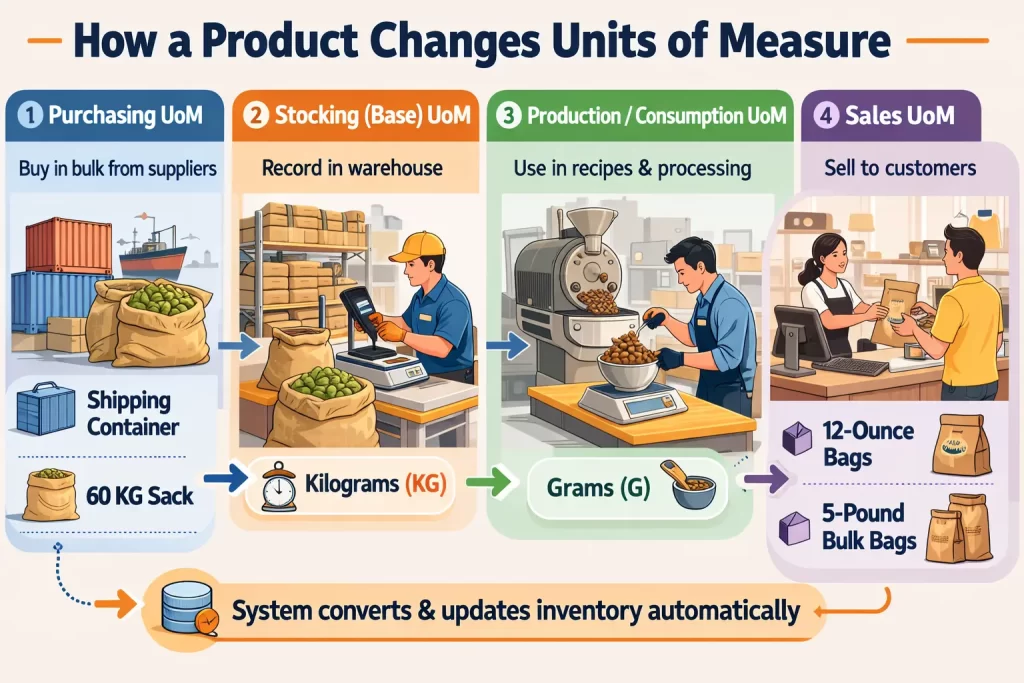
- The Purchasing Unit of Measure starts in procurement, where suppliers sell goods in bulk to improve shipping efficiency and profitability. In the coffee roaster example, the purchasing team orders green coffee beans by shipping container or 60 KG burlap sack, then uses those bulk units to negotiate prices, calculate freight, and create purchase orders.
- The Stocking (or Base) Unit of Measure helps the warehouse manage inventory with more precision in daily operations. Instead of tracking coffee by sack, the team converts it into kilograms so they can manage partial usage more accurately, run cycle counts, and maintain clear inventory valuation.
- The Production or Consumption Unit of Measure gives the production team the precision they need to maintain consistency and quality. In this example, the roasting process measures beans in grams rather than kilograms, so the inventory system deducts grams accurately while keeping the main stock count aligned in kilograms.
- The Sales Unit of Measure shows how the business packages and sells the finished product to different customer groups. The coffee roaster may offer 12-ounce bags to retail buyers and 5-pound bulk bags to cafes, while the system connects every sale back to the base stocking unit and keeps inventory levels accurate in real time.
This journey illustrates why a rigid, one-size-fits-all approach to measurement is destined to fail. Businesses must build flexibility into their item master data, allowing a single product to have multiple, mathematically linked units of measure depending on which department is interacting with it.
Best Practices for Setting Up and Managing Inventory UoM

Establishing a flawless measurement framework requires discipline, foresight, and strict data governance. Because measurement units are deeply embedded in historical data, changing them after the fact can be a monumental and risky task. Therefore, getting it right from the beginning is paramount. Here are the definitive best practices for managing your inventory units.
1. Conduct a Comprehensive Inventory Audit
Begin by cataloging how every item is currently bought, stored, and sold. Map each product’s unit of measure at every stage, then compare purchasing units with stocking and sales units to find mismatches. This audit helps you uncover conversion issues, reduce stock errors, and build a more accurate inventory structure before you make system changes.
2. Establish Strict Naming Conventions and Abbreviations
Inventory accuracy depends on clear and consistent unit labels. If employees enter PC, PCS, and PCE for the same item, the system treats them as different units and creates reporting errors. Companies should build a master unit dictionary, enforce exact abbreviations through drop-down menus, and align standards with international norms for smoother global trade.
3. Define the Smallest Trackable Unit as the Base Unit
A golden rule of inventory configuration is to set the base or stocking unit as the smallest unit you need to track or consume. This setup lets the system multiply quantities more accurately and avoids fractional deductions. For example, if you buy pens by the box but sell them individually, using “Each” (a box of 100 pens is measured as 1 x 100) as the base unit prevents rounding errors.
4. Avoid Duplication and Redundancy
Keep your UoM list lean by using broad unit labels and setting exact conversion factors at the item level. Instead of creating separate units like “Box of 10” and “Box of 12,” use “Box” once. For example, a box of nails may contain 500 pieces, while a box of hammers holds 5. This method keeps your database clean and manageable.
5. Implement Rigorous Data Governance for New Items
Treat new item creation in the inventory system as a controlled process, not a routine task. Companies should use a formal approval workflow and assign the task to someone who understands how the item will be purchased, stored, and sold. That person must define the base unit and conversion factors accurately, while regular audits help catch and fix data issues early.
6. Train Staff Comprehensively
Even the most perfectly configured database is useless if the human operators do not understand it. Warehouse staff, purchasing agents, and sales representatives must be thoroughly trained on the company’s measurement standards. A picker needs to know exactly what a “Case” looks like physically compared to an “Inner Pack.” Visual aids in the warehouse, clear labeling on shelves, and barcode scanning systems can drastically reduce human error related to unit confusion.
The Role of Base Units vs. Multiple Units of Measure
Understanding the mathematical relationship between the base unit and multiple alternative units is required to have mastery of inventory tracking. It is a relationship that is governed by conversion factors, the multipliers or divisors that allow a system to translate one unit into another seamlessly.
The Base Unit of Measure serves as the core tracking metric for each item and acts as the anchor for inventory valuation, ledger entries, and stock control. On top of that, Multiple Units of Measure support different business processes by linking every alternative unit back to the base unit through fixed and precise conversion factors that keep inventory data accurate and consistent.
Consider a pharmaceutical company; it may use milliliters (ML) as its base unit to track liquid medicine precisely, then build larger units such as 1 vial = 50 ML, 1 box = 20 vials = 1,000 ML, and 1 pallet = 100 boxes = 100,000 ML. When the team orders 2 pallets, the system records 200,000 ML, while a sale of 5 boxes deducts 5,000 ML and keeps the inventory accurate.
Common Pitfalls in UoM Configuration
Managing measurement units is fraught with potential pitfalls. Mistakes in this area are notoriously difficult to untangle because they embed themselves into historical transaction records, accounting ledgers, and forecasting algorithms. Being aware of these common challenges is the best defense against them.
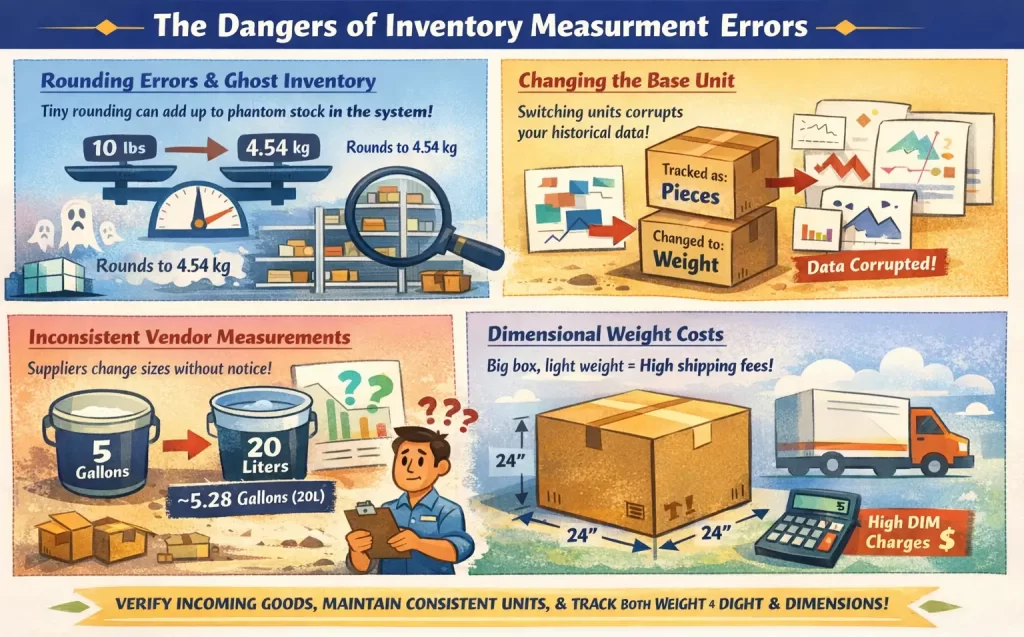
- The Danger of Decimal Precision and Rounding Errors can create ghost inventory when systems round converted units too aggressively. For example, converting 10 pounds into 4.53592 kilograms and rounding it to 4.54 may seem harmless, but repeated transactions turn small gaps into major stock inaccuracies. Companies should use high decimal precision in background calculations to reduce this risk.
- Changing the Base Unit After Transactions Have Occurred can break historical data and damage inventory accuracy. When a company switches an item from pieces to weight after recording purchases, sales, and stock movements, it corrupts cost analysis, sales trends, and valuation records. Instead of changing the old item, companies should create a new item code and transfer stock carefully.
- Inconsistent Vendor Measurements can disrupt inventory records when suppliers change packaging without notice. For example, a supplier may replace a 5-gallon chemical bucket with a 20-liter bucket while keeping the same SKU. This change makes internal conversion factors inaccurate, so receiving teams must verify incoming goods against expected measurements.
- Dimensional Weight and Logistics Complications can raise freight costs when businesses track only actual weight and ignore package size. Carriers charge based on the space a shipment occupies, so a light but bulky box can cost far more to ship than expected. Companies need to track both weight and dimensions to protect their margins.
How Modern ERP Systems Handle Complex UoM Conversions
A modern Enterprise Resource Planning (ERP) system has become a requirement for any business that needs to handle the mathematical complexity and the sheer volume of data involved in tracking multiple units across thousands of SKUs. ERPs are designed to act as the central nervous system of a business, integrating procurement, warehouse management, manufacturing, and sales into a single cohesive platform.
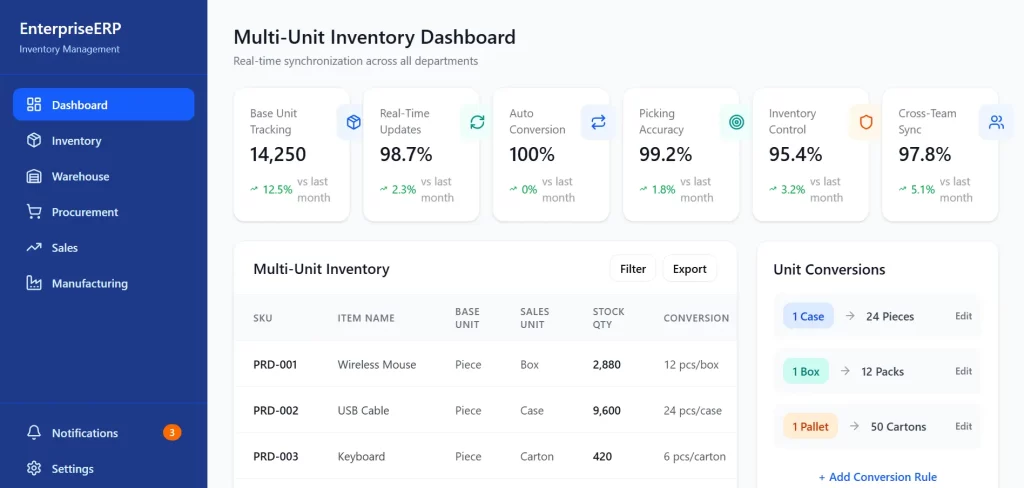
Advanced ERP software manages measurement complexity by using a base unit and a linked conversion table. When teams create sales orders in cases, boxes, or packs, the system converts quantities instantly and updates inventory in real time. This process keeps sales, warehouse, and inventory teams aligned even when they use different units.
Key points:
- tracks one base unit
- converts units automatically
- updates stock in real time
- syncs data across teams
- supports multi-level units
- reduces manual calculation
- improves picking accuracy
- strengthens inventory control
When your business handles multiple units across purchasing, warehousing, production, and sales, selecting the right ERP system becomes critical.
Industry-Specific Unit of Measure Use Cases

Different sectors face unique challenges that require specialized tracking methods. Understanding how various industries adapt their UoM strategies can provide valuable insights for optimizing your own inventory framework.
1. Food and Beverage
- Purchased in: Bale
- Stored/Used in: Kilogram, gram
- Sold/Distributed in: Gallon, milliliter
- Key Challenge: Inventory changes form across production, so businesses need flexible fractional conversions.
2. Construction and Lumber
- Purchased in: Metric ton
- Stored/Used in: Board feet, linear foot
- Sold/Distributed in: Allocated by project requirements
- Key Challenge: Businesses must track materials with dimensional units instead of a simple count or weight.
3. Pharmaceuticals
- Purchased in: Micrograms, milligrams
- Stored/Used in: Measured precisely during compounding
- Sold/Distributed in: Blister packs, cartons, pallets
- Key Challenge: Companies must maintain strict traceability and precision for compliance and safety.
Conclusion
Unit of measure (UoM) is the foundation of inventory control. It keeps warehousing, production, and sales aligned. A company that defines base units clearly, applies consistent conversion rules, and trains teams to follow the same standards will build a stronger inventory system that supports daily operations and long-term growth. On the other hand, weak UoM management creates stock discrepancies, reporting issues, and operational delays that quickly affect profitability and customer trust.
As inventory grows more complex across multiple SKUs, locations, and departments, businesses need tools that can manage these conversions in real time without relying on manual calculations. That is why many companies move toward the best cloud-based inventory management systems that offer better visibility, automation, and control.
FAQ for Unit of Measure
-
How to calculate UoM?
You calculate UoM by converting one unit into another using a fixed conversion factor. Example: if 1 box = 20 units, then 5 boxes = 100 units. In inventory systems, the base unit acts as the reference point, and the system applies conversion rules to translate purchasing, stocking, or sales units accurately.
-
What is UoM and MOQ?
UoM stands for Unit of Measure, which defines how a business counts, stores, moves, or sells an item, such as a piece, box, or kilogram. MOQ usually means Minimum Order Quantity, which is the smallest quantity a supplier allows in one order.
-
What is the 7 system of measurement?
This usually refers to the seven SI base units in the International System of Units: second, metre, kilogram, ampere, kelvin, mole, and candela. These seven units form the foundation of the SI system, and other units derive from them.
-
What is the rate UoM?
Rate UoM means the unit that a rate applies to in a calculation. For example, if the rate UoM is tons, the system calculates the charge by multiplying the quantity in tons by the rate. Companies often use it in logistics, freight, utilities, and pricing rules.