














Managing a supply chain becomes significantly harder when a portion of your inventory is invisible. One critical yet often overlooked factor behind this is pipeline inventory: goods currently in transit between suppliers, warehouses, or production points that still represent tied up capital and affect overall supply chain efficiency.
Without clear insight into what is in transit, companies risk overstocking, missed delivery timelines, and supply chain disruptions. This article will cover what pipeline inventory is, how it works, how to calculate it, and why it matters for smarter supply chain decisions.
Key Takeaways
|
Table of Contents
What is Pipeline Inventory?
Pipeline inventory is the stock of goods that is currently moving through the supply chain but has not yet reached its final destination. It includes items that have been ordered and are in transit from suppliers, manufacturers, or between warehouses.
Even though these goods are not physically on hand, they are still considered part of a company’s inventory because they represent incoming stock that has already been paid for or committed to. This type of inventory is essential for companies with long lead times or complex logistics operations, as it affects production schedules, order fulfillment, and overall inventory planning.
Accurately tracking pipeline inventory helps businesses avoid stockouts, reduce excess inventory, and maintain healthy cash flow, all of which are critical for supply chain efficiency and financial stability. Many organizations achieve this level of accuracy by implementing dedicated tools for tracking and coordinating logistics across their entire distribution network.
How does the Pipeline Inventory Works?

Pipeline inventory works by tracking goods that have already been ordered and are currently moving through the supply chain. These products have left the supplier but have not yet reached your warehouse or production facility. From the moment they are shipped, they become part of your inventory records, even though they are not physically available for use or sale.
What makes pipeline inventory important is that it still represents a financial commitment and directly affects stock planning. Delays in transit, inaccurate tracking, or lack of visibility can easily lead to stockouts or overstocking, both of which impact operations and customer satisfaction. To address these risks, many Philippine businesses are turning to cloud based solutions for real time stock visibility that provide up to the minute data on goods in transit.
By knowing precisely what is in transit and when it is expected to arrive, companies can plan with greater confidence. It is not just about tracking shipments, but about having the right information at the right time to support more intelligent business decisions.
Calculating Pipeline Inventory
Calculating pipeline inventory helps businesses understand how much stock is currently in transit, which is essential for accurate inventory planning and cash flow management. This calculation gives visibility into goods that are on the way but not yet available for use or sale. The basic formula to calculate pipeline inventory is:
Pipeline Inventory = Lead Time × Demand Rate
Where:
- Lead Time is the average time (in days or weeks) it takes for goods to be delivered from the supplier after an order is placed.
- Demand Rate is the average number of units sold or used per day or week.
Why Understanding Pipeline Inventory Is Important for Your Business?
Understanding pipeline inventory is more than just keeping track of goods in transit. It provides your business with better control over supply chain operations, production schedules, and overall cash flow. For professionals in PPIC (Production Planning and Inventory Control), this visibility is essential to ensure that materials arrive when needed and that production plans can move forward without unexpected delays.
Teams in this role often benefit from software that supports smarter production scheduling, enabling them to align material arrivals with manufacturing timelines more effectively. When you have a clear view of what inventory is on the way, your team can also avoid issues like stock shortages, last minute purchasing, or overstocking that ties up valuable resources.
This allows PPIC departments to make more accurate forecasts, plan more efficiently, and reduce storage costs, especially when paired with warehouse management platforms that enhance receiving and storage workflows. With real time insights spanning procurement to production, your entire operation stays aligned and can respond quickly to changes rather than reacting to problems after they occur.
Advantages of Maintaining Pipeline Inventory
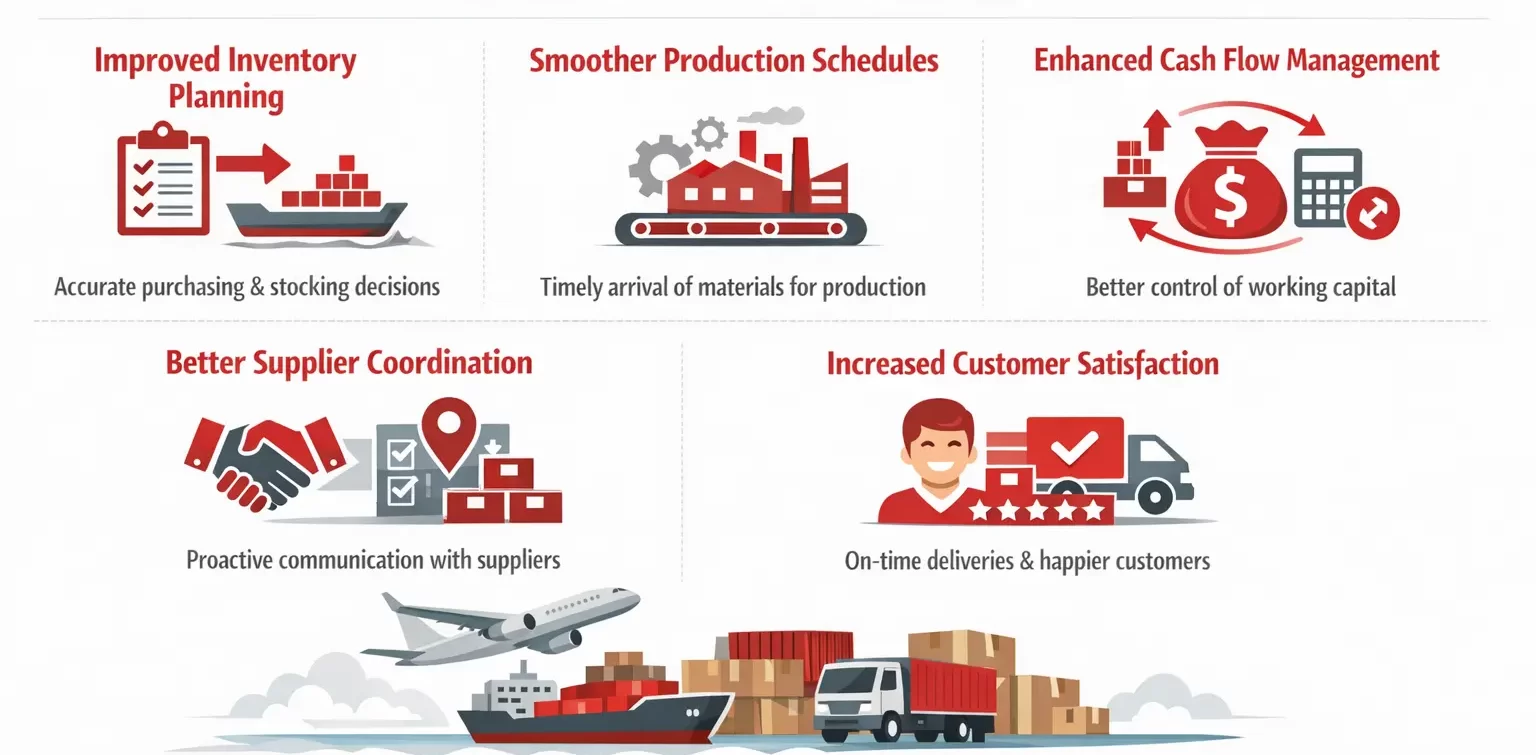
Maintaining pipeline inventory may not always be top of mind, but it brings real, measurable value to your operations. By keeping a close eye on what’s in transit, your business can become more responsive, more efficient, and ultimately, more competitive. Here are some of the key advantages:
1. Improved inventory planning
Having visibility into goods that are currently in transit helps you make more accurate purchasing and stocking decisions. Instead of blindly reordering based on what’s in the warehouse, you’re able to account for what’s arriving soon.
2. Smoother production schedules
For PPIC teams, timing is everything. When raw materials or components arrive precisely when they’re needed, production can continue without disruption. A clear picture of pipeline inventory supports better production planning, helps avoid costly downtime, and allows manufacturing teams to stay focused on output, not delays.
3. Enhanced cash flow management
Pipeline inventory ties up working capital, even though the goods aren’t physically present yet. By monitoring this inventory closely, finance and operations teams can better manage cash flow, schedule payments wisely, and avoid unnecessary borrowing or emergency spending. Pairing this visibility with platforms designed for stronger financial oversight enables teams to reconcile inventory costs with cash flow projections more accurately.
4. Better supplier coordination
When you have insight into where your shipments are and when they’re expected to arrive, communication with suppliers becomes more proactive. You can flag delays early, adjust orders when needed, and build stronger supplier relationships based on real time coordination, not guesswork. Complementing this visibility with tools that streamline your purchasing and supplier workflows can further strengthen these partnerships and reduce procurement cycle times.
5. Increased customer satisfaction
Ultimately, good inventory management techniques including what’s still in the pipeline, leads to better service. Being able to fulfill orders on time, even during peak periods, helps build trust and loyalty with your customers. It also allows your sales and customer service teams to provide more accurate delivery timelines.
Pipeline Inventory Example
Imagine a furniture manufacturing company based in the Philippines that sources timber components from a supplier in the Philippines. This company carefully manages its manufacturing inventory by placing purchase orders every two weeks, with an average lead time of 10 days for shipments via sea freight.
The manufacturer typically uses around 500 units of these components each day for production. To calculate its pipeline inventory, the PPIC (Production Planning and Inventory Control) team applies the following formula:
Pipeline Inventory = Lead Time × Daily Demand
10 days × 500 units/day = 5,000 units
This means the company can expect approximately 5,000 units of material in transit at any given time.
By consistently tracking pipeline inventory, the procurement and PPIC teams are able to plan with greater accuracy. They know when to reorder, how to buffer against delays, and how to prevent costly production disruptions, keeping the manufacturing floor productive and customer delivery timelines on track.
Conclusion
Effectively managing pipeline inventory is a cornerstone of supply chain efficiency. When businesses maintain clear visibility into goods currently in transit, they can make smarter decisions around procurement, production, and cash flow management. This level of control reduces costly delays, minimizes excess stock, and keeps operations aligned with both financial and operational goals.
For managers and executives, pipeline inventory should not be treated as a blind spot. Having accurate, real time data on in transit goods is essential regardless of whether your business deals with long lead times, international suppliers, or complex logistics. Businesses looking to strengthen this area can start by reviewing the top inventory management software options available in the Philippines to find a solution that fits their needs.
FAQ
-
What are the 4 types of inventory?
The four main types of inventory are raw materials, work-in-progress (WIP), finished goods, and pipeline inventory. Each type represents a different stage in the supply chain and needs to be tracked separately to maintain accurate stock records.
-
What is the difference between pipeline inventory and safety stock?
Pipeline inventory refers to goods that are currently in transit between suppliers, warehouses, or stores. Safety stock, on the other hand, is extra inventory kept on hand to protect against unexpected demand or supply delays.
-
How can businesses reduce pipeline inventory?
Businesses can reduce pipeline inventory by shortening lead times through closer supplier relationships, faster shipping methods, or sourcing locally. Improving demand forecasting and order scheduling can also help minimize the amount of goods in transit.