














For manufacturers in the Philippines, inventory control sits at the center of production efficiency too much stock ties up capital and warehouse space, while too little halts the production line. Getting this balance right consistently is one of the most operationally demanding parts of running a manufacturing business.
The following seven practical inventory management strategies address the most common pain points manufacturers face, from forecasting demand and tracking stock accurately to building more resilient supplier relationships. Each tip can be applied independently or as part of a broader operational improvement program.
This article covers practical inventory management tips to help improve your efficiency and optimize your operations in the Philippines.
Table of Contents
Key Takeaways
|
What Is Inventory Management for Manufacturers?
Inventory management for manufacturers is the process of tracking and controlling raw materials, work-in-progress (WIP), and finished goods across every stage of the production cycle. Unlike retail or distribution, manufacturing inventory operates on two fronts simultaneously input materials coming in from suppliers and output products moving out to customers making accuracy and timing critical at every handoff.
When inventory is mismanaged at any point in this cycle, the consequences compound quickly. A shortage of raw materials halts the production line; excess finished goods tie up warehouse space and working capital; inaccurate WIP tracking distorts cost calculations and delivery timelines. Structured inventory management practices give manufacturers the visibility they need to keep each stage of production running on schedule and within budget.
Benefits of Effective Inventory Management for Manufacturers
Effective inventory management directly reduces two of the biggest cost drivers in manufacturing excess stock and production downtime. When raw materials are tracked accurately and reorder points are set correctly, manufacturers avoid both the carrying costs of overstocked warehouses and the line stoppages caused by material shortages, resulting in a leaner and more predictable production cycle.
Beyond cost reduction, structured inventory management improves visibility across the entire supply chain from supplier lead times to finished goods dispatch. For manufacturers in the Philippines, where import lead times and supply chain disruptions are common operational realities, maintaining accurate real-time stock data translates directly into better order fulfillment, faster response to demand shifts, and stronger supplier relationships built on consistent, reliable demand signals.
7 Practical Inventory Management Strategies for Manufacturers

1. Set up Minimum Inventory levels
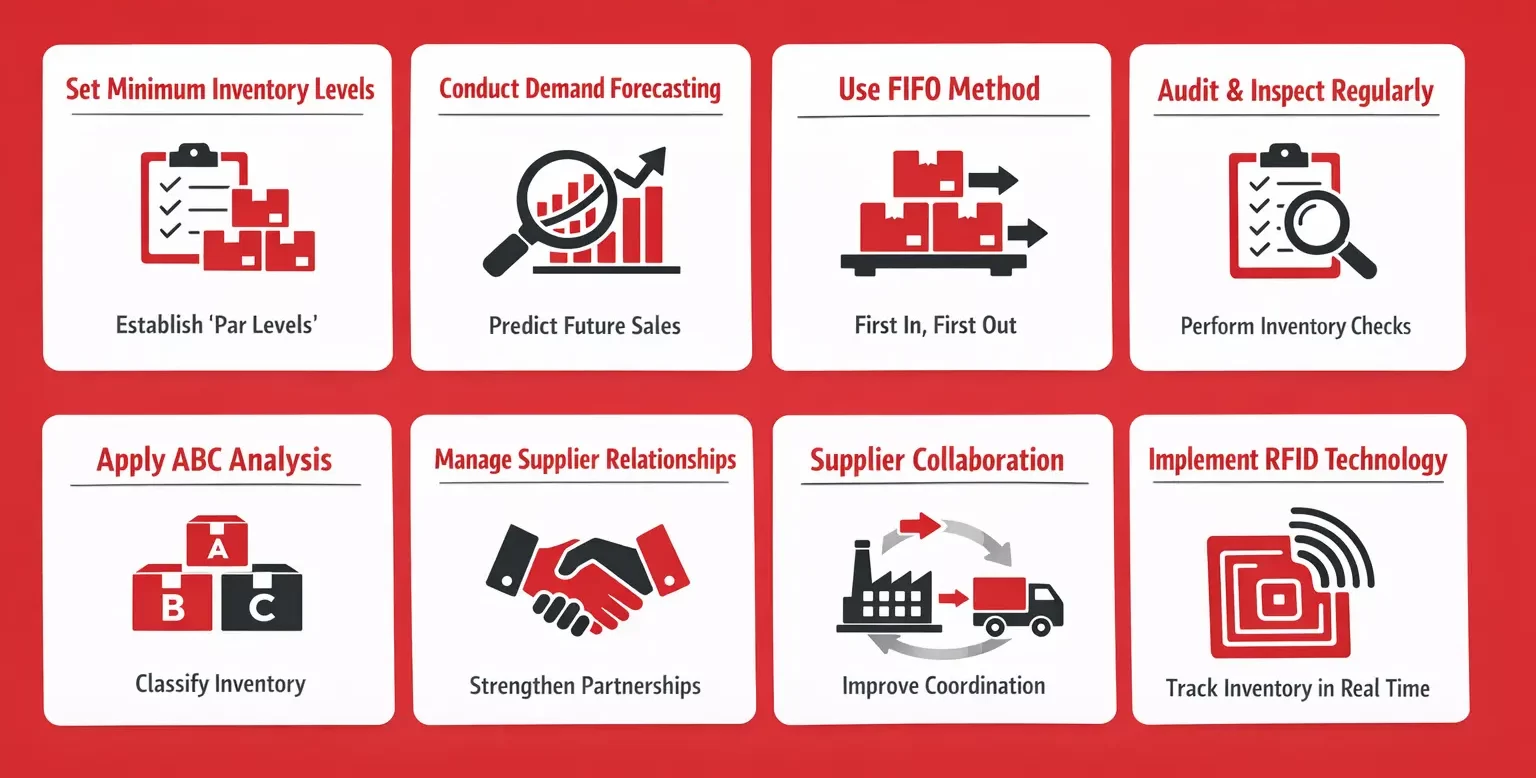
Simplify industrial inventory management by establishing ‘par levels,’ which represent the minimum amount of inventory that must always be on hand. When items reach or approach these set minimum levels, it signals the need to reorder.
Ideally, orders should be placed in quantities that exceed these minimum levels. The appropriate minimum inventory level for each product will vary based on factors such as sales velocity and delivery lead time.
In manufacturing, par levels require more careful calibration than in retail, particularly for raw materials with variable supplier lead times. Tracking these thresholds across multiple SKUs and product lines is where structured inventory management processes and the systems that support them deliver the most operational value.
2. Conduct Demand Forecasting
To determine the ideal amount of inventory to keep on hand and avoid unnecessary purchases, overstock, or stockouts, it is essential to forecast product demand. Manufacturers can approach demand forecasting by considering various internal and external factors, including:
- Market trends
- Last year’s sales data
- This year’s growth rate
- Overall economic conditions
- Upcoming promotions
- Planned advertising expenditures
When using historical sales data, ensure records are complete and consistent to avoid compounding errors in the forecast. Demand forecasting tools and inventory platforms with built-in analytics can help generate more structured projections, especially when multiple product lines or seasonal patterns are involved.
3. Use FIFO Method
First-in, first-out (FIFO) is an essential principle in manufacturing inventory management. It ensures that the oldest stock (first-in) is sold before the newer stock (first-out). This practice is particularly crucial for perishable items to prevent unsaleable goods.
The First-in, First-out (FIFO) method can also be applied to non-perishable products. If older items are consistently pushed to the back, they may become obsolete more quickly. Selling outdated products is something every business wants to avoid.
To effectively implement the FIFO principle, it is important to maintain an organized warehouse by placing new stock at the back or ensuring older stock remains at the front.
4. Audit & Conduct Regular Inventory Inspections
Regularly reviewing and conducting inventory audits is the best way to identify potential issues before they arise. Ideally, manufacturers should perform audits and inspections every month to ensure full coverage of their inventory.
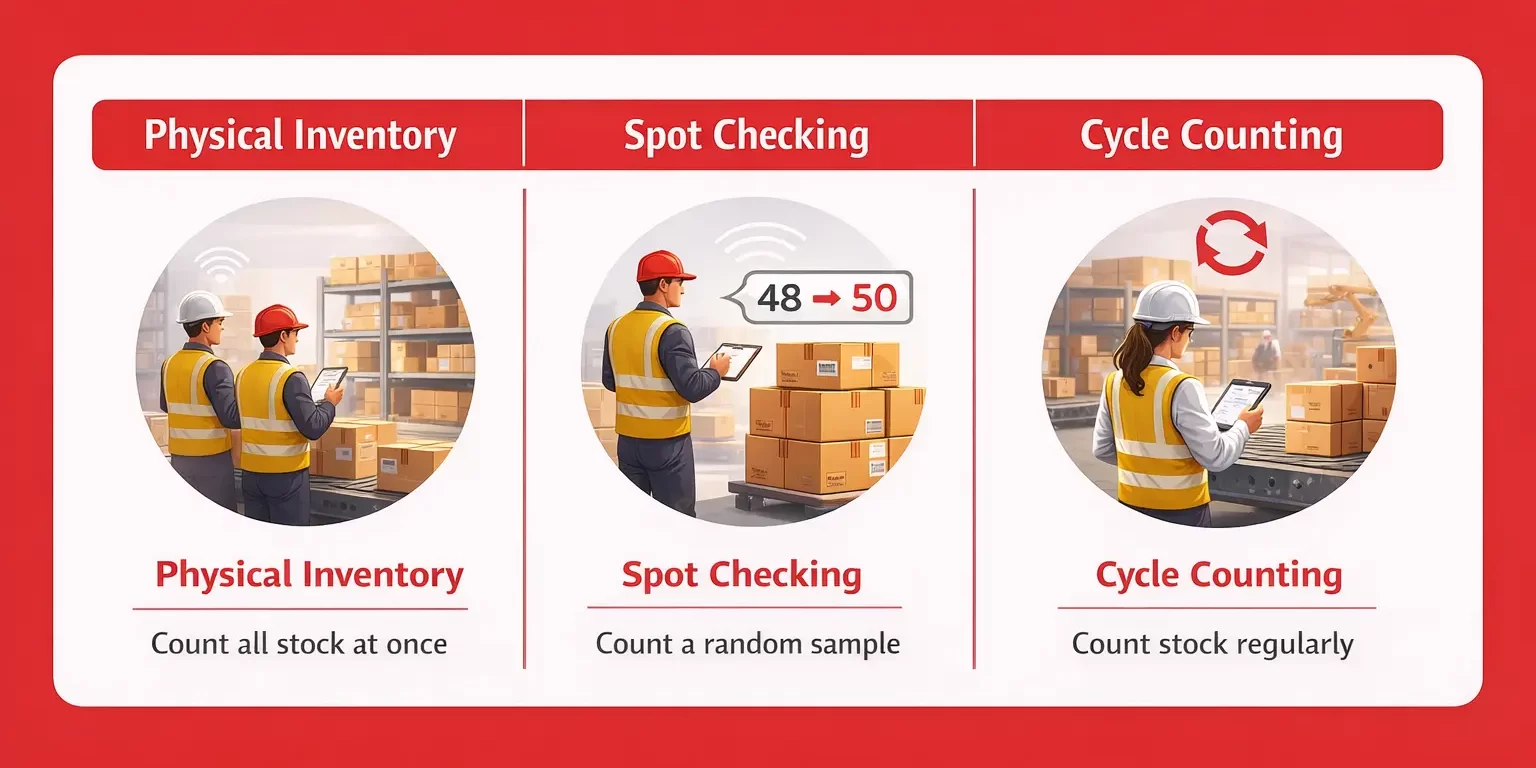
The most efficient way to verify your inventory data is by using inventory management software to generate reports, which show the quantity of products on hand. However, it’s crucial to ensure that the system-recorded quantities align with the physical count of goods. There are several methods for conducting inventory audits, including:
- Physical inventory
Physical inventory involves counting all stock at once, typically at year-end to align with accounting and tax filing cycles. While comprehensive, it is disruptive to operations and makes it harder to trace discrepancies when issues are found since the review covers an entire year of records
- Spot checking
Spot checking involves selecting a product at random, counting it, and comparing the result against the system quantity. It does not follow a fixed schedule and serves as a lightweight complement to the full annual inventory count, particularly useful for high-movement items.
- Cycle counting
Cycle counting replaces the year-end full count with ongoing, rotating audits throughout the year. Different products are counted on a set schedule, with higher-value or faster-moving items verified more frequently, keeping inventory data current without the disruption of a full shutdown.
5. Use ABC Analysis
Certain products require more focus than others. Use ABC analysis to prioritize your inventory management by classifying products based on their needs. Review your product list and categorize each item into one of the following three groups:
- A: High value products with low sales frequency
- B: Moderately valuable products with moderate sales frequency
- C: Low value products with high sales frequency
Products in category A demand more attention due to their significant financial impact, though their sales are less predictable. In contrast, products in category C require less oversight because they have a lower financial impact and sell more frequently. Products in category B fall in between these two extremes.
6. Manage Good Relationships with Suppliers
Building strong supplier relationships gives manufacturers more flexibility and control over their inventory. A solid partnership makes it easier to negotiate minimum order quantities, resolve issues faster, and adjust supply levels when demand shifts.
Manufacturers can also request lower minimums from suppliers to reduce the need for excess stock, which directly helps manage carrying costs. Clear and proactive communication is equally important, so informing suppliers in advance of any expected sales increases allows them to align delivery timelines with your production plans.
Sharing key information such as demand forecasts and production schedules helps minimize the risk of stockouts or overstocking. Understanding how inventory holding costs accumulate during delays can also strengthen the case for negotiating more favorable delivery terms, such as flexible schedules or better pricing.
7. Implement RFID Technology for Inventory Tracking

Radio Frequency Identification (RFID) technology offers a significant upgrade over traditional barcode based tracking in manufacturing environments. RFID tags store unique data about products, components, or raw materials and transmit that data wirelessly to readers placed throughout the production line, warehouse, or storage areas.
Unlike barcodes, RFID does not require direct line-of-sight scanning and can read multiple items simultaneously, substantially reducing time spent on inventory checks and manual data entry. This also improves accuracy by minimizing human errors, ensuring precise inventory counts, and reducing the risk of stock discrepancies or misplaced items.
This real time visibility allows manufacturers to track inventory movements across every stage of production and make faster, more informed decisions on resource allocation and order fulfilment. When integrated with manufacturing ERP platforms, RFID further supports optimized production scheduling and helps reduce inventory holding costs by keeping stock data consistently accurate.
Conclusion
Effective inventory management in manufacturing requires a combination of structured processes and the right tools. Strategies such as FIFO, ABC analysis, demand forecasting, regular audits, and RFID tracking each address a specific vulnerability in the inventory cycle, and together they form a more resilient operational foundation for manufacturers in the Philippines.
Manufacturers looking to strengthen their operations further can also explore how purpose-built software tools compare in terms of features and scalability. Reviewing the top inventory management software options for manufacturers can help identify systems that best match the scale and complexity of their production needs.
Frequently Asked Questions About Inventory Management Strategies
-
How does demand forecasting affect inventory management?
Demand forecasting uses historical data and market trends to predict future demand, helping businesses plan their inventory levels and avoid overstocking or shortages.
-
What are the advantages of using an Economic Order Quantity (EOQ) model?
EOQ helps businesses identify the optimal order quantity to minimize the total costs of ordering and holding inventory.
-
How can businesses scale their inventory management as they grow?
As businesses expand, adopting advanced tools like cloud-based inventory systems or AI-driven analytics can help streamline operations and support larger, more complex inventory needs.
-
What is the FIFO method in inventory management?
FIFO (first-in, first-out) means that the oldest stock is used or sold before newer stock. In manufacturing, this is critical for perishable raw materials and components with shelf lives, but it also applies to non-perishables items that sit at the back of storage too long can become obsolete or deteriorate in quality. Physically organizing storage so older items are always at the front is the simplest way to enforce FIFO.