












Table of Contents
An automated guided vehicle (AGV) is a computer-controlled robot that transports materials through a warehouse, factory, or distribution center without a human operator. These machines follow programmed paths using sensors, navigational markers, and central control software to move raw materials, work-in-progress parts, and finished goods between stations. According to the International Federation of Robotics, Southeast Asian nations including the Philippines are seeing a sharp increase in industrial automation investments as manufacturers seek to reduce labor dependency and improve throughput.
For Philippine businesses managing large-scale warehousing or manufacturing — from PEZA-zone factories in Laguna to cold storage facilities in Cebu — AGVs represent a shift from manual forklifts and hand carts to continuous, error-free material movement. The technology has evolved from simple wire-following carts in the 1950s to sophisticated machines equipped with LiDAR, AI-driven navigation, and real-time fleet management software.
Key Takeaways
Learn what AGVs are, how they work, and why they matter for Philippine warehouse and factory operations.
Explore the main AGV models used in the Philippines for pallet transport, towing, and repetitive material handling.
See how heat, humidity, and local warehouse conditions can affect AGV performance, sensors, and maintenance needs.
Understand how to train Filipino teams to operate, monitor, and work safely alongside AGV systems.
What Is an Automated Guided Vehicle?
An AGV is a driverless transport robot designed to move materials along specific pathways inside a facility. It reads navigational cues — magnetic tape on the floor, laser reflectors on walls, or digital maps stored in its memory — and executes transport tasks assigned by a central control system. The vehicle’s onboard computer processes sensor data, controls the motor, and communicates with other AGVs to avoid collisions.
Unlike a standard forklift that requires a licensed operator per shift, an AGV operates around the clock with minimal human supervision. It follows safety protocols programmed into its software, adheres to speed limits, and stops instantly when its sensors detect an obstacle. For companies already using a warehouse management system, an AGV fleet becomes the physical execution layer that carries out the digital commands.

Types of AGVs for Philippine Warehouses
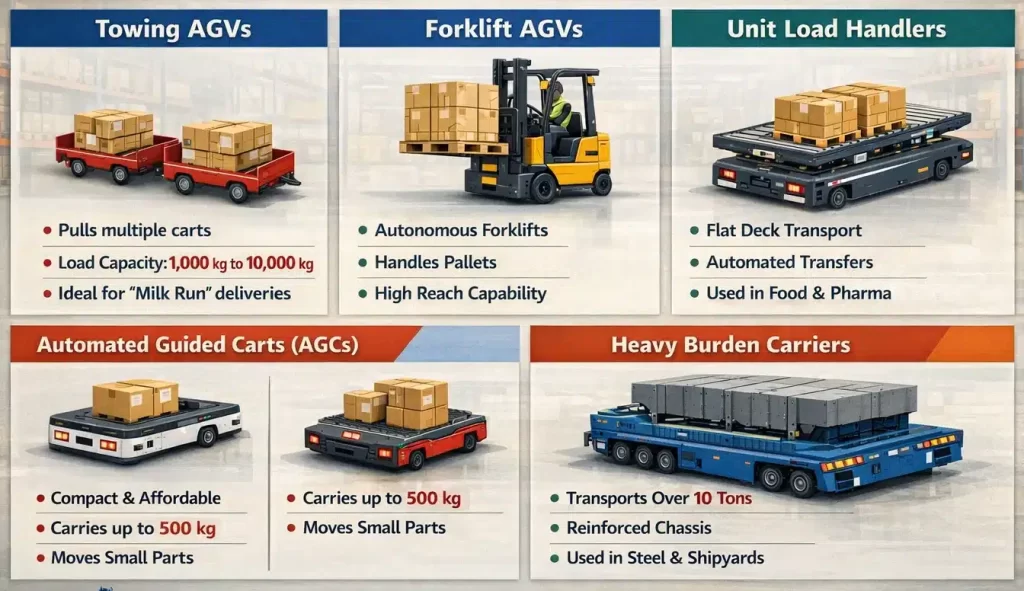
Different material handling requirements call for different vehicle designs. Philippine warehouses — from garment distribution hubs in Valenzuela to electronics assembly plants in Cavite — need to match the AGV type to their specific floor layout, payload weight, and workflow pattern.
1. Towing AGVs
Towing AGVs, also called tuggers, pull one or more non-motorized carts behind them. They work like a small locomotive hauling train cars through the facility. These are the most efficient option for moving large volumes over long distances — such as delivering parts from receiving docks to assembly lines in a process called “milk run” delivery. A single towing AGV can pull loads ranging from 1,000 kg to over 10,000 kg, making it ideal for high-throughput Philippine manufacturing plants that handle bulk raw materials.
2. Forklift AGVs
These are autonomous versions of traditional forklifts. They pick up, transport, and place pallets without a human driver. Subtypes include pallet jacks for floor-level transfers, reach trucks for narrow-aisle racking, and counterbalance forklifts for general pallet handling. For Philippine warehouses that rely on vertical storage to maximize expensive floor space — especially in Metro Manila industrial zones where rent exceeds PHP 400 per square meter — forklift AGVs with high-reach capability are the most practical choice.
3. Unit Load Handlers
Unit load AGVs carry goods directly on their flat deck rather than using fork tines. The deck can be equipped with roller conveyors, chain conveyors, or lift mechanisms to automatically transfer loads to and from stationary conveyor systems. They work best in environments that require precise, automated transfers between production stages — acting as mobile bridges between fixed conveyor lines. Philippine food processing plants and pharmaceutical facilities favor these for their ability to integrate with automated inventory management systems and maintain product traceability.
4. Automated Guided Carts (AGCs)
AGCs are the smallest and most affordable type. They drive underneath a specialized cart, lock onto it, and transport it to the destination. With lower payload capacity (typically under 500 kg), they suit operations that move individual totes, small parts, or assembly fixtures. Philippine electronics assembly plants in the CALABARZON region commonly use AGCs for moving component trays between SMT (surface-mount technology) stations.
5. Heavy Burden Carriers
These custom-built AGVs transport loads weighing tens or hundreds of tons. They feature reinforced chassis, omnidirectional steering, and specialized load surfaces. Industries like shipbuilding, heavy machinery, and steel production use them. In the Philippines, heavy burden carriers are found in facilities like steel mills in Bulacan and shipyards in Subic Bay, where moving massive components manually would require multiple cranes and pose extreme safety risks.
Key Parts of an AGV System
- Vehicle chassis and drive system: This component determines how the AGV moves inside the facility. Common options include differential drive for precise turning, tricycle drive for simpler steering, and omnidirectional drive for movement in multiple directions without rotating.
- Onboard controller: The onboard controller functions as the AGV’s brain. It processes sensor data, controls movement, and ensures the vehicle follows commands accurately during operation.
- Fleet management software: When several AGVs operate at the same time, this software manages task assignment, traffic flow, intersection control, collision prevention, and battery monitoring. It should connect with your existing ERP system so transport orders and inventory updates can run automatically.
- Safety systems: AGVs rely on safety scanners, bumpers, emergency stop buttons, and visual or audible alarms to protect nearby workers. These features are essential in Philippine facilities where AGVs and human operators work in the same environment.
- Energy and charging infrastructure: Lithium-ion batteries are now the standard because they charge quickly, need little maintenance, and support opportunity charging during idle time. This setup helps AGVs run longer and supports continuous warehouse operations.
Benefits of AGVs for Philippine Operations
- Workplace safety improvement is one of the biggest benefits. AGVs reduce accidents caused by human error, fatigue, and distraction. They follow set speed limits, detect obstacles, and operate more consistently than manual forklifts.
- 24/7 continuous operation helps facilities keep goods moving without adding extra shifts. With lithium-ion batteries and opportunity charging, AGVs can support round-the-clock operations. For Philippine e-commerce warehouses during 11.11, 12.12, and Christmas peaks, this means faster fulfillment and fewer delayed shipments.
- Labor reallocation helps businesses reduce dependence on forklift operators. AGVs take over repetitive transport tasks, while staff can focus on supervision, quality control, and system oversight. For companies using supply chain management systems, this can lower labor cost per unit and improve workforce efficiency.
- Reduced product and facility damage is another clear advantage. AGVs move with high precision, which helps prevent collisions with racks, walls, and equipment. Warehouses that monitor stock through inventory management software often see lower handling damage after AGV adoption.
- Scalability completes the value. Businesses can add more AGVs to the same fleet system without major physical changes. This makes it easier for Philippine warehouses to adjust capacity during peak periods.
How AGVs Connect to Your ERP and WMS

The real value of an AGV fleet comes from system integration. AGVs do not create tasks on their own — they follow instructions from connected software. When an order enters the ERP system, the WMS identifies stock location, creates the picking task, and sends it to the AGV fleet manager to dispatch the nearest vehicle. This connection gives businesses real-time updates on inventory movement, equipment status, and order progress. It removes data silos and helps teams monitor warehouse activity more accurately across locations.
Integration also supports Just-In-Time delivery for production lines. Instead of storing excess parts near the line, AGVs deliver the right items in the right quantity at the right time. For manufacturers in the Philippines, connecting AGVs with manufacturing software helps keep this process fast, accurate, and automatic.
Challenges of Setting Up AGVs in the Philippines
High upfront cost
AGV adoption requires major investment in vehicles, navigation systems, software integration, and facility upgrades. Clear ROI calculations over 3 to 5 years are important before seeking funding.
Facility readiness
AGVs need flat floors, enough aisle space, and stable wireless coverage. Poor Wi-Fi or network dead zones can stop operations and disrupt material flow.
Process standardization
AGVs work best in structured environments with consistent pallet quality and load placement. Businesses often need better handling discipline and stronger asset management practices before deployment.
New maintenance skills
AGVs reduce reliance on forklift mechanics but increase the need for technicians who understand sensors, software, and electromechanical systems. Training or external service support should be included in the total cost.
AGV vs. AMR: Which Fits Your Philippine Warehouse?
Automated Guided Vehicles (AGVs) and Autonomous Mobile Robots (AMRs) both automate material transport, but their navigation and decision-making differ fundamentally. Choosing the wrong one for your facility layout and workflow wastes money.
An AGV follows a fixed path — whether physical (wire, tape) or virtual (laser). If it encounters an unexpected obstacle like a parked forklift or a dropped box, it stops and waits for the path to be cleared or for a centralized system to reroute it. This makes AGV behavior highly predictable, which is excellent for tightly controlled environments with consistent traffic patterns.
An AMR navigates dynamically. Given a destination, it calculates the best route using its internal SLAM map. If an obstacle appears, the AMR autonomously finds an alternative path around it. This makes AMRs more flexible but less predictable in high-density traffic scenarios.
| Feature | AGV | AMR |
|---|---|---|
| Navigation | Fixed paths such as wire, tape, laser, or virtual guidance | Dynamic navigation using SLAM, LiDAR, and onboard intelligence |
| Obstacle Response | Stops and waits when obstacles appear | Reroutes automatically around obstacles |
| Payload Capacity | Can handle very heavy loads, including 100+ tons for burden carriers | Usually suited for lighter loads, often below 1,500 kg |
| Best For | Heavy-duty transport, fixed routes, and structured manufacturing environments | Flexible workflows, light loads, and fast-moving warehouse operations |
| Infrastructure Needed | Usually requires reflectors, tape, wire, or predefined mapped paths | Needs minimal physical infrastructure because it learns the environment |
| Cost per Unit (PH estimate) | Around PHP 1.5M to PHP 10M+ | Around PHP 2M to PHP 8M |
| Ideal PH Application | PEZA factories and bulk warehousing operations | E-commerce fulfillment centers and shared warehouse spaces |
For Philippine businesses, the choice usually depends on payload and work environment. AGVs are more suitable for moving heavy pallets along fixed routes in controlled factory settings. AMRs are often a better fit for dynamic e-commerce warehouses where layouts change often and workers share the same floor. Today, the difference is becoming less rigid, as some AGVs now include limited obstacle avoidance, while some AMRs can handle heavier loads.
Which Philippine Industries Use AGVs?
Automotive Manufacturing
Automotive manufacturing was one of the earliest industries to adopt AGVs. In the Philippines, auto parts suppliers in Laguna and Batangas use AGVs to support Just-In-Time delivery of heavy components to assembly lines. Towing AGVs and burden carriers are commonly used to move engine blocks, stamped body panels, and transmission assemblies.
Pharmaceutical and Food Processing
Pharmaceutical and food processing facilities in the Philippines use AGVs to support strict hygiene and compliance standards. Because AGVs produce no exhaust and can be built with stainless steel surfaces, they are well suited for cleanroom and wash-down environments. Some facilities also use temperature-controlled AGVs in cold chain operations, especially as demand for frozen and chilled food exports continues to grow.
E-Commerce Fulfillment
E-commerce fulfillment is one of the fastest-growing AGV applications in the Philippines. Large fulfillment centers in Laguna and Pampanga use AGV fleets to move pallets from receiving areas to storage systems more efficiently. During major shopping events such as 11.11, AGVs help facilities handle higher order volumes that would be difficult to manage manually. Many businesses also connect AGV operations with an ERP solution to keep order processing, inventory updates, and dispatch aligned.
Electronics Assembly
In CALABARZON, the Philippines’ largest manufacturing corridor, companies use AGVs and small unit load handlers to move circuit board trays and component reels between SMT lines. The precision and consistency of AGVs help reduce electrostatic discharge (ESD) incidents caused by rough manual handling.
How to Deploy AGVs Step by Step
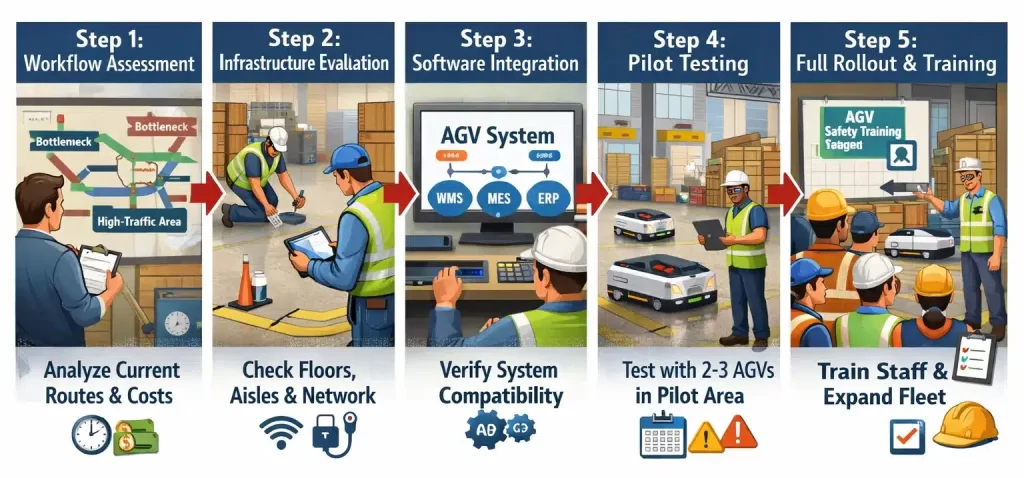
Step 1: Workflow assessment. Map the existing material flow. Identify bottlenecks, high-traffic zones, and repetitive long-distance routes. These are the best candidates for automation. Calculate current costs for manual handling on each route — including labor, damage, and downtime.
Step 2: Infrastructure evaluation. Assess floor flatness, aisle widths, incline grades, and ceiling height. Audit your facility’s wireless network — dead zones will cause AGV stoppages. Budget for floor resurfacing if needed, and ensure electrical capacity can support charging stations.
Step 3: Software integration planning. Confirm that the AGV fleet management software can communicate with your existing WMS, MES, or ERP platform. If you are using a Philippine ERP solution, verify API compatibility before signing an AGV vendor contract.
Step 4: Pilot testing. Start with a limited fleet (2 to 3 vehicles) in a controlled zone. Map the environment, calibrate sensors, test load handling, and refine traffic rules. Run the pilot for at least 30 days to capture edge cases — power outages, floor wet from cleaning, shift-change pedestrian surges — before committing to full-scale deployment.
Step 5: Full rollout and training. Expand the fleet zone by zone. Train all warehouse staff — not just operators — on AGV safety protocols, emergency stop procedures, and how to report malfunctions. DOLE’s occupational safety standards require that workers receive documented training before operating alongside automated equipment. Maintain training records for compliance audits.
AGV Trends Philippine Businesses Should Watch
Predictive maintenance uses continuous telemetry data — battery voltage drops, wheel friction, motor vibration — to schedule repairs before breakdowns occur. This reduces unplanned downtime, which is especially costly for Philippine facilities operating 24/7 to meet export shipment deadlines. Pairing AGV telemetry with a CMMS platform automates work order generation when sensor readings cross threshold values.
Dynamic swarm routing replaces rigid pre-programmed traffic paths with AI-driven real-time rerouting. Instead of vehicles following the same fixed routes regardless of floor conditions, the fleet controller continuously recalculates optimal paths based on current traffic, temporary obstacles, and vehicle battery levels. This can increase throughput by 15% to 25% in dense multi-vehicle environments.
Hybrid AGV-robotic arm systems combine transport and manipulation. An AGV equipped with a robotic arm can not only deliver a pallet to a workstation but also pick individual items from the pallet and place them on a conveyor — eliminating an entire manual step. For Philippine businesses handling high-SKU e-commerce fulfillment, these hybrid systems can dramatically reduce labor requirements in the pick-and-pack process.
5G-connected fleets are emerging as Philippine telcos roll out private 5G networks for industrial use. Unlike Wi-Fi, 5G offers consistent low-latency connectivity across large facilities without dead zones — solving one of the biggest operational pain points for AGV deployments in sprawling Philippine warehouse complexes.
Conclusion
Automated guided vehicles are becoming more common in Philippine warehouses and factories. Rising labor costs, stricter export requirements, and growing e-commerce demand have made AGV adoption a practical step for businesses that want faster, safer, and more consistent material handling. Instead of being seen as a future concept, AGVs are now part of a broader shift toward smarter warehouse and factory operations.
The success of an AGV investment depends on several factors, including the right vehicle type, navigation method, software integration, floor readiness, staff training, and connection with systems such as a fleet management system. For Philippine businesses that want to reduce risk, starting with a workflow assessment and a small pilot deployment remains one of the most effective ways to achieve measurable results in 2026.
Frequently Asked Questions
-
How much does an AGV system cost in the Philippines?
A basic AGV setup for a mid-sized warehouse in the Philippines, including 3 to 5 vehicles, navigation infrastructure, fleet software, and installation, typically costs around PHP 15 million to PHP 40 million. The total cost depends on the vehicle type, navigation method, and the level of floor or network adjustments required.
-
Do AGVs replace warehouse workers in the Philippines?
AGVs mainly replace repetitive transport tasks rather than entire job roles. Many facilities in the Philippines reassign forklift operators to system monitoring, quality control, or maintenance roles. While automation is allowed, employers are still expected to provide retraining opportunities for affected workers.
-
Can AGVs operate in Philippine warehouses with uneven floors?
AGVs work best on flat and smooth floors. Older industrial buildings in the Philippines with cracked or uneven concrete may need resurfacing before deployment. LiDAR-based AGVs are usually more adaptable to minor floor imperfections than wire-guided or tape-guided models.
-
What is the difference between an AGV and an AMR?
An AGV follows fixed routes and typically stops when it detects an unexpected obstacle. An AMR can navigate more freely and reroute on its own. AGVs are usually more suitable for heavy loads and predictable paths, while AMRs fit dynamic environments with lighter payloads.