













Packing slips are a fundamental part of the fulfillment process, even in the age of fast-paced digital commerce. This unassuming document serves as the definitive record of what has been shipped, acting as a vital communication tool between the warehouse floor, the logistics provider, and the final recipient.
Without it, the complex machinery of global e-commerce and business-to-business (B2B) trade would quickly grind to a halt, overwhelmed by discrepancies, missing items, and frustrated buyers. Understanding how to optimize and leverage this document is essential for any business looking to scale its operations and deliver a flawless post-purchase experience.
Table of Contents
Key Takeaways
|
What is a Packing Slip? A Comprehensive Look
A packing slip is a shipping document that shows the exact items inside a specific package. It reflects what the parcel actually contains, not the full order. When a business ships one order in multiple boxes, each box includes its own packing slip for accurate checking and faster receiving.
Common Terminology and Variations
Depending on the region, industry, or specific corporate jargon, this document goes by several different names. While the core function remains the same, you may hear it referred to as a:
- Waybill: Often used in freight and heavy logistics, though a waybill typically includes more routing information.
- Delivery Docket: A term frequently used in the UK, Australia, and New Zealand.
- Packing List: Commonly used in international trade and B2B transactions.
- Shipping List: A general term used interchangeably in many e-commerce fulfillment centers.
- Unpacking Note: Emphasizing the document’s role from the receiver’s perspective.
The Journey of the Document
To truly understand the value of a packing slip, one must trace its journey through the supply chain. A packing slip supports the fulfillment process from warehouse to delivery. After order processing, the system generates the slip for picking and packing. Staff use it to verify the items before shipment, then place it inside or outside the box. When the package arrives, the customer checks the slip to confirm the order contents.
The Fundamental Differences: Packing Slip vs Invoice vs Bill of Lading

One of the most common areas of confusion in logistics documentation is the distinction between various shipping and financial documents. While they may look similar at a glance and contain overlapping information, their legal, financial, and operational purposes are entirely distinct.
Packing Slip vs Commercial Invoice
A commercial invoice manages the financial side of an order, while a packing slip supports the shipping process. The invoice shows prices, taxes, fees, discounts, and total payment for the billing party. In contrast, the packing slip lists only the physical items and quantities received, which helps the recipient check the shipment without revealing pricing.
Packing Slip vs Bill of Lading (BOL)
A Bill of Lading (BOL) serves as a legal contract between the shipper and the carrier. It covers transport details such as freight class, weight, hazardous materials, and carrier terms. In contrast, a packing list helps the buyer verify the shipment’s contents. Carriers need the BOL to move goods legally, but they usually do not need the internal packing list.
Packing Slip vs Delivery Note
While often used interchangeably, a delivery note sometimes requires a signature upon receipt to serve as Proof of Delivery (POD). A packing list is generally an informational document included inside the package that does not inherently require a signature, though the two concepts are frequently merged in modern B2B deliveries.
Core Components: What Should a Packing Slip Include?

For a packing slip to fulfill its operational duties effectively, it must contain a specific set of data points. A poorly designed document can lead to warehouse confusion, customer frustration, and increased support tickets. Here is a comprehensive breakdown of the essential components that should be included on every standard shipping document.
1. Comprehensive Order and Document Identifiers
Every document must be uniquely identifiable to allow for quick cross-referencing in the event of an issue. This section should include:
- Order Number: The primary identifier linking the shipment to the customer’s original purchase.
- Document Number: A unique sequential number for the packing list itself, useful for auditing.
- Purchase Order (PO) Number: Critical in B2B transactions, allowing the receiving business to match the delivery to their internal purchasing system.
- Date of Order and Date of Shipment: Provides a timeline of the fulfillment process.
2. Accurate Address Information
Clear routing and contact information are vital. This typically includes two distinct addresses:
- Shipping Address: The physical location where the package is being delivered. This must be highly visible.
- Billing Address: The address associated with the payment method. Including this helps the recipient verify that the order was placed under their account, especially if the addresses differ.
- Contact Information: Phone numbers or email addresses for the recipient, which aid carriers in the event of delivery difficulties.
3. Detailed Itemized List
This is the heart of the document. The itemized list must be clear, concise, and easy to read at a glance. It should include:
- Item Description: A clear, human-readable name for the product (e.g., “Men’s Cotton T-Shirt – Blue – Large”).
- SKU (Stock Keeping Unit) or UPC: The alphanumeric code used to track the item internally. This is essential for warehouse workers and B2B receivers.
- Quantity Ordered: The total number of this specific item the customer requested.
- Quantity Shipped: The number of items actually included in this specific box.
- Quantity Backordered: If the warehouse did not have enough stock to fulfill the entire order, this column clearly communicates to the customer that the remaining items will arrive in a separate shipment later.
4. Sender and Branding Information
The document should clearly state who sent the package. This includes the company name, return address, customer service contact information, and the company logo. This not only aids in returns but also reinforces brand identity.
5. Return and Exchange Instructions (Optional but Recommended)
Many forward-thinking businesses use the bottom of the document to outline a summary of their return policy or provide a step-by-step guide on how to initiate an exchange. Some even print a return shipping label on the reverse side to create a frictionless customer experience.
The Crucial Role of Packing Slips in Inventory Management
While the customer-facing benefits of these documents are obvious, their role in internal inventory management is equally, if not more, profound. The packing slip acts as a physical manifestation of inventory data, serving as a critical checkpoint in the warehouse workflow.
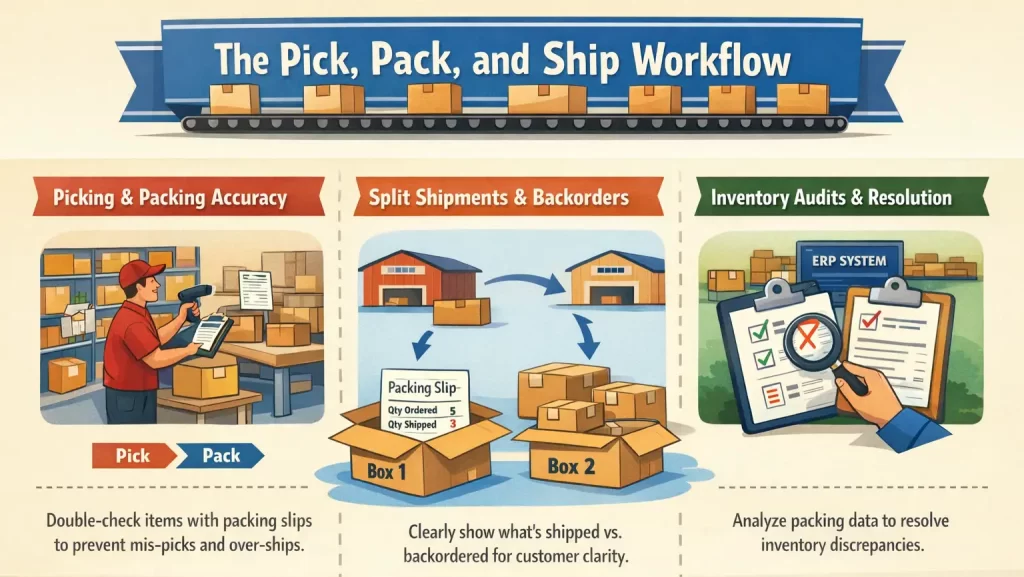
- In a traditional warehouse, teams handle fulfillment through picking, packing, and shipping. Pickers collect items with a scanner or pick list, while packers generate the packing slip, count the items, and match them before sealing the box. This double-checking process helps businesses reduce mis-picks, prevent over-ships, and protect profit margins.
- Businesses also use packing slips to manage split shipments and backorders more clearly. When stock comes from different warehouse locations or some items remain unavailable, the slip shows the difference between the quantity ordered and the quantity shipped. This clear information helps customers understand their order status, reduces confusion, and limits unnecessary customer service inquiries.
- During audits, operations teams review historical packing data to investigate stock discrepancies. By comparing shipped items with ordered quantities, they can spot recurring errors such as miscounts or SKU confusion. Advanced ERP systems automate document creation and storage, which makes audits faster, improves accuracy, and simplifies discrepancy resolution.
Why Packing Slips Are Essential for E-commerce and Logistics
The explosion of e-commerce has fundamentally altered consumer expectations. Today’s buyers expect rapid shipping, perfect accuracy, and hassle-free returns. In this demanding environment, the packing slip is a vital tool for meeting these expectations and maintaining a smooth logistical operation.
1. Enhancing the Unboxing Experience and Building Trust
A critical touchpoint in the customer journey is when they open the package. It is a moment of high anticipation; if a customer opens a box containing multiple items, their first instinct is to verify that everything they paid for is present. A clear, well-designed packing list provides immediate reassurance. It demonstrates professionalism and organizational competence, reinforcing the customer’s decision to trust your brand.
2. Streamlining the Returns Process (RMA)
Returns are common in e-commerce, especially in apparel and footwear. A packing slip helps warehouses process returns faster by identifying the order, customer, and returned items right away. Without it, staff must manually trace the details in the system, which delays refunds, increases labor, and slows the overall return process.
3. Handling Damaged Goods and Carrier Claims
If a package arrives damaged, the packing list serves as a crucial piece of evidence. The customer can use the document to verify exactly which items were destroyed or lost in transit. Furthermore, when the business files a claim with the shipping carrier (like FedEx, UPS, or DHL), the carrier will often request a copy of the packing list to verify the contents and value of the damaged package.
4. Facilitating Third-Party Logistics (3PL) and Dropshipping
In modern e-commerce, many businesses utilize third-Party Logistics (3PL) providers or dropshipping models to deliver their products. In these scenarios, the packing slip is the primary way the seller maintains their brand presence. The 3PL prints a customized slip featuring the seller’s logo and contact information, ensuring that the end consumer feels they are interacting directly with the brand they purchased from, rather than an anonymous warehouse.
Step-by-Step Guide to Creating an Effective Packing Slip
Designing an effective shipping document requires a balance between operational utility and brand aesthetics. It must be easily readable by warehouse staff in poor lighting, yet professional enough to represent your brand to the final consumer. Here is a guide to creating a highly effective document.
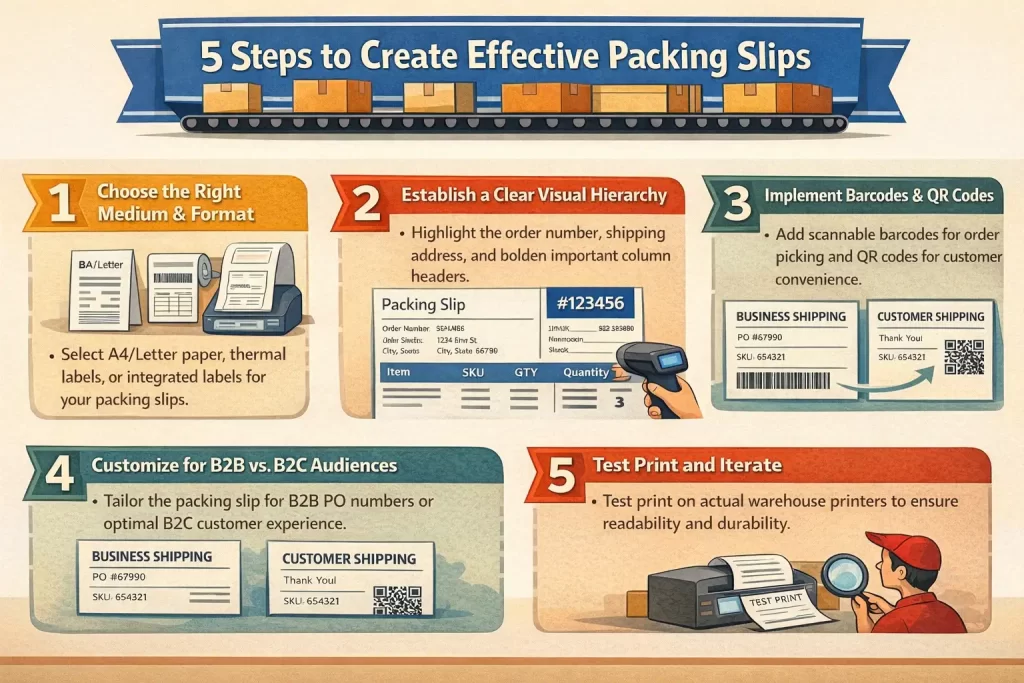
By following these steps, you will make packing slips much more efficient, easier, and more trustworthy to customers.
Common Challenges and Best Practices in Packing Slip Management
Despite their simplicity, the management and execution of packing slips can present several challenges for growing businesses. Addressing these challenges proactively is key to maintaining a highly efficient supply chain.
1. Human Error in Manual Generation
You are highly susceptible to human error when you still manually type out packing lists in Word or Excel. Typos in SKUs or quantities can lead to severe fulfillment mistakes. Never manually create these documents and instead automatically generate them in your e-commerce platform, Order Management System (OMS), or Warehouse Management System (WMS) by pulling data directly from the verified customer order.
2. Lost or Damaged Documents in Transit
Documents placed loosely inside a box, which can be accidentally thrown away by a customer amidst packing peanuts or bubble wrap, and documents attached outside of a box can be torn off or rendered illegible by rain. Standardize how the document is included, like placing the slip on the very top of the items before sealing the box and using high-quality, weather-resistant adhesive pouches. Ensure the barcode is visible through the pouch so carriers and receivers can scan it without opening the pouch.
3. International Shipping and Language Barriers
When shipping internationally, customs officials may need to review the packing list. Writing the document only in the sender’s native language can cause delays at the border. Ensure the item descriptions are clear, universally understood, and devoid of overly localized slang for international shipments. Include harmonized tariff codes (HS codes) directly on the document to expedite customs clearance, and consider bilingual printing for frequent international routes.
4. Environmental Concerns and Paper Waste
Printing millions of paper slips annually has a significant environmental footprint, and modern consumers are increasingly eco-conscious. Optimize the layout to ensure the vast majority of orders fit onto a single page. Use recycled paper or thermal paper free of harmful chemicals like BPA. Additionally, consider transitioning to digital alternatives where appropriate.
How to Improve Customer Experience With Packing Slips
It is easy to view logistics documents purely through an operational lens, but they also play a subtle yet powerful role in consumer psychology. The post-purchase period is a critical time for customer retention. After placing an order, customers often experience a degree of “buyer’s remorse” or anxiety, especially for high-ticket items.

1. Transparency and Cognitive Ease
When a package arrives, the customer wants immediate confirmation that their expectations have been met. A well-structured packing slip provides “cognitive ease”, a psychological state where a person feels comfortable, familiar, and trusting of their environment. By clearly listing what is in the box, acknowledging any backordered items upfront, and providing a clear path for returns, the business removes friction and anxiety from the unboxing experience.
2. The “Gift” Dynamic
In the context of gift-giving, the packing list serves a unique social function. By omitting prices (creating a “gift receipt” or “blind packing slip”), the sender can provide the recipient with a physical record of the item. This allows easy exchanges if the size or color is wrong without violating the social taboo of revealing the cost of the gift. The ability to seamlessly generate these blind slips is a critical feature for any consumer-facing retail operation.
3. Brand Reinforcement
The slip is one of the few pieces of physical marketing material that has a 100% open rate. Every customer looks at it. Using this real estate to reinforce brand values can be done through a personalized thank-you note, a discount code for a future purchase, or a brief story about the company’s sustainability efforts, which can transform a mundane logistical document into a powerful driver of customer loyalty.
Automating Your Packing Slip Process for Maximum Efficiency
Automation is no longer a luxury; it is a necessity for survival in modern commerce. It is simply not feasible for a business to manually scale from shipping ten orders a day to a thousand orders a day. Here are the key benefits of automation for packing slip efficiency:
| Benefit | How packing slip automation improves efficiency |
| Faster order processing | The system generates packing slips instantly after an order is placed, so warehouse teams can start fulfillment without manual input. |
| Fewer manual errors | Automation removes repetitive data entry and helps reduce mistakes in item details, shipping information, and document formatting. |
| Better system integration | Connected e-commerce, inventory, and shipping systems share order data automatically to keep the workflow smooth and accurate. |
| Real-time inventory updates | When the system marks an order as shipped, it updates stock levels right away across all sales channels and helps prevent overselling. |
| Stronger accounting accuracy | ERP integration records cost of goods sold automatically, which helps finance teams track transactions faster and with less manual work. |
| Improved customer records | The system updates customer purchase history automatically, which gives sales and support teams better context for follow-up. |
| Higher warehouse productivity | Automated print-and-apply tools and barcode-triggered printers help staff process more orders in less time. |
| Lower labor costs | Businesses reduce time spent printing, checking, and attaching documents manually, which saves labor hours each month. |
| Easier business scaling | Automation helps businesses handle growing order volume more efficiently, from a few daily shipments to thousands. |
| More consistent fulfillment | Standardized packing slips create a uniform process across packing stations, which improves speed, accuracy, and operational control. |
Implementation Steps for Automated Packing Slips

Transitioning from manual, handwritten notes to an automated, system-generated process is a critical step for growing businesses. Here is a proven roadmap for implementing an efficient packing documentation system:
- Audit Your Current Workflow: Analyze how orders currently flow from your shopping cart to the warehouse floor. Identify bottlenecks where packers spend too much time manually verifying items or searching for paperwork.
- Integrate Your WMS and ERP: Ensure your Warehouse Management System (WMS) communicates seamlessly with your order management software. The data must flow in real-time to prevent printing documents for canceled or modified orders.
- Optimize Hardware Placement: Install industrial thermal or laser printers directly at the packing stations. Forcing packers to walk to a centralized printer increases the risk of placing the wrong document in the wrong box.
- Design Functional Templates: Create a layout that prioritizes readability over aesthetics. Use large, bold fonts for item quantities and SKUs. Incorporate barcodes that can be scanned by the receiving party or by your own staff during the final box audit.
- Conduct Staff Training: Train your fulfillment team on the new procedures, emphasizing the importance of using the printed list as the ultimate source of truth before taping and sealing the parcel.
After you completely automate your packing slips, business operations will become easier. Packing slips will no longer be a slow process prone to error as automation will turn it into an easy task with minimal resource and labor requirements while still retaining the benefit of customer trust and brand likeability.
Conclusion
The packing slip is more than just a simple piece of paper; it is a complex and indispensable tool that sits at the intersection of inventory management, logistics, and customer experience. It is the physical proof of a digital promise, ensuring that what was ordered is exactly what was delivered.
By understanding the critical components of a packing list and implementing the best practices for its design and execution, businesses can get the full benefits of packing slips. It will drastically reduce fulfillment errors, streamline warehouse operations, and build lasting trust with customers.
Whether you are a small boutique shipping a few handmade items a week or a massive enterprise moving thousands of pallets a day, mastering the art and science of the packing slip is a fundamental step toward achieving operational excellence in the modern supply chain. And the best way to achieve that is to utilize the right distribution ERP systems to maximize efficiency.
FAQ for Packing Slips
-
Is a packing slip required for imports into the Philippines?
Yes. Official import-document references for the Philippines include the packing list among the standard documents required for shipments, together with the bill of lading or airway bill, commercial invoice, and other supporting papers when applicable.
-
What information should a packing slip include?
A Philippines-ready packing slip should clearly show the itemized goods and shipment details, such as product description, quantity, weight, marks and numbers, and the number and kind of packages.
-
Should I use the term “packing slip” or “packing list” for Philippine import documents?
For Philippine customs-facing documents, the packing list is the safer and more consistent term because that is the wording used in official import references and customs guidance.
-
Are extra documents needed aside from the packing list?
Often, yes. Depending on the goods, importers may also need permits, clearances, proof of origin, valuation documents, or other requirements under Philippine rules.
-
For local deliveries, is a packing slip enough on its own?
Not for tax or invoicing purposes. Even if a business uses a packing slip or other delivery-related document operationally, the BIR still treats the invoice as the main document for the sale, while other shipment-related papers are supplementary.