













Business data grows faster than most organizations can manage it, and without a clear structure for handling that data at every stage, the risks accumulate quickly. Outdated records consume storage, sensitive information sits exposed longer than it should, and decisions get made on data that no longer reflects reality.
Information Lifecycle Management (ILM) is the strategic framework that addresses this. It governs how data is created, stored, used, archived, and eventually disposed of, ensuring that information remains accurate, accessible, and aligned with both operational needs and compliance requirements.
This article covers what ILM is, its key benefits, the phases involved, and how it differs from Data Lifecycle Management.
Key Takeaways
|
What is Information Lifecycle Management?
Information Lifecycle Management (ILM) is a structured business strategy for handling data throughout its entire existence from the moment it is created, processed, and stored, to the point it is archived or permanently deleted.
It involves establishing clear policies and controls that govern how information is categorized, accessed, and maintained throughout various stages.
ILM ensures that data is managed in alignment with company procedures, regulatory requirements, and operational workflows. When integrated with enterprise resource planning systems, ILM becomes a core part of enterprise information governance, connecting data management to broader business operations.
The Benefits of Information Lifecycle Management

Managing business data strategically is essential to staying competitive, compliant, and efficient. Here are the most important benefits of Information Lifecycle Management process, ranked based on what matters most to companies today:
1. Enhanced compliance and security
For many businesses, meeting regulatory standards and protecting sensitive information are top priorities.
ILM helps enforce consistent data handling policies, reduces the risk of data breaches, and supports compliance with industry-specific regulations ensuring your company stays protected and audit-ready.
2. Cost efficient data storage
Outdated or unused data can quickly drive up storage and infrastructure costs. ILM reduces this burden by automatically archiving or deleting information that is no longer needed, helping companies control IT spending and allocate resources more efficiently.
3. Better decision-making support
Having clean, accurate, and accessible data allows leadership teams to make faster and more confident business decisions. ILM ensures that only relevant, up to date information is kept in active systems, eliminating noise and improving data quality. When combined with the right business management software, these data-driven insights can be translated into actionable strategies across all departments.
4. Smoother operational workflows
When data flows properly across departments, internal processes become more streamlined. ILM reduces duplication, delays, and confusion by making sure the right people have access to the right information at the right time. Pairing ILM with the right operations management software can further amplify these efficiency gains across your entire workflow.
5. Improved data organization
ILM introduces a clear structure for categorizing and managing data throughout its lifecycle. This organization improves collaboration across teams and reduces the time spent searching for files, documents, or historical records.
What are The Phases of The Information Lifecycle Management?
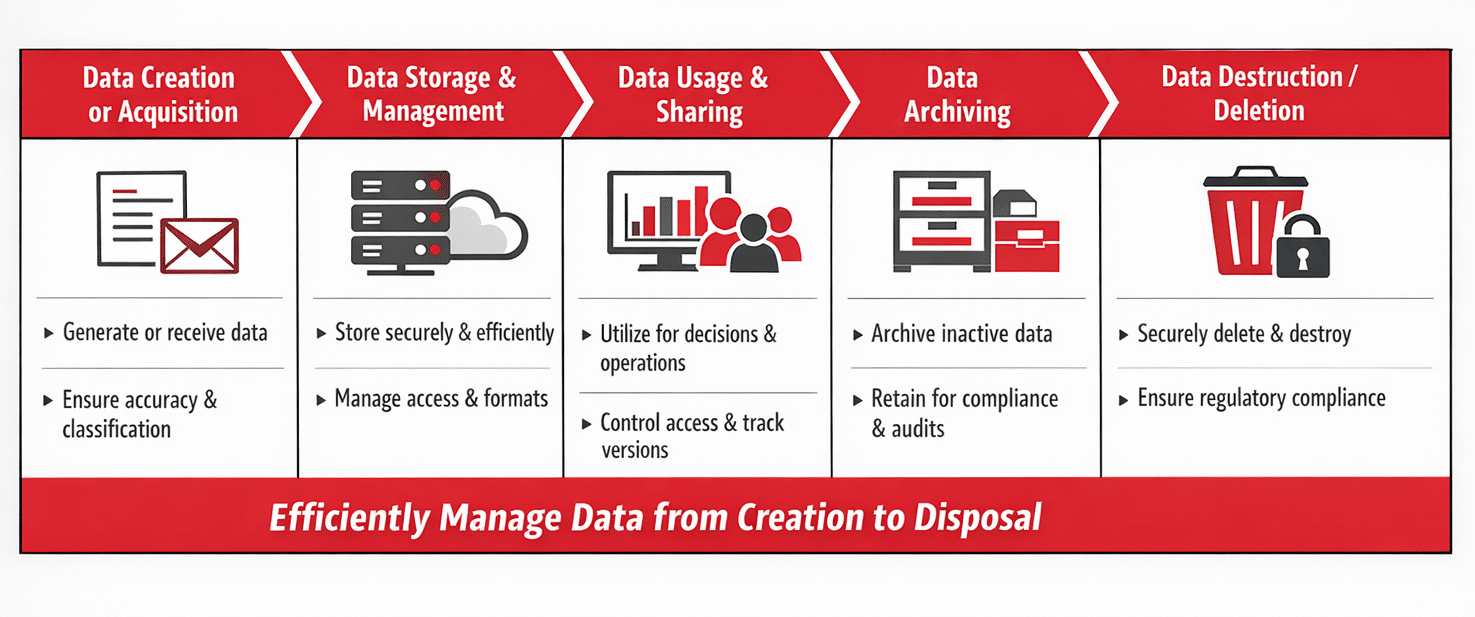
Information Lifecycle Management (ILM) offers a structured approach to handling data from creation to disposal. Below are the key phases in the ILM process, each with its distinct purpose and strategic value:
- Data creation or acquisition: Information is first generated or received. This could be in the form of documents, emails, reports, or data entries. Ensuring data accuracy and proper classification at this stage lays the foundation for effective lifecycle management.
- Data storage and management: Once created, information must be stored securely and efficiently. This phase involves determining storage formats, locations (on-premises or cloud-based), and access protocols to ensure data availability and protection.
- Data usage and sharing: Information is actively used by individuals or systems for decision-making, operations, or transactions. Proper access controls and version tracking are critical during this phase to maintain data integrity.
- Data archiving: When information is no longer actively used but still holds business or legal value, it’s moved into archives. Archiving helps reduce clutter while keeping important data accessible for reference or audit purposes.
- Data destruction or deletion: Eventually, information reaches its end of life and must be securely destroyed to prevent unauthorized access or data breaches. Compliance with data retention policies and industry regulations is vital at this stage.
How does Information Lifecycle Management Work?
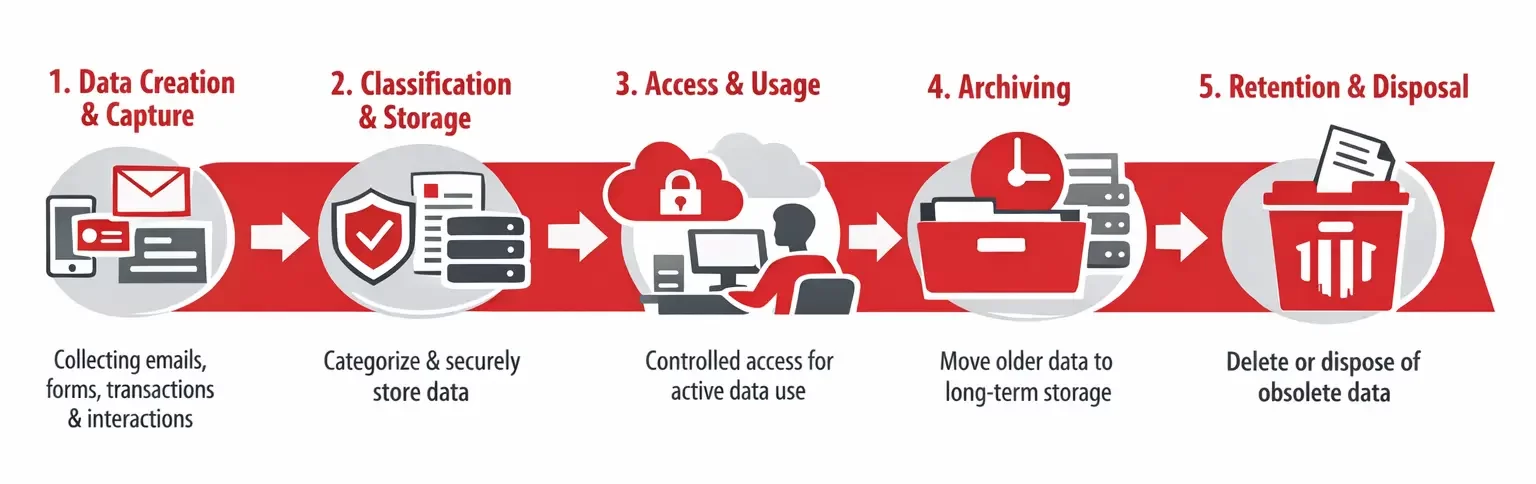
ILM works by applying structured policies to control how business data is handled at every stage of its existence. Rather than treating all data equally, ILM enables companies to manage information based on its importance, usage, and regulatory requirements, aligning closely with business process management principles. Here is how the process typically works:
1. Data creation and capture
Information enters the business through various channels including emails, forms, transactions, and customer interactions. At this stage, it’s essential to identify the type and value of the data to determine how it should be managed moving forward.
2. Classification and storage
Once captured, data is categorized based on sensitivity, relevance, and business use. It is then stored securely in the appropriate systems, whether on-premise or cloud-based, according to predefined access and retention policies.
3. Access and usage
During this phase, the data is actively used by teams across departments. ILM ensures that only authorized users can access specific types of information, supporting both operational efficiency and data security.
4. Archiving
As data becomes less frequently used but still holds value such as for reporting or compliance, it is moved to long-term storage. Archiving reduces the load on active systems while preserving access when needed.
5. Retention and disposal
Eventually, data reaches the end of its useful life. ILM policies determine when information should be deleted or anonymized, ensuring secure disposal and reducing storage clutter or legal risks.
The Difference between Information Lifecycle Management and Data Lifecycle Management
While they sound similar, DLM and ILM are not the same. DLM focuses on raw data assets, while ILM governs the meaningful, contextualized intelligence derived from that data. It is also worth noting that enterprise asset management applies a similar lifecycle approach to physical assets like machinery and equipment. Here is a breakdown of the core differences:
| Feature | Information Life Cycle Management (ILM) | Data Life Cycle Management (DLM) |
| Core Focus | Manages the contextualized, processed data that provides meaning and value. | Manages the raw, unprocessed assets (the facts, figures, and files). |
| Primary Goal | To maximize the value of information to the business over its lifespan. It aligns information with business goals. | To manage data efficiently and securely based on policies. It’s about cost-effective storage, compliance, and availability. |
| Scope | More strategic and business-centric. Focuses on access controls, business relevance, and decision-making value. | More technical and IT-centric. Focuses on storage media, backup procedures, and security infrastructure. |
| Simple Analogy | Managing the finished cake. The focus is on who gets a slice, how it’s served, and when it’s no longer fresh. | Managing the raw ingredients in a pantry (flour, sugar, eggs). The focus is on proper storage and inventory. |
Conclusion
Information Lifecycle Management gives businesses a structured way to handle data responsibly at every stage, from creation through to secure disposal. When policies are applied consistently, organizations reduce compliance risk, control storage costs, and ensure that the information driving their decisions remains accurate and accessible.
For businesses looking to put this into practice, reviewing available ERP software options can help identify which platforms support the data governance and lifecycle management capabilities their operations require.
FAQ Information Lifecycle Management
-
What does lifecycle management mean in IT?
IT lifecycle management is a systematic approach to managing the lifecycle of IT systems, from procurement through deployment, operation, and retirement. This structured process ensures that every stage of an IT system’s life is optimized to meet business objectives while minimizing risks and costs.
-
What is information management in ICT?
According to Wikipedia, Information management (IM) is the collection and management of information from one or more sources and the distribution of that information to one or more audiences. This sometimes involves those who have a stake in or a right to that information.
-
What is the overall goal of information management?
The goal of information management is to help people and organizations access, process and use information efficiently and effectively. Doing so helps organizations operate more competitively and strategically, and helps people better accomplish their tasks and become better informed.