














Efficient inventory management is crucial for business success, especially in competitive markets where small inefficiencies can impact overall performance. One practical method to address this is HML (High, Medium, Low) inventory analysis, which helps businesses identify and prioritize products based on their value and demand.
By organizing stock into clear categories, HML analysis improves control, supports better decision making, and helps maintain balanced inventory levels. This is particularly useful for businesses that need to stay efficient while adapting to changing customer demand.
This article will explain the key concepts of HML inventory analysis, along with its benefits and practical applications.
Key Takeaways
|
Table of Contents
What is HML Inventory Analysis?
HML inventory analysis categorizes items based on their value and demand. It divides inventory into High, Medium, and Low categories, helping businesses focus on key products and manage stock efficiently.
By classifying inventory based on these two factors, HML helps businesses prioritize high-value items that are in high demand. This way, you can ensure that critical products are always in stock while managing lower-demand items more efficiently.
Using inventory management software to automate HML analysis takes this process further. It provides real-time tracking and updates, allowing businesses to efficiently manage stock levels without manual effort. With automation, businesses can make data driven decisions, improving overall inventory control.
Why is HML Inventory Analysis Important?

HML inventory analysis is crucial for Filipino businesses because it helps you make smart, strategic decisions that save time, money, and effort. It ensures you’re prioritizing the right products and staying efficient in managing your stock.
Here’s why it’s so important:
- Avoid Wasting Resources: HML helps you focus on the items that matter most, so you’re not wasting money on slow moving products.
- Reduce Stockouts and Overstocking: By clearly defining stock priorities, it prevents both stockouts and excessive inventory, saving you from costly mistakes.
- Enhance Business Agility: With HML, you can quickly adjust your inventory to meet customer demand, keeping your business flexible and responsive.
How to Perform HML Inventory Analysis
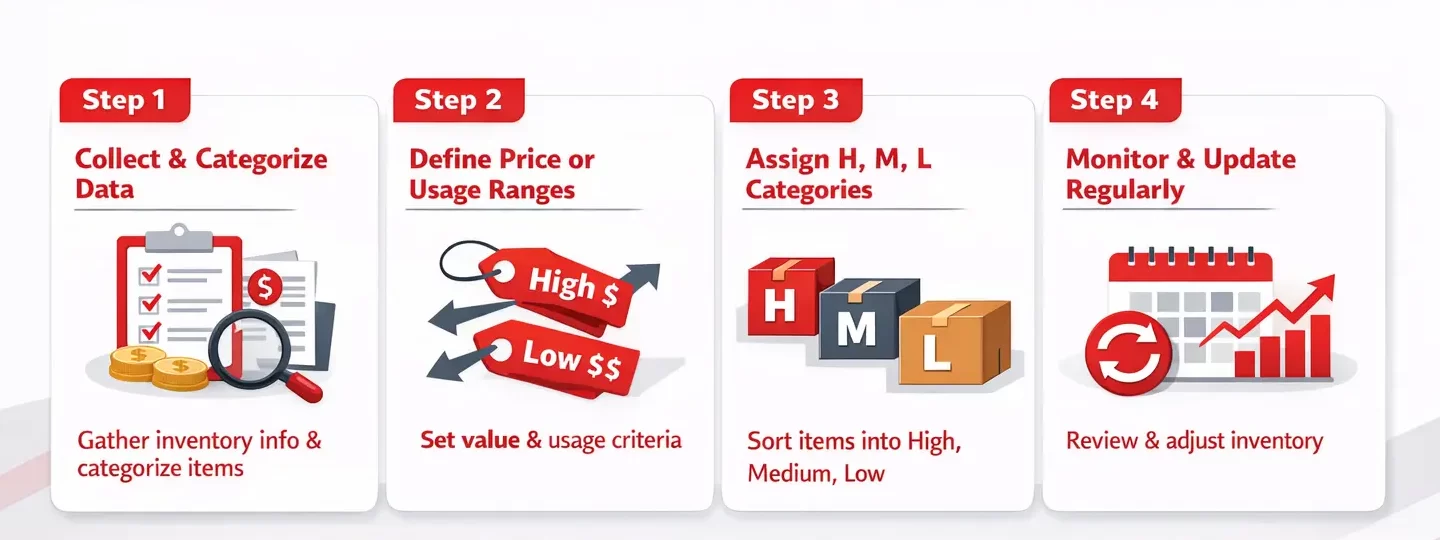
HML analysis is a straightforward process that helps you categorize and manage your inventory efficiently. Here’s how to perform it in simple, clear steps:
Step 1: Collect and Categorize Inventory Data
Start by gathering all the necessary data about your inventory, like product names, prices, and usage frequency. Then, categorize the items based on their value and how often they are sold or used.
Step 2: Define Price or Usage Ranges
Next, decide the price or usage ranges that will determine how you classify your products. For example, high value or high demand items go in the “H” (High) category, while low demand items are placed in the “L” (Low) category.
Step 3: Assign Items to H, M, or L Categories
Now, assign each product to one of the three categories: High (H), Medium (M), or Low (L). This will help you focus on your most important inventory so you know where to put your resources and attention.
Step 4: Monitor and Update Regularly
HML analysis isn’t a one time thing. Continuously track your inventory and update your categories when demand or prices change. This keeps your system up to date and ensures your inventory management stays accurate.
By following these steps, you can keep your inventory well organized and make smarter decisions that save time and money.
Benefits of HML Analysis
HML analysis offers several key advantages that can transform how you manage your inventory. Focusing on the right items at the right time drives efficiency and cuts unnecessary costs, directly boosting your bottom line.
- Improved Inventory Control: By prioritizing high demand items, HML helps you avoid stockouts and overstocking, keeping your stock levels in perfect balance.
- Cost Efficiency: With HML, you can reduce both overstock and understock issues, saving on storage costs and preventing wasted capital on slow moving items.
- Better Decision Making: HML provides clear insights into your inventory, allowing you to make smarter purchasing and stock decisions that align with customer demand.
- Stronger Supplier Relationships: With clear inventory insights, HML helps you communicate better with suppliers, ensuring timely deliveries and avoiding last-minute rush orders.
- Increased Customer Satisfaction: By prioritizing high demand products, you can avoid stockouts, making sure your customers get what they want, when they want it, leading to repeat business.
Using HML analysis gives you full control over your inventory, enabling you to cut costs, improve decision making, and optimize your supply chain. Don’t miss out on the advantage of running an efficient, cost-effective operation!
Applications of HML Analysis in Filipino Businesses

HML analysis can be applied to many types of businesses in the Philippines, making inventory management easier and more effective. Whether you’re in retail, e-commerce, or manufacturing, HML helps you prioritize the right items, ensuring better stock control and efficiency. Take a look at these examples:
Example 1: Retail Business
Let’s say you run a sari-sari store in the Philippines. With HML analysis, you can categorize popular products like canned goods and snacks as “H” (High), ensuring they are always in stock. Less popular items, such as specialty products or seasonal items, go into the “L” (Low) category, allowing you to minimize storage costs and avoid overstocking items that don’t sell often.
Example 2: E-commerce Business
For a Filipino e-commerce business selling gadgets and accessories, HML analysis helps identify fast-selling items like phone chargers or earphones and classify them as “H” to ensure consistent availability. Meanwhile, slower-moving products such as specialized phone cases can be placed in the “L” category to avoid excess stock and unnecessary costs.
Overall, HML analysis helps businesses adjust inventory based on real demand, ensuring better focus on high priority products and more efficient stock management decisions.
Integrating HML Analysis with Other Inventory Management Methods
HML analysis can be combined with other inventory methods to improve accuracy and decision making. By integrating multiple approaches, businesses can gain a more comprehensive view of their stock priorities.
- Combine with ABC analysis: Helps classify items based on cost impact, so you can see both value (HML) and financial importance (ABC).
- Combine with VED analysis: Useful for identifying critical items based on necessity, especially in industries that require strict availability.
- Improve decision accuracy: Using multiple methods together provides deeper insights and reduces the risk of misclassification.
By integrating HML with other strategies, businesses can create a more refined and effective inventory management system.
Conclusion
HML analysis is a practical tool for improving inventory control and overall business efficiency. By categorizing items based on value and demand, businesses can prioritize high-impact products, maintain balanced stock levels, and reduce unnecessary costs.
It also ensures critical items remain available while minimizing excess stock. To further enhance your strategy, you can explore practical tools and approaches in this guide on choosing the right inventory management tools.
Frequently Asked Questions
-
What does HML stand for in inventory?
HML stands for High, Medium, and Low, a system used to categorize inventory based on value and demand. It helps businesses prioritize stock to improve decision making and ensure the right items are available when needed.
-
What is the difference between ABC and HML?
ABC categorizes inventory based on cost impact, while HML focuses on value and demand. HML helps businesses prioritize fast-moving, high-value items, while ABC ensures focus on the most costly or critical products.
-
On which criteria HML classification is done?
HML classification is based on two main factors: product value and demand frequency. High-value and fast-moving products are classified as “H,” while low-demand or low-value items fall into the “L” category.