













Warehouse management is the process of overseeing the storage and movement of goods within a warehouse. Managing a warehouse comes with its challenges, from lost items to delayed shipments. This often happens due to a lack of structure and accuracy. Thus, implementing effective strategies and warehouse operations tools is needed to solve these common problems.
Effective warehouse management leads to a profitable, cost-effective warehouse. Firms should evaluate how well a system supports day-to-day project execution. A suitable system should help teams monitor job costs in real time, improve budget control, and connect financial data with project activities so decision-makers can respond faster when costs start to drift.
Table of Contents
Key Takeaways
|
What is Warehouse Management?
Warehouse management involves overseeing the entire storage and distribution process within a warehouse. It encompasses various activities, including receiving, inventory management, order fulfilment, and shipping. The goal is to optimize efficiency while minimizing costs.
Critical components of warehouse management include inventory tracking, space utilization, and process automation. By implementing effective strategies, businesses can ensure that products are stored correctly and retrieved promptly, enhancing overall operational efficiency.
In essence, warehouse management is not just about storing goods; it’s about creating a systematic approach that improves workflow and accuracy. A well-managed warehouse is crucial for meeting customer demands and driving business growth.

Benefits of Effective Warehouse Management
Effective warehouse management is crucial for boosting operational efficiency and keeping customers happy. Here’s how it can make a significant impact:
1. Improved accuracy
Keeping accurate inventory records helps minimize errors, ensuring customers get the right products. This reliability builds trust, which is essential for customer loyalty. When customers know they can rely on a business for timely and accurate deliveries, they’re more likely to return and recommend the service to others.
2. Reduced costs
Streamlining warehouse operations can lead to significant savings in labour and storage expenses. Efficient processes help manage resources better, reducing waste and unnecessary costs.
For example, optimizing picking routes can save time and labour hours. These cost reductions boost profitability and provide opportunities for reinvestment in the business.
3. Enhanced customer satisfaction
Timely deliveries and precise order fulfilment greatly improve customer satisfaction. When orders arrive as expected, it creates a positive experience that encourages customers to return.
Happy customers will also likely share their experiences, leading to valuable word-of-mouth referrals. In a competitive market, high customer satisfaction can set a business apart.
In short, effective warehouse management goes beyond just improving efficiency. It’s about building a solid foundation for long-term success through accuracy, cost savings, and satisfied customers.
Types of Warehouse Management
Understanding the different types of warehouse management is important because each approach affects how goods are stored, moved, and fulfilled. Finding the right method is crucial, as how well a business manages its warehouse can determine its success or downfall. Here are some common warehouse management approaches:
1. Centralized warehouse management
Centralized warehouse management means controlling inventory and operations from one main warehouse or distribution center. This approach helps standardize processes, improve visibility, and make inventory control easier for businesses that want tighter coordination.
2. Decentralized warehouse management
In a decentralized approach, businesses manage inventory across several warehouse locations. This can shorten delivery times and place stock closer to customers, although it also requires stronger coordination to prevent overstocking or stock imbalances between sites.
3. Manual warehouse management
Manual warehouse management relies on paper records and spreadsheets. They require direct human oversight to manage everything from receiving to shipping. This method may work for small operations, but it often becomes harder to control as transaction volume increases.
4. Automated warehouse management
Automated warehouse management uses tools such as barcode scanning, RFID, conveyors, and digital tracking systems to improve speed and accuracy. This approach helps reduce manual errors, supports real-time inventory updates, and makes warehouse workflows more consistent.
5. Lean warehouse management
Lean warehouse management focuses on reducing waste in movement, time, space, and labor. Businesses using this approach aim to streamline workflows, improve slotting, and remove unnecessary steps so operations become faster and more cost-efficient.
By evaluating these approaches carefully, businesses can choose a warehouse management method that aligns with their operational goals, order volume, and fulfillment requirements.
Fundamental Processes in Warehouse Management
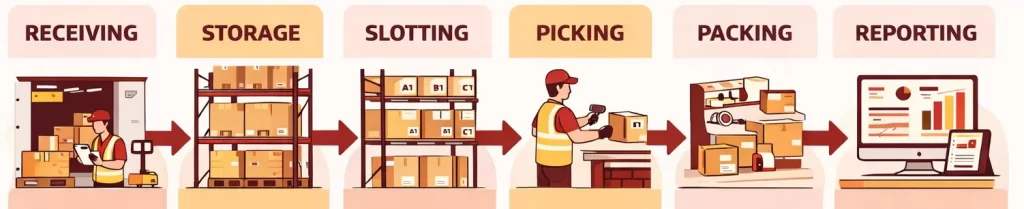
Understanding the critical processes in warehouse management is essential for ensuring smooth operations and customer satisfaction. Each step contributes to overall efficiency, helping businesses meet demand and minimize errors.
1. Receiving
Receiving is the first step in warehouse management. It involves inspecting incoming goods, updating inventory systems, and organizing items for storage. Efficient management minimizes discrepancies and ensures accurate inventory records.
2. Storage
Practical storage maximizes space and provides easy access to products. Appropriate storage systems and slotting techniques enhance organization, ensuring high-demand items are easily retrievable.
3. Slotting
Slotting is the strategic inventory placement within the warehouse to optimize retrieval and storage efficiency. By analyzing item popularity and dimensions, businesses can position high-demand products closer to picking areas, reducing travel time and improving workflow.
4. Picking
Picking involves selecting items for customer orders and directly affects speed and accuracy. Employing batch or zone-picking methods and technology such as barcode scanners can streamline this process and reduce errors.
5. Packing
Packing ensures items are securely prepared for shipping, minimizing damage during transit. Labelling and standardized packing procedures help maintain consistency and improve processing efficiency at delivery points.
6. Shipping
Shipping is the final step, where goods are dispatched to customers. Efficient shipping operations reduce lead times and ensure products arrive in optimal condition, enhancing overall customer satisfaction.
7. Reporting
Reporting involves analyzing warehouse data to monitor performance and identify areas for improvement. Regular reporting helps businesses track key metrics, such as order accuracy and inventory turnover, enabling informed decision-making and strategic planning.
Common Struggles With Warehouse Management in 2026
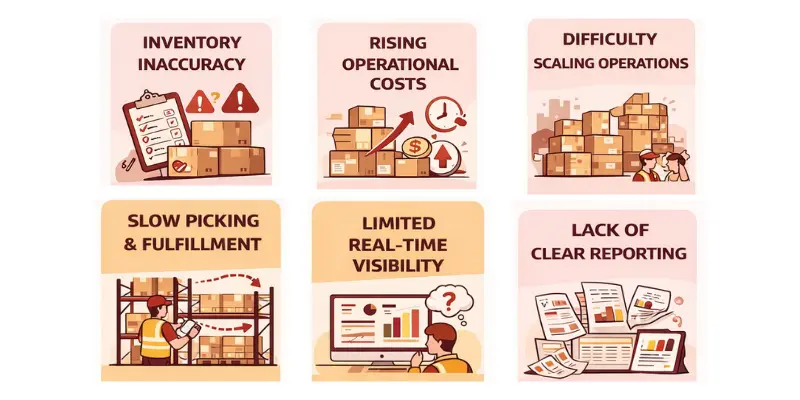
Warehouse management in 2026 remains a challenge for many businesses as order volumes grow, customer expectations rise, and operations become more complex. Technology is not the solution to all problems; advanced tools are useless if it not used well. Here are some of the most common warehouse management struggles businesses face today:
1. Inventory inaccuracy
One of the biggest warehouse problems is inaccurate inventory data. Stock records often do not match actual quantities because of manual entry mistakes, delayed updates, or untracked movements. As a result, businesses may face stockouts, overstocking, and order errors that disrupt operations and damage customer trust.
2. Slow picking and fulfillment
Many warehouses still struggle with inefficient picking routes and disorganized storage layouts. When workers spend too much time locating items, order processing becomes slower and labor productivity drops. This issue becomes even more serious when businesses handle higher-order volumes and tighter delivery expectations.
3. Rising operational costs
Warehouse costs continue to rise due to labor expenses, storage inefficiencies, returns handling, and avoidable process delays. Without streamlined workflows, businesses often spend more than necessary to move, store, and manage the same amount of inventory.
For example, poor slotting decisions can increase travel time for pickers and create bottlenecks during busy periods. Over time, these inefficiencies raise operating costs and make it harder for businesses to maintain healthy profit margins.
4. Limited real-time visibility
Another common struggle is the lack of real-time visibility across warehouse activities. When managers cannot see stock movement, pending orders, or bottlenecks as they happen, decision-making becomes slower and less accurate. This makes it harder to respond quickly to demand changes or operational issues.
5. Difficulty scaling operations
As businesses grow, warehouse processes that once worked manually often become harder to manage. More orders, more SKUs, and more storage locations create complexity that can overwhelm existing workflows. Without a more structured approach, growth can lead to more errors instead of better performance.
6. Lack of clear reporting and performance insights
Many warehouses also struggle to turn daily activities into clear, actionable reports. When stock movement, picking performance, order status, and warehouse bottlenecks are tracked in separate files or updated inconsistently, managers often end up reviewing outdated or incomplete information.
This makes it harder to spot recurring issues, measure productivity accurately, and improve operations based on reliable data. As warehouse complexity increases, businesses usually need a more connected way to monitor performance, generate reports faster, and support better operational decisions.
Warehouse Management vs Inventory Management: Understanding the Difference
Both management styles serve distinct purposes but complement each other. Warehouse management focuses on day-to-day operations within the warehouse and optimizes storage and fulfilment processes, particularly in a warehouse storage system.
In contrast, inventory management systems track stock levels, orders, and deliveries across the supply chain. While warehouse management enhances warehouse efficiency, inventory systems provide a broader view of product movement, ensuring that stock levels align with demand.
By integrating these systems, businesses can develop a streamlined strategy for managing their products. This cohesive operation improves supply chain oversight, reduces costs, and enhances service quality.
Core Principles of Warehouse Management

Grasping the core principles of warehouse management is essential for optimizing operations and enhancing customer satisfaction. Each principle contributes uniquely to creating a thriving warehouse environment.
1. Understand your goals
It’s essential to define the specific aims of your warehouse operations clearly. This includes assessing customer delivery needs and specialized storage requirements and maximizing space, labour, and equipment use.
2. Holistic oversight
Managing the intricate processes involving personnel, equipment, orders, and inventory is critical. Monitoring each aspect ensures smooth operations and allows for timely resolutions to any challenges, maintaining quality control for accurate order fulfilment.
3. Adaptability and resilience
The ability to quickly adjust plans in response to unexpected issues, such as damaged goods or adverse weather conditions, is crucial. Modifying workflows can enhance efficiency through strategic rearrangements or innovative picking methods.
4. Customer-centric approach
Delivering the right product on time is vital for ensuring customer satisfaction. Rapid and precise order fulfilment is key to meeting customer expectations effectively.
5. Data-driven decision making
Implementing a Warehouse Management System (WMS) offers real-time insights into inventory levels, helping to identify areas for improvement. Regular data analysis supports process optimization and boosts operational efficiency.
Conclusion
Effective warehouse management is crucial for improving operational efficiency and customer satisfaction. By implementing an efficient Warehouse Management System (WMS), businesses can streamline inventory tracking, reduce costs, and improve space utilization. Adopting the right WMS software can ensure timely deliveries, minimize errors, and significantly boost productivity.
A more structured management approach also helps businesses stay prepared for future growth. When stock movement, fulfillment, and reporting are easier to control, managers can make faster decisions while maintaining service quality, even as warehouse demands become more complex.
FAQ for Warehouse Management
-
What are the most common warehouse management problems?
The most common warehouse management problems include inventory inaccuracies, slow picking and fulfillment, rising operational costs, limited real-time visibility, and difficulty scaling operations. These issues often become more serious when businesses still rely on manual tracking or disconnected processes.
-
How can businesses improve warehouse inventory accuracy?
Businesses can improve inventory accuracy by applying consistent receiving procedures, organizing storage locations clearly, using barcode-based tracking, and conducting regular cycle counts. Accurate inventory records help reduce stock discrepancies, prevent order errors, and support smoother warehouse operations.
-
What is cycle counting in warehouse management?
Cycle counting is a stock-checking method where businesses count small portions of inventory regularly instead of stopping operations for a full physical count. This approach helps maintain inventory accuracy, detect discrepancies earlier, and reduce disruption in daily warehouse activities.
-
What is the difference between warehouse management and inventory management?
Warehouse management focuses on how goods move, are stored, picked, packed, and shipped inside the warehouse. Inventory management has a broader role, focusing on stock levels, replenishment, and product availability across the supply chain. Both work closely together, but they are not the same.
-
How do you run warehouse operations more efficiently?
To run warehouse operations more efficiently, businesses need a clear warehouse layout, standardized receiving and picking procedures, better slotting, accurate reporting, and faster visibility into stock movement. Improving these areas helps reduce delays, control costs, and keep fulfillment more consistent.