












Workplace conflict can quickly tank your team’s productivity and morale. In the Malaysian business landscape, ignoring these frictions often creates serious operational hurdles. You need to address these issues early to ensure your business remains stable and efficient.
Malaysia’s diverse professional environment often faces communication gaps and cultural differences, especially within hybrid work models. This aligns with findings from the Society for Human Resource Management (SHRM), showing that over half of employees lose job satisfaction due to unresolved disputes. By understanding these triggers, you can prevent minor disagreements from escalating into major organizational crises.
This guide provides practical frameworks to resolve disputes effectively while maintaining a healthy work culture. Mastering these strategies helps you foster a more resilient and collaborative environment. Read on to discover how you can navigate workplace challenges and build a more cohesive team for long-term success.
Key Takeaways
|
Having explored the key strategies for conflict resolution, it’s now time to implement these practices effectively within your organization. To ensure your workforce stays aligned, productive, and compliant across departments, take the next step in optimizing your HR processes.

What Is Conflict Resolution in the Workplace?
Conflict resolution in the workplace refers to the process of helping employees or teams reach a workable solution to a disagreement. The goal is not simply to stop arguments. Instead, it is to identify the source of tension, address it fairly, and restore a productive working relationship.
Not all workplace conflict is harmful. In some cases, conflict can be constructive. When employees challenge ideas respectfully, they can improve decision-making, reduce groupthink, and encourage innovation. However, conflict becomes destructive when it turns personal, damages trust, or creates a hostile work environment.
That is why businesses need to distinguish between healthy disagreement and harmful disruption. When leaders respond early and appropriately, conflict can become an opportunity to strengthen communication, clarify expectations, and improve team dynamics.
The Most Common Causes of Workplace Conflict
Workplace conflict rarely appears without warning. In most cases, it develops from unresolved issues that continue to build over time. Understanding these causes is the first step toward solving them effectively.
1. Communication breakdowns
Poor communication is one of the most common reasons conflict begins. Unclear instructions, vague responsibilities, inconsistent feedback, and limited transparency can all create confusion. When employees do not fully understand expectations, misunderstandings become more likely.
2. Personality clashes and different working styles
Employees often have different ways of thinking, communicating, and approaching deadlines. Some prefer structure and process, while others work more flexibly and spontaneously. Without mutual understanding, these differences can easily lead to friction.
3. Competing priorities and limited resources
Conflict often increases when teams must compete for time, budget, manpower, or leadership support. When priorities are not clearly aligned, departments may begin working against each other rather than toward shared goals.
4. Perceived unfairness
Employees are more likely to feel resentment when they believe rewards, promotions, or opportunities are not distributed fairly. Inconsistent policy enforcement can also damage trust, especially when certain employees appear to be treated differently from others.
5. Poor leadership
Managers play a major role in either preventing or escalating conflict. Micromanagement, indecisiveness, favouritism, and failure to address toxic behaviour can all turn leadership into the main source of tension within a team.
The Hidden Costs of Ignoring Workplace Disputes
Some businesses assume workplace conflict will fade on its own. In reality, ignoring it usually makes the situation worse. When leaders delay action, the problem often spreads beyond the people directly involved.
- Productivity loss:
When employees caught in conflict, they spend more energy on stress, frustration, and avoidance than on actual work. This weakens concentration making slows progress, and increases the likelihood of mistakes. - Employee turnover:
High performers, who typically have the most options, will not tolerate a toxic environment for a long time. When they leave, businesses lose valuable knowledge and must spend more time and money on recruitment and training. - Legal and reputational risk:
Under Malaysian law, particularly the Employment Act 1955 and the Industrial Relations Act 1967, employers have a legal obligation to maintain fair and safe working conditions. If unresolved conflict escalates into harassment, bullying, or discrimination, the organisation may face formal complaints and serious damage to employer trust.
5 Conflict Resolution Styles and When to Use Them
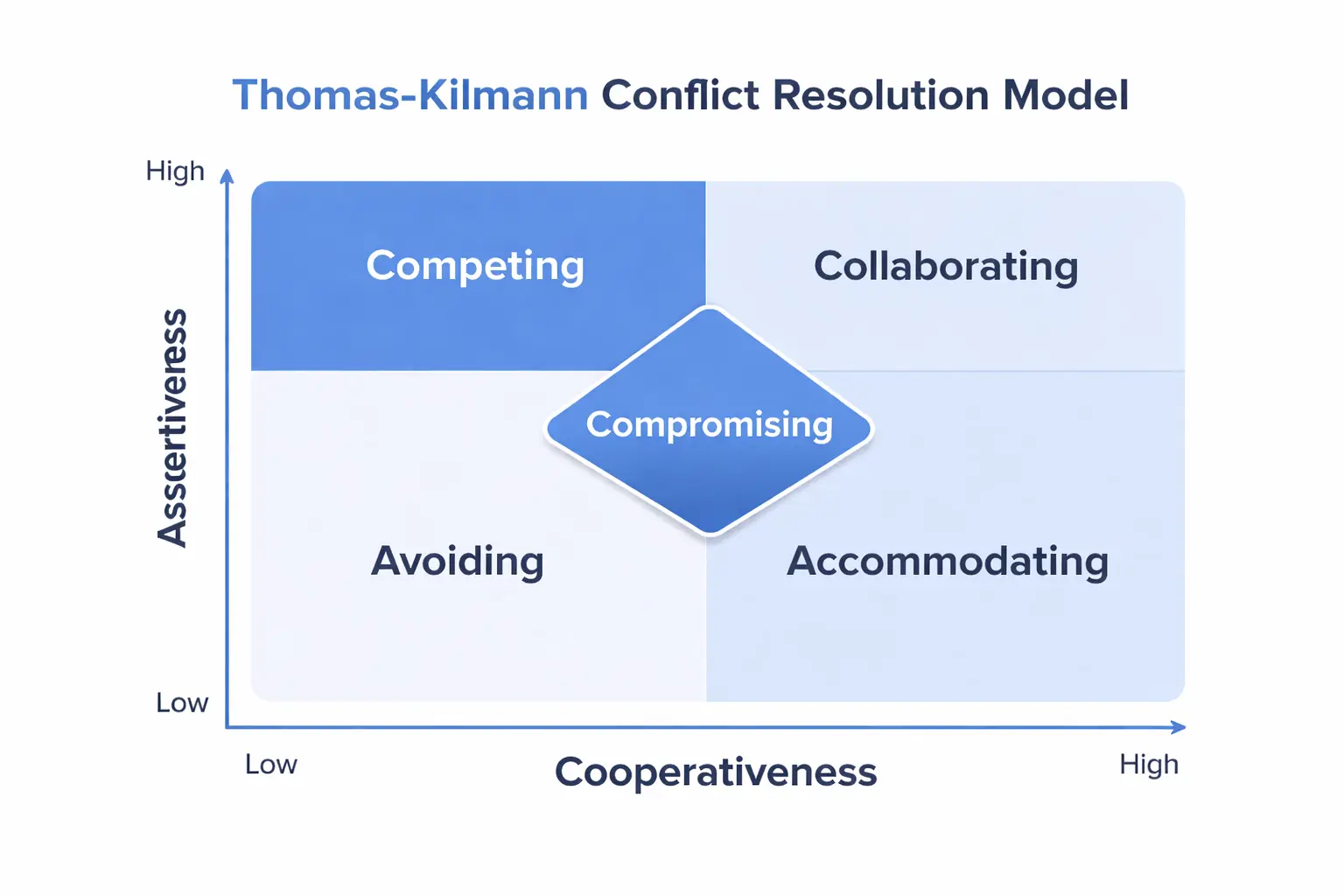
Conflict resolution does not follow one single method. Different situations require different responses. A well-known framework identifies five main styles, each suited to particular circumstances.
- Competing: This style focuses on achieving a clear outcome quickly. It is most useful in urgent situations or when leaders must enforce non-negotiable rules, policies, or compliance requirements
- Accommodating: This style involves giving more weight to the other person’s concern. It works best when the issue matters more to the other party, or when maintaining goodwill is more valuable than winning the disagreement.
- Avoiding: Avoiding means stepping back temporarily instead of confronting the issue right away. This can be useful when emotions are too high, or when the issue is too minor to justify a direct confrontation at that moment.
- Compromising: Compromising aims for a middle ground where both sides give up something. It is often practical when both parties have equal influence and a quick, temporary solution is needed.
- Collaborating: Collaborating is usually the most effective long-term style for important disputes. It focuses on understanding both sides fully and finding a solution that addresses shared interests rather than personal positions.
Managers and HR teams should avoid relying on only one approach. The right style depends on the urgency, power dynamics, emotional intensity, and long-term impact of the issue.
A 7-Steps Framework for Effective Conflict Resolution

When conflict occurs, managers need a clear process rather than an emotional reaction. The framework below helps create a more objective and constructive discussion.
Step1. Pause and assess the situation
Before stepping in, take time to understand who is involved, what triggered the conflict, and whether deeper issues may exist behind the surface problem. Preparation also includes reviewing any relevant policies.
Step 2. Choose a private and neutral setting
Do not address serious conflict in public. A private, calm setting reduces defensiveness and makes it easier for both parties to speak honestly.
Step 3. Listen actively to each side
Allow each person to explain their perspective without interruption. Focus on understanding, not debating. Paraphrasing their concerns can help both sides feel heard and reduce emotional tension.
Step 4. Identify the root cause
The visible disagreement is often only the symptom. The real issue may involve unclear expectations, lack of trust, workload imbalance, or deeper interpersonal frustration. Ask open-ended questions to uncover that root cause.
Step 5. Explore solutions together
Once the real issue is clear, guide both parties toward practical solutions. Involving them in the discussion increases ownership and makes the final agreement more realistic.
Step 6. Agree on an action plan
Turn the discussion into a clear next step. Define what each person will do, what behaviour is expected, and when progress will be reviewed. Documenting this agreement helps create accountability.
Step 7. Follow up
Conflict resolution should not end after one meeting. A follow-up check allows managers to confirm whether the solution is working and whether additional support is needed.
The Strategic Role of HR in Conflict Resolution
HR should not be seen only as a department that handles complaints after problems arise. In strong organisations, HR plays a wider role in shaping how conflict is prevented, reported, and resolved.
- First, HR acts as a neutral mediator in more serious or sensitive cases, especially when there is a power imbalance. This is particularly important when an employee is in conflict with a direct supervisor or when multiple departments are involved.
- Second, HR acts as a capability builder. Instead of resolving every issue personally, HR should equip managers with the skills to handle routine disagreements early. Training in active listening, emotional intelligence, and difficult conversations can reduce escalation significantly.
- Third, HR acts as a data-driven advisor. By monitoring turnover, absenteeism, performance changes, and employee feedback, HR can identify early warning signs of deeper team issues. A reliable HR management system makes this process much easier by centralising employee records and behavioural indicators.
Finally, HR acts as a policy owner. Employees need to know how to raise concerns, who to contact, and what process will follow. Clear grievance procedures create trust because people understand that issues will be handled fairly and consistently.
Proactive Strategies to Prevent Conflict Before It Starts

The best way to manage workplace conflict is to prevent destructive patterns before they become serious disputes. Prevention requires both leadership discipline and strong HR support.
- Build psychological safety:
Employees should feel safe speaking up about concerns, questions, mistakes, or disagreements. When people can raise small frustrations early, those frustrations are less likely to turn into major conflict later.
- Set clear expectations from the beginning:
Teams work better when roles, communication norms, and decision-making processes are clearly defined. This reduces ambiguity and limits the misunderstandings that often trigger conflict.
- Create multiple reporting channels:
Employees should have more than one safe way to raise concerns. Besides speaking to a direct manager, they should also be able to approach HR or use structured review processes. A proper performance appraisal system can help surface recurring issues before they escalate.
- Train leaders consistently:
Managers are the first line of defence against workplace conflict. Regular training on de-escalation, empathy, and feedback delivery helps them address tensions more effectively. This also supports a stronger employee value proposition, because employees are more likely to stay where communication feels fair and respectful.
How HR Software Supports Conflict Resolution in Malaysian Workplaces
A comprehensive HR platform helps businesses centralise employee data, document grievances, monitor attendance patterns, and track performance issues that may indicate deeper tension within a team. It also helps managers respond based on evidence rather than assumptions.
For example, performance tracking can highlight disengagement early. Attendance and leave analytics may reveal sudden behavioural changes. Transparent payroll processes can reduce disputes linked to perceived unfairness, especially when supported by structured payroll workflows and documentation. Businesses that want stronger process consistency can also review how a payroll software Malaysia setup supports transparency in employee administration.
More broadly, companies looking to connect employee records, appraisal workflows, and operational HR processes can benefit from understanding the role of an HRIS system and how it supports day-to-day people management.
Conclusion
Workplace conflict is inevitable, but poor handling is not. When Malaysian businesses respond with structure, fairness, and consistency, conflict becomes more manageable and far less damaging.
By understanding the main causes of conflict, applying the right resolution style, and following a practical framework, HR teams can reduce disruption and protect team performance. More importantly, proactive leadership and clear systems help create a workplace culture where issues are addressed early rather than ignored.
If your business wants to manage employee relations more consistently, improve documentation, and gain better visibility into workplace issues, HR software can help support that process at scale and give you free demo to try it first.

FAQ About Conflict Resolution in the Workplace
-
What is conflict resolution in the workplace?
Conflict resolution in the workplace is the process of addressing disagreements between employees or teams in a structured and constructive way. The goal is to solve the issue fairly, restore collaboration, and prevent the same problem from happening again.
-
What is the most common cause of workplace conflict?
Poor communication is one of the most common causes of workplace conflict. Unclear instructions, vague responsibilities, inconsistent feedback, and misunderstandings often create tension between employees and teams.
-
How should HR handle conflict between employees?
HR should assess the situation objectively, meet both parties in a private setting, listen to each perspective, identify the root cause, and guide them toward a documented action plan. Follow-up is important to make sure the solution actually works.
-
Why is unresolved workplace conflict dangerous?
Unresolved conflict can reduce productivity, increase employee turnover, damage morale, and create legal or reputational risk. The longer the issue is ignored, the more difficult and costly it usually becomes to fix.
-
How can HR software help with conflict resolution?
HR software helps businesses track employee records, attendance patterns, performance issues, and grievance documentation in one place. This gives HR teams better visibility and makes conflict management more consistent and organised.