













The era of “one-size-fits-all” marketing is officially over. Today, businesses aren’t speaking to a single, uniform audience; they’re engaging with individuals who expect brands to recognize their specific needs. This shift has turned customer segmentation from a simple marketing tactic into the foundation of any business looking to stay relevant and scale.
Your CRM is the engine that makes this personalization possible by acting as a central hub for all customer data. However, the real value isn’t just in gathering information, but in how you categorize it to reveal unique preference, different behaviors,and pain points. By segmenting your audience directly within your CRM, you can stop sending generic messages and start targeting profitable niches with pinpoint accuracy.
In the following sections, we will break down the essential strategies to master customer segmentation and explore how the right software solutions can automate this entire process to maximize your marketing ROI.
Key Takeaways
|
Once your segmentation framework is in place, pairing it with the right sales technology can streamline execution and improve forecasting.

What Customer Segmentation Actually Means Inside a CRM System
Customer segmentation categorizes your audience by shared traits and behaviors, replacing the “one-size-fits-all” approach that modern consumers now find easy to ignore. Because people are flooded with generic marketing daily, only personally relevant messaging has the power to actually cut through the noise.
By integrating this into a CRM, segmentation becomes a live process that automatically updates based on every website visit or purchase. This ensures customers move between groups in real-time, keeping your communication perfectly aligned with their current relationship with your brand.
The Core Types of Customer Segmentation
To implement an effective segmentation strategy, businesses must understand the different dimensions by which an audience can be divided. Typically, customer segmentation is categorized into several core types, each offering a unique lens through which to view the customer base. Combining these types yields the most comprehensive and actionable customer profiles.
| Segmentation Type | Core Focus | Strategic Value | Practical Example |
| 1. Demographic Segmentation | Categorize audience using quantifiable stats: age, income, education, marital status | High-value starting point; easy data collection; enables targeting specific life stages | Student loans for young adults or retirement plans for seniors |
| 2. Geographic Segmentation | Map audience by location: countries, regions, cities, or zip codes | Ensures brand relevance, aligns marketing with local weather, culture & purchasing power | Not selling winter coats in tropical regions, localizing campaigns for cultural nuances |
| 3. Psychographic Segmentation | Group customers by values, lifestyle, personality & motivations | Builds deep emotional loyalty, transcends price competition through value-based connection | Ethical sourcing brand targeting customers who prioritize sustainability & social responsibility |
| 4. Behavioral Segmentation | Track actual interactions: purchase history, browsing habits, email engagement | Highly predictive of future behavior, enables pinpoint-accurate incentives & triggers | Sending discount codes to cart abandoners: inviting frequent buyers into VIP loyalty programs |
| 5. Firmographic Segmentation (B2B) | Categorize organizations by size, revenue, industry & location | Enables tailored messaging & sales funnels aligned to each company’s budget & decision process | Different outreach strategies for a 10-person startup vs a Fortune 500 enterprise client |
| 6. Technographic Segmentation | Categorize audiences by tech stack: hardware preferences, software tools, platforms used | Competitive edge for SaaS; highlights integrations & removes technical friction in sales | Targeting iOS users with mobile-first features, highlighting CRM integration for Salesforce users |
Why Customer Segmentation Matters for Business Growth
Implementing a robust customer segmentation strategy requires time, resources, and sophisticated technology. However, the return on investment makes it one of the most impactful initiatives a business can undertake. Segmentation directly influences marketing efficiency, sales effectiveness, and overall customer satisfaction.
Enhanced Personalization and Customer Experience
Customers expect brands to understand their needs and deliver relevant experiences. Segmentation helps businesses tailor content, offers, and recommendations to different customer groups. It also makes it easier to design customer journeys that feel more useful and personal. As a result, customers are more likely to trust the brand and return for future purchases.
Optimized Resource Allocation and Marketing ROI
Marketing budgets are limited, so businesses need to spend them where they will have the most impact. Segmentation helps identify the most valuable customer groups and focus campaigns on them. This improves targeting, reduces wasted spending, and increases the chance of stronger returns. It also helps businesses review weak segments and adjust strategies before more budget is lost.
Improved Customer Retention and Churn Reduction
Keeping existing customers is often more cost-effective than finding new ones. Segmentation helps businesses identify groups that show signs of lower engagement or declining activity. With this insight, companies can respond early through targeted offers, follow-up campaigns, or more personalized support. These actions can improve customer retention and reduce the risk of customer churn over time.
Better Product Development and Refinement
Segmentation is not just a marketing tool; it is a vital asset for product development teams. By analyzing the feedback, usage patterns, and feature requests of different customer segments, businesses can identify gaps in the market and areas for product improvement. If a specific segment of power users consistently requests a new feature, the product team can prioritize that development, knowing there is a validated demand.
Leveraging CRM for Effective Segmentation
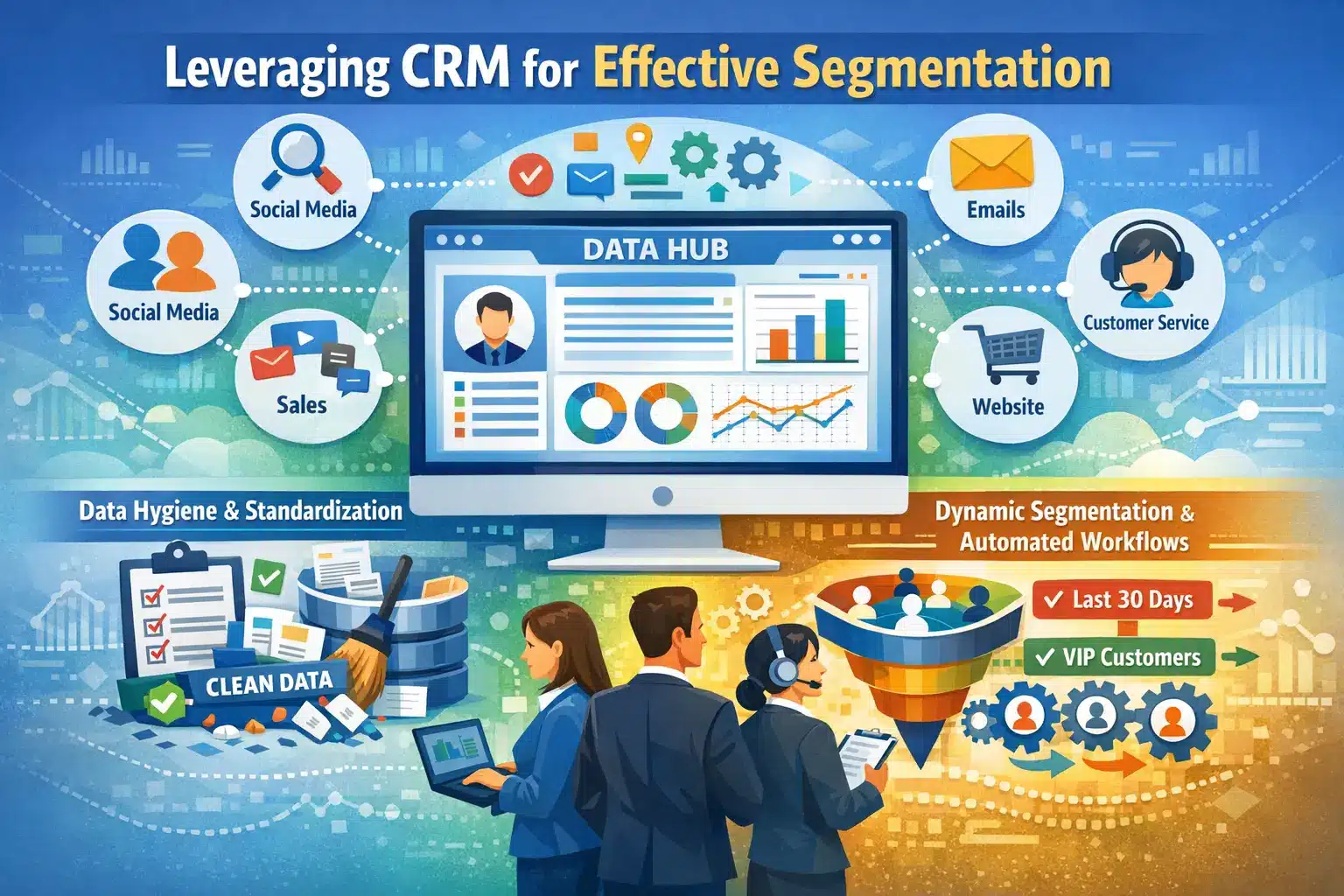
While the concept of segmentation is straightforward, executing it at scale requires the right technological infrastructure. A CRM system is the ideal engine for driving segmentation because it centralizes all customer data into a single source of truth. Here is how businesses can leverage their CRM to maximize the effectiveness of their segmentation efforts.
Centralized Data Hub
A CRM gathers data from multiple touchpoints, including websites, social media, email campaigns, customer service, and sales interactions. This creates a unified customer profile that every team can access. As a result, marketing, sales, and support work with the same data instead of relying on separate systems. This eliminates data silos and improves overall segmentation accuracy.
Data Hygiene and Standardization
Segmentation is only as strong as the data behind it. Businesses must standardize formats, remove duplicates, and update outdated records to maintain data quality. Clean data ensures customers are placed in the correct segments and prevents errors in automated workflows. Without proper data hygiene, segmentation becomes unreliable and leads to poor targeting.
Dynamic Segmentation and Automated Workflows
Modern CRM systems support dynamic segmentation that updates automatically based on real-time behavior. For example, customers who made a recent purchase can enter or exit a segment without manual input. This keeps audience lists always up to date and relevant. As a result, businesses can run more targeted campaigns with less effort and higher accuracy.
Advanced Strategies: Predictive and AI-Driven Segmentation
As technology advances, the capabilities of CRM segmentation are expanding beyond traditional rule-based filtering. The integration of Artificial Intelligence (AI) and machine learning algorithms is ushering in an era of predictive segmentation, allowing businesses to anticipate customer needs before they even articulate them.
RFM Analysis (Recency, Frequency, Monetary)
RFM analysis is a data-driven technique that scores customers based on Recency (last purchase), Frequency (total orders), and Monetary (total spend). By evaluating these metrics, your CRM automatically categorizes users into actionable groups—such as “Champions” (loyal high-spenders), “At-Risk” (lapsing customers), or “New Customers.” This allows you to ditch generic outreach for surgical retention and upselling strategies.
Machine Learning Algorithms
Advanced CRM platforms utilize machine learning to analyze massive datasets at speeds impossible for human analysts. These algorithms can identify hidden correlations and micro-segments that traditional analysis might miss. For example, AI might discover that customers in a specific geographic region who purchase a particular product combination are highly likely to upgrade to a premium service within six months. Businesses can then proactively target this micro-segment with upgrade offers.
Predictive Analytics for Future Behavior
Predictive segmentation uses historical data to forecast future actions. By analyzing past behaviors, AI can assign probability scores to individual customers regarding their likelihood to churn, their likelihood to open an email, or their propensity to purchase a specific product. This allows marketing and sales teams to focus their efforts on the customers with the highest probability of conversion, maximizing efficiency and ROI.
How to Implement a Customer Segmentation Strategy
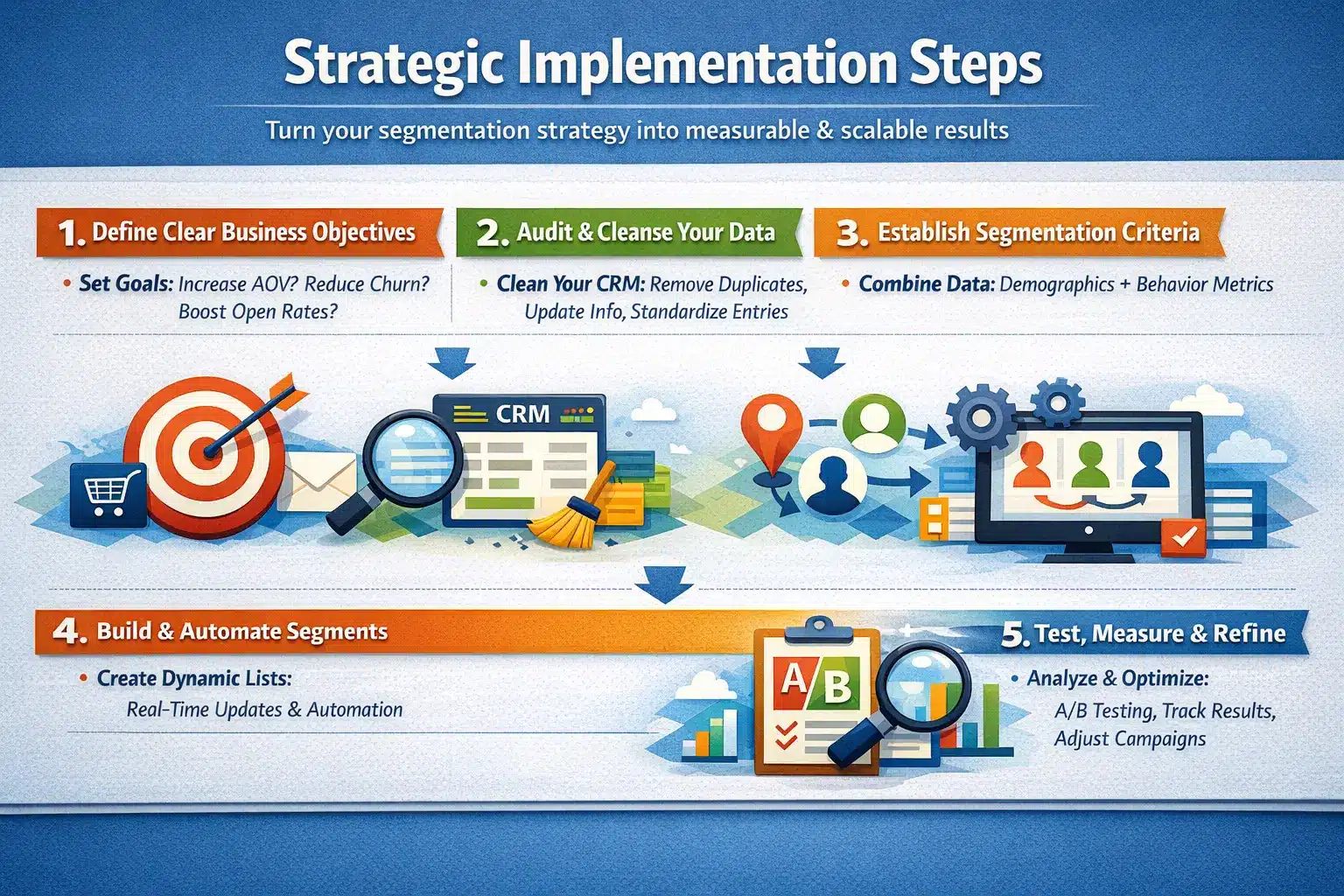
Transitioning from a theoretical segmentation model to a functional, CRM-driven reality requires a systematic approach. Follow these implementation steps to ensure your segmentation strategy yields measurable and scalable results:
- Step 1: Define Clear Business Objectives: Before manipulating data, determine exactly what you want to achieve. Are you trying to increase the average order value (AOV), reduce customer churn, or boost email open rates? Your overarching goals will dictate the specific types of segments you need to build.
- Step 2: Audit and Cleanse Your Data: Segmentation is only as good as the data powering it. Audit your CRM to remove duplicate records, update outdated contact information, and ensure data entry standardization. Clean data prevents misdirected marketing, reduces bounce rates, and protects your brand reputation.
- Step 3: Establish Segmentation Criteria: Decide which data points are most relevant to your goals. This often involves combining demographic data (e.g., location, job title) with behavioral metrics (e.g., website visits, past purchases, email click-through rates) to create multidimensional profiles.
- Step 4: Build and Automate Segments: Utilize your CRM’s filtering and automation tools to create dynamic lists. Unlike static spreadsheets, dynamic segments automatically update in real-time as customers meet or fail to meet the defined criteria, ensuring your lists are always accurate.
- Step 5: Test, Measure, and Refine: Launch targeted campaigns to your new segments and closely monitor the analytics. Use A/B testing on subject lines, offers, and send times to see what resonates best with each specific group, refining your criteria and messaging over time based on actual performance data.
Common Pitfalls to Avoid

Even with the best intentions and a powerful CRM, businesses can stumble when executing customer segmentation. Being aware of these common pitfalls can save valuable time and resources:
- Over-Segmentation: While granularity is important, creating too many hyper-specific segments can become a logistical nightmare. If a segment is too small, the return on investment for creating customized content won’t justify the effort required. Aim for a strategic balance between high relevance and manageable scale.
- Relying on Static Data: Customer preferences and life circumstances change constantly. A segment built on data from three years ago is likely obsolete. Failing to use dynamic CRM lists means you risk sending irrelevant offers to customers whose interactions with your brand have fundamentally shifted.
- Ignoring the “Why” (Psychographics): Many companies focus heavily on demographic and transactional data simply because it is easy to measure. However, ignoring psychographic data—such as a customer’s values, motivations, and pain points—can result in messaging that feels tone-deaf, superficial, or disconnected from the customer’s actual needs.
Conclusion
Customer segmentation is no longer an optional marketing trick. It is the only way to build genuine relationships today. By utilizing a modern CRM, you turn raw data into action. This allows your brand to speak directly to specific needs.
Moving away from generic messaging instantly boosts your marketing efficiency. You can allocate your budget to the most profitable groups. Meanwhile, dynamic automation ensures your lists are always perfectly updated. As a result, you save valuable time while increasing conversions.
The key to success is keeping your initial segmentation strategy simple. Let a modern CRM do the heavy lifting of tracking changing customer behaviors automatically. The easiest way to visualize this impact is by exploring the software firsthand. Request your free demo today to see how seamlessly you can transform data into growth.

Frequently Asked Questions About Customer Segmentation
-
What is customer segmentation in a CRM system?
Customer segmentation within a CRM involves categorizing your customer base into distinct groups based on shared characteristics such as demographics, behavioral patterns, and purchasing history. This strategy allows businesses to replace generic marketing with highly targeted, personalized campaigns.
-
How are Malaysian consumer shopping trends shifting?
Malaysian consumers are increasingly demanding personalized shopping experiences and seamless omnichannel engagement. Buyers expect brands to understand their unique preferences and pain points, making data-driven targeting more critical than ever.
-
Why is CRM adoption a top priority for Malaysian SMEs?
Business sentiment and economic insights indicate that digital transformation remains a fundamental survival strategy. Adopting a CRM allows Malaysian businesses to consolidate fragmented data, automate repetitive workflows, and execute precise segmentation, which is vital for optimizing marketing budgets in a competitive economy.
-
What are the most effective types of customer segmentation?
The most common and effective models include demographic (age, income), geographic (location), psychographic (lifestyle, values), and behavioral (purchase history, engagement). For B2B organizations, firmographic segmentation (company size, industry) is essential for tailoring professional outreach.
-
Can customer segmentation directly improve marketing ROI?
Yes. By leveraging CRM data to identify high-value customer niches, businesses can stop wasting advertising spend on broad, unresponsive audiences. Segmented and personalized campaigns consistently drive higher conversion rates, reduce customer acquisition costs (CAC), and maximize Return on Investment (ROI).