







Progress billing is a structured system that helps businesses manage payments across multiple project stages. Have you experienced handling a project where tracking payments feels harder than completing the actual work?
Despite its advantages, challenges persist, including unclear payment schedules and invoicing errors that disrupt operations. According to BusinessWorld, 20% of projects in the Philippines face delays due to payment disputes and inefficient billing systems.
If you want to streamline your workflow and speed up payment collection, it’s worth exploring how progress billing can transform your operations. Continue reading to learn more and to see how automation can simplify the entire billing process.
Key Takeaways
Progress billing is a payment approach where sellers invoice clients incrementally as specific milestones are completed, ensuring steady cash flow and greater transparency throughout long-term projects
Progress billing benefits both contractors and clients. Contractors gain steady cash flow and reduced non-payment risk, while clients enjoy lower upfront costs and better budget management.
A progress billing invoice typically includes the original contract amount, total paid to date, percentage of work completed, approved changes, and the client’s remaining balance.
Implementing progress billing involves developing a schedule of values, establishing a payment schedule, drafting a clear contract, and issuing invoices after each milestone is completed and reviewed.
What is Progress Billing?
Progress billing is a widely adopted payment approach for long-term projects, where sellers invoice clients incrementally as specific milestones are completed rather than charging a single lump sum. This method ensures steady cash flow for contractors while giving clients greater transparency over how their money is being spent at each stage. It is especially common in construction, where contractors bill for completed phases in line with agreed project milestones and is closely tied to broader billing and invoicing practices used across project-based industries.
Progress Billing Benefits

Progress billing creates a more balanced and transparent financial arrangement for both contractors and clients throughout the life of a long-term project.
Benefits for Contractors
- Steady cash flow: Receiving payments in defined increments allows contractors to manage ongoing expenses — materials, labor, subcontractors — without relying on loans or credit lines that erode profit margins.
- Simplified financial management: Breaking payments into stages makes it easier to budget accurately for each project phase, ensuring sufficient funds are available to keep operations on track.
- Reduced risk of non-payment: Tying compensation to completed milestones protects contractors from finishing an entire project without being paid, and gives them the option to pause work if payments are delayed.
- Easier resolution of payment issues: Tracking when payments are due and identifying discrepancies early allows contractors to address issues proactively before they escalate into prolonged disputes.
- Motivates client compliance: Linking payments to milestones keeps clients engaged and financially committed, fostering a collaborative environment focused on project completion.
Benefits for Clients
- Reduced upfront costs: Spreading payments across milestones eliminates the need for a large initial outlay, making it easier to begin projects without significant financial strain.
- Lower financial risk: Clients pay only for completed and approved work, keeping contractors accountable for quality and deadlines before funds are released.
- Encourages quality and timely work: Contractors are incentivized to meet milestones on schedule, while the approval requirement before payment discourages rushed or substandard outputs.
- Improved budget management: Distributing costs over the project timeline supports better resource allocation and avoids unexpected financial pressure.
What does Progress Billing Include?
Progress billing is a detailed invoicing system built around key components agreed upon by both contractors and clients. These elements ensure transparency, accountability, and alignment throughout the project:
- Original contract amount: The agreed total project cost that serves as the foundation for all billing calculations.
- Total amount paid to date: A running record of what the client has already paid, giving both parties a clear view of completed transactions.
- Percentage of work completed: The proportion of the project finished at each billing stage, directly tying payments to measurable progress.
- Approved changes and adjusted amounts: Documentation of any scope changes or revisions, ensuring the billing remains accurate and up to date.
- Client’s remaining balance: The outstanding amount owed at the end of the project, helping both parties manage their financial planning through to completion.
Regardless of industry or location, a well-structured progress billing format created with HashMicro invoice software keeps all stakeholders informed and ensures consistency and fairness throughout the invoicing process.
The Difference between Progress Billing and Down Payment

Progress billing and down payment both play important roles in project finance, but they serve distinct purposes. Understanding the difference helps businesses select the right payment structure for their needs.
| Aspect | Progress Billing | Down Payment |
| Definition | Payment made in stages based on completed work or milestones. | Initial payment made upfront before work begins. |
| Purpose | Tracks project progress and aligns payments with actual work completed. | Acts as a security deposit to start work or reserve resources. |
| Timing | Collected throughout the project lifecycle. | Paid at the beginning of a project or purchase agreement. |
| Payment Structure | Installments tied to specific milestones or completion percentages. | One-time upfront amount or percentage of total cost. |
| Buyer Benefits | Flexibility and transparency in monitoring progress and financial commitments. | Confirms buyer intent and secures the transaction. |
| Seller Benefits | Ongoing cash flow based on verified progress. | Initial financial assurance before work begins. |
| Use Cases | Long-term, service-based, or project-driven work. | Purchases requiring upfront commitment or resource reservation. |
| Supporting Tools | Often paired with invoice software for accurate tracking and management. | Can also use invoice software to manage payment records. |
Progress Billing Types
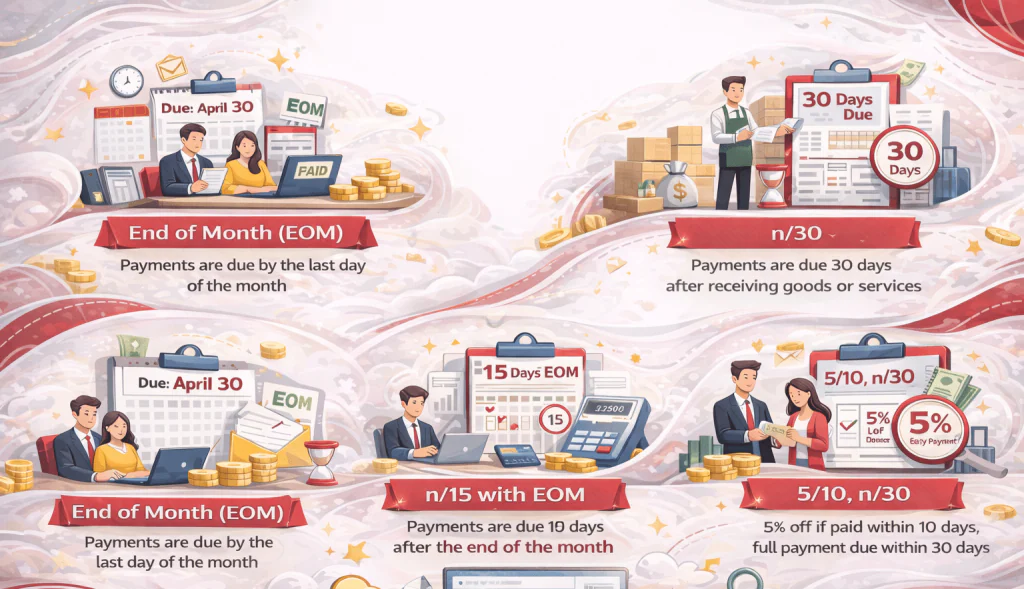
Progress billing can be structured in several ways depending on the terms agreed upon between buyer and seller. Each type offers a different approach to scheduling and managing payments.
1. End of Month (EOM)
This type requires buyers to settle payments by the end of the month, with the exact due date whether the last calendar day or another agreed date defined upfront. It is widely used for its simplicity and alignment with regular financial cycles, making payment schedules easy to predict and plan around.
2. n/30
Under this arrangement, buyers have 30 days from the date of receiving goods or services to complete payment. Its straightforward terms make it one of the most common progress billing formats across industries, balancing flexibility for buyers with timely receipts for sellers.
3. n/15 with EOM
This type combines monthly accounting cycles with a short grace period, requiring payment 15 days after the end of the month in which the transaction occurred. It suits businesses that want structured deadlines while still giving buyers a brief window to manage their cash flow.
4. 5/10, n/30
This format incentivizes early payment by offering a discount such as 5% off if the buyer pays within 10 days, while the full amount remains due within 30 days. It accelerates cash flow for sellers while rewarding prompt payers, and the discount percentage can be adjusted based on mutual agreement.
Switching to a digital system simplifies handling all these billing types. Tools that support document management allow businesses to share invoices, contracts, and supporting documents easily, making progress billing more efficient and paperless.
Progress Billing Function

Progress billing serves several important functions beyond simply structuring payments, it provides documentation and accountability that supports the entire project lifecycle.
1. Reliable Transaction Record
Progress billing acts as a formal record of transactions, documenting payments made and work completed at each stage. Its clarity minimizes disputes by providing a definitive reference point in the event of errors or misunderstandings, and its legal validity reinforces trust between all parties involved.
2. Clear Work Progress Tracking
By tying payments to actual milestones from an initial deposit through to final completion progress billing holds sellers accountable while giving buyers assurance that payments correspond to delivered results. This structured timeline supports effective project management and keeps both parties aligned throughout the engagement.
3. Efficient Financial Planning
Distributing payments across project phases helps both buyers and sellers manage their finances more effectively. Buyers avoid the burden of large upfront costs, while sellers benefit from a consistent income stream that supports smoother operations and better resource allocation, can reducing financial risk for both sides.
How To Implement Progress Billing

Implementing progress billing requires a structured approach to ensure clarity and accuracy for all parties involved:
- Develop a schedule of values: Create a clear task-and-cost breakdown that aligns contractors and clients on project scope, enabling smoother management from the outset.
- Establish a payment schedule: Define milestones with corresponding payment percentages so that progress payments always reflect actual work completed.
- Draft the contract: Produce a detailed contract that specifies scope, milestones, and payment terms, this becomes the foundation for accurate billing throughout the project.
- Commence the project: Begin work according to the agreed timeline, ensuring each task stays on schedule to maintain trust and prevent delays.
- Submit an invoice: After each milestone is reached, issue an invoice that reflects the percentage of work completed, ensuring accuracy and completeness at every stage.
- Customer review: Allow the client or lender to review the invoice, confirming accuracy and resolving any discrepancies early to maintain transparent billing.
- Invoice payment: Once the invoice is approved, the client pays the billed amount minus any retainage to keep the project moving forward.
- End the project: At completion, issue the final invoice including any remaining retainage for the client’s review and final payment.
Using dedicated accounting software can streamline several of these steps by automating invoice generation, tracking payment status, and maintaining an accurate record of each milestone’s billing history.
Conclusion
Progress billing is a practical and structured payment system that benefits both buyers and sellers by distributing costs across a project’s lifecycle rather than requiring large upfront commitments. It promotes transparency, accountability, and steady cash flow, making it particularly well-suited to construction, consulting, and other long-term service engagements.
For businesses looking to manage these processes more efficiently, exploring the best invoicing and billing software available can help identify tools that automate invoice generation, track milestone payments, and reduce the administrative burden of manual billing.

FAQ About Progress Billing
Progress billing is determined by multiplying the total project cost by the percentage of work completed to date. Contractors then issue invoices based on milestone achievements, and clients release payments once they confirm the work meets expectations.
A progress payment typically follows predetermined percentages outlined in a contract. For instance, a construction agreement may require paying 20% of the project cost once specific milestones are successfully reached.
Progress payments are recorded as liabilities because the customer has paid for work that has not yet been fully delivered. Until the contractor completes the corresponding work, the amount received remains an obligation.
Progress billing in construction is a payment method where contractors invoice clients in stages based on the percentage of work completed at each project phase, rather than billing the full amount upfront. For example, a contractor may bill 20% of the total project cost once the foundation is completed, another 30% after framing is done, and so on until the project reaches full completion. This approach ensures contractors maintain steady cash flow throughout the build while giving clients the assurance that payments are tied directly to verified, completed work.