










 Limited to 100 registrants

Inventory decisions are not only operational but also strategic. LIFO or Last In First Out is a method that companies use to manage and value inventory by assuming the newest stock is sold first. While the concept is simple, the implications for cost control, tax strategies, and financial reporting are not.
It can offer tactical advantages for companies facing rising material costs or seasonal fluctuations. This article outlines how it works, why it matters, and how your business can decide if it is right for you.
Key Takeaways
LIFO is an inventory valuation method that records the most recently acquired items as the cost of goods sold. It’s particularly useful when purchase prices are rising, as it aligns COGS more closely with current market costs and can lower taxable income.
Compared to FIFO, LIFO produces higher COGS and lower taxable income during inflation, but it also results in a lower carrying value for remaining inventory on the balance sheet.
While LIFO can improve cash flow through tax savings, it introduces reporting complexity and may understate the actual value of on-hand inventory making it a poor fit for businesses with global reporting obligations.
LIFO is not illegal, but it is banned under IFRS. Businesses operating in international markets must review their local compliance requirements before adopting it.
What is LIFO?

LIFO stands for Last In, First Out. Under this approach, the most recently purchased or produced items are recorded as the cost of goods sold (COGS) when a sale is made, while older inventory remains on the balance sheet at its original acquisition cost. For example, if a company first buys raw materials at ₱500 per unit and later purchases the same materials at ₱600, LIFO records the ₱600 units as sold first leaving the ₱500 units as remaining inventory.
This method is commonly adopted by businesses that deal with rising procurement costs, as it aligns COGS more closely with current market prices and can reduce taxable income during inflationary periods. When integrated into a perpetual inventory system, LIFO allows companies to track real-time inventory movements while keeping cost data consistent with market conditions.
The Key Differences Between LIFO and FIFO
Understanding the key differences between LIFO and FIFO is crucial for businesses to make informed inventory control, taxation, and financial reporting decisions. Let’s break down how each method affects your company’s financials with a quick comparison.
| Aspect | LIFO | FIFO |
| Inventory Valuation | Assumes the newest inventory is sold first. | Assumes the oldest inventory is sold first. |
| Cost of Goods Sold (COGS) | Higher COGS during inflation due to recent higher costs. | Lower COGS during inflation, as older, cheaper inventory is sold first. |
| Tax Implication | It may reduce tax liabilities in inflationary times. | Higher tax liabilities due to higher reported profits. |
The Advantages and Disadvantages of Using LIFO
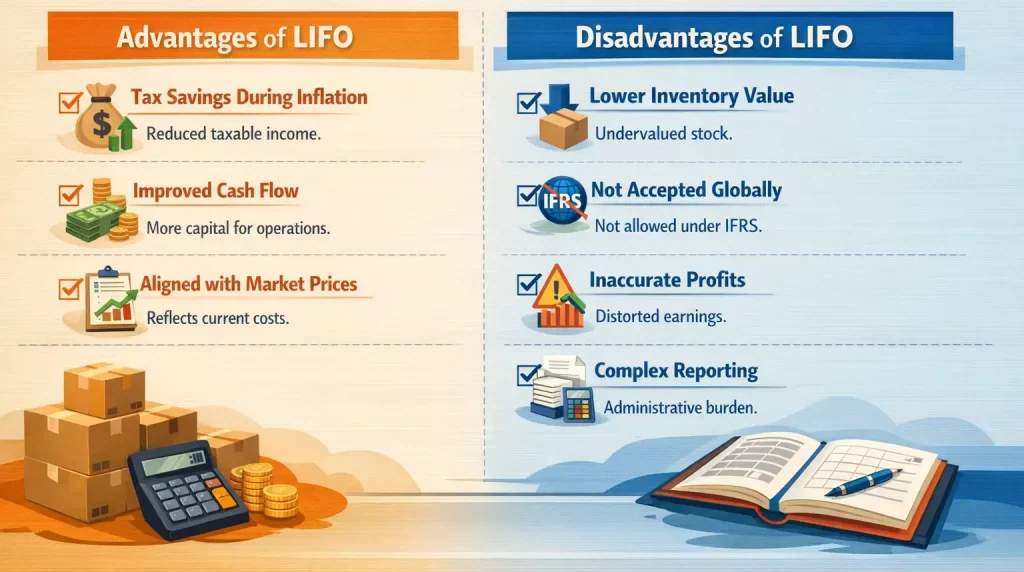
LIFO offers distinct benefits in specific operating conditions, but it also introduces complexity that may outweigh those benefits for many businesses.
Advantages of LIFO
- Tax savings during inflation: Higher COGS reduces taxable income, allowing businesses to retain more cash during periods of rising costs.
- Improved cash flow: Lower tax liabilities translate directly into greater available capital for reinvestment or day-to-day operations.
- Better alignment with current market prices: Valuing COGS at recent purchase prices gives a more realistic view of profitability in volatile markets.
Disadvantages of LIFO
- Lower inventory value: Remaining stock is recorded at older, lower costs and potentially understating total asset value.
- Not accepted in all countries: It is not allowed under specific accounting standards, such as the International Financial Reporting Standards (IFRS), which means it may not be a viable option for global businesses.
- Can lead to inaccurate profit reporting: In stable or declining price environments, LIFO can overstate costs and understate margins.
- Complicated for financial reporting: Maintaining separate records for tax and financial reporting purposes adds administrative burden, especially when managing a high-volume warehouse management process.
Is LIFO an Illegal Practice Under Global Accounting Standards?

Although LIFO is not illegal, it is not permitted under the International Financial Reporting Standards (IFRS), which are adopted by many countries worldwide. In contrast, the United States allows using LIFO under its Generally Accepted Accounting Principles (GAAP).
While the method remains legally valid in jurisdictions that recognize GAAP, it is considered non-compliant under IFRS. As a result, companies operating in international markets must carefully assess their reporting requirements and regulatory environment before adopting LIFO as an inventory valuation method.
Conclusion
LIFO offers a clear advantage for businesses operating in high-inflation environments or industries with frequent cost fluctuations, particularly those subject to U.S. GAAP, where it remains a legitimate option for reducing taxable income. However, its incompatibility with IFRS, tendency to understate inventory values, and added reporting complexity make it a method that requires careful evaluation before adoption.
For businesses weighing their options, reviewing how different inventory valuation methods interact with broader financial reporting requirements is an important step. A good place to start is comparing the full range of best inventory management software available today, which can support multiple costing methods and help teams manage compliance more efficiently.
FAQ LIFO
LIFO (Last In, First Out) and FIFO (First In, First Out) are two inventory valuation methods used in accounting. LIFO assumes the newest inventory is sold first, resulting in higher COGS and lower taxable income during inflation. FIFO assumes the oldest inventory is sold first, producing lower COGS and higher reported profits. The right choice depends on your reporting framework, FIFO is accepted globally under IFRS, while LIFO is only permitted under U.S. GAAP.
The LIFO accounting method records the most recently acquired inventory as the first to be sold or used. When calculating the cost of goods sold (COGS), businesses apply the cost of their newest stock rather than older purchases. This approach is commonly used during inflationary periods because it aligns COGS with current market prices, reducing taxable income and improving short-term cash flow.
LIFO and FIFO are the two most widely used inventory costing methods. LIFO prioritizes the cost of the most recently purchased items when calculating COGS, while FIFO uses the cost of the oldest inventory on hand. In practice, neither method necessarily reflects the actual physical flow of goods, they are accounting conventions used to determine how inventory costs are reported on financial statements and tax returns.
The main differences between LIFO and FIFO lie in how each method affects COGS, net income, and inventory value. For example, if a company purchases 100 units at ₱500 and later buys 100 more at ₱600, selling 100 units under LIFO records COGS at ₱600 (most recent cost), while FIFO records it at ₱500 (oldest cost). During inflation, LIFO produces higher COGS and lower profit and reducing taxes. FIFO produces lower COGS and higher profit to increasing both reported income and tax liability.