









 Limited to 100 registrants

For many F&B and manufacturing businesses in the Philippines, warehouses fill up with stock that moves too slowly, tying up capital that could be working elsewhere. At the same time, late or mistimed deliveries can stall production and create costly delays on the other end.
Just-in-Time inventory management addresses both problems by aligning procurement and production directly with actual demand so materials arrive when needed, not before, and stock doesn’t accumulate without purpose.
Key Takeaways
Just-in-Time inventory management synchronizes procurement and production with actual demand, so goods are ordered and received only when they are needed.
JIT reduces inventory holding costs and frees up capital by eliminating stock that sits unused in storage.
JIT’s effectiveness depends on reliable suppliers and accurate demand signals, disruptions anywhere in the supply chain can pause production.
JIT was developed by Taiichi Ohno at Toyota in the 1930s and has since expanded into lean manufacturing practices adopted across industries worldwide.
What is Just-in-Time (JIT) Inventory Management?

Just-in-Time (JIT) inventory management is a strategy that synchronises procurement and production with real demand, goods are ordered and received only when they are needed, not in advance. This eliminates the carrying costs tied to unsold or unused stock and reduces the capital held in inventory that isn’t yet generating value.
By maintaining only the minimum necessary safety stock, businesses operating on JIT principles reduce storage requirements, avoid overproduction, and free up resources to focus on value-adding activities rather than managing excess.
How Does Just-in-Time Inventory Work?
JIT works by tying production and procurement decisions directly to current market demand rather than forecasts. Instead of building stock in advance, production is triggered by actual orders or consumption signals, meaning companies produce only what is needed, when it is needed, keeping inventory lean and storage costs low.
The critical mechanism is synchronisation: procurement schedules are calibrated so materials arrive precisely as production needs them. This timing precision reduces holding costs, prevents spoilage in industries with perishable goods, and supports more agile responses to demand shifts. Cloud-based inventory tools are commonly used to maintain this synchronisation in real time.
Advantages of JIT Inventory Management
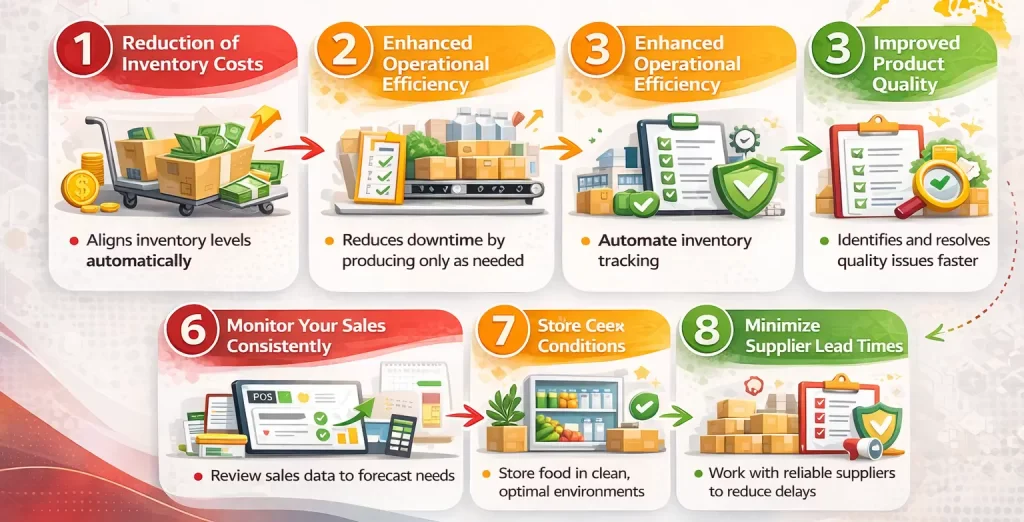
JIT delivers three core advantages when implemented consistently. These advantages streamline operations and optimize financial performance. Advantages of JIT Inventory Management include:
- Reduction of Inventory Costs: JIT aligns inventory levels with demand, reducing capital tied up in unsold stock. This freed-up capital can be better utilized elsewhere or act as a buffer against market fluctuations.
- Enhanced Operational Efficiency: JIT ensures production occurs only in response to demand, minimizing unnecessary activities and downtime, which smooths operations.
- Improved Product Quality: A feedback loop in JIT systems identifies and resolves quality issues immediately, reducing defects and improving overall product quality.
Together, these advantages allow businesses to respond to market changes more nimbly, holding less stock, producing more precisely, and maintaining higher quality standards with fewer defect-related losses.
Read More: Top Construction Inventory Management Software
Disadvantages of JIT Inventory Management
While Just-in-Time (JIT) Inventory Management offers significant benefits. These disadvantages stem from dependencies and the adjustments needed for successful implementation.
JIT’s efficiency gains come with trade-offs that businesses need to plan for:
- Vulnerability to Supply Chain Disruptions: JIT relies heavily on precise timing, making it susceptible to issues like supplier delays or transportation disruptions, which can pause production.
- High Coordination and Reliability Requirements: JIT requires high levels of coordination and reliability from suppliers, which can be challenging due to external factors beyond the company’s control.
- Transition Challenges: Implementing JIT involves major operational changes, including staff training and redesigning logistics frameworks, which can be time-consuming and costly.
Despite these disadvantages, businesses must weigh the potential for streamlined operations and cost savings. Companies can mitigate risks by developing strong supplier relationships and investing in effective training programs to fully leverage JIT Inventory Management’s benefits.
What Kind of Companies Use JIT Inventory?

Just-in-Time (JIT) Inventory Management is particularly advantageous for industries that have significant inventory costs and need high levels of operational efficiency. JIT is most effective for businesses where inventory costs are high and demand visibility is strong:
- High-Volume Manufacturers: Industries like automotive and electronics, where inventory costs significantly impact finances, benefit from JIT by minimizing the capital tied up in inventory and enhancing production efficiency.
- Businesses with Variable Demand: Retail and fashion companies, where demand can fluctuate sharply due to seasons or trends, use JIT to adjust quickly to market changes without overstocking.
- Custom and Bespoke Manufacturers: Firms producing to order from specialized machinery to bespoke furniture benefit from JIT by aligning production directly with confirmed orders, eliminating pre-built stock
By implementing JIT, companies across these varied sectors can maintain leaner inventories, improve cash flow, and enhance their ability to meet customer demands efficiently and effectively.
History and Evolution of Just-in-Time Inventory Management
Just-in-Time inventory management originated in post-World War II Japan as a response to resource scarcity. Developed by Taiichi Ohno at Toyota in the 1930s, the approach was built on eliminating waste by ensuring materials were supplied only as production required, a practice that drove significant efficiency gains and contributed directly to Toyota’s competitive growth.
By the late 1970s and early 1980s, industries in the United States embraced JIT principles, expanding them beyond automotive manufacturing and evolving into lean manufacturing. Multiple sectors worldwide have since adopted this methodology, leveraging technological advances and data analysis to enhance supply chain efficiency.
Questions to Consider Before Implementing JIT Inventory Management

Before committing to JIT, these six questions help determine whether your operations are structured to support it:
-
- Can my products be manufactured or supplied quickly enough? Assess if the turnaround times align with JIT’s demand-driven approach.
- Is my demand forecasting accurate? You need confidence in your sales forecasts, which should account for fluctuating consumer demand.
- Is my supply chain flexible enough to adapt to disruptions? This includes potential issues like supplier disruptions or natural disasters.
- Are my suppliers reliable and capable of delivering on time, every time? Supplier reliability is crucial for JIT as inventory levels are kept minimal.
- Is my workforce committed and sufficiently trained? A JIT system requires a thorough understanding and adaptability from all divisions. Employees may need to be cross-trained to handle various roles.
- Do I have the necessary technology to support JIT? Ensure your inventory software for production and other technological infrastructures can support JIT operations.
These questions help assess whether your organizational structure and operational capabilities align with JIT Inventory Management. Moreover, considering these factors allows you to make an informed decision about whether JIT is a viable strategy for your business.
Conclusion
Just-in-Time inventory management streamlines procurement and production by ensuring materials arrive only when needed, reducing holding costs, preventing overproduction, and keeping businesses responsive to shifting demand. The approach is particularly valuable in manufacturing and retail, where inventory costs and market timing directly affect margins.
For businesses evaluating whether JIT is the right fit, understanding what tools support its implementation is a natural next step. A comparison of the leading inventory management systems available in the Philippines can help teams identify which platforms offer the real-time synchronization and demand visibility that JIT depends on
Frequently Asked Questions
-
FAQ
Just-in-time (JIT) production is a manufacturing strategy that aligns raw material orders with production schedules. Jit can increase efficiency and reduce waste by receiving goods only when needed.
The basic concept of just-in-time (JIT) is to minimize inventory and reduce carrying costs. JIT focuses on purchasing and producing items exactly when needed in the production process to meet customer demand.
The purpose of JIT (Just-in-Time) production is to streamline manufacturing processes by reducing lead times and minimizing inventory levels. This approach helps in reducing waste and improving the efficiency of production operations.