









 Limited to 100 registrants

Are inventory problems like overstocking or stock shortages holding your business back? Efficient stock management is essential for growth, but without the right system, it can be a challenge.
A study on Right Goods Philippines Incorporated showed that implementing an inventory control system led to a 27.4% increase in sales through improved stock management and promotions.
Inventory control is one of those operational fundamentals that tends to get overlooked until something goes wrong, a stockout during peak demand, or shelves full of products that stopped moving months ago. Both scenarios cost money, and both are largely preventable with the right approach.
A study on Right Goods Philippines Incorporated found that implementing a structured inventory control system led to a 27.4% increase in sales, driven by improved stock management and more targeted promotions. The numbers reflect what most businesses eventually discover: getting inventory right isn’t just a logistics function, it’s a revenue driver.
Key Takeaways
Inventory control is the systematic process of managing stock levels to prevent both overstocking and shortages, ensuring capital is used efficiently and customer demand is consistently met.
Businesses can choose between a periodic system for simplicity or a perpetual system for real-time accuracy, depending on their transaction volume and operational requirements.
Techniques like ABC analysis, FIFO, JIT, and MRP each serve different inventory priorities from cost control and stock rotation to demand-driven procurement and production planning.
Effective inventory control depends on combining regular stock audits, accurate demand forecasting, and automation tools to maintain consistent accuracy as operations scale.
What is Inventory Control?

Inventory control is the process of managing stock levels to ensure a business has the right products available at the right time — not too much, not too little. It goes beyond simple counting; it’s a systematic approach to tracking stock movements and levels so that capital isn’t tied up in excess goods and sales aren’t lost to shortages.
Many businesses now use dedicated software to automate this process, making inventory tracking more accurate and reducing the manual effort involved in keeping records current.
Why Is Inventory Control Important?
Inventory sits at the intersection of cash flow, operations, and customer experience, which is why poor control has visible consequences across all three. Overstocking locks up working capital in goods that may spoil or become obsolete, while stockouts push customers toward competitors, with research suggesting 55% of shoppers won’t buy a substitute if their preferred product is unavailable.
Beyond availability, effective inventory control reduces operational costs by cutting unnecessary storage, spoilage, and emergency procurement. It also improves supply chain visibility, helping businesses respond faster to demand shifts rather than reacting after the damage is done.
What are Common Inventory Control Problems and Challenges?
The most common inventory problems — overstocking, stockouts, inaccurate data, and poor demand forecasting — tend to compound each other. Inaccurate records lead to bad purchasing decisions, which lead to either surplus or shortage, both of which carry their own downstream costs.
Other persistent challenges include supplier unreliability, theft and shrinkage, common warehouse challenges including disorganized layouts, and difficulty integrating inventory software with existing systems. In regulated industries, compliance tracking adds another layer of complexity that manual processes struggle to handle consistently.
Benefits of Inventory Control Systems
A well-implemented inventory control system does more than prevent stockouts, it creates operational leverage across the business. Real-time stock visibility means teams can respond to demand changes without waiting for manual counts, and automated reorder triggers reduce the risk of human oversight causing supply gaps.
The broader benefits of a well-run inventory system include optimized logistics, lower carrying costs, more accurate order fulfillment, and a measurable improvement in customer satisfaction, all of which contribute directly to profitability.
Inventory Control vs. Inventory Management
Inventory control and inventory management are related but not the same. Control focuses on the warehouse maintaining accurate stock records, regulating what comes in and goes out, and ensuring goods are in good condition and correctly located. Management takes a broader view, covering the full inventory lifecycle from procurement to final sale, including supplier relationships, demand forecasting, and order fulfillment strategy.
A useful way to distinguish them: inventory control answers “what do we have and where is it?” while inventory management answers “what should we order, when, and from whom?” Both are necessary, and for businesses that experience significant seasonal inventory fluctuations, coordinating the two functions effectively becomes especially important.
| Aspect | Inventory Control | Inventory Management |
|---|---|---|
| Scope | Focuses on existing inventory in the warehouse | Deals with raw materials and finished goods throughout the entire production lifecycle |
| Goal | Ensuring stocks in the warehouse are enough and in good condition | Aiming to have the right inventory in the right place, at the right time, and in a sufficient quantity |
| Areas of Concern | – What items are in the inventory? – Where are these items located in the warehouse? – What is the condition and status of these items? |
– Which items should you order? – How many items do you need to order? – When should you order these items? |
| Actions | – Receiving, storing, and transporting inventory – Checking stock items for expiry dates, spoilage, quality issues, etc. |
– Predicting customer demands based on previous data – Reordering and managing inventory items in the supply chain |
Types of Inventory Control Systems
Inventory control systems help businesses manage stock efficiently, ensuring accurate tracking and optimal inventory levels. These systems come in different types, each offering unique methods to monitor, organize, and control inventory based on business needs. They are typically divided into two types:
1. Periodic Inventory System A periodic system counts stock at fixed intervals, weekly, monthly, or quarterly. It’s simpler to implement and works well for smaller operations, but the gaps between counts mean that discrepancies often go undetected until the next audit. For businesses where real-time accuracy matters, this limitation is significant.
2. Perpetual Inventory System A perpetual inventory system records every stock movement in real time using tools like barcode scanners or RFID, providing a continuously updated view of stock levels. This approach reduces errors, supports faster decision-making, and is generally better suited to businesses with high transaction volumes or strict accuracy requirements.
Inventory Control Techniques and Methods
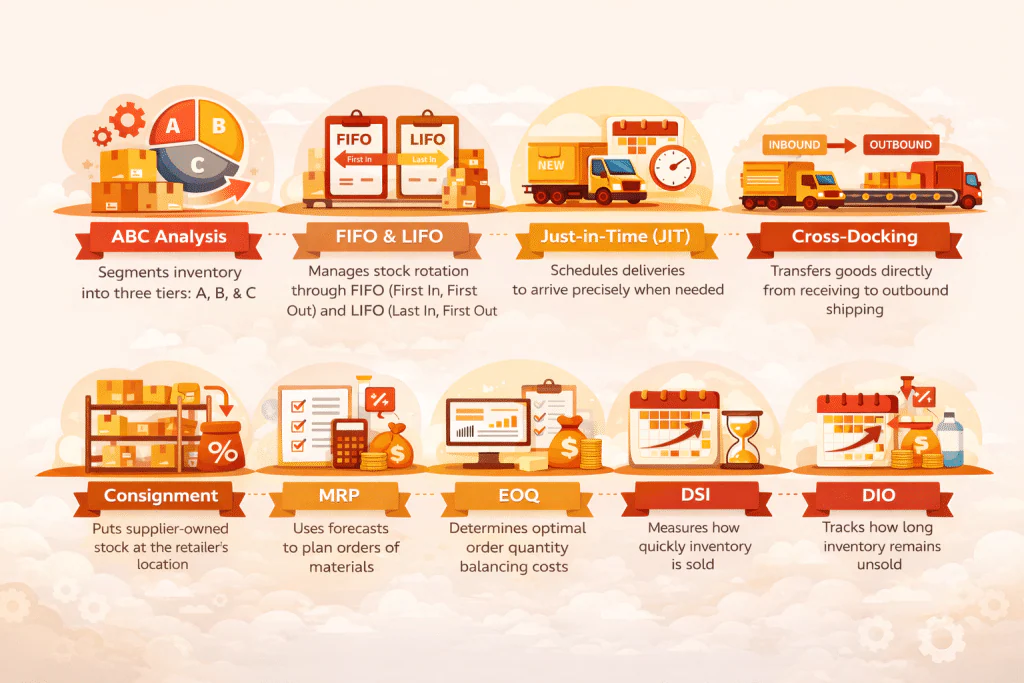
There are ten widely used inventory control techniques, each suited to different business contexts:
- ABC analysis segments inventory into three tiers by value and importance, allowing businesses to focus their tightest controls on the items that drive the most revenue.
- FIFO and LIFO govern stock rotation, FIFO ensures older inventory moves first, which is critical for perishables, while LIFO is used in specific accounting and cost contexts.
- Just-in-time (JIT) minimizes holding costs by scheduling deliveries to arrive only when needed, though it demands reliable suppliers and precise forecasting to work well.
- Batch tracking groups products by production lot, which is essential in food, pharma, and other industries where traceability and expiry management are regulatory requirements.
- Cross-docking transfers goods directly from receiving to outbound shipping, cutting storage time and warehouse costs.
- Consignment lets suppliers place stock at a retailer’s location with payment deferred until the item sells, reducing upfront capital risk.
- Materials Requirement Planning (MRP) uses sales forecasts to determine what materials need to be ordered and when though its accuracy depends heavily on the quality of the underlying forecast data.
- Economic Order Quantity (EOQ) calculates the optimal reorder quantity to balance holding costs against ordering costs.
- Days Sales of Inventory (DSI) measures how quickly stock turns over, with a lower figure generally indicating healthier inventory velocity.
- Days of Inventory Outstanding (DIO) tracks how long goods sit before being sold, a metric that has risen 8.3% on average over the past five years, reflecting broader pressure on businesses to improve inventory cost management.
Recent trends show an 8.3% increase in DIO scores over the past five years, highlighting the need for better inventory control practices. Optimizing inventory control systems reduces storage costs and ensures businesses free up working capital, allowing for improved financial stability and growth.
Best Practices for Effective Inventory Control
Effective inventory control depends on a combination of process discipline and the right tools. Regular cycle counts rather than infrequent full audits catch discrepancies early and keep records accurate without disrupting operations. Prioritizing inventory management based on demand velocity and item value ensures that the most critical stock gets the most attention.
Automation plays an increasingly important role here. AI-driven inventory management tools can handle demand forecasting, reorder triggers, and anomaly detection at a level of speed and accuracy that manual processes can’t match. Pairing automation with well-organized warehouse layouts and consistent supplier performance monitoring creates the foundation for a system that stays accurate over time, not just at implementation.
Conclusion
Inventory control is ultimately about making sure the right stock is in the right place at the right time and building the systems that maintain that balance even as demand, suppliers, and operations shift. Whether a business is dealing with overstocking, shrinkage, or fulfillment gaps, addressing these at the process level leads to measurable improvements in cost efficiency and customer reliability.
For businesses evaluating tools to support this function, a structured comparison is a good starting point. Reviewing the best inventory management software options can help narrow down which platforms align with specific operational needs, industry requirements, and scale.
Frequently Asked Questions
This system is crucial for maintaining optimal stock levels and avoiding overstocking or stockouts. It enhances operational efficiency and customer satisfaction by ensuring products are available when needed.
A common example of this is the use of a barcode system to manage stock levels in real-time. This method allows businesses to monitor inventory movements and adjust orders accordingly and accurately.
The primary purpose is to manage the supply chain efficiently by maintaining the right balance of stock. It aims to minimize holding costs and maximize the availability of goods to meet customer demands.
Inventory control focuses on maintaining accurate stock records and regulating what enters and exits the warehouse, while inventory management covers the broader lifecycle including procurement, supplier relationships, and demand forecasting.