



In trading and distribution, few documents carry as much operational weight as the delivery order. It is not merely a piece of paper, it is a legally recognized instrument that authorizes the release and transfer of goods between parties, creating a clear chain of accountability from origin to final destination. Whether you are a logistics manager, warehouse supervisor, or supply chain executive, understanding how delivery orders work is essential for any business that deals in physical goods.
Despite its ubiquity, the delivery order is frequently confused with related documents such as purchase orders, invoices, or bills of lading and conflating them can lead to costly delays, compliance issues, and strained business relationships. This guide covers the delivery order’s definition, structure, types, legal implications, and the digital tools transforming how businesses manage them today.
Key Takeaways
|
Table of Contents
What Is a Delivery Order?
A delivery order (DO) is an official document issued by a freight forwarder, shipping line, cargo owner, or logistics provider that authorizes the release of specified goods to a designated recipient. It instructs a warehouse operator, port authority, or carrier to release a shipment to the bearer or named party, functioning as the bridge between legal ownership of goods (typically established by a bill of lading) and the physical act of handing them over. Without a valid delivery order, goods generally cannot be released from a bonded warehouse, shipping terminal, or distribution center, making it a critical control mechanism in any well-run supply chain.
The document typically includes identifying information about the shipper, consignee, goods description, quantity, weight, delivery location, and any special handling instructions. It may be issued in paper or electronic format, and in some regulated industries must carry official stamps, signatures, or digital authentication to be considered valid with specifics varying by country, industry, and the nature of goods being transported.
Key Components of a Delivery Order
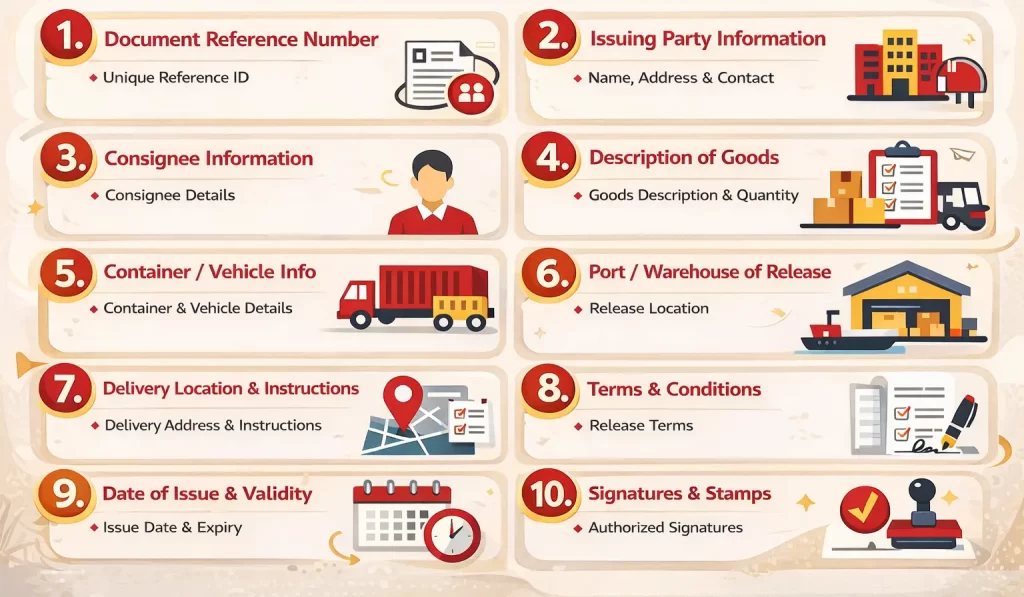
A well-structured delivery order contains several critical fields that ensure the correct goods are delivered to the correct party under the correct conditions. Missing or inaccurate information in any of these fields can cause delays, disputes, or even legal liability. Here is a breakdown of every essential component:
1. Document Reference Number
Every delivery order should carry a unique reference number that allows all parties, the shipper, carrier, warehouse, and consignee to track and reference the document unambiguously. This number is typically linked to corresponding purchase orders, invoices, and shipping manifests in the company’s ERP or logistics management system.
2. Issuing Party Information
This section identifies who is authorizing the release of goods. It may be a freight forwarder, shipping line, cargo owner, or logistics provider. The issuing party’s name, address, contact information, and official stamp or signature are usually required for the document to be considered valid.
3. Consignee Information
The consignee is the party authorized to receive the goods. This section includes their full legal name, address, and often a government-issued identification number or business registration number. In cases where the delivery order is transferable, the consignee field may be left blank or designated as “to order,” allowing the document to be endorsed and transferred to a third party.
4. Description of Goods
This is arguably the most critical section. It must include an accurate and complete description of the goods being released, including their nature (e.g., electronic components, apparel, industrial machinery), quantity (in units, cartons, pallets, or other applicable measure), weight (gross and net), and any relevant product codes or SKUs. Vague descriptions can lead to disputes and delays at the point of delivery.
5. Container or Vehicle Information
For containerized shipments, the delivery order should specify the container number(s), seal number(s), and container size and type. For road freight, the vehicle registration number and driver’s identification may be included. This information is critical for matching the physical goods to the document at the warehouse or port gate.
6. Port or Warehouse of Release
This field identifies the physical location from which the goods are to be released. In international shipping, this is typically the name of the port terminal and the relevant terminal operator. In domestic distribution, it may be the address of a distribution center or bonded warehouse.
7. Delivery Location and Instructions
Where are the goods going, and under what conditions? This section specifies the delivery address, expected delivery date or window, and any special handling or storage instructions, such as temperature control requirements, fragile handling, or hazardous materials protocols.
8. Terms and Conditions
Many delivery orders include a brief statement of the terms under which the release is authorized, including any financial conditions (such as proof of payment or freight charges settled) that must be met before goods are released. This protects the issuing party from unauthorized or premature release.
9. Date of Issue and Validity Period
The date the delivery order was issued and, in some cases, the date by which it must be presented for release. Expired delivery orders are typically not honored, and a new document must be issued sometimes incurring additional administrative fees.
10. Signatures and Stamps
Official authorization, whether in the form of wet-ink signatures, company stamps, or digital signatures, is what transforms a delivery order from a form into a legally operative document. The level of authentication required varies by jurisdiction and industry sector.
Types of Delivery Orders

Not all delivery orders are created equal. Depending on the industry, the nature of the goods, and the commercial arrangement between parties, there are several distinct types of delivery orders, each with its own characteristics and use cases.
1. Shipping Line Delivery Order
Issued by the shipping line or carrier upon receipt of the original bill of lading (or a bank-guaranteed letter of indemnity in its absence), this type of delivery order authorizes the port terminal to release a containerized shipment to the consignee or their appointed agent. It is one of the most commonly encountered forms in international trade and requires careful coordination between the importer, freight forwarder, customs broker, and port operator.
2. Freight Forwarder Delivery Order
When a freight forwarder consolidates multiple smaller shipments into a single container LCL (Less than Container Load), they issue their own delivery orders to individual consignees upon deconsolidation at the destination container freight station (CFS). This allows each consignee to collect their respective portion of the consolidated shipment independently.
3. Warehouse Delivery Order
Used in domestic distribution contexts, this type authorizes the release of goods from a warehouse or distribution center to a retailer, dealer, or end customer. It is often integrated with inventory management systems and triggers stock reduction entries upon execution.
4. Bank Delivery Order
In trade finance scenarios where goods are used as collateral for financing, banks may issue delivery orders that authorize the partial or full release of pledged goods upon receipt of payment or other agreed conditions. This type has significant legal and financial implications and is governed by specific banking regulations.
5. Internal Delivery Order
Large organizations with multiple warehouses or distribution points use internal delivery orders to authorize the transfer of goods between their own facilities. While not involving external parties, internal DOs are essential for maintaining accurate inventory records and traceability across the supply chain.
6. Electronic Delivery Order (e-DO)
The digital evolution of the traditional paper delivery order, the e-DO is issued, transmitted, authenticated, and processed entirely through digital platforms. Many major ports and shipping lines have already transitioned to e-DO systems, dramatically reducing processing time, paper consumption, and fraud risk. In Singapore, for example, the Port of Singapore Authority has been at the forefront of digitalizing delivery orders across its extensive terminal network.
Delivery Order vs. Other Trade Documents
One of the most common sources of confusion in supply chain management is the relationship between the delivery order and other trade documents. Understanding the distinctions is crucial for both operational efficiency and legal compliance.
| Document | Description | Key Difference | Example |
|---|---|---|---|
| Purchase Order (PO) | Buyer-generated request to purchase goods, specifying price and terms. | PO initiates the transaction; DO authorizes release of goods. | PO example: Purchase Order for raw materials to be delivered to factory. |
| Bill of Lading (B/L) | Shipping document acting as a receipt, contract of carriage, and title. | B/L confers ownership; DO is issued against the B/L for physical possession. | B/L example: Bill of Lading for container shipment from overseas supplier. |
| Invoice | Financial document recording the value of goods and payment obligations. | Invoice is for payment; DO is for physical release and movement of goods. | Invoice example: Invoice for goods purchased and delivered to warehouse. |
| Packing List | Detailed account of items packed, including dimensions, weights, and descriptions. | Packing List describes contents; DO authorizes release. | Packing List example: List of items and quantities packed for shipment. |
| Goods Received Note (GRN) | Issued upon receipt of goods, confirming quantity and condition. | DO precedes receipt; GRN confirms delivery. | GRN example: Goods Received Note upon delivery of goods to warehouse. |
How the Delivery Order Process Works
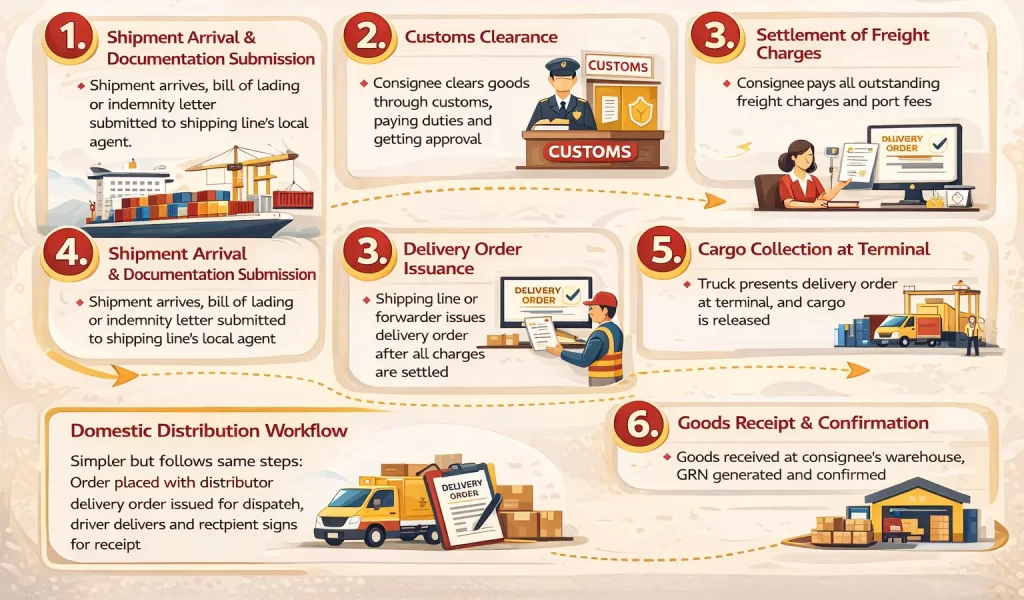
Understanding the delivery order in isolation is less valuable than understanding how it fits into the broader operational workflow. Here is a step-by-step walkthrough of the typical delivery order process in both international shipping and domestic distribution contexts.
Step 1: Shipment Arrival and Documentation Submission
In international trade, the process begins when a vessel carrying the consignee’s goods arrives at the destination port. The shipping line notifies the consignee or their freight forwarder of the vessel’s arrival and the availability of the cargo. The consignee must then surrender the original bill of lading (or provide an acceptable alternative such as a letter of indemnity) to the shipping line’s local agent.
Step 2: Customs Clearance
Before a delivery order can be obtained, the consignee must clear their goods through customs. This involves filing the necessary import declarations, paying applicable duties and taxes, and obtaining customs release approval. In many countries, customs clearance and delivery order issuance are closely linked, customs authorities may need to endorse the delivery order, or the shipping line may require proof of customs clearance before issuing the DO.
Step 3: Settlement of Freight and Terminal Charges
The shipping line will typically require that all outstanding freight charges including destination port charges, demurrage (charges for delays in clearing containers), and detention fees be settled before the delivery order is issued. This financial gatekeeping function is one reason why delivery orders are so closely associated with payment and trade finance processes.
Step 4: Delivery Order Issuance
Once the original B/L has been surrendered, customs clearance obtained, and all charges settled, the shipping line or freight forwarder issues the delivery order. In traditional systems, this was a paper document physically collected from the shipping line’s office. In modern e-DO systems, the delivery order is issued electronically and transmitted directly to the port terminal’s operating system.
Step 5: Cargo Collection at the Terminal
Armed with the delivery order, the consignee’s appointed truck or carrier presents the document at the port terminal gate. The terminal operator validates the DO against their system, confirms the container details, and authorizes the release of the cargo. The container is then positioned for loading onto the collection vehicle.
Step 6: Goods Receipt and Confirmation
Once the goods are physically received at the consignee’s warehouse or premises, a goods received note (GRN) is generated. The GRN confirms the quantity, condition, and identity of the received goods and triggers downstream processes such as inventory updates, accounts payable processing, and quality inspection.
Domestic Distribution Workflow
In domestic settings, the workflow is somewhat simpler but follows the same logical structure. A retailer or dealer places an order with a distributor or manufacturer. The seller’s logistics team creates a delivery order authorizing the warehouse to release the specified goods for dispatch. The warehouse team picks, packs, and loads the goods based on the delivery order. A driver receives the DO and uses it to confirm delivery to the recipient. Upon delivery, the recipient signs a copy of the delivery order (or a GRN) as proof of receipt, and the signed copy is returned to the seller as evidence that the delivery was completed.
Legal and Compliance Importance
The delivery order is not merely an administrative convenience, it carries significant legal weight. In jurisdictions around the world, delivery orders are recognized as formal instruments of commerce, and their improper use or fraudulent reproduction can expose businesses to serious legal liability.
Liability and Risk Transfer
A key legal function of the delivery order is to mark the point at which risk and responsibility for goods transfer from one party to another. When the warehouse or terminal releases goods against a valid delivery order, the issuing party’s responsibility for those goods typically ends. The consignee assumes full responsibility for the goods from the moment of release. This makes accuracy in identifying the authorized consignee absolutely critical releasing goods to the wrong party can result in claims for missed delivery, which can be costly to resolve.
Fraud Prevention
Delivery order fraud is a genuine concern, particularly in high-value cargo scenarios. Fraudsters may attempt to present forged or altered delivery orders to collect cargo that does not belong to them. This is why many shipping lines and terminal operators have invested in digital authentication systems, including QR codes, blockchain-verified records, and encrypted digital signatures, to ensure that only legitimate delivery orders can be acted upon.
Regulatory Compliance
In many industries and jurisdictions, the delivery order must comply with specific regulatory requirements. In international trade, customs authorities may require delivery orders to bear specific endorsements. In pharmaceutical distribution, delivery orders for controlled substances must comply with strict chain-of-custody regulations. In food and beverage distribution, DOs may need to be linked to food safety documentation such as temperature logs and sanitation certificates.
Dispute Resolution
Delivery orders serve as critical evidence in commercial disputes. If a consignee claims they never received their goods, or if a shipper claims goods were released to an unauthorized party, the delivery order along with signatures, timestamps, and supporting documents forms the evidentiary basis for resolving the dispute. Businesses that maintain clean, complete, and properly archived delivery order records are far better positioned to defend themselves in such situations.
Common Challenges in Managing Delivery Orders

Despite the delivery order’s straightforward purpose, managing it effectively at scale presents numerous operational challenges. Businesses that fail to address these challenges often experience unnecessary costs, delays, and compliance risks.
Manual Processing Bottlenecks
In organizations that still rely on paper-based delivery order processes, the sheer volume of documents can create significant administrative bottlenecks. Printing, signing, distributing, and filing physical delivery orders takes time and consumes resources. More critically, paper-based systems are prone to loss, damage, and delays, any of which can hold up cargo release and generate expensive demurrage charges.
Data Entry Errors
Manual data entry is inherently error-prone. Incorrect container numbers, misspelled consignee names, or wrong quantity figures on a delivery order can cause significant delays when discrepancies are discovered at the point of cargo release. In worst-case scenarios, these errors can result in goods being held at port beyond free storage periods, accruing substantial demurrage and storage fees.
Lack of Real-Time Visibility
In complex distribution networks with multiple warehouses, carriers, and delivery points, tracking the status of delivery orders in real time is extremely challenging without integrated digital systems. Operations managers may not know whether a delivery order has been presented, accepted, or acted upon until after the fact making proactive exception management nearly impossible.
Coordination Between Multiple Parties
A single delivery order may involve five or more distinct parties: the shipper, the freight forwarder, the shipping line, the customs broker, the port terminal, and the consignee. Coordinating information and authorizations across all these parties often across different time zones, languages, and systems is inherently complex and creates multiple points of potential failure.
Demurrage and Detention Cost Management
One of the most financially significant challenges associated with delivery orders is the management of demurrage and detention costs. If a consignee fails to collect their cargo within the free storage period allowed by the shipping line often because of delays in obtaining the delivery order, they incur daily demurrage charges. These can accumulate rapidly, particularly for high-volume importers. Effective delivery order management is therefore directly linked to cost control.
Compliance with Evolving Regulations
Trade regulations are constantly evolving, and businesses must ensure that their delivery order processes remain compliant with the latest requirements. Changes in customs regulations, new electronic documentation mandates, or updated security protocols at ports can all require adjustments to delivery order workflows that take time and resources to implement.
Digital Transformation of Delivery Orders
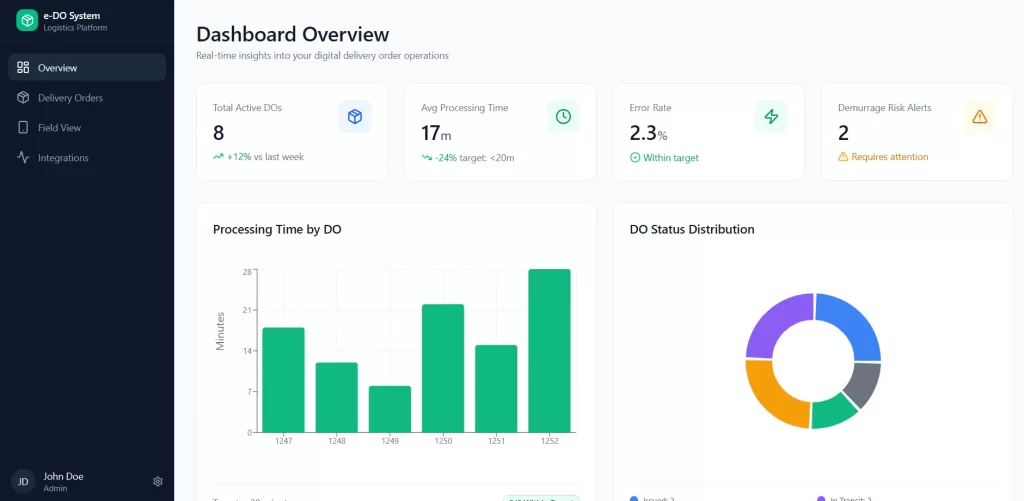
The digitalization of global trade is fundamentally changing how delivery orders are created, transmitted, authenticated, and managed. What was once a paper-intensive, largely manual process is rapidly evolving into a streamlined, data-driven workflow powered by integrated digital platforms.
Electronic Delivery Orders (e-DOs)
The shift to electronic delivery orders represents the single most impactful change in delivery order management in recent decades. E-DOs are generated digitally, authenticated through cryptographic methods, and transmitted directly to port terminal operating systems eliminating the need for physical collection and reducing processing time from hours to minutes. Major shipping lines including Maersk, MSC, and CMA CGM now offer e-DO capabilities across many of their key trade routes.
Port Community Systems Integration
Port community systems (PCS) are shared digital platforms that connect all parties involved in port logistics: shipping lines, freight forwarders, customs authorities, terminal operators, and cargo owners. By integrating delivery order workflows into PCS platforms, businesses can automate the transmission and validation of delivery orders, track their status in real time, and receive instant notifications when goods are available for collection.
Blockchain-Based Delivery Orders
Blockchain technology offers a compelling solution to delivery order fraud and document authenticity challenges. By recording delivery order issuance and endorsement on an immutable distributed ledger, blockchain systems make it virtually impossible to forge or alter a delivery order without detection. Several pioneering trade finance and logistics platforms are already piloting blockchain-based delivery order systems, with early results showing significant improvements in security and processing speed.
ERP and WMS Integration
Modern enterprise resource planning (ERP) and warehouse management systems (WMS) can be configured to automatically generate delivery orders based on confirmed sales orders, automatically update inventory records when DOs are executed, and archive completed delivery orders in searchable digital repositories. This integration eliminates manual re-entry of data, reduces errors, and creates a seamless flow of information across the supply chain.
For companies managing high-volume distribution operations, deploying a robust distribution management platform can bring all of these capabilities together in a unified environment. Systems like these automate delivery order generation, link them directly to purchase orders and invoices, and provide real-time dashboards that give managers complete visibility into every stage of the delivery order lifecycle.
Mobile and Cloud Technologies
Cloud-based delivery order management platforms accessible via mobile devices are empowering field teams: drivers, warehouse staff, and delivery agents to create, sign, and confirm delivery orders digitally from any location. Digital signatures captured on mobile devices carry the same legal weight as wet-ink signatures in many jurisdictions, and the instant synchronization of cloud data ensures that headquarters can see delivery confirmations in real time as they occur in the field.
AI and Predictive Analytics
Advanced analytics tools are beginning to be applied to delivery order data to generate actionable insights. By analyzing historical patterns in delivery order processing times, error rates, and exception frequencies, AI-powered systems can identify bottlenecks before they become crises, predict demurrage risk for specific shipments, and recommend optimal routing and scheduling for cargo collection. This represents the frontier of delivery order management and will become increasingly mainstream as data volumes and computing capabilities grow.
Best Practices for Effective Delivery Order Management

Regardless of the size or nature of your business, implementing sound delivery order management practices will reduce costs, improve customer satisfaction, and minimize compliance risk. Here are the most impactful best practices drawn from industry experience.
Standardize Your Delivery Order Templates
Develop standardized delivery order templates that include all required fields and comply with the regulatory requirements of every market in which you operate. Standardization reduces the risk of omitting critical information and makes it easier to train staff and integrate with partner systems. Include mandatory fields with validation rules in your digital systems to prevent incomplete DOs from being issued.
Integrate Delivery Orders with Your Core Business Systems
Delivery orders should not exist in isolation. Integrate them with your order management system, inventory management platform, and financial accounting system to ensure that every DO is linked to corresponding purchase orders, sales orders, and financial records. This integration creates a complete audit trail and enables automated reconciliation.
Implement a Centralized Tracking Dashboard
Create a centralized view whether within your ERP, WMS, or a dedicated logistics platform where all open delivery orders can be tracked by status. Categorize DOs by stage: issued, in transit, presented at warehouse/terminal, collected, and completed. This visibility enables proactive management of exceptions and timely escalation of delays.
Establish Clear Authorization and Approval Workflows
Define who within your organization is authorized to issue delivery orders, and implement formal approval workflows, particularly for high-value shipments. Requiring a second-level approval for DOs above a certain value threshold is a simple but effective fraud prevention measure. Maintain a clear audit log of all approvals.
Train All Relevant Staff
Delivery order errors often stem from insufficient training. Ensure that everyone involved in the DO process from order entry clerks and warehouse staff to drivers and receiving personnel understands their role, the information they are responsible for, and the consequences of errors. Regular refresher training and clear written procedures are essential.
Monitor and Manage Demurrage Risk Proactively
For businesses involved in international trade, establish a process for monitoring the free storage periods for all incoming shipments and flagging those at risk of accruing demurrage. Proactive collection of delivery orders and timely cargo uplift should be treated as a high-priority operational task. Even a few days of demurrage on a large container can generate costs that far exceed the administrative effort required to prevent it.
Maintain Secure and Accessible Archives
Every completed delivery order should be archived securely and indexed in a way that makes it easily retrievable for dispute resolution, audit, or compliance purposes. Digital archives with full-text search capabilities are far superior to physical filing systems. Comply with your jurisdiction’s document retention requirements, which typically mandate keeping trade documents for a minimum of five to seven years.
Embrace Electronic Delivery Orders Wherever Possible
If your trade lanes and supply chain partners support electronic delivery orders, adopt them as a priority. The operational and financial benefits of e-DOs: faster processing, reduced errors, lower administrative cost, and improved security, make the transition a compelling business case in virtually any trading environment. Work with your freight forwarders, shipping lines, and logistics service providers to understand what e-DO capabilities they offer and plan a phased implementation accordingly.
Conduct Regular Process Audits
Periodically audit your delivery order process end-to-end from issuance to archiving to identify inefficiencies, compliance gaps, and improvement opportunities. Involve representatives from all departments that touch the delivery order workflow: procurement, logistics, warehouse, finance, and compliance. Document your findings and implement corrective actions with clear ownership and timelines.
Leverage Technology for Continuous Improvement
The most effective delivery order management operations are those that treat technology not as a one-time investment but as a continuous enabler of improvement. Regularly evaluate new features in your existing platforms, stay abreast of industry developments in e-DO standards and blockchain trade solutions, and benchmark your performance against industry peers. Most Companies that specialize in integrated distribution management solutions continuously update their platforms to reflect evolving best practices and regulatory requirements, providing their customers with a future-proof foundation for delivery order management.
The Role of Delivery Orders in Stock and Securities Trading
It is worth briefly addressing the use of the term “delivery order” in the context of securities markets, as this application is frequently encountered and can cause confusion for readers coming from a logistics background.
In equity markets, particularly in India and other Asian markets, a delivery order in the securities context refers to an instruction issued by a seller’s broker to their depository participant to transfer a specified number of shares from the seller’s Demat account to the buyer’s Demat account. This is in contrast to intraday trading, where shares are bought and sold within the same trading session without any actual transfer of ownership.
Delivery-based trading (or delivery trading) in stocks means that the buyer receives the actual shares in their Demat account and holds legal ownership of those securities. The “delivery order” in this context is the mechanism that makes this physical transfer of securities ownership happen. It is processed through the stock exchange’s clearing and settlement system, typically on a T+1 basis (one business day after the transaction date) in major markets.
While the securities-market meaning of “delivery order” is conceptually related to its logistics counterpart both involve the transfer of ownership and physical custody of assets, the two operate in entirely different legal and operational frameworks. Investors and traders should be careful not to conflate these two meanings when navigating the literature of trade and commerce.
Global Variations in Delivery Order Practices

Delivery order practices are not uniform across the world. Significant variations exist in how different countries and regional trade blocs define, regulate, and process delivery orders. Understanding these variations is essential for businesses engaged in international trade.
Asia-Pacific
In the Asia-Pacific region, which handles the world’s largest volume of container trade, delivery order practices are well-established but vary significantly by port and country. Singapore has been a pioneer in electronic delivery orders, with its National Single Window system and PORTNET platform enabling fully digital DO processing across its terminals. China, by contrast, has historically relied more heavily on paper-based processes, though major ports like Shanghai and Shenzhen are rapidly digitalizing. In Southeast Asia, practices vary widely, with some ports highly automated and others still largely manual.
Europe
European ports and logistics hubs generally operate under sophisticated digital frameworks. The Netherlands’ Port of Rotterdam, Europe’s largest port, has invested heavily in digital trade documentation systems. The EU’s ongoing effort to digitalize trade documents including the proposed Regulation on Electronic Information for Freight Transport (eFTI) is pushing member states toward standardized electronic delivery order processes across the continent.
Americas
In North America, the delivery order is most commonly encountered in the context of freight release from ports and rail terminals. The U.S. Customs and Border Protection’s Automated Commercial Environment (ACE) platform has streamlined customs processes, and many terminal operators have adopted electronic delivery order systems. In Latin America, progress varies considerably, with some countries having advanced trade facilitation frameworks and others still relying primarily on paper documentation.
Middle East and Africa
The Middle East, particularly the UAE with its Jebel Ali port, has emerged as a regional leader in logistics digitalization, including electronic delivery orders. DP World, one of the world’s largest port operators headquartered in Dubai, has pioneered several digital trade documentation innovations across its global terminal network. In Africa, adoption of electronic delivery orders is progressing more slowly due to infrastructure and regulatory challenges, though major ports in South Africa, Egypt, and Kenya are making significant advances.
Measuring Delivery Order Performance
For operations managers and supply chain executives, measuring the performance of the delivery order process is essential for identifying improvement opportunities and demonstrating operational efficiency. Several key performance indicators (KPIs) are particularly relevant:
Delivery Order Processing Time
The average time elapsed between when a delivery order is requested and when it is issued and available for action. In paper-based systems, this can range from several hours to days. In optimized e-DO systems, it should be measured in minutes.
Error Rate
The percentage of delivery orders that contain errors requiring correction before they can be acted upon. A high error rate indicates systemic data quality issues and is a reliable predictor of downstream delays and cost overruns.
On-Time Delivery Rate
The percentage of deliveries completed within the originally specified delivery window. This metric reflects the combined performance of the delivery order process and the broader logistics operation.
Demurrage Incidence Rate
The percentage of shipments for which demurrage charges are incurred due to delays in delivery order processing or cargo collection.
Conclusion
A delivery order is far more than a release slip, it is the operational linchpin that connects commercial agreements, physical cargo, and legal accountability across the entire supply chain. Whether your business handles international container shipments or domestic last-mile deliveries, the ability to issue, track, and manage delivery orders accurately determines how smoothly goods flow through your network.
Understanding the document’s components, legal weight, and relationship to other trade paperwork helps teams at every level from procurement to warehouse floor make faster, more informed decisions. As businesses move toward electronic workflows and integrated platforms, the delivery order is becoming a data asset as much as a compliance requirement.
For companies looking to manage their logistics operations more effectively, learning about the best distribution management software available today can be a practical next step in strengthening end-to-end delivery control.