













In corporate accounting, managing a prepaid expense correctly is essential for keeping financial statements accurate. Although the concept seems simple, the accounting treatment involves accrual principles, proper journal entries, and careful timing.
Poor handling of prepayments can distort profit, overstate or understate assets, and create issues during audits. This article will explain the full lifecycle of prepaid expenses, from initial payment to final amortization, so businesses can maintain accurate and reliable financial records.
Table of Contents
Key Takeaways
|
Understanding Prepaid Expense
A prepaid expense is a cost a business pays in advance for goods or services it will use later. Since the benefit is not used up right away, the payment is recorded first as an asset instead of an expense. Common examples include prepaid rent, insurance, and software subscriptions.
This treatment follows the matching principle in accounting, which means businesses should record expenses in the same period as the benefit they receive. Instead of recognizing the full cost at once, the amount is gradually recorded as an expense over the periods it covers.
As a result, financial statements show a more accurate picture of business performance. It helps separate cash outflow from actual expense recognition, so profit is not overstated or understated in a single period.
Common Real World Examples of Prepaid Expenses
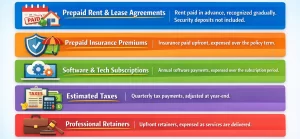 In the day to day operations of a modern business, prepayments are incredibly common. They span across various departments and operational needs. Understanding these common examples helps contextualize how diverse these assets can be.
1. Prepaid Rent and Lease Agreements
Businesses often pay rent in advance on a quarterly or annual basis. Since the benefit is used over time, the payment is recorded as prepaid rent and recognized gradually. Security deposits are not prepaid expenses because businesses expect them to be returned.
2. Prepaid Insurance Premiums
Insurance premiums are usually paid upfront for several months or a full year. Because the coverage applies over a set period, the cost is recorded as a prepaid expense and recognized gradually over the policy term.
3. Software and Technology Subscriptions
Many companies pay annually for software, cloud hosting, or digital tools to get lower rates. These upfront payments are treated as prepaid expenses and recognized over the subscription period.
4. Estimated Taxes
Businesses may make estimated tax payments before the final tax amount is confirmed. These payments are recorded as prepaid taxes and adjusted at year-end based on the actual tax liability.
5. Professional Retainers
Retainers paid to lawyers, consultants, or agencies are recorded as prepaid expenses until the services are delivered. As the work is completed, the amount is moved from asset to expense.
The Accounting Cycle and Journal Entries for Prepayments
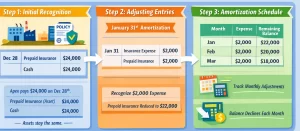 The mechanical process of recording and managing a prepaid expense involves a specific sequence of journal entries within the accounting cycle. This process requires discipline and a rigorous month-end close procedure to ensure no assets are left unamortized. Let us walk through a detailed, step-by-step example of how this is executed.
Step 1: The Initial Recognition
Suppose a manufacturing company, Apex Industries, purchases a comprehensive property insurance policy for its warehouse. The policy costs $24,000 and covers the period from January 1st through December 31st. Apex Industries pays the invoice in full via a bank transfer on December 28th of the preceding year.
The initial journal entry on December 28th to record the cash outflow and establish the asset is as follows:
| Date | Account | Debit | Credit |
|---|---|---|---|
| Dec 28 | Prepaid Insurance (Asset) | $24,000 | |
| Dec 28 | Cash (Asset) | $24,000 |
At this stage, total assets stay the same because cash decreases and prepaid insurance increases by the same amount. The income statement is not affected yet.
Step 2: The Adjusting Entries (Amortization)
As time progresses, Apex Industries begins to consume the economic benefit of the insurance policy. According to the matching principle, the company must recognize the expense as the benefit is consumed. Since the policy covers twelve months, the monthly expense is calculated as $24,000 divided by 12, which equals $2,000 per month.
At the end of January, during the month-end close process, the accounting team must record an adjusting journal entry to recognize the first month of insurance coverage:
| Date | Account | Debit | Credit |
|---|---|---|---|
| Jan 31 | Insurance Expense (Expense) | $2,000 | |
| Jan 31 | Prepaid Insurance (Asset) | $2,000 |
This entry records $2,000 as an expense on the income statement and reduces the prepaid insurance balance from $24,000 to $22,000 on the balance sheet.
Step 3: The Amortization Schedule
This entry is repeated each month to reduce the prepaid asset and record the expense gradually. Accountants usually track it through an amortization schedule that shows the starting balance, monthly expense, and remaining amount. If the entry is missed, assets can be overstated, expenses understated, and profit can appear higher than it actually is.
How Prepaid Expenses Impact Financial Statements
A prepaid expense affects all three main financial statements. On the balance sheet, it appears as a current asset because the business has paid in advance for a future benefit. As time passes and the benefit is used, the prepaid balance decreases through adjusting entries.
On the income statement, the cost is recognized gradually instead of all at once, which makes expenses more consistent across each period. On the cash flow statement, the cash leaves the business when the payment is made, even though the expense is recorded later. This shows why cash movement and expense recognition do not always happen at the same time.
Why Proper Recording of Prepaid Expenses Matters
 Recording prepaid expenses correctly helps businesses keep their financial reports accurate and easier to trust. If a prepaid cost is recorded as an expense too early, profit can look lower than it really is in one period and higher in another. This can confuse management and make performance harder to evaluate.
Proper recording also helps businesses avoid balance sheet errors and audit issues. When prepayments are tracked and adjusted on time, the company can show the right asset balance and recognize expenses in the correct period. This supports better decisions, cleaner reporting, and more reliable financial statements.
Businesses that want to automate prepaid schedules, recurring adjustments, and month end reporting usually need accounting software built for Philippine reporting needs.
Prepaid Expenses vs. Accrued Expenses vs. Deferred Revenue
To master accounting, one must understand how prepaid expenses fit into the broader ecosystem of accruals and deferrals. These concepts are often confused, but they represent distinctly different timing differences between cash flows and expense/revenue recognition.
| Aspect | Prepaid Expenses | Accrued Expenses | Deferred Revenue |
| Meaning | Paid before use | Incurred before payment | Received before delivery |
| Cash Timing | Cash paid first | Cash paid later | Cash received first |
| Type | Asset | Liability | Liability |
| Example | Rent, insurance | Wages, utilities | Subscription fees, deposits |
Conclusion
Prepaid expenses help businesses record advance payments more accurately by recognizing the cost over time instead of all at once. This gives a clearer view of profit and financial position. When tracked properly, prepaid expenses can reduce reporting errors and support more reliable financial statements.
To handle this efficiently, having the right accounting software makes a big difference. Check out our recommended top accounting software in the Philippines to find the best fit for your business.
FAQ About Prepaid Expenses
-
What is a prepaid expense?
A prepaid expense is a payment a business makes in advance for goods or services it will use later. It is recorded first as an asset, then recognized gradually as an expense over time.
-
Why is a prepaid expense recorded as an asset?
It is recorded as an asset because the business has paid for a future benefit that has not been fully used yet. The cost only becomes an expense as the benefit is consumed.
-
What are common examples of prepaid expenses?
Common examples include prepaid rent, insurance premiums, software subscriptions, estimated tax payments, and professional retainers paid in advance.
-
How are prepaid expenses recorded in journal entries?
The initial payment is recorded as a prepaid asset and reduces cash. After that, adjusting entries are made over time to move part of the prepaid balance into expense.
-
How do prepaid expenses affect financial statements?
Prepaid expenses appear as current assets on the balance sheet at first. Over time, the cost is recognized on the income statement, while the cash outflow appears when the payment is made.