







Project uncertainty is unavoidable, making contingency cost planning an important part of responsible budgeting. Rather than being viewed as an extra reserve, contingency funds help organizations prepare for cost fluctuations and operational risks.
In complex projects, unexpected changes can affect schedules, resources, and financial performance. Having a structured contingency approach allows teams to respond to these situations more calmly and maintain stability across project phases.
With stronger risk awareness and clearer cost visibility, organizations can maintain better control over project outcomes. Contingency planning ultimately helps ensure that projects remain financially sustainable while supporting consistent and reliable execution.
Key Takeaways
|
What Is Contingency Cost in Project Management?
A contingency cost is a budget allocation reserved to address identified project risks, often referred to as known unknowns. It acts as a financial buffer to handle these risks without affecting the project’s baseline budget.
This fund is not meant to cover poor planning or unplanned expenses, but to manage specific risks listed in the risk register. When used correctly, contingency costs enable faster responses, reduce disruption, and support on-time, on-budget project delivery.
The Strategic Importance of Contingency Cost for Business Success
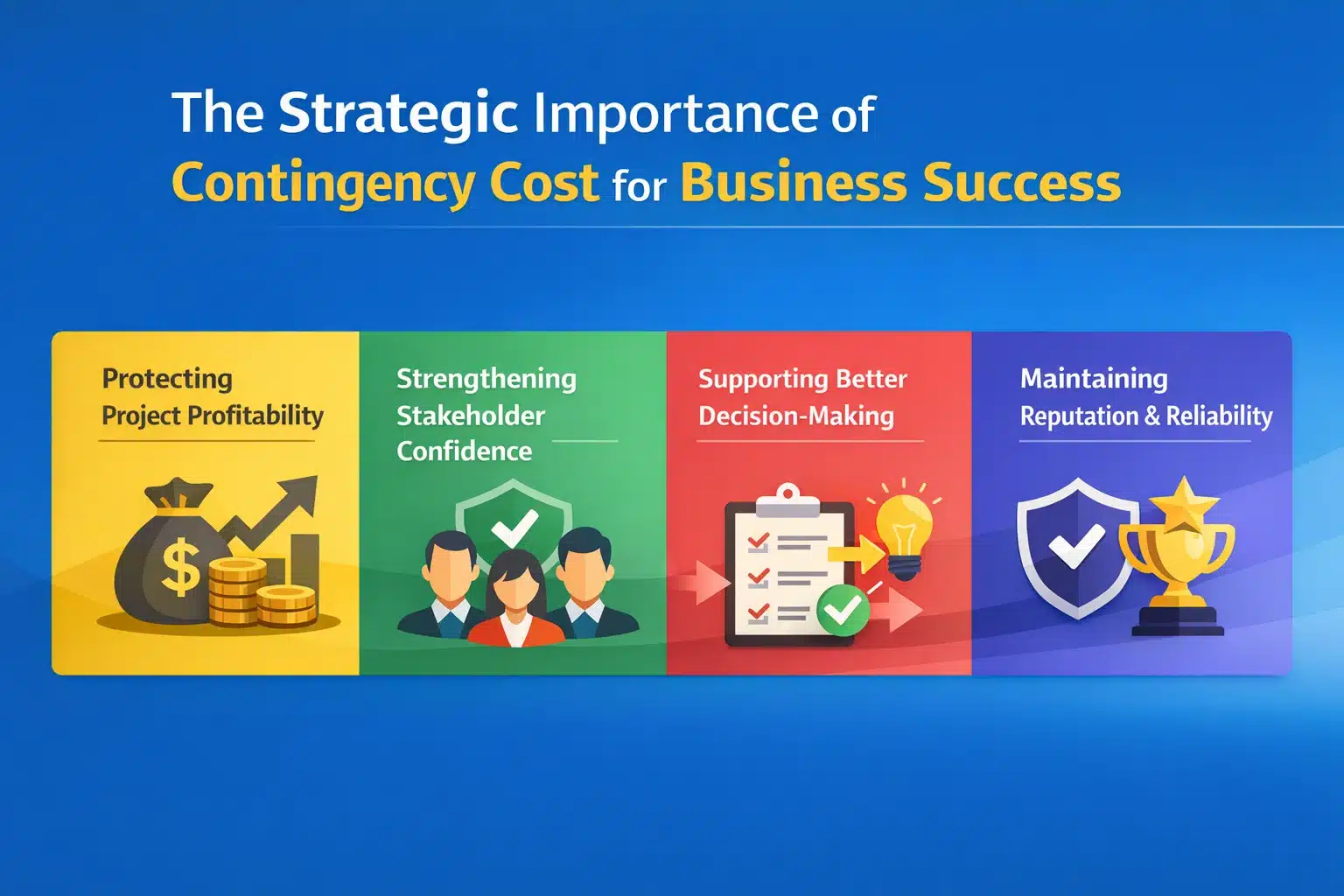
Beyond serving as a financial safeguard, contingency costs play a strategic role in strengthening project and business performance. When planned deliberately, it enables organizations to manage uncertainty with greater control while protecting long-term objectives.
- Protecting project profitability
Contingency cost helps preserve profit margins by covering unexpected expenses without eroding planned returns. This ensures projects remain financially viable even when risks materialize. - Strengthening stakeholder confidence
Including contingency operating costs in budgeting signals preparedness and professionalism to stakeholders. It reassures them that risks have been anticipated and managed responsibly. - Supporting better decision-making
Access to contingency funds allows project managers to choose optimal solutions instead of rushed compromises. This flexibility leads to higher-quality outcomes and more sustainable project decisions. - Maintaining the company’s reputation and reliability
Consistent use of contingency costs enables projects to stay on track despite disruptions. This reliability reinforces a company’s reputation for disciplined execution and dependable delivery.
Contingency Cost vs. Management Reserve vs. Escalation
Understanding the differences between contingency cost, management reserve, and escalation is essential for accurate budgeting. Each serves a distinct purpose in managing uncertainty and must be applied correctly to maintain financial discipline.
Below are the differences between contingency cost, management reserve, and escalation.
- Contingency Cost: Funds allocated to manage identified project risks, also known as known unknowns, and included in the project cost baseline.
- Management Reserve: A budget set aside for unforeseen risks that were not identified during planning and require senior management approval to use.
- Escalation: Allowance for anticipated increases in project costs due to external economic factors such as inflation or price fluctuations.
For a clearer picture, see the table below.
| Aspect | Contingency Cost | Management Reserve | Escalation |
| Risk Type | Known unknowns | Unknown unknowns | External cost changes |
| Risk Source | Identified in the risk register | Unidentified, unforeseen | Economic and market factors |
| Primary Purpose | Manage identified risks | Cover unexpected events | Offset inflation and price increases |
| Calculation Basis | EMV, PERT, or risk analysis | Percentage of total budget | Cost indices and forecasts |
| Approval Authority | Project manager | Senior management | Financial planning team |
| Cost Baseline | Included | Excluded | Separate allowance |
How to Calculate Contingency Cost: 4 Practical Methods
Choosing the proper method to calculate contingency cost helps balance financial protection and budget efficiency. Each method varies in complexity and accuracy, making it essential to align the approach with the project’s risk profile.
- Percentage of total cost method
This method calculates contingency by applying a fixed percentage to the total project budget, typically 5–25% depending on risk level. While simple and fast, it does not directly link the contingency amount to specific risks. - Expected Monetary Value (EMV) method
The EMV method calculates contingency by multiplying the probability and financial impact of each identified risk using the formula EMV = P × I. The total contingency cost is obtained by summing the EMV of all risks, making it more risk-specific and transparent. - PERT (Program Evaluation and Review Technique) method
PERT uses three cost estimates, Optimistic (O), Most Likely (M), and Pessimistic (P), to account for uncertainty. The forecast is calculated as (O + 4M + P) / 6, with the difference between this and the most likely cost forming the contingency reserve. - Monte Carlo simulation method
Monte Carlo simulation runs thousands of cost scenarios using probability distributions to model overall project uncertainty. The resulting probability curve helps determine contingency based on a chosen confidence level, such as 80% or 90% certainty.
Common Types of Contingency Costs to Anticipate in Projects
Understanding the different types of contingency costs helps project teams anticipate risks more accurately and allocate budgets more strategically. By categorizing these risks, managers can build a stronger risk register and reduce the likelihood of unexpected financial strain.
- Scope contingency costs
Scope contingency covers costs related to unplanned changes or additions to project deliverables. It helps address minor scope adjustments, rework, or newly identified tasks without disrupting the approved budget. - Schedule contingency costs
Schedule contingency accounts for costs caused by project delays and time-related disruptions. These funds support recovery actions such as overtime work, expedited procurement, or additional staffing to keep progress on track. - Estimating contingency costs
Estimation contingency addresses cost differences between initial estimates and actual expenses. As part of broader cost estimation strategies in construction, it helps absorb inaccuracies or complexity discovered during execution without compromising financial stability. - External contingency costs
External contingency is reserved for risks beyond the project team’s control, such as regulatory changes or adverse weather conditions. This allocation protects the project from financial shocks caused by external uncertainties.
Best Practices for Managing Contingency Cost Effectively
Effective contingency cost management requires more than setting aside a budget; it depends on structured processes and ongoing control. When managed systematically, contingency funds become a practical tool for mitigating risk rather than a reactive safety net.
- Develop a comprehensive risk register
A detailed risk register helps identify, assess, and document potential risks along with their financial impact. Linking each risk to a specific contingency allocation ensures funds are used only for predefined risk responses. - Establish clear fund usage protocols
Clear approval and documentation procedures prevent contingency funds from being misused. These protocols ensure every withdrawal is justified, traceable, and aligned with the identified risk. - Perform regular monitoring and reporting
Tracking contingency costs separately improves financial visibility and accountability. Regular reporting helps stakeholders understand risk exposure and take corrective action early if needed. - Conduct post-project analysis for learning
Reviewing contingency usage after project completion reveals which risks occurred and how effectively they were managed. These insights improve the accuracy of future budgeting and risk planning.
The Role of Technology in Optimizing Contingency Cost Management
Managing contingency costs with manual tools like spreadsheets often leads to data inaccuracies, limited visibility, and delayed decision-making. These limitations can disrupt the project timeline when teams struggle to respond quickly to emerging risks.
Integrated project management software and ERP systems centralize risk and financial data in real time. This technology enables proactive cost control, improves transparency, and helps optimize contingency funds while keeping the implementation timeline on track.

Conclusion
Contingency cost is a strategic safeguard against uncertainty in project execution. When planned carefully and monitored consistently, it helps protect profitability, maintain timelines, and preserve stakeholder confidence in complex projects.
A structured approach to contingency planning, supported by accurate budgeting and continuous risk monitoring, enables project teams to stay prepared for unexpected changes without losing financial control. This ensures projects remain stable even when conditions shift.
For organizations looking to strengthen project budgeting and risk management practices, seeking a free consultation with industry experts can help identify the right strategies to manage contingency costs more effectively and sustainably.

FAQ About Contingency Cost
-
What is the main difference between contingency cost and project insurance?
Contingency cost is a pre-allocated budget for identified risks (known unknowns) managed internally. Project insurance is a contract with a third party to cover specific, often catastrophic, unforeseen events (unknown unknowns) in exchange for a premium.
-
Is a contingency cost always necessary for every project?
For most projects, yes. Even small projects have uncertainties. The amount may be small, but allocating a contingency demonstrates good practice and prepares for minor issues that could otherwise impact the project.
-
How can technology help in tracking the use of contingency cost?
Software like ERP systems can automate the tracking of contingency fund usage by linking expenditures directly to specific risks in the risk register. This provides real-time visibility, ensures auditability, and generates accurate reports on the remaining balance.
-
How often should the contingency budget be reviewed during a project?
The contingency budget should be reviewed regularly, typically at key project milestones or on a monthly basis. This allows the project manager to assess if the remaining contingency is sufficient for the remaining project risks.
-
What happens to unused contingency funds at the end of a project?
Typically, unused contingency funds are returned to the company’s general finances or the funding source. They are not automatically counted as project profit, as their purpose is risk mitigation, not revenue generation.