














Central warehouses are becoming increasingly important centers as companies look for ways to supply goods around the globe with more agility, cost-effectiveness, and efficiency. These well-located facilities help the nation’s growing retail marketplaces and e-commerce industry, in addition to streamlining inventory management.
Read more below as this article will discuss how central warehouses are changing the logistics environment, the benefits of their influence on distribution networks, and their expanding importance in the Philippines.
Key Takeaways
|

Table of Contents
What is a Central Warehouse?
In the Philippines, a central warehouse is a well-located storage facility that functions as the primary hub for the distribution of products, materials, or items in a supply chain. It serves as the hub for receiving, managing, and storing goods before it is sent to local warehouses, retail warehouses, or customers nationwide.
It combines inventory from several sources and enables companies to monitor and manage inventory levels more effectively. In order to provide accessibility to transportation networks such as highways, ports, and airports, they are usually located in significant logistics hubs like Metro Manila or Cebu.
The nation’s geography makes efficient logistics difficult. This is why a central warehouse is important; by serving as a command center for inventory distribution, a warehouse’s inventory management enables companies to overcome these obstacles and expedite delivery times to distant places and islands.
Implementation of a Central Warehouse
Strategic planning that takes into consideration the Philippines’ unique geography, restricted infrastructure, and rising demand for effective distribution is necessary when implementing a central warehouse in the Philippines.
First, you need to find the perfect site, which requires a detailed feasibility assessment and careful consideration of the warehouse location, typically done close to important transit hubs like Metro Manila or Cebu. These locations provide quicker access to highways, ports, and airports, which facilitates the distribution of commodities throughout the country.
Facility design comes after site selection, with a focus on future scalability, layout efficiency, and storage capacity. To guarantee precise and seamless operations, technology integration such as inventory tracking tools, warehouse management systems (WMS), and automation solutions is also crucial.
After the warehouse is constructed and the technologies are in place, companies need to set up reliable logistics networks, employ and train employees, and adhere to regional laws, including environmental and business permits.

Advantages of a Central Warehouse?
Companies have to deal with issues including divided transportation systems, unpredictable lead times, and expensive operating expenses. Many businesses are employing central warehousing as a strategic way to deal with these problems.
Here are the main advantages of a central warehouse:
1. Improved inventory control
Accurate stock level management is made easier by central warehouses, which combine products from warehouse clustering into one place. Businesses can use consolidated data to monitor which things are inactive and which are moving quickly.
2. Cost efficiency
Running several warehouses in several locations frequently leads to divided logistics, bigger personnel expenses, and unnecessary procedures. Many of these inefficiencies are eliminated by a central warehouse.
3. Better coordination and planning
Coordination across a multi-client warehouse, including sales, logistics, and procurement, is enhanced by centralizing processes. Decision-makers may view demand projections, supply schedules, and stock levels in real time using an integrated system.
Disadvantages of a Central Warehouse
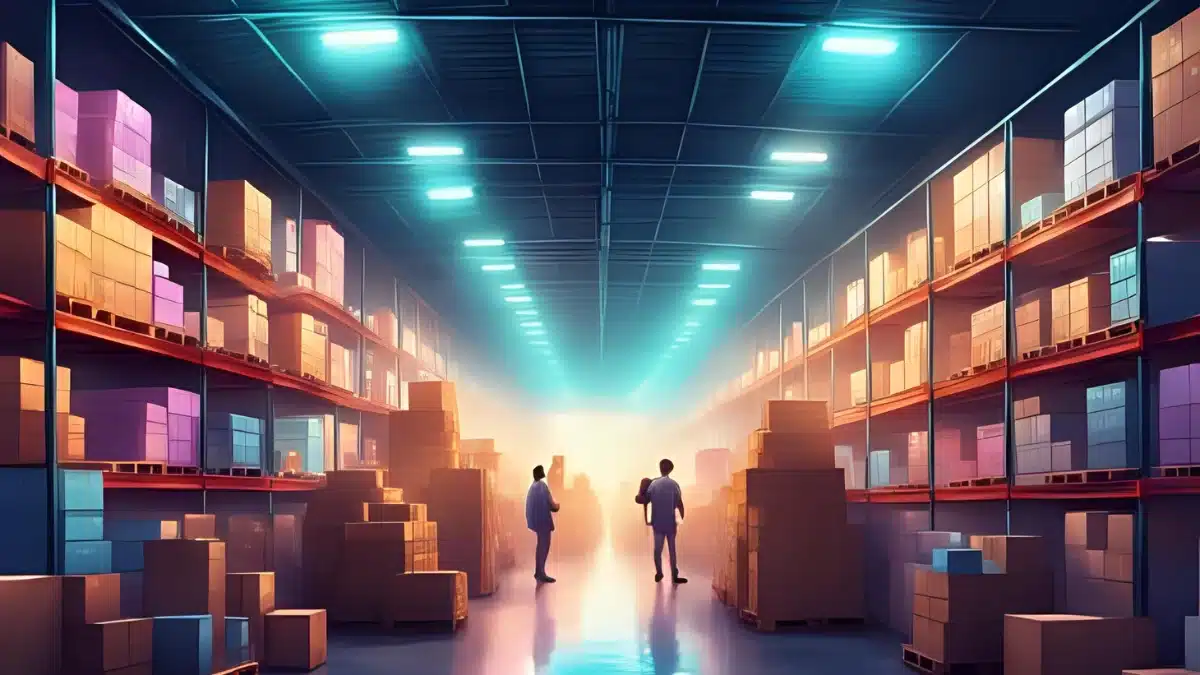
By knowing the advantages of a central warehouse in the previous paragraph, you know that you’re missing out by not using the right system for your central warehouse. Here are the main disadvantages of implementing a central warehouse:
1. Risk of operational disruption
Relying on just one warehouse, any interruption—whether from labor disputes, technological malfunctions, or natural disasters—can have a significant impact on the entire supply chain. Typhoons, earthquakes, and flooding are among the hazards that must be properly taken into account in site development and disaster recovery plans in the Philippines.
2. Higher transportation costs
Transporting goods from a central place to several distant provinces or islands can be expensive, particularly if air cargo, ferries, or inter-island freight are used. The savings from centralizing operations might overcome these expenses.
3. Longer delivery times to remote areas
Longer lead times for deliveries to Visayas and Mindanao could be the consequence of a major warehouse situated on Luzon. For consumers who live far from the center of town, this arrangement might not be the best option for serving time-sensitive or fragile products.
The Logistics of Central Warehouse in The Philippines
Domestic logistics can be costly and complex across the island archipelago. For that reason, it is important for businesses in the Philippines to focus on improving their central warehouse model. It is a vital component of logistics as it lets businesses receive, inspect, store, and release stock from one main hub before sending it to branches, stores, or project sites.
Robinsons Retail shows the importance of this model in the Philippines. In its FY2022 management report, the company said suppliers deliver most merchandise to its distribution centers, many of which use cross-docking so non-perishables can move to Metro Manila stores within one to five days and to Visayas and Mindanao within three to ten days. The same report says daily replenishment planning and warehouse management systems help the company keep top-selling SKUs available while controlling carrying cost.
How to Implement an Efficient Central Warehouse System in the Philippines
Building an efficient central warehouse system in the Philippines requires more than just finding a large storage facility. Businesses need to plan around geography, demand patterns, transport lead times, and stock visibility. When teams put the right structure in place early, they can reduce delays, improve stock accuracy, and support branch
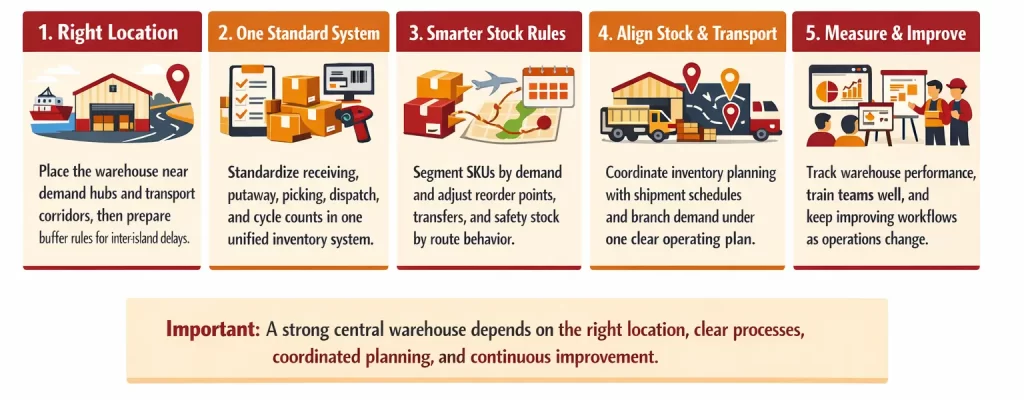
Following the right steps of implementation is the only way for companies to see the benefits of a central warehouse system.
The Calculation Behind Central Warehouse
A central warehouse decision should rest on numbers, not instinct. One of the most common planning shortcuts is the square-root law, which says total inventory is proportional to the square root of the number of stocking locations. In simple terms, businesses often estimate centralization with this formula: New inventory = Current inventory × √(New warehouses ÷ Current warehouses).
If a company reduces four stocking points to one, the rough estimate becomes Current inventory × √(1/4), or about 50% of the previous stock position. Still, later research warns that the square-root law can oversimplify real networks, so companies should treat it as a starting estimate, not a final answer.
Beyond that, the warehouse should track reorder points, safety stock, and total inventory cost. Under continuous review logic, managers calculate reorder points from expected demand during lead time plus safety stock, then estimate annual inventory cost from purchasing cost, ordering cost, and holding cost. That gives finance and operations teams a clearer way to test whether lower stock, lower shrinkage, and better control can offset any added transfer cost to provincial branches.
Conclusion
Businesses are able to maintain an eye on inventory levels, optimize supply chain processes, and guarantee steady product availability by utilizing central warehouses and efficient picking methods such as wave picking.
In the Philippine context, where infrastructure and geography pose logistical challenges, a central warehouse facilitates communication between producers, suppliers, and customers throughout Luzon, Visayas, and Mindanao.
The right warehouse system helps a company boost decision-making with real-time data insights, reduce expenses, and increase productivity. So, it is a paramount duty to find the best warehouse management system to overcome the problems faced by Filipino businesses.
FAQ About Central Warehouse
-
What is an example of a centralized warehouse?
Example, Imagine a large e-commerce company with one main warehouse located in Manila. This warehouse stores all its products in one central place. From here, they ship products to customers and stores all over the Philippines.
-
What is the use of centralised warehousing?
Integration streamlines data flow, enhances real-time reporting, improves inventory management, and provides better insights into sales.
-
What is a warehousing strategy?
Strategic warehousing is the complete process of managing your transportation spending, organizing warehouse space, and efficiently fulfilling customer orders. It is a complex logistics process involving specialized teams, equipment, technologies, and safety measures.
-
What are the 7 C’s of logistics?
Businesses commonly classify warehouses into seven types: private warehouses, public warehouses, bonded warehouses, distribution centers, fulfillment centers, smart warehouses, and cold storage warehouses. Some articles swap one category for another, but these seven are among the most widely used in logistics and supply chain discussions.
-
What are the 7 types of warehouse?
The 7 C’s of logistics usually refer to the goal of delivering the correct product, in the correct quantity, in the correct condition, to the correct place, at the correct time, for the correct customer, at the correct cost. In short, they focus on accuracy, service, and efficiency across the supply chain.