














You may not fully appreciate the impact of workforce management until you see the numbers for yourself. Consider the benefits: lower absenteeism, streamlined operations, and a more motivated, productive team. This is the kind of transformation businesses strive for, and it’s entirely achievable.
What if you could make this a reality? With an effective workforce management system, you can transform your workers into efficient, motivated, and productive output makers. It’s a strategic approach to optimizing operations and maintaining a competitive edge in today’s dynamic market.
Sa artikulong ito, tatalakayin natin ang mga pangunahing kaalaman sa workforce management, ang kahalagahan nito, at kung paano ito makapagbibigay ng konkretong resulta para sa iyong negosyo.
Table of Contents
Key Takeaways
|
What is a Workforce Management System?
A workforce competency management system (WFM System) is a comprehensive set of tools and processes designed to help businesses plan, oversee, and track employee activities, including timekeeping, scheduling, and compliance with labor regulations.
Beyond managing daily operations, modern workforce management solutions also address evolving employee expectations, work-life balance, and overall well-being, fostering greater engagement and job satisfaction.
Moreover, effective workforce management (WFM) helps employers allocate resources efficiently and comply with changing workplace regulations. It also helps businesses anticipate potential challenges, put proactive strategies in place, and boost productivity while reducing operational risks.
Essential Elements of a Workforce Management System

A WFM system comprises several essential components that help businesses effectively manage their workforce while enhancing the overall employee experience. These include time and attendance tracking, shift scheduling, labour law compliance, and performance management.
Beyond optimizing operations, a well-structured system ensures employees have a seamless and fair work experience, including clear access to employee benefits such as compensation, leave entitlements, and performance-based rewards. By integrating these key elements, businesses can create a more efficient, compliant, and employee-centric work environment that promotes engagement, satisfaction, and long-term productivity.
1. Time and attendance management
GPS tracking and facial recognition help verify employees’ locations, reducing the risk of fraudulent check-ins. This approach enhances accuracy and simplifies attendance management, making the process more efficient and reliable for everyone.
2. Employee scheduling and management
Flexible scheduling solutions make shift management more straightforward. Whether using fixed or rotating schedules, businesses can create work plans that balance operational needs with employee well-being, saving time and improving overall efficiency.
3. Payroll and compensation management
Automating wage calculations for hourly and daily employees reduces manual workload. Generating pay stubs directly from timesheet data enhances payroll accuracy and streamlines the entire process.
4. Task management and approvals
Assigning tasks and utilizing automated follow-up notifications speed up the approval process. This minimizes the need for constant manual oversight, ensuring projects stay on track.
5. Talent and performance management
Tracking employee performance through key performance indicators (KPIs) provides valuable insights into their progress. Using structured evaluation methods helps identify top performers and those needing additional support, strengthening overall talent management.
6. Competency gap analysis and skill matching
Identifying skill gaps makes aligning employees with the right job roles easier. This ensures that team members are well-positioned for growth and success, improving individual and team performance.
Benefits of Workforce Management
Research indicates that effective workforce management (WFM) leads to measurable improvements in key business metrics. Studies have shown notable employee engagement, productivity, and overall performance increases.
In the following sections, we will explore these key benefits, supported by data demonstrating the positive impact of workforce management software.
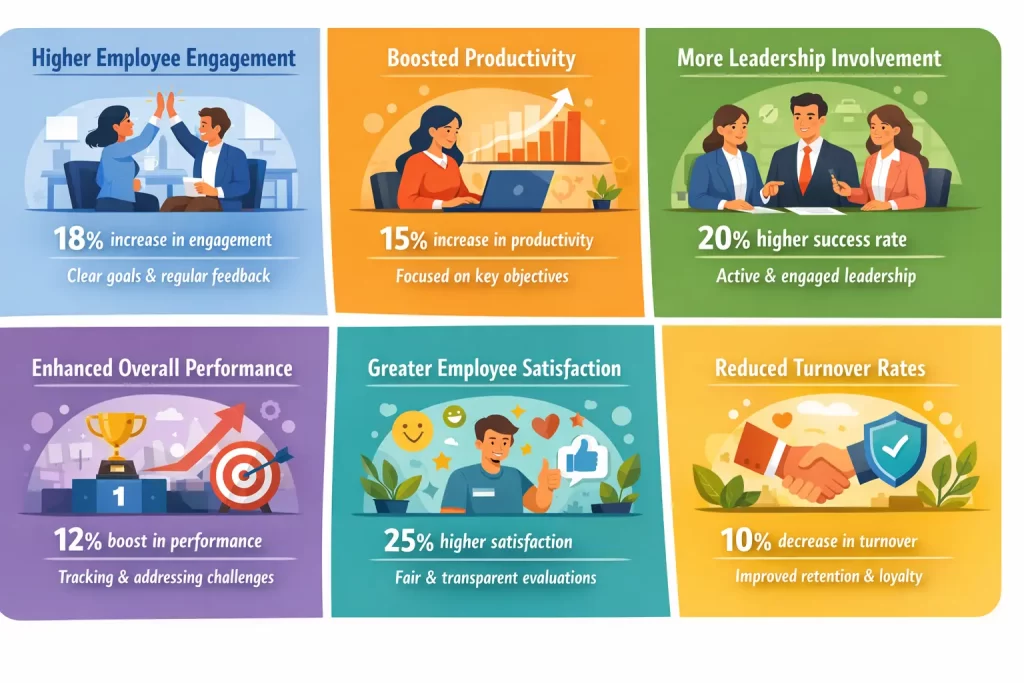
- Higher employee engagement: Organizations that implement effective performance management systems see an 18% increase in employee engagement. Clear performance goals and regular feedback help employees feel more connected and motivated in their roles.
- Boosted productivity: Proper use of performance management systems leads to a 15% improvement in productivity. Setting clear expectations and conducting regular evaluations allow employees to focus on key objectives.
- More substantial leadership involvement: Companies with active leadership participation in performance management have a 20% higher success rate. When leaders are engaged, performance metrics align more effectively with business objectives.
- Enhanced overall performance: Businesses that adopt structured performance measurement report a 12% increase in overall performance. Tracking progress against goals helps identify and address challenges early.
- Greater employee satisfaction: Organizations with well-defined performance metrics experience 25% higher employee satisfaction. Transparent and fair evaluations give employees a sense of accomplishment and purpose.
- Lower turnover rates: Effective performance management systems can reduce employee turnover by 10%. When employees understand how their performance is assessed and how it contributes to company success, they are more likely to remain with the organization.
Read more: What is Loan Management System? Features, Benefits, & Beyond
Disadvantages of Doing Manual Workforce Management
Every company faces unique challenges, and your workforce management (WFM) system should be designed to address them effectively. Some of the most common workforce management issues include:
1. Time tracking
Accurate time monitoring is essential for all employees, yet many companies struggle with outdated or disconnected time and labour systems that do not integrate with their master HR system. These inefficiencies can lead to costly payroll errors, excessive administrative work, and compliance risks.
Incorrect paychecks not only affect employee morale but can also expose businesses to legal issues and reputational damage.
2. Managing represented employees
Handling represented employees can be complex due to their higher salaries, benefits, and detailed contract provisions related to seniority, tenure, and pay entitlements.
Without a robust workforce management system, organizations may find it difficult to stay compliant and manage these regulations effectively.
3. Absence management
Without a reliable attendance management system, businesses may face increased costs, compliance risks, and reduced productivity.
Managing absence policies across multiple locations with varying labour regulations can be challenging, making it crucial for companies to have a system that ensures consistency and efficiency.
4. Reporting health and safety issues
Many businesses struggle to receive timely reports of workplace hazards and safety incidents. Complicated reporting procedures or difficult-to-use tools may discourage employees from reporting near-misses or unsafe conditions.
Integrating these processes within an HRIS system can help streamline reporting, ensuring a safer work environment.
Key Factors to Evaluate Before Selecting a Workforce Management (WFM) System

To ensure the successful implementation of workforce management solutions, organizations should follow these best practices:
- Employee training and support: Proper training is essential to ensure employees can effectively use the workforce management system. Clear guidance and ongoing support help employees adapt to the new tools, reducing resistance to change and improving overall adoption.
- Customization and scalability: Select a workforce management system that can be customized to fit your organization’s specific needs and is flexible enough to grow with your business. The system should seamlessly adapt to workflow changes, workforce size, and regulatory requirements.
- Data security and privacy: Strong security measures are essential since workforce management systems handle sensitive employee data. Ensure the system complies with data privacy regulations and includes encryption, access controls, and regular security audits to safeguard information.
- Analytics and reporting: A workforce management (WFM) system should provide advanced analytics and reporting capabilities. These features enable organizations to analyze workforce trends, forecast staffing needs, and make data-driven decisions to enhance efficiency and productivity.
- Change management: Adopting a new system can be a complex process. A well-structured change management strategy, including clear communication, comprehensive training, and addressing employee concerns, helps facilitate a smooth transition and ensures successful implementation.
Readiness Checklist Before Applying Workforce Management (WFM) System
Knowing the right workforce management (WFM) system for your organization is just one part of the battle; you must be familiar with your organization, inside and outside, before trying to implement a WFM. Evaluate your company’s internal readiness across operational, structural, and policy dimensions using this 4-level scoring framework:
Scoring Framework
For each section, evaluate your readiness and assign one of the scores:
- 0 – Not ready (No documentation, inconsistent execution, unclear process)
- 1 – Limited readiness (Basic structure exists, but major gaps remain)
- 2 – Structured but needs refinement (documented and functioning, minor improvements required)
- 3 – Fully ready (Clearly defined, standardized, aligned across departments, implementation-ready)
Maximum total score: 24
1. Operational readiness
Evaluate your organization’s method of scheduling and attendance across departments. From how approvals are handled, how attendance is recorded, whether shifts are made manually or digitally, and how exceptions are resolved. It is necessary to know this as it could cause disruption in the system from data inconsistencies, policy gaps, compliance risks, and inefficiencies.
| Asses | Scoring Guide |
|
|
2. Policy readiness
Evaluate your policies again to ensure that there are no unclear policies or inconsistent practice which can cause the system to produce incorrect calculations, disputes, and rework.
| Asses | Scoring Guide |
|
|
3. Reporting and KPI readiness
Evaluate your KPIs and make sure that it produces measurable outcomes as a strategic WFM system directly contributes to operational performance, cost control, and service quality. Without defined metrics, businesses cannot evaluate the impact, which hinders them from enacting actions.
| Asses | Scoring Guide |
|
|
4. Organizational structure readiness
Evaluate your real business structure before configuring a WFM, as schedules, approvals, and labor reporting follow a hierarchy of orders. If that structure is unclear, then the system would function as intended and would just churn out errors after errors: misallocated labor costs, misroutes approvals, and unreliable reports.
| Asses | Scoring Guide |
|
|
5. Time capture readiness
Evaluate the consistency of your time capture as its calculations rely on clean clock-in and clock-out data, break records, overtime rules, and approved edits; any inconsistency will create payroll errors, disputes, and compliance risk.
| Asses | Scoring Guide |
|
|
6. Payroll and finance readiness
Evaluate your payroll structure because time data only becomes payroll-ready when it matches your pay items, cut-off dates, rounding rules, and overtime premiums. If alignment is weak, payroll teams spend hours reconciling exports, fixing misclassified hours, and handling disputes, which defeats the whole purpose of using a WFM.
| Asses | Scoring Guide |
|
|
7. Data readiness
Evaluate the quality of your data, as WFM configuration relies on accurate employee records, job roles, locations, shift templates, and historical attendance patterns. Any incomplete or inconsistent data will cause the data to be all over the place, rendering the WFM system useless.
| Asses | Scoring Guide |
|
|
8. Integration readiness
Evaluate your organization’s broader digital ecosystem, as scheduling and time data must flow to HRIS, payroll, finance, and sometimes POS or project systems. Having no integration will cause issues with the system, like duplicated approvals, conflicting reports, and having to re-enter data.
| Asses | Scoring Guide |
|
|
Conclusion
Workforce management is an essential aspect of running a successful business. Companies that implement an effective workforce management (WFM) system can enjoy better resource allocation, improved compliance, and higher employee engagement.
Companies must evaluate their own system and needs to determine which WFM system is the best fit for them. Before applying it to their organization, they must run a diagnostic evaluation of their internal system to fix any issues that can cause problems.
FAQ Workforce Management
-
Why is workforce management important?
A workforce management (WFM) system helps businesses automate and streamline their processes and get insights into their operations and relevant metrics. It manages tasks, schedules work hours, controls costs, increases productivity, and measures output.
-
What is the main responsibility of the workforce management team?
The team is focused on balancing efficiency in operations, cost-efficiency, and the satisfaction of employees by reducing downtime, overstaffing, or understaffing. They also study data to increase productivity, decrease absenteeism, and make sure that they are in compliance with labor laws and company policy.
-
What are the responsibilities of management to employees?
The role of management is to support and guide employees. Develop a plan of action to address and deal with any potential workplace hazard, including workplace violence. Ensure employees are trained in proper procedures.