












For Malaysian import-export businesses, an inaccurate bill of lading can slow cargo release, disrupt customs clearance, and trigger disputes over shipment ownership, while also affecting delivery schedules and coordination between shippers, carriers, and warehouse teams.
According to data reported by The Edge Malaysia, Port Klang handled 14.64 million TEUs in 2024, making accurate bill of lading records essential for aligning cargo details, ownership, carrier responsibility, and customs documentation in Malaysia’s import-export flow.
This article explains bill of lading meaning, types, required information, sea waybill differences, examples, templates, letter of credit usage, Malaysia trade rules, and supply management workflows.
Key Takeaways
|
Inventory management software helps align B/L records with stock movement, warehouse receiving, and procurement data.
What Is a Bill of Lading?
A bill of lading is a legal shipping document issued by the carrier once goods are loaded onto the vessel, binding three parties: the shipper (sender), the consignee (receiver), and the carrier or shipping line. It is also referred to as BoL or BL.
Unlike a commercial invoice document or packing list, a bill of lading can act as a document of title giving the holder the right to claim or transfer ownership of goods in transit, which makes it critical for Malaysian businesses involved in import-export and freight forwarding.
Why Is a Bill of Lading Important?
A bill of lading is important because it gives every party a clear reference for shipment proof, carrier responsibility, and cargo ownership. Its main roles include:
Receipt for goods: The carrier issues a bill of lading as proof that the goods have been received for shipment, including their quantity, condition, and description.
Contract of carriage: It acts as a legal agreement between the shipper and carrier, outlining delivery terms, liability, and each party’s responsibilities.
Document of title: The original holder has the right to claim the cargo at the destination port, which is especially important in trade transactions involving payment or credit.
Types of Bill of Lading
Different types of bill of lading are used depending on how goods are shipped, who can claim them, and whether ownership can be transferred during transit. For Malaysian import-export businesses, choosing the right B/L helps avoid cargo release delays, payment disputes, and documentation issues.
| Type of Bill of Lading | Short Description | Negotiable? |
|---|---|---|
| Straight Bill of Lading | Issued to a specific consignee and cannot be transferred to another party once the shipment is in transit. | No |
| Order Bill of Lading | Can be transferred to another party through endorsement and is commonly used in international trade transactions involving a letter of credit. | Yes |
| Clean Bill of Lading | Confirms that the carrier received the goods in good condition without any visible damage, shortage, or defects. | — |
| Claused Bill of Lading | Includes remarks indicating that the goods were damaged, incomplete, or not in satisfactory condition when received by the carrier. | — |
| Through Bill of Lading | Covers shipments involving multiple transportation methods, such as ocean freight combined with road or rail delivery. | — |
| Ocean Bill of Lading | Used for international cargo shipments transported by sea between ports in different countries. | Yes / No |
| Inland Bill of Lading | Used for domestic transportation by road or rail before goods reach the seaport or after they leave the destination port. | No |
What Information Is Included in a Bill of Lading?
A bill of lading should include complete shipment details so the carrier, consignee, freight forwarder, bank, and customs authority can verify the cargo correctly.
Name and address of the shipper, consignee, and notify party: Identifies who sends the goods, who can legally receive them, and who should be contacted when the shipment arrives.
Carrier name, vessel name, and voyage number: Shows which shipping line handles the cargo, which vessel carries it, and which voyage the shipment belongs to.
Port of loading and port of discharge: Confirms where the goods are loaded and where they must be released, such as Port Klang, Penang Port, or another destination port.
Cargo description: Covers the type of goods, quantity, gross weight, measurement, and packaging type so the B/L can be matched with the invoice and packing list.
Container number, seal number, freight terms, issue date, and signature: Verifies the physical container, freight payment terms, document issue date, and official approval of the bill of lading.
Downloadable Bill of Lading Template
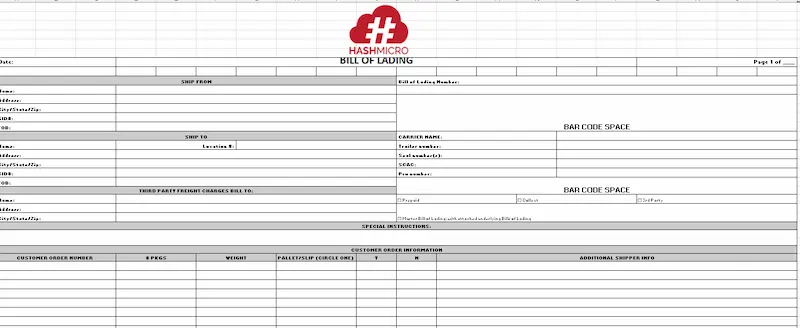
A bill of lading template can help businesses understand the common fields required in a shipping document, but it should only be used as a general reference and not as a replacement for the official B/L issued by a carrier or freight forwarder.
Bill of Lading Template
For businesses managing high volumes of shipments, a centralised system helps store and retrieve B/L records faster.
Bill of Lading vs Sea Waybill
A bill of lading and a sea waybill are both used in shipping, but they serve different purposes in cargo ownership, release, and documentation control. The table below highlights the key differences.
| Aspect | Bill of Lading | Sea Waybill |
|---|---|---|
| Negotiable | Yes, depending on the type of B/L used. | No, it is not negotiable. |
| Original copy required | Yes, the original B/L is usually needed to claim goods. | No, cargo can be released without presenting an original document. |
| Suitable for | Transactions involving letters of credit, third-party buyers, or ownership transfer. | Shipments between trusted parties, affiliates, or intra-company transfers. |
| Cargo release | Goods are released to the holder of the original B/L. | Goods are released directly to the named consignee. |
| Risk of document loss | Higher, because the original document is required. | Lower, because no original document is needed for release. |
| Common use case | International trade where payment and ownership control are important. | Faster shipments where the buyer and seller already trust each other. |
Bill of Lading and Letter of Credit
Bill of Lading
A bill of lading supports the physical movement of goods by proving that the carrier has received the shipment. It also helps confirm who has the right to claim or transfer the cargo during the trade process.
This document is important because it helps businesses:
- Confirm that goods have been received by the carrier for shipment.
- Record shipment details such as consignee, port, cargo description, and carrier responsibility.
- Support cargo ownership transfer when a negotiable or Order type is used.
- Reduce disputes when shipment details match the invoice, packing list, and other trade documents.
Letter of Credit
A letter of credit supports the payment side of international trade. It gives exporters more payment assurance, as the bank will release payment when all required documents match the agreed terms.
In practice, this payment process depends on document accuracy because it helps banks:
- Verify that the shipment has been made according to the trade agreement.
- Check whether the original negotiable bill of lading is submitted correctly.
- Confirm that Clean type documents show no visible damage or shortage.
- Reduce the risk of payment delay, cargo release issues, or bank rejection due to document mismatch.
Bill of Lading in Malaysia Trade and Customs
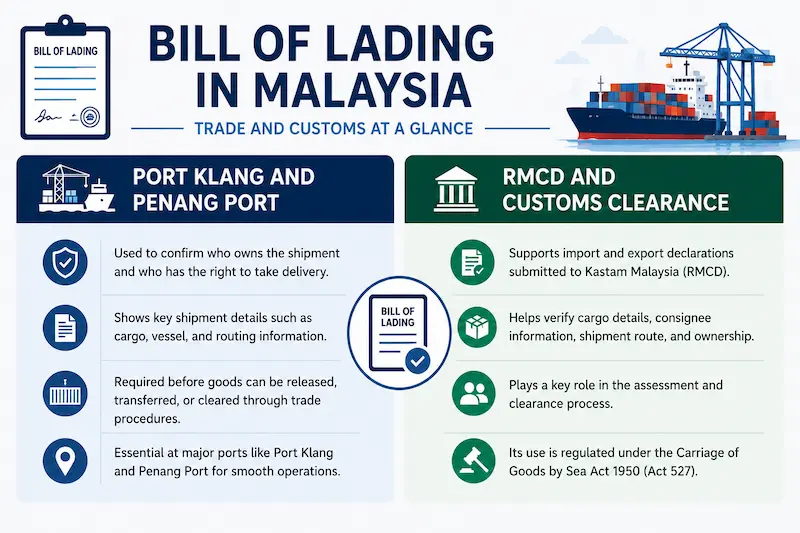
Port Klang and Penang Port
Port Klang is Malaysia’s largest container port and one of the busiest in Southeast Asia, while Penang Port serves as a key gateway for northern Malaysia trade. In both ports, the bill of lading is used to verify shipment ownership, cargo details, vessel information, and delivery rights before goods are released, transferred, or cleared through the import-export process.
RMCD and Customs Clearance
For customs clearance in Malaysia, the bill of lading supports declarations submitted to the Royal Malaysian Customs Department (RMCD), or Kastam Malaysia. It helps verify cargo details, consignee information, shipment route, and ownership, while its use is governed by the Carriage of Goods by Sea Act 1950 (Act 527).
Electronic Bill of Lading for Malaysian Businesses
An electronic Bill of Lading (eBL) is the digital version of a traditional paper B/L that can be issued, sent, verified, and transferred online. It reduces the need to courier original documents between exporters, importers, carriers, banks, and freight forwarders.
For Malaysian businesses trading with Singapore and other Southeast Asian markets, eBL helps reduce logistics challenges across trade routes. It also supports faster access to shipment records, especially for companies managing frequent import-export activities through ports such as Port Klang and Penang Port.
As shipping documentation becomes more digital, businesses need a reliable way to store, track, approve, and retrieve B/L records across teams. This creates a natural need for connected ERP and WMS systems that can manage trade documents alongside inventory and shipment workflows.
How ERP and WMS Help Manage Bills of Lading with a Visual Dashboard
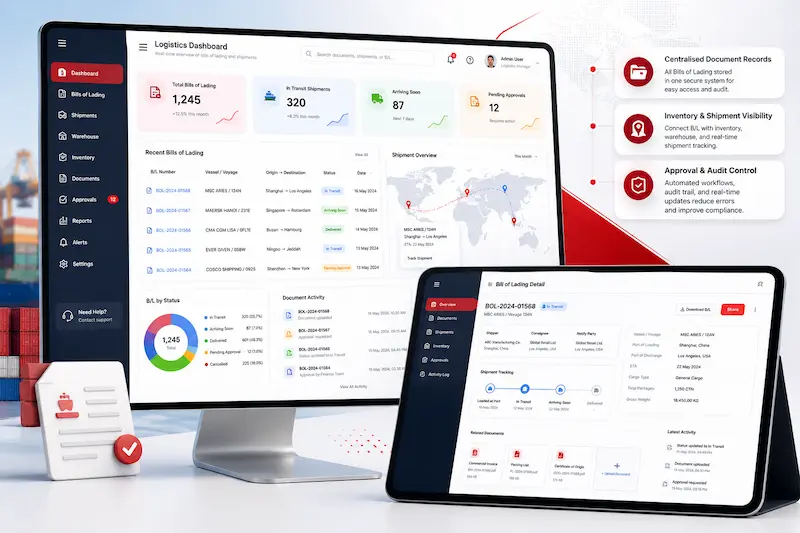
ERP and WMS systems help businesses manage bills of lading more efficiently by connecting shipping documents with inventory, warehouse, and approval workflows in one visual dashboard.
Centralised Document Records
An ERP system stores all B/L records in one platform, making documents easier to search, review, and retrieve when needed. This is useful during audits, shipment disputes, customs queries, or internal checks because teams no longer need to rely on scattered files, email threads, or manual folders.
Inventory and Shipment Visibility
A WMS connects B/L data with stock movement, inbound logistics records, and warehouse receiving activities. This helps warehouse teams see which goods are arriving, when they are expected, and how they relate to purchase orders, containers, or shipment records before the cargo reaches the warehouse.
Approval, Audit Trail, and Error Reduction
Automated workflows help reduce manual errors by standardising how B/L records are reviewed, approved, and updated. Every document change can be tracked with timestamps and user logs, giving managers clearer accountability when correcting shipment details, resolving discrepancies, or preparing supporting records for customs and finance teams.
Conclusion
A bill of lading is a key trade document that helps Malaysian businesses control cargo release, ownership, and shipping accountability. Poor B/L management can slow customs clearance, warehouse receiving, and procurement coordination.
For frequent shipments, a centralised system makes B/L management easier because teams can archive documents, track approval status, and connect shipment records with purchase orders, inventory movement, and warehouse receiving. This helps reduce scattered files, manual follow-ups, and mismatched information between logistics, procurement, finance, and warehouse teams.
Businesses that want better control over shipping documents can review how ERP and WMS workflows manage B/L records in one platform. A free demo can help teams see how document tracking, stock movement, procurement records, and warehouse activities are connected before they decide on the right system.
FAQ About Bill of Lading in Malaysia
-
What should Malaysian businesses check before approving a draft bill of lading?
Businesses should check the consignee name, notify party, port details, cargo description, container number, seal number, weight, and quantity against the invoice, packing list, and purchase order. Small mismatches can create problems during customs clearance, payment processing, or cargo release.
-
Who should handle bill of lading corrections?
Corrections are usually requested by the shipper or freight forwarder through the carrier, but warehouse, finance, and customs teams should flag errors early. Fixing mistakes before the final document is issued is usually faster than correcting them after the vessel has departed.
-
Can a bill of lading mismatch affect letter of credit payment?
Yes, banks may reject documents if the shipment details do not match the letter of credit terms exactly. Exporters should align the bill of lading, invoice, packing list, and credit terms before submitting documents for payment.
-
Is an electronic bill of lading suitable for every Malaysia shipment?
Not always. An electronic bill of lading is useful when the carrier, buyer, seller, bank, and destination process all accept digital documents. Businesses should confirm acceptance before relying on it for cargo release or trade finance.
-
How can warehouse teams use bill of lading data before cargo arrives?
Warehouse teams can use the document to prepare receiving space, match inbound goods with purchase orders, plan inspection, and coordinate stock updates. This helps reduce delays when containers reach the warehouse.