












Many businesses in Malaysia still struggle with inconsistent data across different departments. Sales, finance, and logistics teams often store separate customer information, creating confusion and increasing the risk of billing errors, delayed deliveries, and poor customer experiences. As more companies adopt digital systems, managing accurate business data has become a growing challenge.
Malaysia’s push toward digital adoption, including initiatives under programs like MyDIGITAL and industry-wide ERP uptake in manufacturing and logistics, has increased pressure on businesses to standardize and integrate their data systems. Without a centralized platform, companies often struggle with duplicate records, fragmented workflows, and inconsistent reporting that can lead to delayed or inaccurate operational decisions.
Master data management (MDM) helps businesses maintain consistent and reliable information with improve efficiency and support better ERP performance. This article will discuss the important of MDM for modern businesses in Malaysia.
Key Takeaways
|
Discover how the right ERP and MDM strategy can help your business grow faster. Click the banner below to learn more.
What is Master Data Management (MDM)?
Master Data Management (MDM) is a strategy that combines technology, processes, and governance to keep business data accurate and consistent across all systems. Instead of storing separate data in different platforms, MDM creates a single trusted version of important information that can be used by every department.
Master Data Management is the process of creating a single, reliable source of truth for the most critical data assets of an enterprise, ensuring high data quality and governance.
To simplify the concept, MDM can be compared to an Identity Card (IC) in Malaysia. Just as an IC serves as an official and recognized identity, MDM ensures businesses have one verified version of customer or product data that all departments can rely on. Besides technology, effective MDM also requires proper governance and standardized data management processes.
Master Data vs Other Types of Data
Not all data is created equal. To manage your information effectively, you must distinguish master data from the surrounding sea of information. Master data represents the “nouns” of your business, the core entities that don’t change frequently but are referenced constantly.
Understand these distinctions as the first step toward effective data governance.
| Data Type | Definition | Example |
|---|---|---|
| Master Data | Core business entities shared across the enterprise. | Customer Name, Product SKU, Vendor Bank Details. |
| Transactional Data | Records of business events or actions (high volume). | Invoice Amount, Sale Date, Order Quantity. |
| Reference Data | Standards used to categorize other data. | Country Codes (MY, SG), Currency (MYR), Tax Codes. |
| Metadata | Data that describes other data (technical context). | File Size, Creation Date, Database Schema. |
| Hierarchical Data | Data showing relationships between entities. | Organizational Charts, Product Categories. |
Types of Master Data: Domains and Examples

In the world of MDM, data is grouped into “domains.” Each domain represents a specific area of the business. Managing these domains correctly is vital for industries prevalent in Malaysia, such as manufacturing, distribution, and F&B, where high volumes of inventory and complex supplier networks are common. Below is a detailed breakdown of the primary master data domains:
- Customer Master Data: This is arguably the most critical domain. It includes not just names and addresses, but also credit limits, contact preferences, and interaction history. Effective customer MDM enables a “360-degree view” of the client, ensuring that marketing, sales, and support teams aren’t working with conflicting profiles.
- Product/Item Master Data: Essential for retail and manufacturing, this domain manages SKUs, dimensions, technical specifications, and bills of materials (BOM). Without standardized product data, businesses often face errors in e-commerce listings or production line delays due to incorrect component specifications.
- Supplier/Vendor Master Data: This domain contains records of the organizations your company buys from. It includes tax IDs, payment terms, banking details, and compliance certifications. Centralizing this data prevents duplicate payments and allows for better negotiation of bulk discounts through vendor consolidation.
- Location Master Data: Crucial for logistics and supply chain management, this tracks the physical and virtual addresses of warehouses, retail outlets, and distribution centers. It ensures that inventory is routed to the correct destination every time.
- Employee Master Data: This focuses on the internal workforce, covering roles, organizational hierarchies, and payroll information. It is often the link between HR systems and the broader ERP environment.
- Financial/COA Data: This domain encompasses the Chart of Accounts, cost centers, and tax hierarchies. Consistent financial master data is the only way to achieve accurate consolidated reporting across multiple subsidiaries.
In a Malaysian distribution business, poor product data management can create duplicate SKUs and uneven stock levels across warehouses. Inaccurate customer data may also cause credit limit issues due to disconnected systems. Master Data Management (MDM) helps synchronize data to reduce these operational problems.
Why Does Your Business Need Master Data Management?
Many businesses suffer from poor data quality without realizing it is the root cause of their inefficiencies. Research by Gartner indicates that organizations lose an average of $12.9 million annually due to poor data quality. MDM is the solution to these “invisible” costs and a prerequisite for advanced technologies like AI and Machine Learning.
- Eliminate Data Silos: When the sales team updates a customer address in the CRM, MDM ensures the ERP and logistics systems are updated instantly. This prevents delivery errors and customer frustration.
- Improve Decision-Making: Executives cannot make sound decisions based on conflicting reports. MDM ensures that a “Total Sales” report means the same thing to both the CEO and the CFO.
- Operational Efficiency: Without MDM, administrative staff spend hours manually reconciling data between spreadsheets. MDM automates this, allowing your team focus on high-value tasks.
- Regulatory Compliance: In Malaysia, the Personal Data Protection Act (PDPA) mandates that customer data be accurate and secure. MDM provides the audit trail and control needed for compliance.
- Better Relationships: Consistent data means no duplicate marketing emails, no billing mistakes, and no incorrect shipments, fostering trust with both customers and suppliers.
- AI Readiness: Artificial Intelligence requires high-quality, structured data to provide accurate insights. MDM prepares your data foundation for the future of automation.
Common Master Data Management Challenges and How to Overcome Them
Implementing MDM is a transformative journey, but it is often met with significant hurdles. Understanding these challenges is the first step toward building a resilient data strategy:
1. Maintaining a “Single Version of Truth”
With multiple legacy systems in place, each with its own database, synchronization is a nightmare. Different systems might use different formats for the same entity (e.g., “012-3456” vs “+60123456”).
Solution: Implement a centralized MDM hub that acts as the ultimate arbiter, using “fuzzy matching” algorithms to identify and merge duplicate records into one golden record.
2. Overwhelming Data Quality Issues
Years of manual entry lead to typos, missing fields, and outdated information. Trying to fix all of this at once is impossible.
Solution: Prioritize “high-impact” data fields first. Use automated data cleansing tools and enforce validation rules at the point of entry so that new “bad data” cannot enter the ecosystem.
3. Organizational Resistance and Ownership Conflicts
Department heads often guard their data jealously, fearing a loss of control or increased oversight. Disputes arise over who has the authority to change a record.
Solution: Establish a formal data governance committee. Appoint Data Stewards from different departments who are accountable for the accuracy of their specific domains, moving the culture from “departmental ownership” to “enterprise stewardship.”
4. Technical Integration with Legacy Systems
Many Malaysian businesses still rely on older, on-premise software that lacks modern APIs, making it hard to push updates from the MDM hub.
Solution: Utilize middleware or modern ERP solutions with high integration capabilities, ensuring data flows smoothly between the cloud and legacy environments.
5. Data Decay and Ongoing Maintenance
MDM is not a “one-and-done” project. Customer addresses change, businesses merge, and products are discontinued. Without a maintenance plan, the golden record quickly becomes obsolete.
Solution: Schedule periodic data audits and automate the verification process where possible, such as using third-party services to verify company registrations or postal codes.
The 5-Step MDM Implementation Roadmap
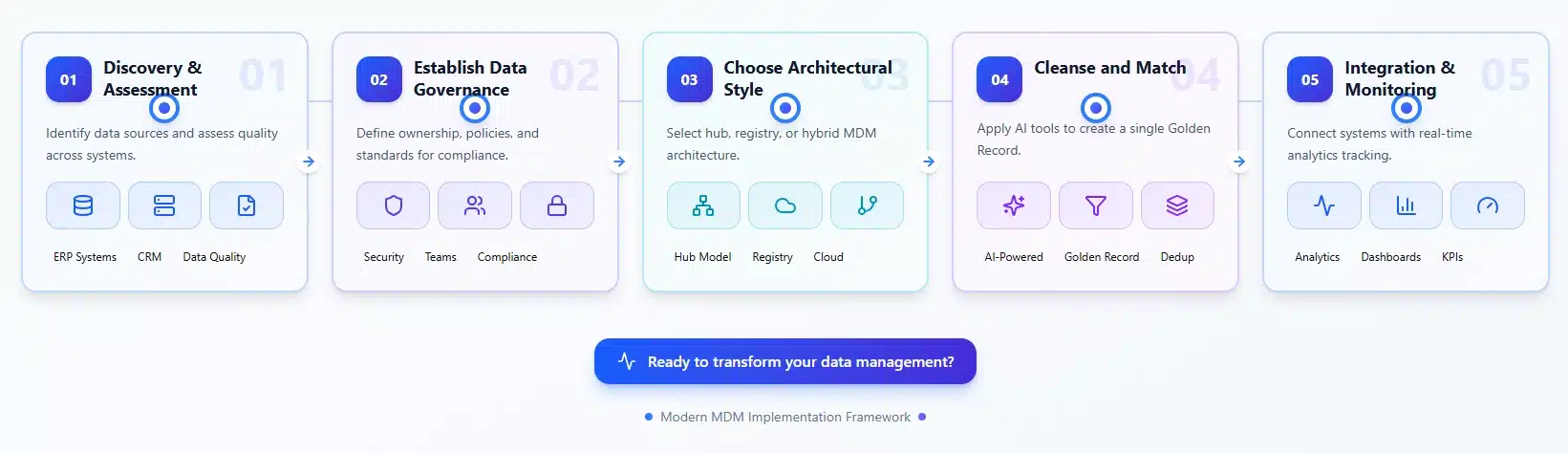
To achieve a successful MDM deployment, businesses should follow a structured approach rather than jumping straight into software installation.
- Discovery & Assessment:
The first step is identifying where master data is stored across the organization, such as ERP, CRM, inventory, and finance systems. Businesses also need to assess data quality by checking for duplicate, incomplete, or outdated records that may affect operations. - Establish Data Governance
Businesses should create clear rules for managing master data, including who can create, edit, and approve information. Standardizing naming conventions and data formats also helps maintain consistency across departments. - Choose the Architectural Style
Companies need to select the right MDM architecture based on their business needs. Some organizations use a centralized hub for all master data, while others prefer a registry model that connects data across existing systems. - Cleanse and Match
This stage focuses on improving data quality by removing duplicate and inaccurate records. MDM tools help merge similar entries into a single trusted “Golden Record” used across the organization. - Integration and Monitoring
The final step is connecting the MDM system with platforms like ERP, CRM, and finance software. Businesses should also monitor data regularly to maintain accuracy and prevent future inconsistencies.
Master Data Management in ERP Systems
ERP systems are the central nervous system of a modern business, but an ERP is only as good as the data inside it. This is where the principle of “Garbage In, Garbage Out” becomes painfully evident.
How ERP Relies on Master Data?
Every module within an ERP system is interconnected through master data. A single transaction triggers actions across multiple modules, all of which must reference the same master record.
- Sales Module: Relies on Customer Master Data for billing and shipping accuracy.
- Procurement Module: Relies on Vendor Master Data for automated purchase orders.
- Inventory Module: Relies on Product Master Data for stock levels and unit of measure consistency.
- Finance Module: Relies on Chart of Accounts for error-free ledger entries and financial reporting.
How MDM Works in a Modern ERP System?
A modern ERP integrates MDM processes directly into the workflow. When a new product is created, it goes through a Create > Validate > Approve > Publish cycle. Only after a Data Steward approves the entry is the data synchronized across the inventory, sales, and accounting modules, ensuring total consistency across the organization.
Key Features to Look for in Master Data Management Software
If you are evaluating MDM solutions in Malaysia, look for these critical features to ensure the tool meets your long-term needs for scalability and security:
- Centralised Data Repository: A centralised data repository allows businesses to store all master data in one unified system. Instead of having separate records across different departments, companies can access consistent and accurate information from a single source.
- Data Cleansing & Deduplication: Data cleansing and deduplication features help businesses maintain high-quality and accurate data. Algorithms automatically detect duplicate or incomplete records using intelligent matching technology, then merge or correct the information when needed.
- Data Governance & Access Control: Strong data governance and access control features allow businesses to manage who can view, edit, or approve specific data. With role-based permissions, companies can protect sensitive information and reduce the risk of unauthorized changes.
- Integration with Existing Systems: An effective MDM solution should integrate easily with existing business systems such as ERP, CRM, and warehouse management software. Through APIs and system connectivity, businesses can synchronize data across platforms and ensure information remains updated in real time.
- Audit Trail: An audit trail feature provides complete visibility into all data changes within the system. Businesses can track who updated specific records, when the changes were made, and what information was modified.
- Workflow Automation: Workflow automation helps businesses simplify the process of creating, updating, and approving master data records. The system can automatically route requests to the appropriate teams or managers.
How ERP System Supports Master Data Management?
An ERP system plays a key role in supporting master data management by centralizing and synchronizing core business data across departments. When properly integrated, updates such as product information, pricing, or vendor details are automatically reflected across related modules like inventory systems, procurement, and finance, reducing inconsistencies and manual data entry errors.
Modern ERP platforms are widely used by businesses in Malaysia and across Southeast Asia, particularly in industries such as manufacturing, retail, and F&B. By consolidating data into a single system, organizations can reduce data silos, improve data accuracy, and strengthen overall operational control, especially when managing large volumes of product and supplier information.
Conclusion
Many modern ERP systems in Malaysia now place Master Data Management (MDM) at the center of business operations. This helps companies maintain accurate and consistent information across multiple departments, especially as businesses continue adopting digital systems and integrated technologies.
With connected business software, updates made in one module, such as inventory, procurement, or sales can automatically synchronize across the organization in real time. This reduces data silos, minimizes manual errors, and improves operational visibility for better decision-making.
ERP solutions with strong master data management capabilities help businesses improve data accuracy and operational efficiency. Try a free demo to see how an integrated ERP system can support better data management for your business.

FAQ about Master Data Management (MDM)
-
How long does a typical MDM implementation take for a Malaysian SME?
Implementation timelines vary based on the size and complexity of the business. For a small to mid-sized Malaysian company with one or two core systems (such as an ERP and a CRM), a basic MDM rollout can take between three to six months. Larger businesses with multiple legacy systems or complex data domains may require nine to eighteen months. The longest phase is usually data cleansing and stakeholder alignment.
-
What is the difference between MDM and a data warehouse?
These two are often confused but serve different purposes. A data warehouse stores large volumes of historical transactional data for reporting and analytics. MDM, on the other hand, manages the core reference data, that other systems use in real time. Think of a data warehouse as a library of past events, while MDM is the dictionary that defines the key terms used across the business.
-
Does MDM help with PDPA compliance in Malaysia?
Yes. By ensuring that customer data is accurate, up-to-date, and centrally managed with an audit trail, MDM helps businesses meet the requirements of the Personal Data Protection Act.
-
What is a golden record in Master Data Management (MDM)?
A golden record is the one authoritative, de-duplicated, and verified version of a data entity that all systems use as the single source of truth.