













Traditional farming methods relied on uniform practices across entire fields. Farmers applied seeds, fertilizers, and pesticides at a consistent rate based on average field conditions. However, this approach overlooked natural variations in soil, moisture, and nutrients, often leading to inefficient input use and uneven crop performance.
Each section of land has different characteristics, from soil texture to water retention levels. Applying the same treatment across the field can result in overuse in some areas and underperformance in others. To address this, the smart agriculture revolution in Malaysia is pushing farms toward more precise and data-driven methods.
With the help of data analytics, sensors, and automated equipment, inputs can be applied more accurately and efficiently. The following section explores how variable rate agriculture works and why it is becoming essential in modern farming.
Key Takeaways
|
Understanding Variable Rate Agriculture and Spatial Variability
Understanding variable rate agriculture starts with recognizing spatial variability within a field. Soil properties such as texture, nutrient levels, and moisture can change significantly even within short distances. These differences often lead to inconsistent results when inputs are applied uniformly across the land.
Changes in elevation and soil composition can affect water distribution and nutrient availability. As a result, some areas may lack essential inputs, while others receive more than necessary. This imbalance can limit crop potential and increase unnecessary input costs.
Variable rate agriculture addresses this issue by adjusting input application based on specific field conditions. Using field data and defined management zones, farmers can apply seeds, fertilizers, and water more precisely. This approach is widely considered a fundamental element of modern precision agriculture, and the next section explains how it improves efficiency and supports better decision-making in farming.
The Core Components of Variable Rate Technology (VRT)

Variable Rate Technology (VRT) combines hardware and software to enable precision agriculture system through accurate input application. This system depends on multiple components working together to ensure field accuracy. Key elements include positioning systems, control units, actuators, and farm management software.
1. Global Positioning Systems (GPS) and RTK
VRT systems rely on highly accurate positioning technologies such as DGPS and RTK instead of standard GPS. These systems deliver centimeter-level accuracy, allowing machinery to track its exact location in real time. This precision ensures alignment between field position and digital prescription maps.
2. In-Cab Computers and Displays (ECU)
The Electronic Control Unit (ECU) functions as the main control hub inside the tractor. It allows operators to load maps, monitor application rates, and view field zones through a digital interface. The ECU continuously processes location data and sends instructions to the equipment during operation.
3. Variable Rate Controllers and Actuators
Controllers and actuators are responsible for carrying out adjustments in the field. They regulate mechanical functions such as seed distribution, spray pressure, or fertilizer flow. These components must respond quickly to ensure accurate application when moving across different zones.
4. Farm Management Information Systems (FMIS)
Farm Management Information Systems (FMIS) software collects and analyzes data from sources like soil sampling, yield records, and satellite imagery. It is used to create prescription maps with specific input instructions for each zone. These maps are then transferred to the ECU for execution in the field.
Map-Based vs. Sensor-Based Application Methods
In variable rate agriculture, two main approaches are used to decide how much input should be applied: map-based and sensor-based methods. Each offers different advantages depending on crop type, timing, and field conditions. Many farming operations combine both to achieve better accuracy and efficiency.
Map-Based Variable Rate Application
The map-based method is a proactive approach that uses historical and pre-collected data. Farmers gather information such as soil samples, past yield data, and field conditions before entering the field. Additional data like topography and soil conductivity is often included to improve accuracy.
After collecting the data, it is processed using mapping software to define specific management zones. Each zone is assigned a different application rate based on its characteristics. The final prescription map is then transferred to the tractor’s system for use during field operations.
| Advantages | Disadvantages |
|
|
Sensor-Based Variable Rate Application
Unlike the map-based approach, sensor-based VRA works in real time and reacts directly to field conditions. This method does not always rely on preloaded maps, as machinery is equipped with sensors that scan soil or crops during operation. The system instantly analyzes the data and adjusts input levels based on current needs.
A common use of this method is nitrogen management in crops. Sensors mounted on equipment measure light reflection from the crop canopy to assess plant health. Using indicators like NDVI, the system detects nutrient levels and adjusts fertilizer application accordingly, increasing rates for weaker plants and reducing them for healthier ones.
Advantages of Sensor-Based VRA:
- Eliminates the need for extensive, time-consuming soil sampling and pre-mapping for certain applications.
- Responds to the actual, real-time physiological condition of the crop, providing exactly what the plant needs at that specific moment.
- Highly effective for mid-season applications where crop conditions can change rapidly due to weather events.
Disadvantages of Sensor-Based VRA:
- The sensors can be expensive to purchase and require calibration.
- Environmental factors, such as extreme sunlight, cloud cover, or heavy dew, can sometimes interfere with the accuracy of optical sensors.
- Does not account for underlying soil limitations, a plant might look small due to a lack of water or a soil compaction issue, rather than a lack of nitrogen, leading the sensor to mistakenly over-apply fertilizer.
Key Applications in Modern Farming Operations
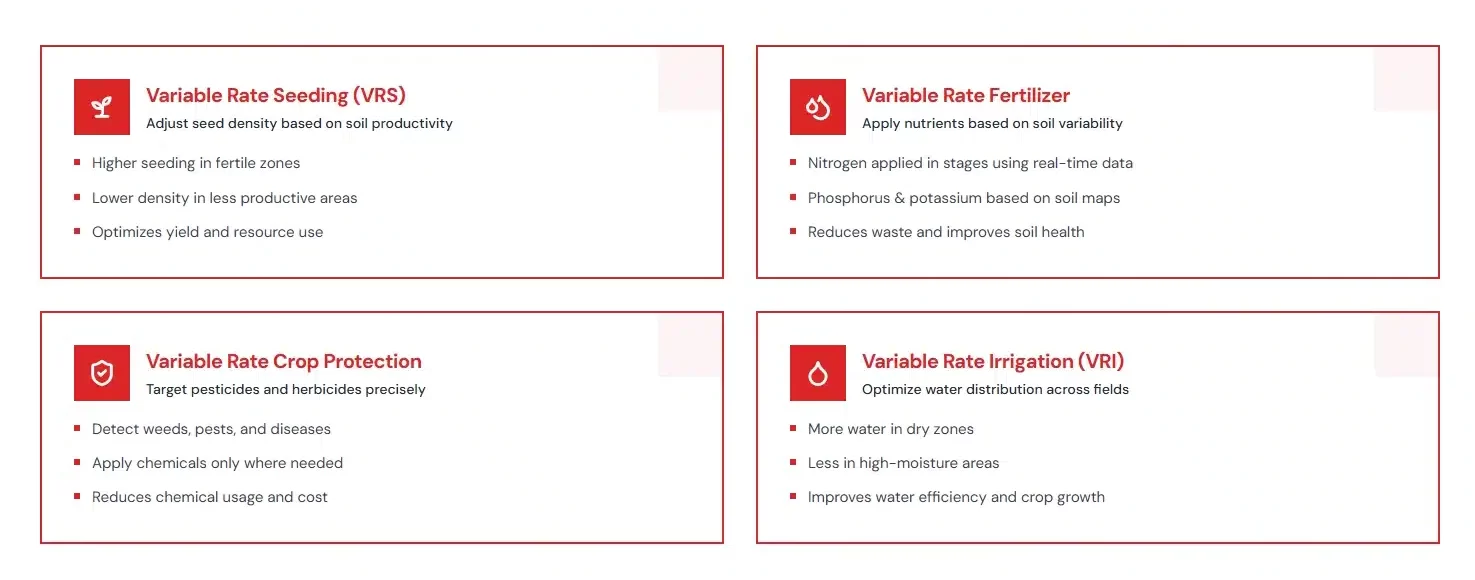
Variable rate agriculture is applied across different stages of crop production, from planting to crop protection. It helps farmers adjust inputs based on field conditions to improve efficiency and overall performance. The following sections outline its key applications in modern farming.
- Variable Rate Seeding (VRS)
Variable rate seeding replaces uniform planting density with a more targeted approach. Instead of applying the same seed rate across the field, farmers adjust it based on soil productivity and field conditions.In high-productivity zones, seeding rates are increased to maximize yield potential. In less fertile areas, lower seed density helps reduce competition for water and nutrients, allowing crops to grow more effectively. - Variable Rate Fertilizer Application
Fertilizer management can be improved by adjusting nutrient application based on soil variability. Different nutrients require different strategies, depending on how they behave in the soil.Nitrogen is often applied in multiple stages using real-time data, while phosphorus and potassium are managed through soil-based maps. This approach helps reduce input waste, control costs, and maintain long-term soil health. - Variable Rate Crop Protection (Pesticides and Herbicides)
Crop protection inputs can be applied more accurately by targeting specific areas instead of the entire field. This method focuses on identifying where weeds, pests, or diseases are present.Advanced systems use sensors and AI to detect issues in real time and apply chemicals only where needed. This reduces overall chemical usage while maintaining effective crop protection. - Variable Rate Irrigation (VRI)
Variable rate irrigation allows farmers to adjust water application based on soil moisture and field conditions. Instead of watering evenly, the system distributes water according to specific field needs. Drier areas receive more water, while zones with higher moisture levels receive less. This improves water efficiency and supports better management of limited water resources.
Economic and Environmental Impacts of VRT
The use of variable rate technology is growing because farms need better profitability and lower environmental impact at the same time. By applying inputs based on field conditions, VRT helps farmers reduce waste, improve efficiency, and meet sustainability goals.
Transforming Farm Economics and ROI
Farming businesses often deal with rising input costs and unstable market prices. Implementing VRT requires careful planning to balance fixed and variable costs, especially because farmers need to invest in GPS tools, sensors, controllers, and software.
The ROI comes from using inputs only where they are needed most. Instead of treating the whole field the same way, farmers can focus resources on high-potential areas, reduce unnecessary spending, and improve yield performance over time.
Driving Environmental Sustainability
Traditional farming can harm the environment when fertilizers are applied in excess. Unused nutrients may enter water systems, causing pollution, algal blooms, and damage to aquatic ecosystems.
Variable rate agriculture helps reduce this risk by applying fertilizer based on actual crop needs. This supports the 4R principles, lowers nutrient loss, and reduces emissions linked to fertilizer production and excess nitrogen in the soil.
Measuring Machinery Efficiency in Precision Farming
As farms adopt variable rate agriculture, machinery becomes more advanced and expensive. Equipment such as RTK-guided tractors and variable rate planters can cost millions, making efficiency a top priority. Farmers must ensure these machines perform well during critical planting and harvesting periods.
Modern agriculture is now using performance metrics similar to those in manufacturing. One key metric is Overall Equipment Effectiveness (OEE), which measures availability, performance, and quality. This helps farmers evaluate whether equipment is running on time, operating efficiently, and applying inputs accurately.
Monitoring goes beyond basic usage, with telematics systems providing real-time data on machine performance. Farmers can track pressure levels, flow rates, and system accuracy, while receiving alerts if issues occur. This ensures equipment follows prescription maps correctly and delivers the expected results in the field.
Overcoming Adoption Challenges and Data Management
Although variable rate agriculture offers strong agronomic and financial benefits, adoption still requires proper planning. Farmers need to handle new tools, upfront investment, and more complex field data before VRT can run effectively.
The Challenge of Data Silos and Interoperability
One common challenge is poor compatibility between equipment and software from different providers. This can make prescription maps harder to transfer and increase the risk of data errors.
VRT also produces large amounts of field data, from application rates to planting records and yield results. Without a clear system, storing and analyzing this data can become difficult.
The Role of Comprehensive Farm Management Software
Agricultural ERP systems help solve this issue by centralizing farm operations and data in one platform. They organize information from different sources so farmers can plan, monitor, and allocate resources more accurately.
With better data visibility, farms can improve productivity, reduce waste, and support more sustainable field management.
Industry Use Cases of Variable Rate Agriculture
Variable rate agriculture can be used in different farming sectors because it adjusts inputs based on field conditions. While it was first common in large crop farms, it is now also used in orchards, vineyards, forestry, and turf management.
Row Crop Production
For crops like corn, soybeans, and wheat, VRT helps farmers adjust seed and fertilizer use in each field area. Stronger zones can receive more seeds or nutrients, while weaker zones receive less to avoid waste. This helps improve crop growth and resource efficiency.
Vineyards and Orchards
In vineyards and orchards, VRT helps improve crop quality by controlling water, fertilizer, and spraying more precisely. Farmers can use field data to give each area what it needs, resulting in healthier plants, better fruit quality, and lower environmental impact.
Step-by-Step Implementation Steps for VRA
Transitioning from flat-rate farming to variable rate agriculture requires a systematic approach. Successfully implementing VRA is less about purchasing the most expensive equipment and more about building a reliable data foundation.
- Step 1: Comprehensive Data Collection: The process begins with gathering historical and real-time data. This includes multi-year yield maps, high-resolution topography data, electrical conductivity (EC) soil scans, and grid or zone-based soil sampling.
- Step 2: Defining Management Zones: Using farm management software, the collected data layers are overlaid to identify patterns. Areas with similar soil characteristics, elevation, and historical performance are grouped into distinct management zones.
- Step 3: Creating Prescription Maps: Once zones are established, agronomists or farm managers write a prescription (Rx) for each zone. This digital map dictates exactly how much seed, fertilizer, or chemical should be applied in each specific area.
- Step 4: Equipment Integration and Calibration: The prescription map is exported to the tractor’s in-cab display. It is crucial to ensure that the display console, the GPS receiver, and the implement controller (such as an ISOBUS-compatible sprayer or planter) are communicating correctly. Proper physical calibration of the application equipment is also required to ensure the digital commands match the physical output.
- Step 5: Execution and Post-Season Analysis: As the machinery moves through the field, the application rate adjusts automatically. After harvest, the new yield data is compared against the prescription map to evaluate the return on investment and refine the management zones for the following season.
Conclusion
Variable rate agriculture shifts farming from uniform input use to precise, data-driven management. By adjusting inputs based on field conditions, farmers can improve yield, reduce waste, and operate more efficiently. This makes VRT a key part of modern precision agriculture.
In addition to productivity gains, VRT supports better cost control and environmental sustainability. Targeted input use helps lower expenses while reducing nutrient loss and emissions. Despite challenges like data integration, the long-term value makes it a strong investment.
To fully benefit from VRT, farmers need the right system to manage data and operations. A farm management or ERP solution can help centralize insights and improve decision-making. You can start by trying our free demo to see how it fits your needs.

FAQ about Variable Rate Agriculture
-
Can variable rate agriculture be used with older farming equipment?
In some cases, older machinery can be upgraded with compatible controllers or GPS systems. However, full functionality may require newer equipment designed to support variable rate applications.
-
What types of crops benefit the most from VRT?
Crops with high input costs and sensitivity to soil conditions, such as corn, wheat, and specialty crops, tend to benefit the most. However, VRT can be adapted to many different crop types.
-
How much land is needed to benefit from variable rate agriculture?
VRT can be applied on both small and large farms, but the impact is usually more noticeable on larger fields with high variability. Smaller farms can still benefit if there are clear differences in soil conditions within the land.
-
Can VRT help with regulatory compliance in agriculture?
Yes, precise input tracking and reduced over-application can help farms meet environmental regulations and reporting requirements more easily.