















Variable costing is a costing method that includes only variable manufacturing expenses, such as materials, labor, and overhead. This approach helps businesses analyze profitability based solely on variable production expenses.
Both absorption costing and variable costing are essential because they help companies determine accurate product costs. To simplify these calculations, HashMicro Accounting Software provides automated variable costing features that deliver real-time results.
To improve profitability, companies must manage both total and variable costs effectively. Below, you’ll find definitions, strengths, and examples of variable costs to guide better financial decision-making. Get a free demo now!
Key Takeaways
Variable costing includes only variable production costs, such as materials and labor, treats fixed overhead as period expenses, and is used mainly for internal reports.
Variable costing benefits management by optimizing decisions, controlling variable costs, and simplifying budgeting.
The formula for variable cost is: Total variable cost = Total output quantity × Variable cost per unit of output.
HashMicro provides budget comparison and tracks variable costs for better control, while automated reports save time and enable quicker, smarter decisions.

What is Variable Costing?

Variable costing is an accounting method that includes only variable production costs like materials, labor, and overhead in the cost of goods sold. It helps businesses assess how changes in production volume affect profitability by excluding fixed costs from the calculation.
Variable costing helps businesses make more accurate decisions by focusing on variable costs and ignoring fixed costs. This approach allows companies to see how changes in production levels impact profitability and helps in setting prices or managing production efficiently. It also helping managers make short-term decisions by showing how production affects profit without including fixed costs.
Types of Variable Costing
Variable costing is a cost accounting method focusing on costs that vary directly with production or business activity levels. These costs are crucial for decision-making and pricing strategies.
Below are the main types of variable costs:
- Direct Materials are raw materials directly used to create a product, such as wood for furniture, steel for cars, or fabric for clothing. These costs change with production volume.
- Direct Labor refers to wages paid to workers directly involved in manufacturing, like assembly line staff or machine operators. The cost varies based on the labor needed for each unit produced.
- Variable Manufacturing Overheads include production-related costs that fluctuate with output, such as machine utilities, maintenance supplies, and factory consumables.
- Variable Selling Costs are expenses that change with sales volume, including sales commissions, shipping fees, and promotional discounts.
- Variable Administrative Costs are admin expenses that vary with business activity, such as temporary staffing and travel for sales meetings.
- Miscellaneous Variable Costs are other costs that shift with production or sales, such as packaging materials or royalties per unit sold.
The Function of Variable Costing

Variable costing helps management make short-term decisions by:
- Letting them know the contribution margin to plan profits through cost-volume-profit analysis and guide short-term policies.
- Making it easier to monitor operations, assess performance, and ensure accountability across departments, considering variable cost factors.
- Providing insights to control costs effectively by focusing on variable expenses.
- Helping in determining the best product pricing strategy for higher profitability.
- Simplifying budget comparisons by focusing only on relevant variable cost.
For a better understanding of variable cost and how to simplify it, read our article on the accounting system to discover how to automate calculations and improve cost management.
Example of Variable Costing
Below, we provide two examples of variable costing, so that you can gain a clearer picture of what it is and how to calculate it.
Example 1:
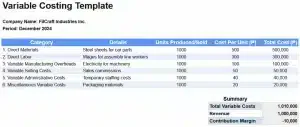 This template is a tool designed to calculate and analyze variable costs for businesses. It provides a structured way to categorize and quantify costs that change with production or sales levels.
This variable costing template shows that FICraft Wearables Inc. spent 1,070,000 on variable costs in December 2024, while earning only 1,000,000 in revenue. As a result, the company posted a negative contribution margin of -70,000, which means its sales did not fully cover its variable expenses for the period.
Example 2:
JDN, a phone case manufacturer, shared parts of its income statement for 2024. In 2024, the company produced 1,000,000 phone cases with total manufacturing costs of ₱33,700,000 (around ₱33.70 per phone case). Recently, they received a special order for 1,000,000 phone cases at a total cost of ₱22,500,000.
Although the company has enough production capacity, the manager hesitates to accept the special order because it is lower than the ₱33,700,000 manufacturing cost stated in their financial report. As the company’s cost accountant, the manager asks for your input on whether to accept the order.
It’s important to note that the ₱33,700,000 includes fixed costs like insurance, equipment, and utilities. Variable costing should be used to evaluate the special order.
Direct materials cost ₱8,325,000, direct labor is ₱4,162,500, and variable overhead is ₱4,440,000. Total variable costs amount to ₱16,927,500 for 1,000,000 units, which equals ₱16.93 per phone case.
To produce the special order of 1,000,000 cases, the total variable cost is ₱16,930,000. Thus, the contribution margin is ₱22,500,000 – ₱16,930,000 = ₱5,570,000.
The company should accept the special order based on the variable cost formula, as it will increase profits by ₱5,570,000.
The manager’s hesitation stemmed from mistakenly including fixed costs in the calculation. Since the company has enough capacity, there won’t be additional fixed costs for producing the extra 1,000,000 units. This shows how important variable cost is for decision-making.
Formula and Calculation of Variable Costs

The total variable cost is calculated by multiplying the quantity of output by the variable cost per unit:
Total Variable Cost = Total Quantity of Output x Variable Cost Per Unit of Output
Variable costing per unit can fluctuate based on the level of profit achieved. In most cases, these costs are determined by adding together the various types of variable costs described below.
Additionally, if variable cost is incurred in batches, they may need to be allocated proportionally across the products produced in that batch to ensure accurate cost distribution.
Variable Cost vs Average Variable Cost
Variable cost and average variable cost are related but different. Variable cost refers to the cost of producing one unit, while average variable cost (AVC) compares total variable costs to total output over time.
Average Variable Cost = Total Variable Costs / Total Output
These two measures can differ due to factors like price changes or wage adjustments. For example, an employee’s hourly wage is a variable cost; if they receive a raise, the current variable cost increases, while the AVC reflects an average between past and current wages.
AVC typically forms a U-shaped curve on a graph, helping companies identify the most efficient production level. By evaluating AVC, businesses can determine when to keep producing, reduce output, or temporarily shut down operations.
Here is a table comparison of variable cost vs average variable cost:
| Aspects | Variable Cost | Average Variable Cost |
| Definition | Cost of producing one unit | Average variable cost per unit across the total output |
| Formula | — (direct per-unit cost) | Total Variable Costs ÷ Total Output |
| Focus | Per-unit expense | Overall cost efficiency |
| Changes over time | Changes immediately with price or wage updates | Shows a smoothed average over different periods |
| Usage | For pricing and marginal decisions | For analyzing efficient production levels and shutdown points |
Variable Cost vs Fixed Cost
Understanding the difference between variable cost and fixed cost is essential for managing a business effectively. Variable costing varies with production or sales levels, such as raw materials or direct labor.
In contrast, fixed costs remain constant regardless of output, such as rent, salaries, or insurance. Variable costs provide flexibility and directly affect the cost per unit.
Here is a table comparison of variable cost vs fixed cost:
| Aspects | Variable Cost | Average Variable Cost |
| Definition | Costs that change based on production volume | Costs that remain constant regardless of production level |
| Behavior | Increases or decreases with output | Stays the same even if output rises or falls |
| Examples | Raw materials, direct labor, shipping costs | Rent, salaries of administrative staff, and insurance |
| Calculation Impact | Affects the cost per unit directly | Cost per unit decreases as production increases |
| Usage in decision-making | Helps determine marginal cost and production adjustments | Used for budgeting and understanding long-term financial obligations |
Variable Costing vs Absorption Costing

Both variable and absorption costing have their respective advantages and drawbacks. Understanding these will help businesses make an informed choice for managing costs and improving decision-making.
| Variable Costing | Absorption Costing |
| Includes only variable costs (materials, labor, overhead). | Includes both variable costs and fixed costs (e.g., rent, salaries). |
| Shows how variable costs impact profits directly. | Fixed costs are not recognized until products are sold, affecting short-term profits. |
| Helps managers make quick decisions based on variable costs. | Provides a full view of all costs, supporting long-term production planning. |
| Useful for pricing special orders by focusing on variable cost. | This may lead to overpriced products if based on absorption cost (including fixed overhead). |
| Finished goods are undervalued as variable cost is included only. | Higher inventory value due to the inclusion of fixed overhead in product costs. |
| Not GAAP-compliant, so not suitable for external financial reporting. | Compliant with GAAP, suitable for external and tax reporting. |
By understanding these advantages and disadvantages, businesses can better choose the right costing method to optimize financial management and decision-making.
Why External Financial Reports Do Not Allow the Use of Variable Costing
Financial reporting standards require that inventory valuation reflects all expenses involved in preparing goods for their intended use. This requirement is based on the accounting principle of matching costs with the revenue they generate. Absorption costing satisfies this principle more accurately by ensuring expenses are recognized in the same reporting period as the income they support.
In contrast, variable costing does not effectively apply the matching principle. That’s because it records certain costs, like fixed manufacturing overhead, immediately when incurred rather than when the related goods are sold.
If a company doesn’t sell all produced inventory within the same year, this causes a misalignment between reported costs and earned revenue. Due to this inconsistency, variable costing isn’t accepted for external reporting purposes. However, it is widely applied in internal reporting and management decision-making.
Automate Variable Cost Calculation with HashMicro
Tracking variable costing is crucial for managing production efficiently. Features like profit & loss vs budget & forecast and budget & realization help you compare actual spending with your budget. With HashMicro, this process becomes easier, giving you clear insights to boost your profits.
HashMicro’s Accounting Software goes beyond by providing financial statements with budget comparison, so you can stay on top of variable cost, ensuring accurate financial control. Its automated reporting saves time and helps you make smarter, faster decisions, especially when integrated with effective business budgeting software.
Need to track variable cost across branches or projects? HashMicro’s multi-level analysis lets you compare costs effortlessly. With these features, you’ll streamline cost management and boost your bottom line. Get your free demo of HashMicro Accounting Software today and see the difference!
Conclusion
In conclusion, variable costing provides a clear picture of production costs by focusing on expenses that change with production. Using the variable costing formula, businesses can make informed decisions for short-term planning. Comparing absorption and variable cost, the latter offers more flexibility for internal management.
For accurate cost control, understanding the costing formula helps managers evaluate special orders without overestimating expenses. By analyzing variable cost examples, businesses can predict how increased production impacts profitability, avoiding mistakes in decision-making.
If these methods seem complex, try HashMicro’s Accounting Software. It provides accurate financial analysis and reduces manual tasks like bookkeeping and asset depreciation. HashMicro also offers other useful features. Subukan mo na! Get your free demo today!
Frequently Asked Questions about Variable Costing
How to use variable costing?
Variable cost is determined by adding direct labor cost, direct material cost, and variable manufacturing overhead, then dividing by the total units produced. The variable costing formula is: (Direct Labor Cost + Direct Raw Material Cost + Variable Manufacturing Overhead) ÷ Number of Units Produced.
What is another name for variable costing?
Variable costs, also known as prime or direct costs, fluctuate based on production levels. In contrast, fixed costs are time-based and remain steady over a specific period, while variable costs adjust according to changes in output volume.
What is the role of variable costing in decision making?
Variable costing helps in decision-making by setting targets for product sales or services. It allows us to calculate the company’s break-even point, which is essential for establishing sales goals.