





In modern manufacturing, efficiency depends on more than machinery. Skilled employees who adapt to technology, troubleshoot equipment, and maintain quality are essential, making a skill matrix assessment key for evaluating and managing workforce capabilities.
Effectively managing these skills requires a structured, data-driven approach. A skill matrix assessment provides a clear picture of employee competencies, helping management understand strengths and weaknesses across the workforce.
Beyond identifying weaknesses, a skill matrix helps with workforce planning, succession management, and shift scheduling. By ensuring that every team has the right expertise in place, manufacturers can maintain consistent productivity and reduce downtime.
Table of Contents
Key Takeaways
|
The Strategic Value of Skill Matrix Assessments
The manufacturing industry faces challenges like an aging workforce, rapid technological change, and a shrinking talent pool, creating a widening skills gap. A skill matrix assessment goes beyond HR administration, serving as a key tool for operational risk management.
It provides visibility into workforce capabilities, highlighting critical knowledge held by “super-users” and preventing single points of failure. It also supports regulatory compliance and safety standards by documenting operator competency for audits.
Additionally, a skill matrix improves efficiency by helping managers quickly identify qualified operators for specific tasks, optimize shift equipment scheduling, and reduce downtime, ensuring production schedules are consistently met.
Defining Core Concepts: Matrix vs. Assessment
To implement this tool effectively, it is essential to distinguish between the “Skill Matrix” as a visual aid and the “Assessment” as a process. While the terms are often used interchangeably, they represent different stages of workforce management.
The Skill Matrix is the output, the visual grid that maps employees (rows) against specific skills or tasks (columns). The intersection of a row and column contains a symbol, number, or color code representing the individual’s proficiency level.
It is a snapshot in time, offering a high-level view of the team’s capabilities. However, a matrix is only as good as the data that feeds it. Without a rigorous underlying process, the matrix becomes a collection of subjective opinions that can lead to dangerous assumptions.
The Assessment is the input, the systematic process of evaluating an employee’s actual ability. This involves defining what “competence” looks like for each skill, establishing criteria for different proficiency levels, and conducting the evaluation through observation.
The assessment phase is where the real work happens. It requires objective standards to ensure that a “Level 3” operator on the night shift possesses the exact same capabilities as a “Level 3” operator on the day shift.
Developing a Robust Assessment Methodology
A robust Assessment Methodology ensures that competency evaluations are objective, consistent, and based on observable behaviors rather than subjective opinion. The foundation of a reliable assessment is a clearly defined rating scale.
Binary systems (Competent vs. Not Competent) are generally insufficient for complex manufacturing roles because they fail to capture the nuance of skill progression. Instead, a tiered scale is recommended to reflect the journey from novice to expert.
A widely accepted standard in manufacturing is the 0-4 scale. Level 0 indicates no knowledge or training. Level 1 implies the employee is currently in training or has theoretical knowledge but cannot perform the task.
Level 2 represents an operator who can perform the task but requires supervision or assistance. Level 3 signifies full competence, the ability to perform the task independently, safely, and to quality standards.
Level 4 is reserved for subject matter experts who not only perform the task flawlessly but also have the ability to train others and troubleshoot complex issues. Defining these levels with specific behavioral indicators removes ambiguity.
The method of verification is equally critical. Self-assessment, where employees rate themselves, can be a useful starting point for engagement but is prone to inaccuracy (both overestimation and underestimation).
Therefore, it should never be the sole data source for critical operational skills. Supervisor observation is the most common method, where a team leader watches the operator perform the task against a standard operating procedure (SOP) checklist.
For highly technical or high-risk roles, formal testing may be required. This could involve written exams to test theoretical knowledge or practical simulations to test troubleshooting skills. For example, a routine maintenance check technician might be asked to diagnose a staged fault in a PLC system.
By combining these methods, self-assessment for initial gaps, observation for routine tasks, and testing for critical skills, organizations create a multi-layered verification process that guarantees the integrity of the skill matrix.
Specific Manufacturing Applications and Use Cases
Specific Manufacturing Applications include optimizing shift scheduling, managing compliance audits, and reducing downtime through cross-training. The practical utility of a skill matrix assessment becomes evident when applied to daily factory operations.
One of the most common applications is in New Product Introduction (NPI). When a manufacturing line switches to a new product, the specific skills required to assemble or process that product may change.
A skill matrix allows planners to conduct a gap analysis prior to the launch, identifying which operators need upskilling on specific new assembly techniques or quality checks, ensuring a smooth ramp-up phase.
Another critical application is in Total Productive Maintenance (TPM). In a TPM environment, operators are expected to perform basic maintenance tasks (autonomous maintenance) rather than relying solely on the maintenance department.
A skill matrix assessment helps track which operators have been certified to perform tasks like lubrication, sensor cleaning, or minor adjustments. This empowers the workforce to maintain their own equipment, leading to higher machine availability.
Quality control is deeply tied to skill assessments. In industries like automotive or aerospace, where precision is non-negotiable, the matrix ensures that only certified personnel perform critical quality inspections.
A digital skill matrix allows the quality manager to instantly demonstrate that the operators on that specific shift possessed the required “Level 3” or “Level 4” certification at the time of production, thereby proving compliance and process control.
Furthermore, the assessment supports Lean Manufacturing initiatives. Cross-training is a pillar of Lean, enabling a flexible workforce that can move between cells based on Takt time and demand.
By using the matrix to track “polyvalence” (the number of skills a single operator possesses), managers can incentivize learning. For instance, a pay-for-skills program can be structured around the matrix, where operators receive a wage increase for every new “Level 3” skill they acquire.
Analyzing Data and Closing Skill Gaps
Conducting the assessment is only half the battle; the true value lies in analyzing the data to close skill gaps. A skill gap exists when the required competency level for a specific role or machine exceeds the actual competency level of the assigned personnel.
Data analysis should begin with the “Criticality Assessment.” Not all skills are created equal. Some tasks are rarely performed and have low impact, while others are daily necessities with high safety risks.
Managers should cross-reference the skill matrix with the criticality of the equipment. If a critical bottleneck machine has only one operator rated at Level 3 or 4, this represents a severe operational risk.
The analysis also aids in budget allocation for training and development. Instead of a “spray and pray” approach where generic training is given to everyone, the matrix allows for targeted intervention.
If the data shows that 40% of the workforce is deficient in a specific troubleshooting skill, a focused workshop can be organized. Conversely, if an individual is lagging behind their peers across multiple categories, it may indicate a need for a workforce performance tracking improvement plan.
Long-term workforce planning also benefits from this data. By tracking skill acquisition rates over time, HR can predict how long it takes to train a new hire to full productivity. This “time-to-competence” metric is vital for recruitment planning.

Common Challenges in Implementation
Despite the clear benefits, implementing a skill matrix assessment in a manufacturing setting is fraught with challenges. The most significant hurdle is often cultural resistance. Employees may view the assessment as a punitive tool designed.
To overcome this, management must clearly communicate that the purpose is development and safety, not punishment. Involving union representatives or employee councils early in the process can help frame the initiative as a pathway to career progression and job security.
Bias and inconsistency are also major pitfalls. If Supervisor A is a lenient grader and Supervisor B is a strict disciplinarian, the matrix becomes skewed. Employees under Supervisor B will appear less competent than those under Supervisor A, even if their skills are identical.
To mitigate this, calibration sessions are essential. Supervisors should assess a sample of operators together to align their standards. Additionally, creating detailed rubrics for each skill level, specifying exactly what a “Level 3” performance looks like.
Another logistical challenge is the “Staleness” of data. In a dynamic factory environment, skills can decay if not used (skill atrophy), and new procedures are constantly introduced. A matrix that is updated only once a year is virtually useless.
Maintenance of the matrix requires a predefined cadence, for example, reviewing safety skills annually and technical skills quarterly. It also requires a trigger-based update system, where significant changes to machinery or SOPs automatically trigger a requirement for re-assessment.
Finally, the complexity of managing the data can become overwhelming. A mid-sized factory with 200 operators and 50 distinct skills creates 10,000 data points. Managing this in static spreadsheets leads to version control issues, broken formulas, and a lack of accessibility.
This administrative burden often causes the initiative to lose momentum, resulting in a “zombie matrix” that exists on a server but reflects a reality that is months or years out of date.
The Digital Transformation of Skills Management
The Digital Evolution of skills management moves beyond spreadsheets to integrated real-time systems for dynamic workforce agility. As manufacturing moves toward Industry 4.0, the manual spreadsheet-based skill matrix is becoming obsolete.
Modern operations require dynamic, real-time visibility into workforce capabilities, which is best achieved through specialized software solutions or modules within Enterprise Resource Planning (ERP) systems.
Digital skill matrices allow for integration with other operational systems. For example, a digital system can link directly to the Time and Attendance system. If a shift supervisor attempts to schedule an operator for a specific machine, the system can cross-reference the assignment against.
If the operator’s certification has expired or they are not rated at the required proficiency level, the system can block the assignment or flag a warning. This prevents safety violations and ensures quality control in real-time.
Furthermore, digital platforms facilitate “micro-learning” and immediate verification. Instead of waiting for an annual review, an operator can complete a digital training module on a tablet at their workstation, take a quick quiz.
This reduces the administrative lag between learning a skill and being recognized for it. It also allows for the attachment of digital evidence, such as photos of completed work or logs of machine operation, providing a robust equipment review trail.
They can identify trends in skill decay or highlight correlations between skill levels and defect rates. For instance, data might reveal that scrap rates increase when the shift is staffed with operators who are only at “Level 2” proficiency.
This insight allows management to make a business case for additional training. While various vendors like SAP, Oracle, and HashMicro offer solutions that include competency management features, the key is to choose a system that integrates seamlessly with the shop floor workflow.
Future Trends: AI and the Skills Economy
Looking ahead to 2025 and beyond, the concept of the skill matrix assessment is evolving into a “Skills Economy” within the enterprise. Artificial Intelligence (AI) and Machine Learning (ML) are beginning to play a role in how skills are assessed and utilized.
Future systems will likely move away from rigid, pre-defined roles toward fluid project-based skill allocation. AI algorithms could analyze production schedules and automatically recommend the optimal team composition based not just on technical skills.
Augmented Reality (AR) is also set to transform assessment. Instead of a supervisor standing over an operator with a clipboard, the operator might wear AR glasses that guide them through a complex assembly task.
The system could track their eye movements, the speed of their hands, and the accuracy of their placement, providing an automated. This would eliminate human bias entirely and provide granular data on exactly which part of the process the operator struggles with.
The definition of “skill” itself is expanding. As factories become more automated, the demand for manual dexterity decreases while the demand for data literacy and systems thinking increases.
Future skill matrices will weigh digital fluency as heavily as mechanical aptitude. The ability to interpret data from a digital twin or collaborate with a “cobot” (collaborative robot) will become standard columns in the matrix.
Ultimately, the skill matrix assessment will transition from a compliance document to a dynamic digital twin of the workforce itself. Just as manufacturers model their machinery to predict maintenance needs, they will model their workforce to predict training needs.
Sector-Specific Applications of Competency Frameworks
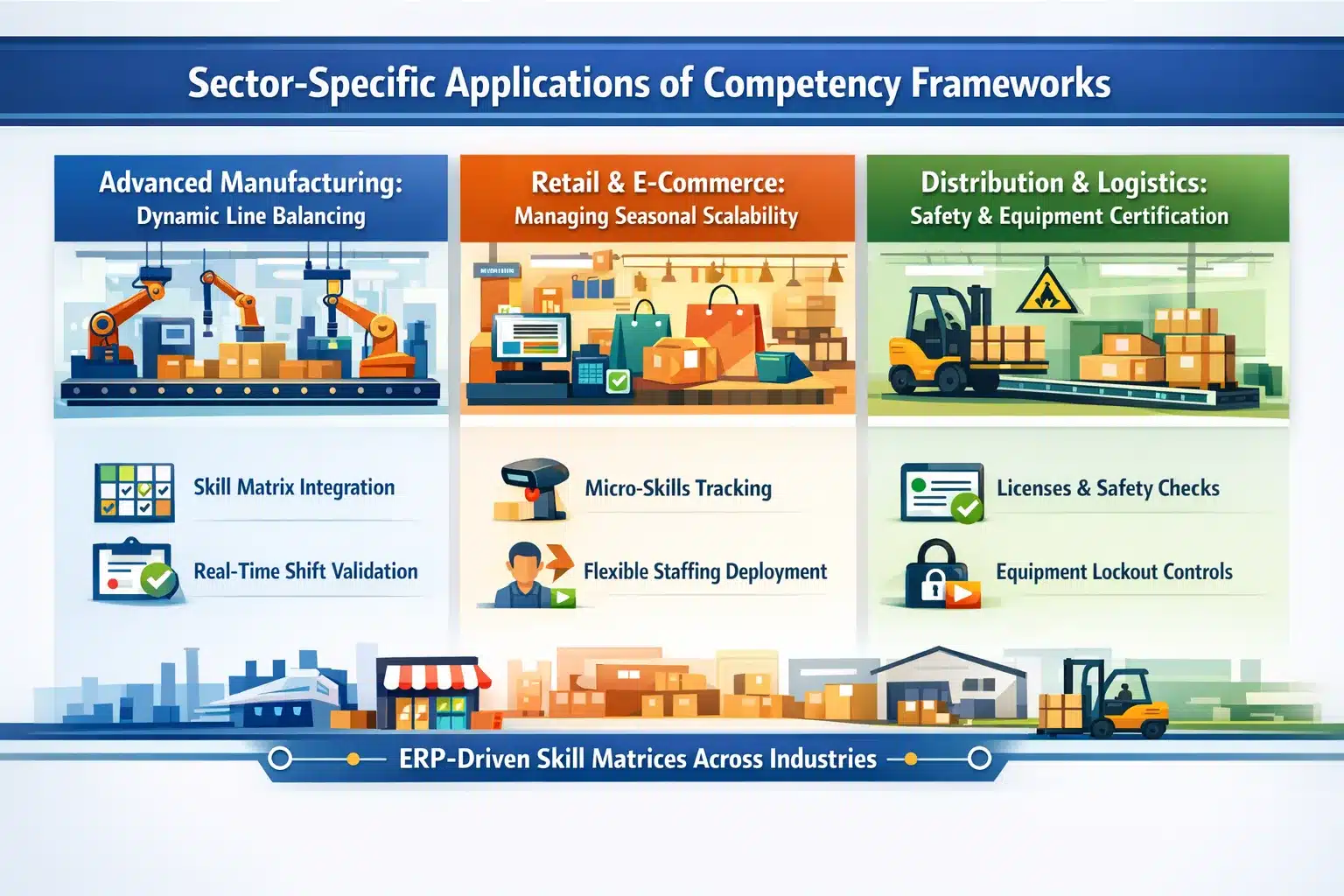
While the concept of a skill matrix originated in manufacturing, its application has evolved. Modern Enterprise Resource Planning (ERP) systems enable organizations across various sectors to adapt this tool to their specific operational nuances.
1. Advanced Manufacturing: Dynamic Line Balancing
In discrete and process manufacturing, the skill matrix is the engine behind dynamic line balancing. Production managers use these matrices to adjust staffing in real-time based on the specific product being assembled.
By integrating the skill matrix with the ERP’s production planning module, manufacturers can automatically validate if a scheduled shift possesses the aggregate certification level required for a specific work order.
2. Retail and E-commerce: Managing Seasonal Scalability
For the retail and e-commerce sectors, the primary challenge is volatility. Demand spikes during holiday seasons or promotional events require rapid workforce scaling. Here, the skill matrix focuses on versatility and onboarding speed.
A matrix in this environment tracks “micro-skills” such as Point of Sale (POS) operation, inventory cycle counting, and returns processing. During peak periods, store managers use the matrix to identify floor staff who can be instantly redeployed to fulfillment centers.
This data-driven flexibility reduces the reliance on temporary agency staff and improves long-term client engagement by ensuring that available employees are deployed where the pressure is highest.
3. Distribution and Logistics: Safety and Equipment Certification
In distribution centers, the skill matrix is inextricably linked to safety and equipment licensing. The matrix must track certifications for various classes of forklifts, reach trucks, and hazardous material handling.
Unlike other sectors where a skill gap might slow production, a gap here can lead to license revocation or severe accidents. Best-in-class logistics operations utilize the matrix to enforce “hard stops” in their workforce management systems.
If an operator’s certification for a specific vehicle has expired, the system prevents them from logging into the equipment or accepting a pick-list that requires that machinery, enforcing compliance through digital constraints.
Detailed Implementation Steps and Metrics
Transitioning from a subjective understanding of workforce capability to a data-driven matrix requires a rigorous implementation methodology. Organizations must move beyond binary “can/cannot do” indicators toward a granular leveling system.
Phase 1: Taxonomy and Standardization
The first step is defining a standardized skills taxonomy. Operations leadership must collaborate with HR to break down roles into specific, observable competencies. A common pitfall is being too vague (e.g., “Communication Skills”) or too granular (e.g., “Turning Screw A”).
The ideal level of granularity focuses on process ownership. A 4-point scale is the industry standard for rating:
- Level 1 (Learner): Is currently in training; cannot perform the task without supervision.
- Level 2 (Doer): Can perform the task independently but may lack speed or troubleshooting ability.
- Level 3 (Expert): Performs the task efficiently, meets all quality standards, and can troubleshoot common issues.
- Level 4 (Trainer): Demonstrates mastery and is qualified to train and certify others on this task.
Phase 2: The Audit and Validation Process
Once the framework is set, an initial audit establishes the baseline. This must not be a self-assessment, which is prone to inflation bias. Instead, “Level 4” operators or supervisors must validate the skills of the workforce through practical demonstration.
Phase 3: Defining KPIs for Workforce Development
To measure the effectiveness of the skill matrix, organizations must track performance metrics. These metrics move workforce planning from intuition to calculation.
- Skill Saturation Rate: This metric calculates the percentage of required skills that are currently possessed by the active workforce. A low rate indicates high vulnerability.
Formula: (Total Verified Skills / Total Required Skills for Role) x 100 - Bus Factor Risk Score: This identifies processes dependent on fewer than two individuals. If only one person knows how to operate a critical machine, the risk score is critical. The goal is to drive this score to zero through cross-training.
- Time-to-Competency: This tracks the average time it takes for a new hire to move from Level 1 to Level 3. Reducing this timeline through better training protocols directly impacts labor ROI.
Common Pitfalls and Mitigation Strategies
Despite the logic of skill matrices, implementation often fails due to behavioral and administrative hurdles. Recognizing these pitfalls early is essential for long-term viability.
1. The “Halo Effect” and Subjectivity
A major risk in assessment is the “Halo Effect,” where a supervisor rates an employee highly in technical skills simply because they are punctual. This creates a “Green Illusion,” where the matrix looks healthy (all green), but production fails when those employees are tested.
Mitigation: decouple behavioral assessments from technical ones. Use standardized checklists for technical validation that require objective evidence (e.g., “Successfully completed 3 changeovers under 20 minutes”) rather than supervisor opinion.
2. Static Data Decay
A skill matrix is a snapshot in time. If it is not updated, it becomes a liability. An employee who was a Level 3 operator two years ago but hasn’t performed the task since has likely experienced skill degradation. Relying on old data leads to quality failures.
Mitigation: Implement “Skill Expiry” dates within the ERP system. If an operator has not logged time against a specific work center in six months, the system should automatically downgrade their skill level, triggering a requirement for a refresher course or re-certification.
3. Complexity Paralysis
Organizations often attempt to map every single variable, resulting in a matrix with thousands of data points that is impossible to maintain.
Mitigation: Apply the Pareto Principle (80/20 rule). Focus the matrix on the 20% of skills that drive 80% of the operational risk and value. Routine, low-risk tasks do not require the same level of tracking as critical control points.
Advanced Best Practices for ERP Integration
The future of skill management lies in integration. Leading organizations are no longer viewing the skill matrix as a standalone HR document but as a constraint logic within their ERP.
1. Automated Scheduling Logic
Advanced implementations link the skill matrix directly to the finite scheduling engine. When the ERP generates a production schedule, it checks the rostered employees against the required skills for the planned maintenance request.
If a gap is detected, for example, a night shift lacks a certified welder, the system flags the conflict days in advance, allowing managers to adjust the schedule or call in covered support before the shift begins.
2. Predictive Hiring and Training
By analyzing the “Skill Gap Trend” over time, organizations can move from reactive hiring to predictive workforce planning. If the data shows a 15% degradation in electrical troubleshooting skills due to impending retirements over the next 12 months, the system can trigger a hiring requisition.
Conclusion
The skill matrix assessment is a vital tool for achieving operational excellence in manufacturing, helping bridge the gap between workforce potential. By adopting a data-driven approach, manufacturers can identify risks and optimize labor efficiency.
Implementing this system requires clear competency definitions and ongoing analysis to inform strategic decisions. Transitioning from manual records to digital tools can be challenging, but the benefits in agility, resilience, and productivity are significant.
For manufacturers looking to evaluate their workforce capabilities and explore tailored solutions, booking a free consultation can provide practical guidance on how to implement a skill matrix assessment effectively and maximize operational performance.
Frequently Asked Questions
-
What is the best rating scale for a manufacturing skill matrix
A 0-4 scale is widely recommended for manufacturing. Level 0 indicates no knowledge, Level 1 is training/theory only, Level 2 is performance with supervision, Level 3 is independent competence, and Level 4 represents a subject matter expert who can train others.
-
How often should a skill matrix assessment be conducted?
Assessments should be dynamic rather than purely periodic. However, a best practice is to review safety-critical skills annually, technical skills quarterly, and conduct ad-hoc assessments immediately following new equipment installation or process changes.
-
How can we reduce bias in skill assessments?
Bias can be reduced by defining specific behavioral indicators for each rating level (rubrics), using multiple verification methods (observation + testing), and conducting calibration sessions where supervisors align their grading standards.
-
What is the difference between a skill gap analysis and a skill matrix?
A skill matrix is the visual tool (the grid) that displays current proficiency levels. A skill gap analysis is the process of comparing that current state against the required future state to identify deficiencies and plan training.