







Table of Contents
In today’s fast moving business environment, many organizations struggle not because they lack ambition, but because they mismanage their resources. Projects fall behind schedule, employees feel overwhelmed, budgets quietly overrun, and leadership is left reacting instead of planning. The real problem is rarely effort, it’s allocation.
Resource allocation is no longer just about assigning people to tasks. Even with strong planning and advanced systems, resource allocation often breaks down due to internal habits rather than strategy itself. Overload employees may across too many initiatives ignoring the productivity loss caused by constant context switching. Without clear rules such as booking expiration policies, a single source of truth, and limits on fragmented assignments, even the best allocation strategy can quietly fail in execution.
Key Takeaways
|
What Is Resource Allocation In The Modern Era?
In today’s business landscape, the meaning of resource allocation has evolved beyond scheduling tasks. Resource allocation is now a strategic process of scheduling and assigning available resources that aligns financial, human, and technological assets with long-term business priorities to drive efficiency, growth, and competitive advantage.
To fully grasp the nuances of this practice, There are two categories of resources such as tangible and intangible resources. Effective management requires a holistic view where tangible and intangible assets are synchronized. For instance, assigning a high-performance computer (tangible) to a developer is useless if that developer lacks the specific coding skills (intangible) required for the project.
Choosing the Right Resource Allocation Framework
In practice, companies rarely rely on just one methodology. Instead, they select frameworks based on industry demands, project complexity, and strategic priorities.
- Construction and engineering firms commonly use the Critical Path Method (CPM) to protect deadlines.
- Organizations facing limited capacity apply Resource leveling to prevent over-allocation.
- Businesses operating under fixed timelines often implement Resource smoothing to maintain workload balance without extending delivery dates.
- Technology and creative companies typically adopt Agile resource allocation, allowing teams to reassign resources in short cycles to adapt quickly to changing requirements.
The Strategic Benefits of Effective Allocation
When resources are allocated correctly, the benefits permeate every level of the organization. The impact is measurable not just in financial terms but also in cultural and operational metrics.
Maximizing Operational Efficiency. The most immediate benefit is the reduction of idle time. By ensuring that resources are utilized optimally, companies avoid the cost of paying for downtime.
Improving Employee Retention. Conversely, under-allocation can lead to boredom and a lack of professional fulfillment. Intelligent resource allocation balances workloads, ensuring that employees are challenged but not overwhelmed.
Cost Reduction and Profitability. Effective allocation ensures that the right level of resource cost is matched to the value of the task, preserving profit margins.
Predictability and Risk Management. With a clear view of where resources are committed, leadership can forecast future capacity with greater accuracy. This visibility allows for better risk management.
From Planning to Performance: A Strategic Resource Allocation Roadmap

Even the best strategy fails without execution. To transform resource allocation from a reactive, chaotic activity into a structured, strategic advantage, organizations need a clear and disciplined roadmap. Effective resource allocation begins with visibility, evolves through prioritization, and succeeds through continuous optimization.
-
Conduct a Comprehensive Resource Audit
Strategic resource allocation starts with clarity. Companies must identify every available asset human skills, financial capacity, technology, and physical infrastructure. A detailed skills matrix, cost structure, and asset capacity overview establish the true baseline of organizational strength. Without this foundation, allocation decisions are based on assumptions rather than data.
- Forecast Demand with Data, Not Guesswork
Modern resource allocation requires accurate demand forecasting. By analyzing project pipelines, historical performance, and workload patterns, leaders can anticipate skill shortages before they disrupt operations. Forecasting shifts resource allocation from reactive firefighting to proactive capacity planning. - Prioritize What Truly Matters
Not every project deserves equal attention. Strategic resource allocation means ranking initiatives based on ROI, urgency, and alignment with long-term objectives. High impact projects receive priority access to critical resources, while lower-value initiatives are deferred or rescaled. - Schedule with Strategic Buffers
Execution requires discipline. Assign resources using structured methodologies whether CPM, Agile, or resource leveling while maintaining realistic utilization rates. Planning at 80% capacity protects productivity, prevents burnout, and preserves flexibility for unexpected changes. - Monitor, Measure, and Adjust Continuously
Resource allocation is dynamic, not static. Real-time tracking of utilization, cost impact, and performance metrics ensures alignment between planning and execution. Continuous monitoring enables leaders to rebalance workloads early, safeguarding profitability and operational stability.
When organizations treat resource allocation as an ongoing strategic cycle rather than a one-time plan, they build resilience, improve efficiency, and sustain competitive advantage.
The Role of Technology: Spreadsheets vs. ERP Software
| Feature | Spreadsheets (Excel/Sheets) | ERP & Resource Software |
| Data Visibility | Requires manual updates and quickly becomes outdated. | Dynamic updates provide an instant “single source of truth”. |
| Accuracy | High Risk: Prone to manual entry errors and broken formulas. | Automated: System-driven calculations and data validation. |
| Conflict Detection | Manual: Managers must hunt for double-bookings. | Automated: Instant alerts for over-allocations or scheduling clashes. |
| Scalability | Limited: Difficult to manage once teams exceed 10–15 people. | Enterprise-Ready: Designed to handle thousands of users and assets. |
| Scenario Planning | Requires complex, fragile “what-if” workarounds. | One-click simulations for “what-if” project impacts. |
| Integration | Disconnected from Finance, HR, and Payroll data. | Seamless data flow between HR, Finance, and PMO. |
| Version Control | Chaotic: Multiple “Final_v2” files create data silos. | Centralized: Audit trails track every change in one database. |
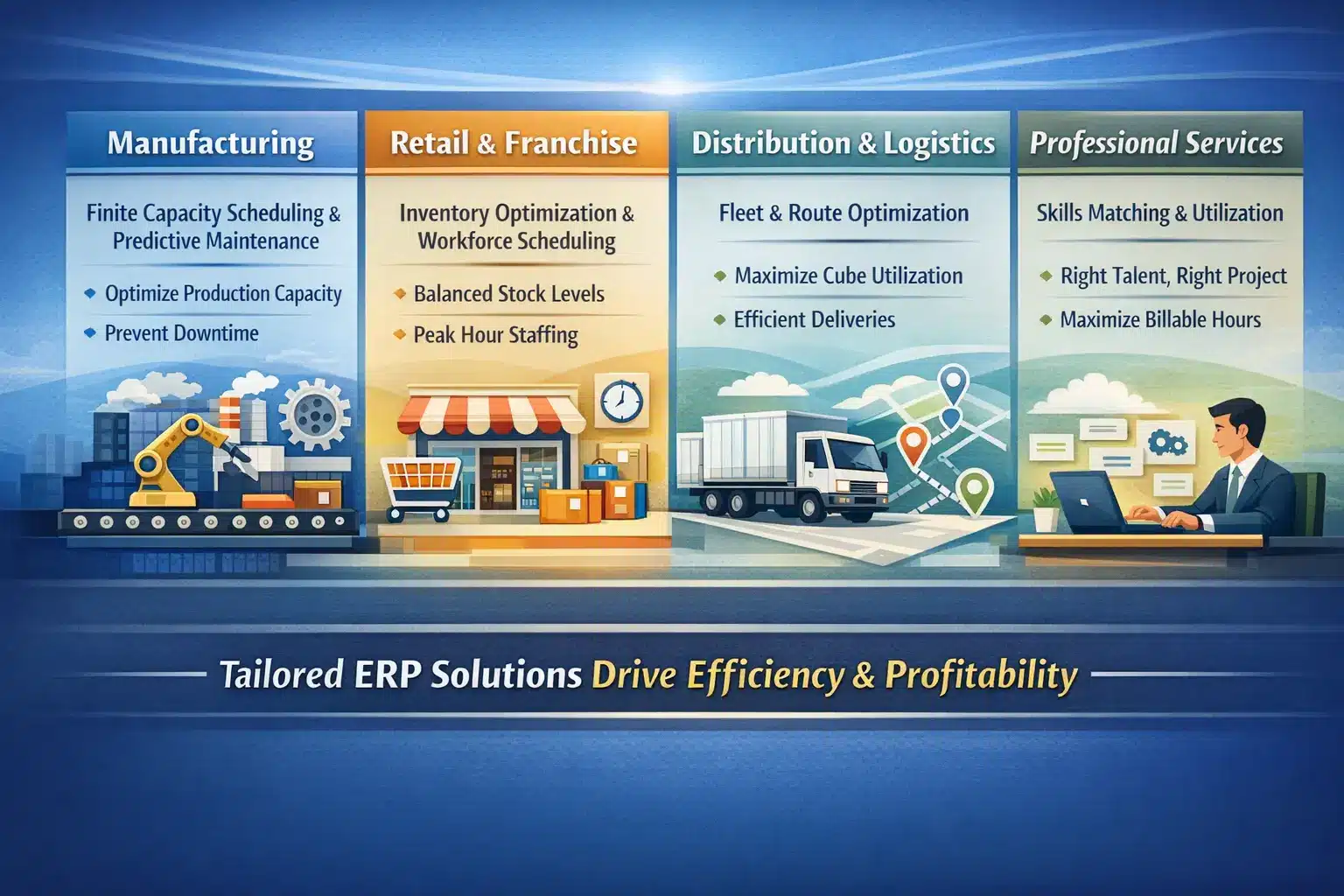
Tailoring Resource Allocation Across Key Industries
A Comprehensive Implementation Framework
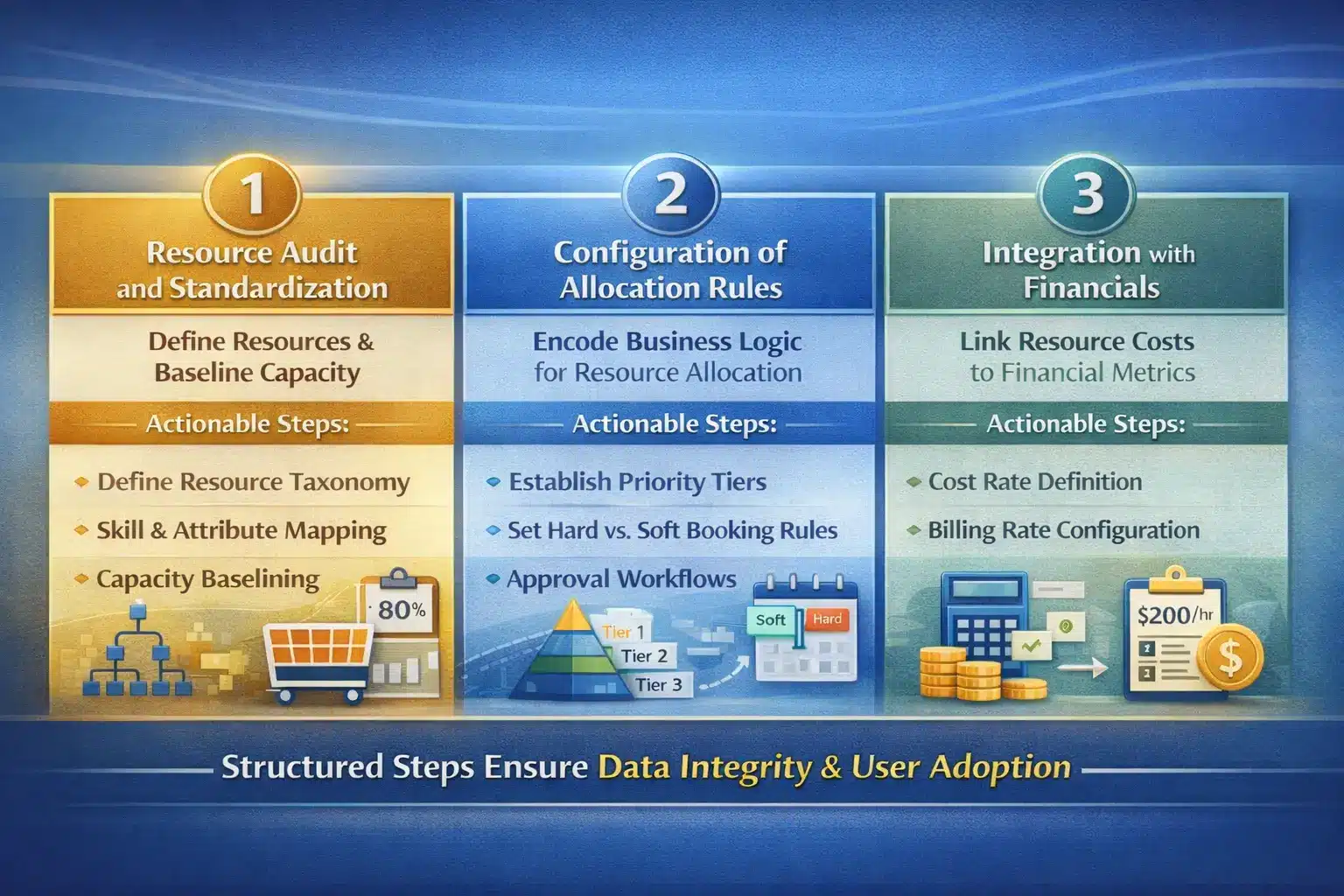
Transitioning from ad-hoc spreadsheets to a fully integrated ERP resource allocation system is a significant operational overhaul. To ensure success, organizations must follow a structured implementation path that prioritizes data integrity and user adoption over speed.
Phase 1: Resource Audit and Standardization
Before any software configuration begins, the organization must define what constitutes a “resource.” This sounds elementary but is often the source of implementation failure.
Actionable Steps:
- Define Resource Taxonomy. Create a standardized hierarchy. For example, Level 1 is Human vs. Non-Human. Level 2 is Department or Asset Class. Level 3 is Individual Role or Machine Type.
- Skill and attribute Mapping. For human resources, build a skills matrix. This should not just list job titles but specific competencies (e.g., “Python Programming”, “Forklift Certified”, “Fluent in Spanish”). Rank these skills by proficiency level (Beginner, Intermediate, Expert).
- Capacity Baselining. Determine the true capacity of resources. A 40-hour work week rarely yields 40 hours of project time. Account for administrative overhead, breaks, and leave. A standard baseline might be 80% billable utilization.
Phase 2: Configuration of Allocation Rules
Once the data is standardized, the ERP must be taught how to handle conflicts and priorities. This is where business logic is encoded into the software.
Actionable Steps:
- Establish Priority Tiers. Define which projects or clients get first claim on scarce resources. Strategic initiatives might have “Tier 1” status, allowing managers to bump resources from “Tier 3” internal projects.
- Set Hard vs. Soft Booking Rules. Configure the system to distinguish between tentative plans (Soft Booking) and confirmed assignments (Hard Booking). This visibility prevents managers from fighting over resources that are only hypothetically unavailable.
- Approval Workflows. Automate the request process. If a project manager needs a resource from another department, the system should automatically route the request to the functional manager for approval, creating an audit trail of negotiation.
Phase 3: Integration with Financials
Resource allocation must be tied to the General Ledger to provide value. This integration allows for real-time profitability analysis.
Actionable Steps:
- Cost Rate Definition. Assign cost rates to every resource. This includes fully burdened costs (salary + overhead + benefits).
- Billing Rate Configuration. For service firms, map resources to rate cards. This ensures that when a Senior Engineer is allocated, the project budget reflects the higher burn rate immediately.
Critical Metrics and KPIs for Resource Management
To govern the allocation process effectively, leadership relies on specific Key Performance Indicators (KPIs). These metrics move management from intuition-based decisions to data-driven governance.
-
Billable Utilization vs. Realization Rate
While Billable Utilization measures the percentage of available time spent on revenue-generating work, it does not tell the whole story. A resource might be allocated 100% of the time, but if the work is written off or non-billable due to inefficiencies, the metric is misleading.
Realization Rate is the superior metric. It measures the total billed revenue divided by the resource’s potential revenue capacity.
Formula: (Total Billed Hours / Total Available Hours) x 100
Tracking the delta between Utilization and Realization often reveals allocation inefficiencies where resources are busy but not profitable.
-
Resource Schedule Variance (RSV)
This KPI tracks the accuracy of the planning process. It compares the hours allocated at the start of the project against the actual hours consumed.
Formula: (Budgeted Resource Hours – Actual Resource Hours) / Budgeted Resource Hours
A consistently high negative variance indicates chronic under-scoping or “scope creep,” signaling that the allocation strategy needs to adjust for higher buffers.
-
Bench Strength and Time-to-Staff
Time-to-Staff measures the duration from when a resource request is made to when the resource begins work. High latency here suggests bottlenecks in the approval workflow or a skills shortage.
Bench Strength tracks the percentage of resources currently unallocated but available. While finance teams want this near zero, operations teams know that a bench strength of 5-10% is necessary to absorb sudden demand spikes without stalling existing projects.
Advanced Best Practices and Future Trends
As we look toward the future of resource management, the integration of Artificial Intelligence (AI) and Machine Learning (ML) into ERP ecosystems is shifting the paradigm from reactive to predictive allocation.
Predictive Hiring Triggers
Legacy systems flag a resource shortage only when a project is booked and no one is available. Advanced ERPs now analyze the sales pipeline (CRM data) to predict shortages months in advance. By assigning probability weights to potential deals, the system can calculate the “expected value” of resource demand. If the weighted demand for Java Developers exceeds current capacity by 20% for Q3, the system triggers a recruitment requisition in Q1, ensuring talent is onboarded and trained exactly when the demand materializes.
Scenario Planning and “What-If” Analysis
Top-tier organizations use their ERP to run simulations. The system creates sandbox environments to test these scenarios, showing the ripple effect on resource allocation across the entire portfolio. This allows leadership to build contingency plans such as identifying potential contractors or alternative suppliers before the crisis occurs.
Skills Gap Analysis Automation
Instead of annual reviews, modern allocation tools provide continuous feedback on organizational competency. If the system detects that 30% of projects requiring “Data Analysis” are being delayed due to resource constraints, it identifies a strategic skills gap. It can then recommend specific training modules for existing employees who have adjacent skills (e.g., suggesting SQL training for Business Analysts), thereby solving the allocation problem through internal upskilling rather than external hiring.
By moving beyond simple scheduling and embracing these advanced, data-centric methodologies, organizations transform resource allocation from a logistical hurdle into a competitive advantage. The ability to deploy the right assets, at the right cost, at the exact moment of need, is the ultimate lever for operational excellence.
Conclusion
Resource allocation is the engine that drives organizational strategy. Without it, strategic goals remain abstract concepts, disconnected from the operational reality. By mastering the art and science of assigning the right resources to the right tasks, businesses can unlock significant value, improve employee satisfaction, and navigate the complexities of the modern market with agility.
The journey toward mature resource allocation involves moving beyond intuition and static spreadsheets toward a core strategic competency. As the business landscape becomes increasingly resource-constrained, success depends on a commitment to data visibility and the integration of advanced technology. This strategic evolution is most effective when fueled by the rich employee data found in modern Human Resource Information Systems (HRIS), which provide the foundational insights needed to bridge the gap between human potential and operational execution.
FAQ Around Strategic Resources Allocation
-
What is the difference between resource allocation and resource leveling?
While resource allocation is the general process of assigning assets to tasks, resource leveling is a specific technique that adjusts the project timeline to resolve overbooking within resource constraints.
-
Why is resource allocation critical for project management?
Strategic resource allocation ensures projects stay on schedule and under budget by maximizing utilization, preventing bottlenecks, and balancing workloads to protect teams from burnout.
-
What tools are best for resource allocation?
While spreadsheets suffice for small teams, growing organizations need ERP systems for the real-time visibility and automated conflict detection that manual methods lack.
-
What is the biggest challenge in resource allocation?
Scope creep and poor visibility often lead to project failure as expanding requirements collide with a lack of centralized resource data, causing unavoidable conflicts and delays.
-
What is the biggest challenge in resource allocation?
Scope creep and poor visibility often lead to project failure as expanding requirements collide with a lack of centralized resource data, causing unavoidable conflicts and delays.
-
How does resource allocation affect employee retention?
By aligning workloads with skills and preventing chronic overwork, proper resource allocation fosters job satisfaction and reduces turnover.