





Bakit parang laging may delay kahit kumpleto ang tao at makina? Production workflow optimization has become a strategic priority as inefficiencies directly impact costs, output, and customer satisfaction. In 2026, businesses must refine how tasks, resources, and processes flow across production operations.
A McKinsey analysis reveals that manufacturers adopting advanced workflow optimization achieve 37% higher productivity growth over three years alongside 20-30% reductions in processing time and operational costs. These gains illustrate how structured workflows and enhanced process visibility fuel efficiency and competitive advantage.
To achieve these results, many companies now use digital systems to standardize and monitor production workflows. This guide breaks down what a production workflow looks like in practice, how to build one from scratch, and which KPIs tell you whether it’s actually working
Key Takeaways
|
Why Structured Workflows Matter for Manufacturers
Implementing a structured production workflow is not just an administrative formality but a strategic investment that affects financial and operational health. Without it, processes become reactive and disorganized, increasing hidden costs. By standardizing each step, you lay the groundwork for efficiency, quality, and scalability. As a result, your business can shift from constant troubleshooting to strategic control and continuous improvement.
This structured approach reshapes manufacturing by giving managers stronger visibility and control. It also builds accountability, as every team member knows their role. Ultimately, a well-designed workflow drives consistency, cuts waste, and helps your business thrive in a competitive market.
In the Philippines, where over 90% of manufacturers are MSMEs, production workflows are often informal. Passed down by word of mouth or managed on paper. But as DOLE tightens workplace standards and DTI pushes for quality certifications, even smaller operations need documented processes.
A. Enhancing operational efficiency
With a defined workflow, every task follows a logical sequence and clear time standard, eliminating confusion and waste. As a result, employees move between tasks faster, cycle times drop, and output rises. In turn, this higher efficiency cuts downtime and keeps productivity at the right levels.
B. Ensuring product consistency and quality
One key benefit of a production workflow is standardization, so every product follows the same process. This consistency maintains quality and meets customer expectations. With quality checks at critical stages, defects are caught early, reducing recalls and protecting your brand reputation.
C. Reducing costs and waste
Inefficiency leads to wasted materials, time, and labor. A good workflow helps you spot and cut that waste — by tightening how raw materials are used and preventing interruptions. This idea is at the core of lean manufacturing principles that many PH factories are now adopting. With better planning and quality control, you can avoid excess inventory, cut rework, and increase profitability. Tracking exactly where your money goes starts with a clear production cost report that breaks down materials, labor, and overhead.
D. Improving visibility and control
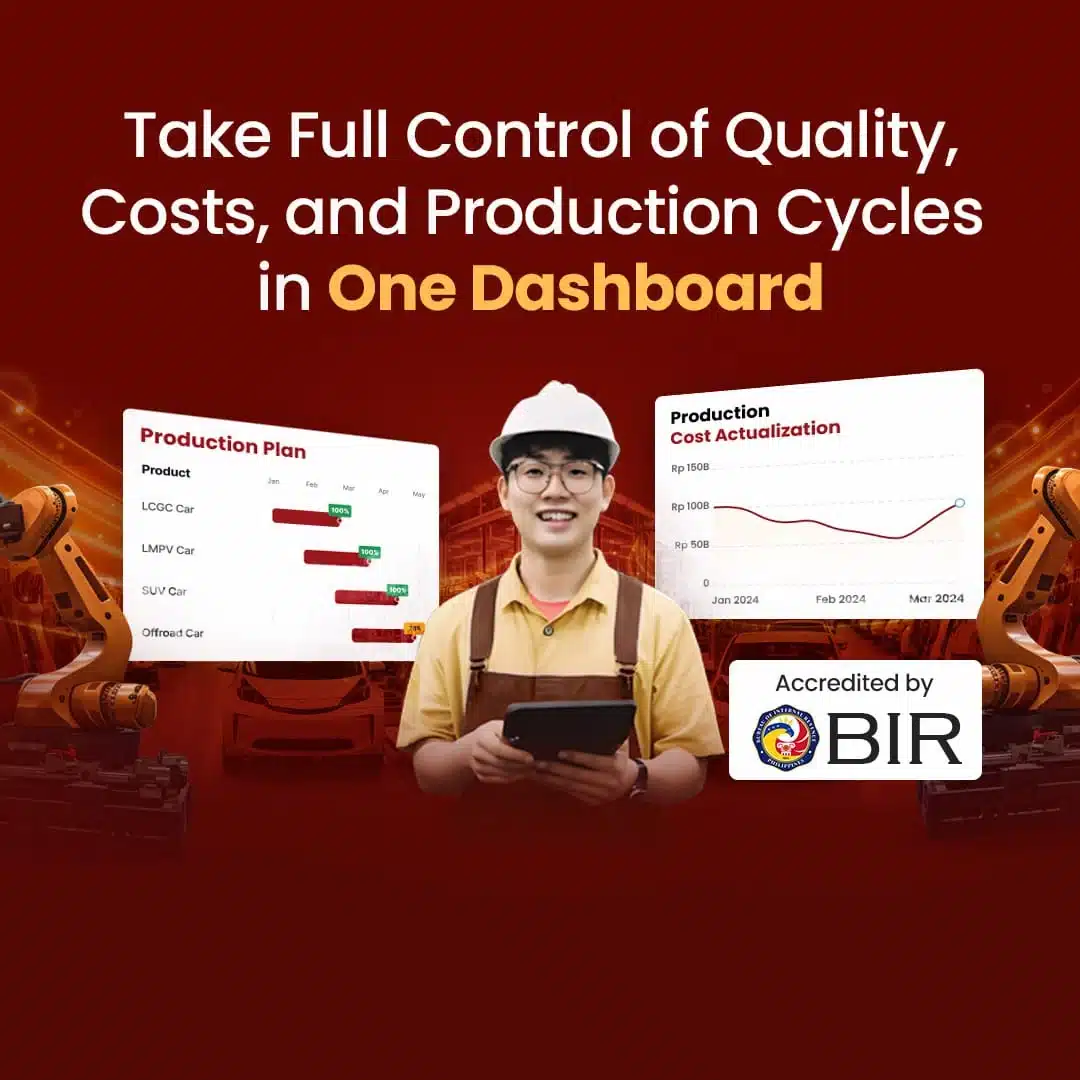
A well-documented workflow gives managers full visibility to track orders, see each production stage, and anticipate delays. This clarity speeds up data-driven decisions. A centralized system also helps you monitor the workflow through interactive dashboards.
E. Facilitating business scalability
As a business grows and production volume rises, manual or informal processes eventually break down. In contrast, a structured production workflow offers a scalable framework. When you add lines or hire new staff, clear SOPs speed adaptation and help maintain quality so growth stays sustainable.
4 Workflow Models: Which One Fits Your Operation?
A. Project-based workflow
A project-based workflow is used for unique, complex products made in very limited quantities. Each project has tasks that may not repeat. The focus is finishing on time, within budget, and to spec. Industries include construction, shipbuilding, and film, where each result is a single, complete project.
B. Batch production workflow
In a batch production workflow, a group of identical products is made at the same time. Each batch finishes one stage before moving to the next. This model sits between mass production and custom orders, and it works well for industries that need flexibility across variants — bakeries, pharma, printing, and apparel all rely on it. For a deeper look at how batch production works and when to use it, we’ve covered it separately.
C. Mass production workflow
Mass production (or flow production) churns out large volumes of standardized products using automated assembly lines that keep unit costs low. Automotive, electronics, and fast food all depend on it. If your factory makes countable, assembled items instead, you’re likely dealing with discrete manufacturing setups and their unique requirements.
D. Continuous process workflow
A continuous process workflow runs 24/7 to produce very large volumes, but unlike mass production, it handles non-discrete materials like liquids, gases, or powders. This is what’s known as process manufacturing, which has its own set of rules and challenges. The highly automated process avoids costly stops, so it suits oil refineries, chemical plants, power plants, and water treatment facilities.
3 workflow mistakes PH manufacturers keep making:
Skipping the “as-is” mapping
Jumping straight to a new process without documenting what you’re currently doing. You’ll miss the real bottlenecks.
Automating a broken process
Software won’t fix a badly designed workflow. Fix the flow first, then automate.
No KPI tracking after go-live
Many companies build a workflow, launch it, and never measure whether it’s working. Set your OEE and on-time delivery targets from day one.
How to Build a Manufacturing Workflow in 7 Steps
Designing an effective production workflow requires systematic analysis and careful planning. It’s not just a task list but an integrated, efficient, and adaptable system. By following a structured approach, you ensure no detail is missed and create a practical workflow that can elevate your operations.
- Identify the goals and final output
Start by defining what you want to achieve — the final product, its quality standards, specs, and target volume. If you’re unsure how to structure this, these production planning examples from real Philippine businesses can give you a practical starting point. This clear objective guides every workflow decision. Otherwise, you risk designing an ineffective process that wastes time and resources. - Map the current process (As-Is Process Mapping)
Before designing a new workflow, you need to fully understand your current production process. Therefore, document every step, responsibility, tool, and duration. This process mapping reveals inefficiencies, redundant tasks, and bottlenecks, especially when you involve employees directly handling the work. - Identify the necessary resources
Once the process is mapped, list every resource needed for each step — people, machines, and materials. For physical products, this usually means building a structured bill of materials that tracks every component and quantity required per unit. This analysis is important to ensure you have what you need and to plan procurement or training when resource gaps could slow production. - Define roles and responsibilities
An effective workflow requires clear roles. For each task, assign the responsible role or department. Clear roles cut confusion, prevents overlapping work, and ensures accountability. Moreover, when everyone understands their impact on later steps, it builds ownership and collaboration. - Document and standardize the workflow
After designing the new workflow, the next important step is to document it as Standard Operating Procedures. These SOPs should detail each step, instructions, quality standards, and safety rules. They guide all employees, support training, and ensure consistent execution for predictable results. - Implement and conduct a trial run
Once documented, implement the new workflow on a small scale as a pilot test. This phase shows how it performs in real conditions and lets you gather employee feedback. Use the trial to spot issues, make adjustments, and refine the process before full implementation. - Monitor, evaluate, and pursue continuous improvement
Your workflow isn’t a set-it-and-forget-it document — it’s a living system. After go-live, use KPIs and regular production reports to track what’s working and what’s falling behind. Review efficiency monthly and adjust as your team, tech, or market shifts.
How Software Eliminates Bottlenecks and Manual Errors

If you’re still running production on spreadsheets, relying on manual processes for a complex production workflow leads to inefficiency and falling behind. Instead, integrated software turns workflows into dynamic, intelligent systems. With the right manufacturing ERP, you can remove bottlenecks, gain real-time visibility, and unlock new efficiency gains.
A. Automation of repetitive tasks
Many production workflow tasks are repetitive, such as creating work orders or updating statuses. Modern software automates these jobs, freeing employees for higher-value work. As a result, errors drop, data becomes more accurate, and operations run more reliably from start to finish.
B. Real-time monitoring and data visibility
One major advantage of technology is real-time data from the production floor. With IoT sensors and dashboards, managers track orders, machine performance, and productivity as they happen. With that kind of visibility, you can react to issues in minutes, not hours, and keep production on track.
C. Integrated inventory management
Your workflow depends on having the right materials at the right time. Integrated systems automatically deduct stock and trigger purchase orders when levels hit the minimum. If you’re still tracking inventory manually, it’s worth looking into what a modern inventory management system actually does. When your inventory system auto-deducts stock and triggers POs at minimum levels, you’ll avoid delays and excess inventory, creating a lean, responsive supply chain.
D. Accurate production planning and scheduling
Planning tasks like building an MPS or running material requirements planning (MRP) calculations are nearly impossible to manage well without software. Advanced systems analyze demand, capacity, and material availability to generate optimal schedules. As a result, machines and employees are used effectively, deadlines are met, and customer trust grows.
E. Standardized quality control
Tech plays a big role in keeping quality consistent. Software sets parameters, schedules inspections, and logs results automatically. If your QC process still relies on manual checklists, it’s worth understanding how a structured quality control system actually works before you pick a tool. If standards aren’t met, the system flags products for review, ensuring no quality step is missed, and all data is ready for audits and analysis.
As production workflows become more complex, adopting the right system is key to maintaining efficiency and control. Reviewing pricing options can help businesses evaluate the most suitable solution for optimizing their production workflows.
5 KPIs That Show If Your Process Is Actually Working
Designing and implementing a production workflow is only half the battle. To confirm it delivers results and find improvements, you need to measure performance objectively. Using the right KPIs lets you track progress, compare results with targets, and make data-driven decisions for continuous optimization.
A. Overall Equipment Effectiveness (OEE)
OEE combines three factors — Availability, Performance, and Quality — into a single score that tells you how productively your machines actually run. A perfect 100% means only good parts, at full speed, with zero stops. For a breakdown of how to calculate and improve OEE on your factory floor, we’ve got a separate guide. By tracking OEE, you can pinpoint productivity losses, as emphasized by experts like McKinsey.
B. Cycle Time
Cycle time is the total time to turn raw materials into finished goods ready to ship, including processing, waiting, inspection, and transfer. Measuring and reducing it boosts efficiency, speeds response to demand, and raises throughput, giving your workflow a clear competitive edge.
C. Throughput
Throughput is the number of units produced in a given time, such as per hour or per day. It directly reflects your workflow’s output. When throughput rises without reducing quality, it shows optimization is working. Tracking it also improves capacity planning and scheduling so you can meet demand confidently.
D. Defect Rate / First Pass Yield (FPY)
The defect rate shows the percentage of products that fail quality standards and need rework or scrapping. In contrast, First Pass Yield measures items that pass perfectly the first time. A high FPY means your workflow consistently produces quality goods, cuts waste, and lowers costs.
E. On-Time Delivery Rate
This KPI measures the percentage of orders delivered by the promised date. Although it seems like a logistics metric, it depends heavily on an efficient, predictable workflow. A high on-time rate shows smooth operations and supports customer satisfaction and long-term relationships.
What does production workflow software actually cost in the Philippines?
- Basic MES/tracking tools: ₱3,000–₱8,000/month
- Mid-tier manufacturing ERP: ₱15,000–₱40,000/month
- Full enterprise ERP with MRP/MPS: ₱50,000+/month (custom pricing)
- Hardware (barcode scanners, tablets for floor tracking): ₱15,000–₱50,000 one-time
For MSMEs, starting with a basic scheduling + inventory combo at ₱5,000–₱10,000/month often delivers the fastest ROI.
Conclusion
Production workflow optimization helps manufacturers speed things up, cut waste, and keep product quality consistent. By choosing the right workflow, applying structured design steps, and tracking KPIs, businesses gain tighter control over efficiency. This approach also supports scalable, predictable production.
A solid production workflow isn’t a one-time project — it’s something you build, measure, and improve over time. Start by mapping what you have now, fix the obvious gaps, and track the KPIs that matter most to your operation. Whether you’re running a 20-person garment shop in Cavite or a multi-line food processing plant in Laguna, the fundamentals are the same: clear steps, clear roles, and clear data.
FAQ about Production Workflow
-
What is the difference between a process and a workflow?
While often used interchangeably, a process is a broader series of activities to achieve a business goal, whereas a workflow is the specific, structured, and repeatable sequence of tasks to complete part of that process. Simply put, a workflow is how you execute a process in detail.
-
How often should a production workflow be reviewed?
Ideally, a formal review should be conducted at least once a year or whenever there is a significant change in the business, such as a new product, technology adoption, or a change in production volume. However, continuous improvement principles suggest always being open to feedback and making small adjustments as needed.
-
What is the biggest challenge in implementing a new production workflow?
The biggest challenge is often cultural resistance to change from employees accustomed to the old ways of working. To overcome this, it’s the key to involve the team from the beginning of the design process, communicate the benefits clearly, and provide adequate training.
-
Is a formal production workflow necessary for small businesses?
Absolutely. While it may not be as complex as in a large corporation, small businesses can greatly benefit from early standardization. A clear workflow helps ensure consistent quality, simplifies new employee training, and builds a strong foundation for future business growth.
-
How do you identify a bottleneck in a production workflow?
A bottleneck is a stage in the workflow where work piles up because its capacity is lower than the stages before or after it. To identify it, map the process and measure the time spent at each workstation. The station with the longest wait times or the largest pile of work is your bottleneck.