






Under Revenue Memorandum Circular No. 57-2015, the Bureau of Internal Revenue (BIR) requires businesses that maintain inventories to file an annual inventory list within 30 days after the close of each taxable year. The circular covers stock-in-trade, raw materials, goods in process, supplies, and other goods, and the BIR cross-checks this submission against your income tax return and financial statements. A mismatch between the two is one of the most common triggers for a deficiency assessment.
Getting the format right matters more than most businesses realize. Each annex type applies to a different inventory category, and using the wrong annex or leaving out required fields gives BIR examiners grounds to question the entire submission. Late filing also carries a compromise penalty of ₱1,000 per offense under Section 250 of the Tax Code, on top of any deficiency tax and 25% surcharge.
This guide walks you through the correct BIR inventory list format for 2026, the differences between Annex A, B, and C, the exact submission deadline, and the most common filing mistakes that attract BIR scrutiny along with a free downloadable template you can use immediately.
Key Takeaways
An inventory list BIR is essential for tax and financial reporting compliance.
Accurate categorization of inventory, including exclusions, ensures clearer reporting.
Businesses must submit their inventory list to the BIR within 30 days after the end of their financial year, typically by January 30 for calendar-year companies.
Automating with a digital inventory control platform ensures accurate, timely inventory list preparation.
What is a BIR Inventory List?
The BIR inventory list is a sworn declaration of all goods, materials, and merchandise your business holds, whether for sale, in production, or stored as raw materials, as of a specific reporting date (usually December 31 for calendar-year filers).
The inventory list is not just a compliance formality. The BIR uses it as a cross-referencing tool during audits, matching the figures you report against your books of accounts, Audited Financial Statements (AFS), and Annual Income Tax Return (ITR). Under the newly issued RMO No. 1-2026, the inventory list is now explicitly part of the standardized audit checklist (Annex B), meaning examiners are required to verify it in every single-instance audit. If the numbers don’t reconcile across these documents, it raises a red flag that can trigger an expanded audit.
For retailers, the same stock figures also connect to BIR POS accreditation, since the sales recorded at the register feed the ending inventory the BIR expects to see.
Who Needs to Submit a BIR Inventory List?
Who Needs to Submit a BIR Inventory List?
In practice, this covers nearly all businesses in the following industries:
- Manufacturing: raw materials, work-in-process, and finished goods
- Merchandising and Retail: goods purchased for resale
- Wholesale and Distribution: stock held across warehouses
- Real Estate: land, housing units, and lots held for sale (reported under Annex B-1)
- Construction: materials and supplies allocated to ongoing projects (reported under Annex C)
Important edge case: Even if your business has zero inventory on December 31, you are still required to submit if you held inventory at any point during the taxable year. Submitting a nil report is better than not submitting at all. For companies with multiple branches, the TRRA Portal allows consolidated submission; you don’t need to file separately per branch (per RMC No. 66-2024 guidelines).
Many of these same taxpayers also report their sales through BIR eSales, and those figures should reconcile with the inventory list before either one is filed.
When Should the Inventory List Be Submitted?

The BIR inventory list must be submitted within 30 days after the close of the taxable year. For calendar-year taxpayers, this means the deadline falls on January 30 of the following year. Fiscal-year filers count 30 days from the last day of their approved fiscal period.
The list must be submitted to the Revenue District Office (RDO) where the business is registered, together with a notarized certification. If your business operates multiple branches or warehouses, each location's inventory must be consolidated and filed under the principal registration. Late submissions are subject to penalty under the Tax Code, so building the inventory count into your year-end closing process is strongly recommended.
Compliance and Penalties: What’s at Stake
Non-compliance with BIR inventory list requirements carries real costs that entail a ₱1,000 penalty per failure under NIRC Section 250, plus a 25%–50% surcharge, 12% annual interest, and compromise penalties once an audit uncovers understated income. Knowing what's at stake helps businesses treat accurate inventory reporting as a compliance priority, not an afterthought.
1. Direct Penalties Under NIRC Section 250
Failing to submit the inventory list on time is classified as a failure to file an information return under the National Internal Revenue Code. The penalty is ₱1,000 per failure, with a maximum of ₱25,000 per calendar year per type of return. This applies regardless of whether there’s an actual tax deficiency; it’s a flat administrative penalty for non-compliance.
2. Tax Deficiency Consequences
The bigger risk isn’t the ₱1,000 fine; it’s what happens when the BIR finds discrepancies during an audit. If the examiner determines that your inventory figures are misstated and this results in underpayment of income tax or VAT, the following apply on top of the basic tax due:
- Surcharge: 25% for late or incorrect filing; 50% if the BIR determines willful neglect or fraud
- Interest: 12% per annum on the deficiency amount (subject to adjustment based on BSP reference rate)
- Compromise penalty: A negotiable amount based on the BIR’s published Schedule of Compromise Penalties, often used to settle without a full formal assessment
3. Inventory Errors Lead to Tax Problems
Overstated inventory directly distorts the link between stock figures and your cost of goods sold, which can lead to understated taxable income and trigger an audit. Here’s how common errors play out:
- Overstated inventory → inflated ending inventory → understated COGS → overstated net income → potential excess tax payment
- Understated inventory → understated ending inventory → overstated COGS → understated net income → underpayment of income tax and VAT
- Inconsistency between inventory list and AFS → BIR examiner raises an audit query → investigation expands to cover all tax types under the new single-instance audit framework
Many of the accounting problems that draw BIR scrutiny start as mismatches between the inventory list and the financial statements. Reconciling both before submission is far cheaper than defending the gap during an examination.
"BIR inventory list compliance is critical for verifying taxable income and maintaining accurate financial planning, as late or inaccurate submissions can lead to legal issues and reputational risk for businesses."
What to Include in the BIR Inventory List
Each submission must follow the format the BIR accepts, so your inventory report should cover every required field on each line item. Below is the standard Annex A structure used by manufacturers as well as merchandising and retail businesses:
| Column | Description | Example |
|---|---|---|
| Item Description | Name or nature of the goods | White Portland Cement 40kg |
| Product / Inventory Code | Internal SKU or item code | WPC-40K-001 |
| Location (Address + Code) | Warehouse or branch where the item is stored | Warehouse A, Pasig City — Code 03 |
| Inventory Valuation Method | FIFO, Weighted Average, or LCNRV | FIFO |
| Quantity in Stocks | Units on hand at reporting date | 2,500 |
| Measurement | Unit of measure (pcs, kg, liters, etc.) | Bags |
| Total Weight / Volume | Aggregate quantity | 100,000 kg |
| Unit Price | Cost per unit based on chosen valuation method | ₱285.00 |
| Total Cost | Quantity × Unit Price | ₱712,500.00 |
| Remarks | Notes on condition, expiry, or slow-moving status | Expires March 2026 |
Businesses running a BIR-registered computerized accounting system can pull most of these fields directly from their books, which keeps the submitted figures traceable to the underlying records.
Valuation Methods: Which One to Use
Your inventory valuation method must stay consistent with your audited financial statements, and the BIR checks this during examination. Here's a quick breakdown:
- FIFO (First In, First Out). Assumes the oldest stock is sold first. Most common for perishable goods and industries where prices trend upward. Results in lower COGS and higher taxable income in inflationary periods.
- Weighted Average. Averages the cost of all units available for sale during the period. Simpler to apply for businesses with high-volume, low-variation products.
- Lower of Cost or Net Realizable Value (LCNRV). Required under PAS 2 (Philippine Accounting Standard 2). If the market value of inventory drops below cost, you must write it down to the lower amount.
Each method behaves differently in practice, so grounding your choice in sound inventory accounting keeps the policy aligned with your financial statements and defensible under audit. Whatever method you use, consistency is the critical rule. Switching between years without disclosure and justification will raise questions during examination.
What NOT to Include
The inventory list covers only items that form part of Cost of Goods Sold (COGS) or Cost of Sales. Exclude the following:
- Capital assets. These are classified as Property, Plant, and Equipment (PPE) and are tracked and reported under a separate fixed asset register, not in the BIR inventory list. To keep that register accurate and audit-ready, see our comparison of the best asset management software in the Philippines.
- Office supplies. Pens, paper, printer toner, these are period expenses, not inventory.
- Consigned goods you don’t own. If another party consigned goods to your warehouse but you haven’t purchased them, exclude them. Conversely, include goods you consigned to others that you still own.
- In-transit goods (FOB Destination). If goods are shipped FOB Destination and haven’t arrived at your warehouse by the reporting date, ownership hasn’t transferred yet
Drawing this line correctly depends on disciplined inventory control, since the same records that separate owned stock from consigned or third-party goods are the ones examiners will ask to see.
An ERP software in the Philippines keeps item descriptions, quantities, and valuations updated automatically, so pulling your year-end figures takes minutes rather than weeks.

How to Submit: Three Methods
Once your inventory data is ready and saved in the prescribed format on a DVD-R or USB flash drive, the next step is choosing how to submit it to the BIR. As of 2024, hard copy submission has been removed, all submissions must now be in soft copy. There are three accepted methods, each with its own advantages depending on your business setup:
| Method | Pros | Cons |
|---|---|---|
| TRRA Portal (Recommended) | Digital trail, consolidated multi-branch submission, automatic email confirmation to RDO | Maximum 4MB per file; requires a stable internet connection |
| Email to RDO | Flexible submission; follows standard email attachment limits | No automatic confirmation; requires manual follow-up |
| Manual / In-Person Submission | Stamped receiving copy issued immediately | Time-consuming; requires a physical visit to the RDO |
TRRA Portal Walkthrough
This is the BIR’s preferred method as of RMC No. 66-2024. Here’s exactly how to do it:
- Access the Portal. Go to the BIR website → eServices section → TRRA Portal
- Select the right transaction. Choose “Submission of Inventory Report and Notice (Under RR No. 7-2024)”
- Choose your RDO. Select the Revenue District Office where your business is registered
- Download the suggested format. If you haven’t prepared your inventory file yet, the portal provides a downloadable template
- Attach your scanned documents. Upload the inventory list in PDF format (max 4MB per file). If your file exceeds the limit, split it into multiple PDFs
- Submit. Once uploaded, the system automatically sends an email notification to your RDO’s Compliance Section
- Save your confirmation. Screenshot or save the confirmation page and email as your proof of timely submission
Cross-check tip: Businesses enrolled in BIR EIS should confirm that their e-invoice data reconciles with the inventory figures they report. Discrepancies between the two are among the first things examiners flag during an audit.
These rules came into effect on June 14, 2024, after being published on the BIR’s website.
Step-by-Step: How to Prepare Your BIR Inventory List
Doing an actual inventory hands-on count in your warehouse is the foundation of an accurate BIR inventory list, estimation or system-only figures won’t hold up under audit. Here’s a practical timeline to keep your team on track.
8-Week Preparation Timeline
| Week | Phase | Key Actions |
|---|---|---|
| Week -8 (Early Nov) | Plan | Set count date, notify external auditor, assign team leads per zone/warehouse |
| Week -6 (Mid Nov) | Prepare | Print count sheets or configure barcode scanners; train counters on procedures |
| Week -4 (Early Dec) | Clean Up | Organize warehouse layout, label zones clearly, and resolve known system discrepancies |
| Week -2 (Mid Dec) | Tag | Pre-label slow-moving and serialized items; print count tags for high-value stock |
| Day 0 (Dec 31) | Execute | Conduct full physical count; supervisor spot-checks begin immediately |
| Day 1–3 (Jan 1–3) | Reconcile | Match count sheets to perpetual records; investigate and document variances |
| Day 4–10 (Jan 4–10) | Finalize | Post adjustment journal entries; generate Annex A/B/C files; prepare soft copy |
| Day 11–20 (Jan 11–20) | Submit | Upload via TRRA Portal or deliver to RDO; retain stamped copy or email confirmation |
How RMO No. 1-2026 Changes the Game for Inventory Compliance
In January 2026, the BIR issued Revenue Memorandum Order No. 1-2026, which overhauls the bureau's audit framework.
What Changed
Under the old framework, multiple audit teams could issue separate electronic Letters of Authority (eLAs) covering different tax types for the same taxable year. RMO No. 1-2026 replaces this with a Single-Instance Audit Framework, one eLA per taxable year, covering all internal revenue taxes simultaneously. This means the examiner reviewing your income tax will also be looking at your VAT, withholding taxes, and supporting documents like the inventory list in a single, consolidated examination.
Why It Matters for Your Inventory List
The inventory list is now included in the standardized audit checklist (Annex B of RMO No. 1-2026). This means examiners are specifically required to:
- Verify that the inventory list was submitted on time
- Cross-reference inventory values against your books of accounts, AFS, and ITR
- Check for consistency in the valuation method used across all documents
- Flag discrepancies that suggest underreported sales or overstated expenses
The criteria for audit selection also sets a hard trigger. An underdeclaration of sales or income of at least 30 percent, or an overstatement of expenses or deductions at the same level, is treated as prima facie evidence of fraud and places the taxpayer in the mandatory audit category.
An inventory list that does not reconcile with your financial statements is one of the easiest ways for the BIR to surface that gap.
BIR Inventory List Format by Annex Type
The BIR prescribes different reporting formats depending on your industry. Using the wrong annex or mixing formats is a common mistake that delays processing.
| Annex | Industry | What It Covers | Key Differences from Annex A |
|---|---|---|---|
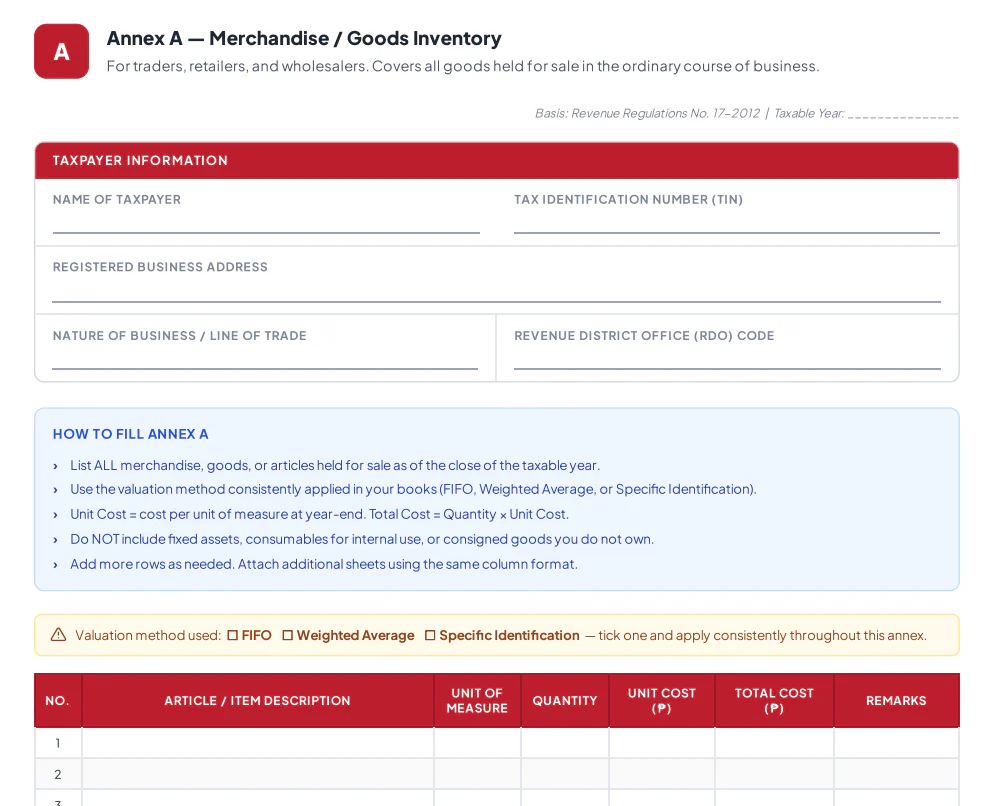
| Annex A | Manufacturing, Marketing, Retail | Raw materials, WIP, finished goods, goods for resale | Standard format — includes product code, location, valuation method, and unit price |
| Annex B | Real Estate and Property Developers | Land for development, housing units for sale, subdivision lots | Uses property identifiers (TCT/CCT number, lot area, zoning classification) instead of product codes |
| Annex C | Construction Contractors | Materials and supplies for ongoing projects | Requires project-level allocation: project name, contract reference, % completion, allocated cost |
Before completing any annex, organize your records by category and verify unit costs against your inventory accounting entries, discrepancies at this stage are far easier to correct than after submission. A reliable inventory management system can generate the stock count and valuation data each annex requires, cutting preparation time significantly.
Use the templates below to build your BIR inventory list submission. Each file follows the exact column structure prescribed by the BIR for the corresponding annex type.
Download BIR Inventory List Template
Soft Copy Requirements
All taxpayers are required to submit a soft copy alongside the hard copy, stored on a USB flash drive or DVD-R (not CD-R). Key formatting rules:
- File format: Excel (.xlsx) using the BIR-prescribed Annex template.
- Label the storage media clearly: Taxpayer Name, TIN, RDO Code, “Inventory List CY 2025”.
- The soft copy data must match the hard copy exactly; any discrepancy voids the submission.
Annex D: Notarized Certification
Alongside the inventory list itself, you must submit a Notarized Certification (Annex D) signed by the owner, president, or authorized officer, declaring that:
- The inventory list is true, correct, and complete.
- The valuation method is consistent with the company’s Financial Statements.
- The signatory is duly authorized to make the certification.
Among the inventory categories BIR requires businesses to list separately, merchandise inventory typically forms the largest line for trading and retail entities.
Common Mistakes to Avoid

To illustrate how things can go wrong, here’s a realistic scenario based on common compliance issues BIR examiners encounter.
Scenario: A mid-sized retail business with three branches in Metro Manila
The company uses a perpetual inventory system in its ERP, but only performs a physical count once a year in late December. During the count, they discover several problems:
- Branch 2 didn’t freeze shipments during the count. Several deliveries arrived mid-count, leading to double-counted items. The branch reported 340 units of a product that the system only showed 285 for, a 19% variance that went unexplained in the final Annex A file.
- The valuation method on the inventory list said “FIFO,” but the AFS used Weighted Average. When the BIR examiner compared the two documents, the inconsistency flagged a deeper review of the entire income tax computation.
- Slow-moving stock wasn’t written down. Over ₱1.2 million in expired and damaged goods was still carried at full cost in the inventory list. Under PAS 2, these should have been written down to net realizable value, resulting in overstated inventory, understated COGS, and overstated taxable income that drew a surcharge.
- The soft copy didn’t match the hard copy. An updated Excel file was submitted on the USB, but the printed hard copy was from an earlier draft. The RDO flagged the discrepancy and required a resubmission.
Conclusion
Filing an accurate BIR inventory list is a year-end obligation that can make or break your standing with the BIR. The annex format, valuation method, and completeness of your stock records all factor into whether the submission survives scrutiny or triggers a closer look.
Most filing errors come from businesses that manually count and record inventory without a consistent system. Discrepancies between the physical count, the ledger, and the BIR submission are common when these records are maintained in separate spreadsheets or paper logs.
An inventory management system that integrates with your accounting records can close these gaps before the 30-day deadline arrives. See how HashMicro's inventory automates stock valuation, generates annex-ready reports, and keeps your inventory ledger aligned with your financial statements year-round.

FAQ for Inventory List of BIR
The inventory list for BIR is an official record that provides a detailed breakdown of a company’s inventory at the end of the fiscal year. It’s required to ensure accurate reporting for tax purposes.
Yes, the BIR allows digital submissions, but the format and labeling must adhere to their requirements.
HashMicro’s Inventory Management System automates inventory tracking, provides customized reports, and offers reminders for compliance deadlines, making it easier to prepare an accurate BIR-compliant inventory list. Aside from that, HashMicro also provides BIR POS and accounting software for end-to-end business processes.
Items such as office supplies, capital assets, and depreciated assets should not be included as they do not qualify as inventory.