










 Limited to 100 registrants

Managing finished goods inventory is crucial to maintaining smooth operations and driving profitability in any business. As companies grow, keeping accurate records of finished goods directly affects how well they can meet demand, control costs, and avoid supply chain disruptions.
One of the biggest challenges is maintaining accuracy across production, sales, and distribution systems. Without efficient tracking, businesses face overstocking, stockouts, and fulfillment delays. A study from Nanyang Technological University found that improved production planning helped a leading company reduce inventory levels and lower storage costs significantly.
This article covers what finished goods inventory is, why it matters, how to calculate it, and practical ways to manage it more effectively using the right tools.
Key Takeaways
Ineffective finished goods management leads to issues like stock discrepancies and overstocking, disrupting the supply chain and increasing costs.
Tracking finished goods accurately across production stages supports better financial budgeting, current asset records, and overall inventory control.
Understanding the three production stages, from raw materials to finished goods, helps businesses apply the inventory formula more accurately and anticipate costs at every point.
Regularly calculating ending finished goods inventory using the right formula helps businesses balance supply with demand and avoid stockouts.
What is the Finished Goods Inventory?

Finished goods inventory refers to the stock of products that are entirely manufactured and ready to be sold to customers without requiring further processing or assembly. These products have completed the manufacturing cycle, transitioning from raw materials to finished products, and are now stored as inventory until purchased.
For example, if you own a clothing store, you might need an ERP system for the finished goods includes ready to wear apparel, such as shirts and dresses, ready for sale. However, in their raw material inventory stage, items like fabric rolls or thread do not qualify as finished goods since they require further work to become sellable products.
To effectively manage inventory, businesses must track the flow of products from when they are completed to when they are sold. Implementing a finished goods inventory formula and using advanced inventory system can help businesses maintain optimal stock levels, reducing the risk of overproduction or stockouts while improving overall operational efficiency.
Why Is Finished Goods Inventory Important?

A clear understanding of finished goods inventory is essential for operational efficiency and financial accuracy in managing a business’s inventory. The finished goods formula is a powerful tool that helps businesses track their stock of goods, manage production, and maintain a healthy balance of raw materials to finished products.
This formula allows companies to optimize inventory management, minimize waste, and prevent stockouts. Below are several key reasons why managing stock of goods is critical for any successful business operation.
1. Improves financial budgeting
Accurately tracking finished goods inventory helps businesses improve financial budgeting by providing precise balance sheets and income statement data. Knowing the value of your stock of goods allows you to plan operating budgets more effectively for current operations and future projections.
This ensures better cash flow management and reduces financial risks. By leveraging the finished goods formula, companies can create more accurate financial reports that enhance strategic planning.
2. Records the number of current assets
Finished goods is crucial in maintaining accurate accounting records, especially when understanding the difference between assets and inventory. By using the finished goods formula, businesses can effortlessly track items across various stages of production, from raw materials to finished products.
This helps avoid costly accounting errors and ensures compliance with financial regulations. Accurate inventory records also safeguard businesses from potential audits or financial discrepancies.
3. Reduces waste of materials
Maintaining an optimal level of finished goods prevents businesses from overstocking, which can lead to unnecessary waste of raw materials and finished products. The finished goods inventory formula helps companies balance storing the right amount of raw materials and finished products.
This reduces warehousing costs and eliminates excess inventory that may go unused or expire. Ultimately, this optimization leads to more sustainable operations and cost savings.
4. Optimizes inventory management processes
Using the finished goods formula allows businesses to refine their inventory system by providing better visibility into production costs and labor efficiency. Tracking every stage, from raw materials to finished products, helps identify areas for improvement, whether through automation or process adjustments.
This optimization leads to smoother operations, fewer bottlenecks, and better resource use, ultimately improving the supply chain.
5. Minimizes stockouts
A well maintained finished goods prevents stockouts, ensuring customers can receive orders without delays. By accurately predicting demand and adjusting the stock of goods accordingly, businesses can minimize backorders and avoid lost sales.
Utilizing the finished goods inventory formula allows companies to balance supply with demand, ensuring they have the right inventory levels to meet customer expectations without overextending resources.
Read more: Top Construction Inventory Management Software
3 Steps to Becoming Finished Goods
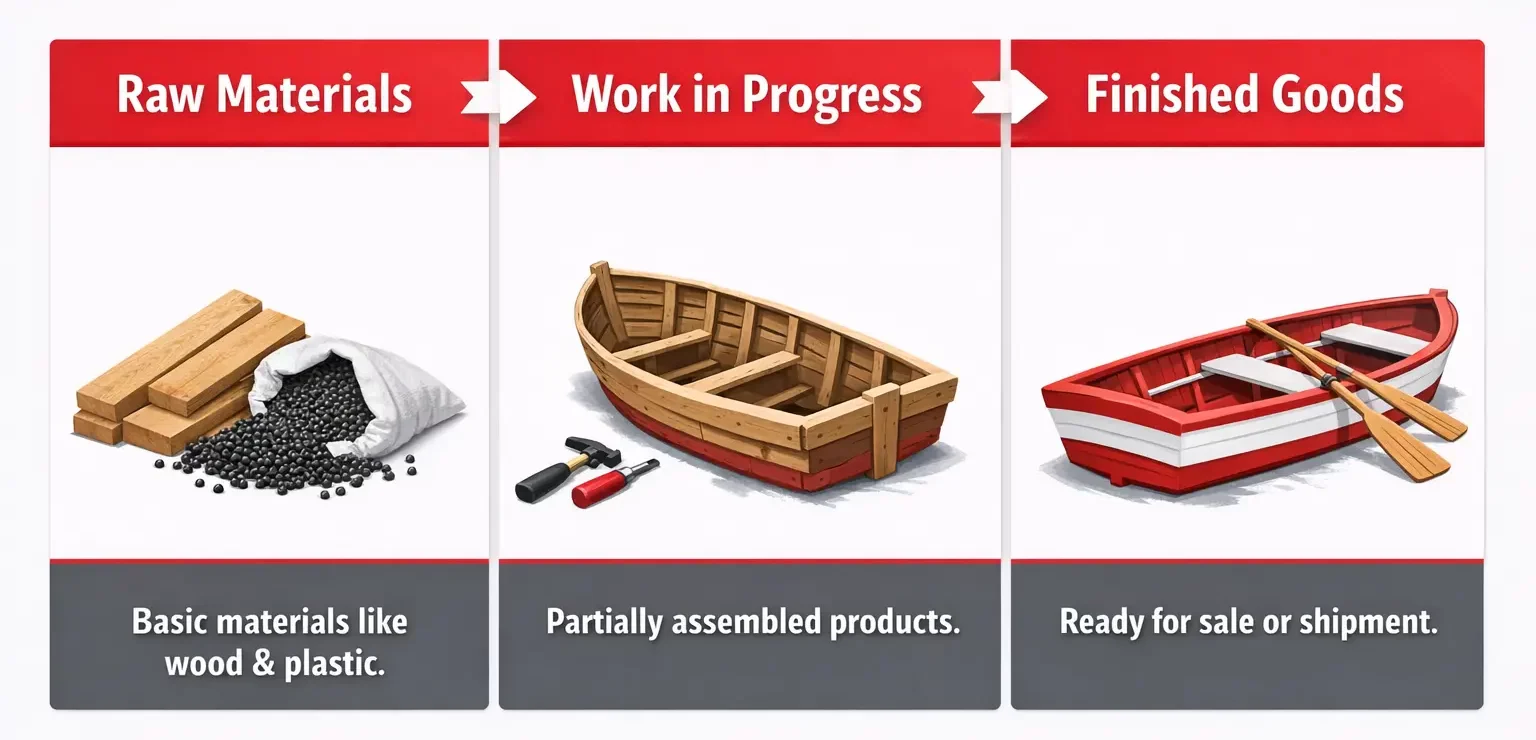
Before a product is categorized as finished goods, it must pass through several critical stages in the manufacturing process, including the production of semi finished goods. Each stage is vital in transforming raw materials into a fully completed product, ready for sale or distribution.
Understanding these steps helps optimize the finished goods inventory formula and clarifies how raw materials transition into valuable goods stocks.
- Raw materials: The first step in producing finished goods involves gathering raw materials essential for manufacturing. For example, a company needs to maintain a sufficient inventory of raw materials, such as wood and plastic, to ensure a smooth transition from raw materials to finished products and generate the right stock of goods.
- Work in Progress: Working in progress (WIP) refers to items currently being manufactured but not yet complete. Like a half assembled rowboat, these products have undergone part of the production process but still require labor and additional materials before becoming finished goods ready for distribution.
- Finished goods: Once all components are assembled and the product is complete, it becomes finished goods, ready for sale or distribution. Like a fully equipped rowboat, the finished goods inventory is now part of the company’s stock, available for shipment to customers or retail outlets.
How to Calculate Finished Goods Inventory

Calculating finished goods is vital for any business to understand its stock value at the end of a fiscal period. Finished goods typically carry a higher value than items in earlier stages, like raw materials or work in progress, because direct labor, materials, and overhead have been added.
By using the inventory formula, businesses can accurately assess the value of their stock of goods and ensure their pricing strategy reflects the actual cost of production.
Ending Finished Goods Inventory = Beginning Finished Goods Inventory + Cost of Goods Manufactured (COGM) – Cost of Goods Sold (COGS)
To apply this formula, take the beginning finished goods balance, add the Cost of Goods Manufactured (COGM), and subtract the Cost of Goods Sold (COGS). The result represents the ending finished goods inventory for the period.
For example, a manufacturing company begins the quarter with $100,000 in finished goods. During the period, it records $90,000 in COGM and $70,000 in COGS. The ending finished goods inventory is calculated as follows
Beginning Finished Goods: $100,000
+ Cost of Goods Manufactured (COGM): $90,000
− Cost of Goods Sold (COGS): $70,000
Ending Finished Goods Inventory = $120,000
This finished goods inventory example shows how tracking the value from raw materials to finished products can help businesses maintain an optimal balance between production, inventory management, and sales growth. Implementing a barcode inventory system can improve this process by ensuring accurate inventory updates.
Read More: Top Manufacturing Inventory Software
Conclusion
Finished goods inventory sits at the center of production planning, financial reporting, and customer fulfillment. When businesses track it accurately, using the right formula and consistent processes, they reduce waste, prevent stockouts, and maintain healthier cash flow. For businesses looking to put the right tools in place, reviewing the leading inventory management software options available today is a practical starting point.
FAQ About Finished Goods Inventory
Add the beginning finished goods inventory to the cost of goods manufactured. Subtract the cost of goods sold (COGS) during the accounting period. The resulting value is the ending finished goods inventory, which should be recorded in the balance sheet as a current asset.
WIP Inventory: These products are currently at some phase of the manufacturing process. They’re in an unfinished state, and, therefore, you cannot sell them. Once a raw material meets human labor, you should consider it a work in process. Finished Goods: These are your final assembled products ready for sale.
Finished goods inventory is a current asset account. It represents the fully manufactured products that are ready for sale but not yet sold. These goods are listed on the balance sheet under current assets because they are expected to be sold within the normal operating cycle, which provides liquidity for the business.
Finished goods are valued using cost accounting, which includes direct materials, direct labor, and manufacturing overhead. Businesses typically apply FIFO, LIFO, or weighted average methods. This valuation affects both the balance sheet and income statement.