







Employee productivity is key to keeping a business running smoothly, and when it drops, profits take a hit. A recent study found that workers in the Philippines, Indonesia, Malaysia, and Vietnam especially in the digital and electronics sectors have been less productive since the 2000s.
While global companies in digital manufacturing improved productivity by 76% from 2005 to 2015, these four countries only saw a 31% increase on average. To turn things around, businesses need a system that helps them perform at their best.
This article will explore why employee productivity matters, the common challenges businesses face, and how the right tools can make a difference in building a more efficient and motivated workforce.
Key Takeaways
Employee productivity measures how effectively a worker transforms instructions or requirements into finished results within a specific timeframe.
Higher labor productivity, which grew by 3.32% in the Philippines in 2023, directly leads to increased company profits and more timely task completion.
Businesses use specific performance benchmarks to track how well employees are meeting goals and where they can perform at their best.
Studies conducted after the pandemic showed that remote workers often performed better than those in the office, proving the workforce’s ability to stay productive through adaptability.
What is Employee Productivity?
Employee productivity refers to how well an employee transforms input (such as instructions or requirements) into output. It essentially measures how efficiently tasks are completed within a specific timeframe.
In addition, it also means completing key tasks consistently while managing all aspects of work to maximize output with minimal effort. It reflects a mindset focused on progress and process improvement, requiring conscious effort to maintain.
A company’s success and return on investment (ROI) depends on its employees. Even with strong business opportunities, investments, or strategies, execution and innovation rely on the workforce. That’s why businesses aim to boost employee productivity and help them perform at their best.
Why is Employee Productivity Important?
In 2023, labor productivity in the Philippines grew by 3.32%, showing that employees were working more efficiently. The pandemic also pushed many Filipino employees into remote work, and contrary to early concerns, a study by Pontanoza (2023) found that remote workers actually performed better than their in-office counterparts.
For businesses, investing in employee productivity creates a compounding effect. Companies that prioritize it tend to see stronger profits, higher employee retention, greater resilience in tough times, and the kind of long-term flexibility that keeps them competitive.
- More profits and steady revenue growth.
- Employees feel engaged and happy.
- Businesses achieve goals and stay competitive.
- Stronger resilience, even during tough times.
- More innovation and flexibility for long-term success.
- Increased employee retention.
Essential Benchmarks for Measuring Employee Productivity

A productive workforce drives business success, but how do you measure it? Here are four benchmarks to help you see the quantitative and qualitative conditions of what constitutes “employee being productive”:
1. Customer Impact
How does an employee’s work affect customers? This is a crucial factor in productivity measurement.
Metrics like customer satisfaction scores (CSAT) and net promoter scores (NPS) quantify customer impact. For instance, if the company’s average NPS is 8 out of 10, and an employee scores 7.5, their productivity level is 93.75%.
2. Quality of Work
Does the employee maintain high standards in their tasks? While CSAT and NPS can reflect quality, many industries use internal benchmarks. For example, manufacturers track defects per unit (DPU) fewer defects indicate higher productivity.
In roles like software development, managers assess output based on code quality and deadlines, rather than just work hours. Identifying industry-specific quality benchmarks helps measure true productivity.
3. Mental Health and Well-being
Is the employee’s productivity sustainable over time?
In the Philippines, a significant number of employees face mental health challenges that can impact their long-term performance. A study revealed that 87% of Filipino workers experience at least one work-related mental health issue, such as stress, anxiety, or loss of interest.
One way to measure this is by monitoring absenteeism, turnover rates, and employee engagement scores.
Additionally, research indicates that 70.71% of employees in the Philippines report high or very high levels of burnout, which can be assessed through wellness surveys, self-reported stress levels, and feedback from managers.
However, it also means that the company needs to improve their employee experience if they don’t want burn-out, non-productive workers.
4. Efficient Time Management
Productivity isn’t just about output; it also requires smart time use and a healthy work-life balance. Employees shouldn’t rely on excessive overtime to meet expectations, but they also shouldn’t spend too much time on non-work-related tasks.
A survey in January 2022 by Milieu Insight found that 45% of employees typically feel productive for five to six hours each day. So, be mindful when assigning tasks to the workforce.
Companies can measure time efficiency by tracking task completion rates, project deadlines, and time spent on high-priority tasks. Additionally, tools like time-tracking software and performance analytics can help businesses understand work patterns and reduce time wastage
Factors that Affect the Productivity of Employees
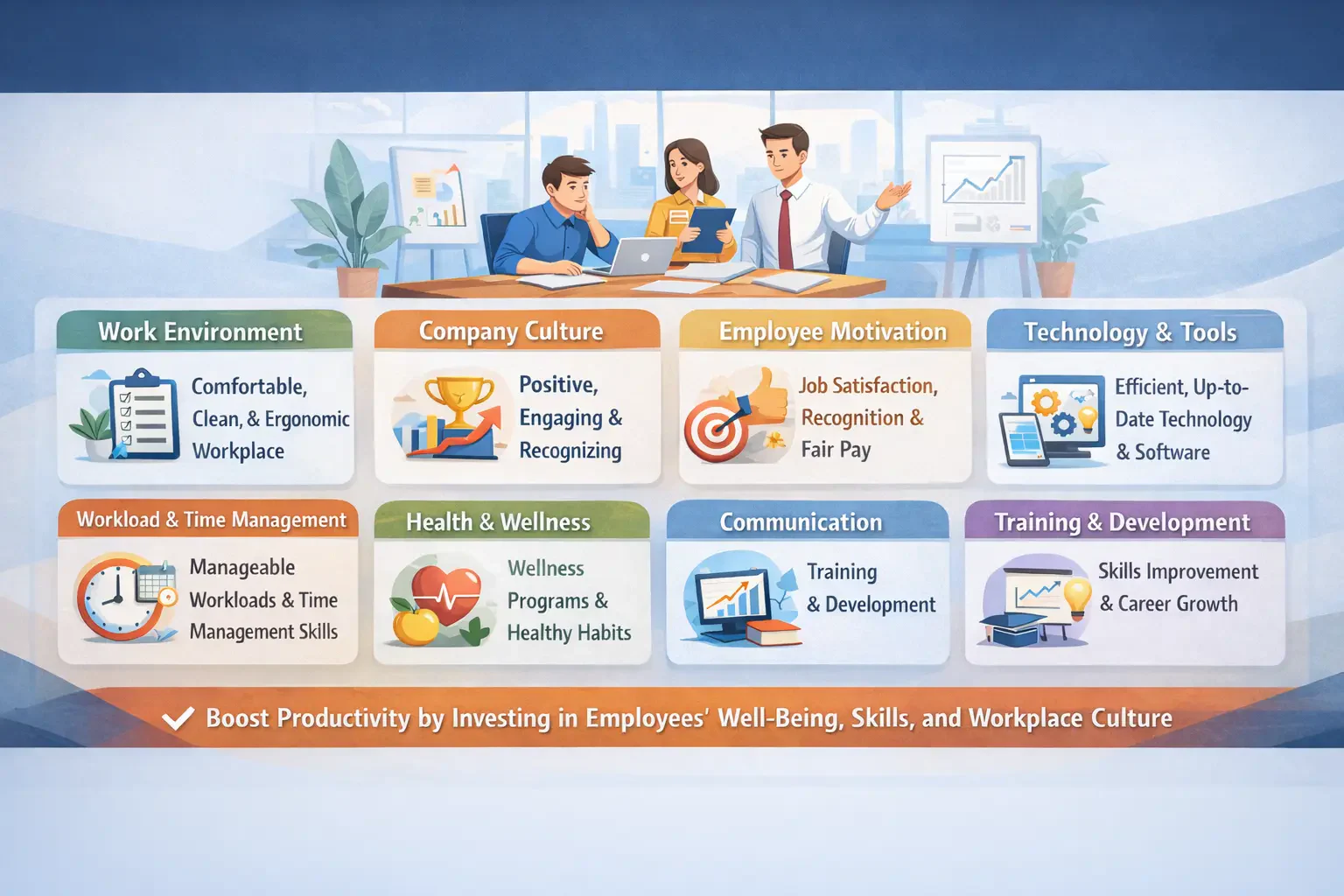
You can’t stress enough how important employee productivity is for a company’s growth and success. A number of factors can affect how well an individual performs, which can ultimately impact profits:
- Work Environment: A clean, organized space makes a big difference in productivity. Things like comfortable temperature, proper lighting, noise levels, and good ergonomics especially for those working from home can all contribute to a more productive atmosphere.
- Company Culture: Company culture influences how employees work. Gallup emphasizes timely, useful feedback and recognition as important parts of employee engagement; outcomes vary by team and implementation.
- Employee Motivation: Keeping employees motivated is key to high productivity. Factors like job satisfaction, recognition, growth opportunities, and fair pay all play a part in maintaining that drive.
- Technology and Tools: Having the right tools is essential. Old or inefficient tech can hold back productivity and leave employees feeling frustrated.
- Workload and Time Management: Employees who are overwhelmed or struggle with time management may find it hard to keep up with their workload. Employers should make sure workloads are manageable and offer support to help improve time management skills.
- Health and Wellness: Healthy employees are more productive. Employers can help by encouraging healthy habits and offering wellness programs to support well-being.
- Communication: Open communication between employees and management is crucial. Employers should create clear, transparent communication channels to keep everyone in the loop and engaged.
- Training and Development: Ongoing training is key to improving productivity. By investing in employees’ skills, companies can boost performance and motivation across the board.
Tips to Improve Employee Productivity
 If your employees are struggling with productivity, here are seven key ways to help them work better and stay motivated:
1. Give Work a Purpose
People perform better when they understand how their work contributes to the company’s success. Give them a sense of purpose by showing them why what they do matters and how it connects to the company’s goals.
2. Trust and Empower Employees
Stop micromanaging and give employees autonomy. Whether it’s through flexible working arrangements or allowing them to set meaningful goals that align with the company’s objectives, giving them more control over their work leads to better engagement and higher productivity.
3. Create a Positive Work Environment
Engagement isn’t just about free perks. Listen to employees, use feedback tools, and focus on creating an experience where they feel valued and supported.
4. Provide opportunities for growth and mastery
Employees want to get better at what they do, and you can help them by giving them opportunities to develop new skills, take on challenging tasks, or work toward a promotion. Offer access to training and mentorship, which benefits both them and the company.
5. Challenge them, but at the right time
Increasing accountability and responsibility can be a great way to keep employees engaged, but only when they’re ready for it. Adding more pressure to someone who’s already overwhelmed won’t help, so timing and balance are key to motivate rather than discourage.
6. Prioritize well-being and recognize their efforts
A burnt-out employee isn’t a productive one, so encourage self-care and provide support for mental well-being. Sometimes taking a break or stepping away from work is more beneficial than pushing through exhaustion.
At the same time, recognizing hard work, saying thank you, and celebrating wins big or small can go a long way in keeping employees motivated.
7. Use the right tools and communicate effectively
Having the right technology in place helps employees do their best work, especially if it makes their job easier rather than adding complexity, like a solid HR management platform built to handle the varying needs of a growing workforce.
Clear, frequent, and meaningful communication is just as important. Employees need feedback and support when things aren’t going well, but they also need to feel heard when they have concerns or ideas of their own.
Employees want to get better at what they do, and you can help them by giving them opportunities to develop new skills, take on challenging tasks, or work toward a promotion. Offer access to training and mentorship if you’re not sure where to start, exploring some of the available competency management tools can help structure those development paths effectively.
Common Challenges and How to Avoid Them
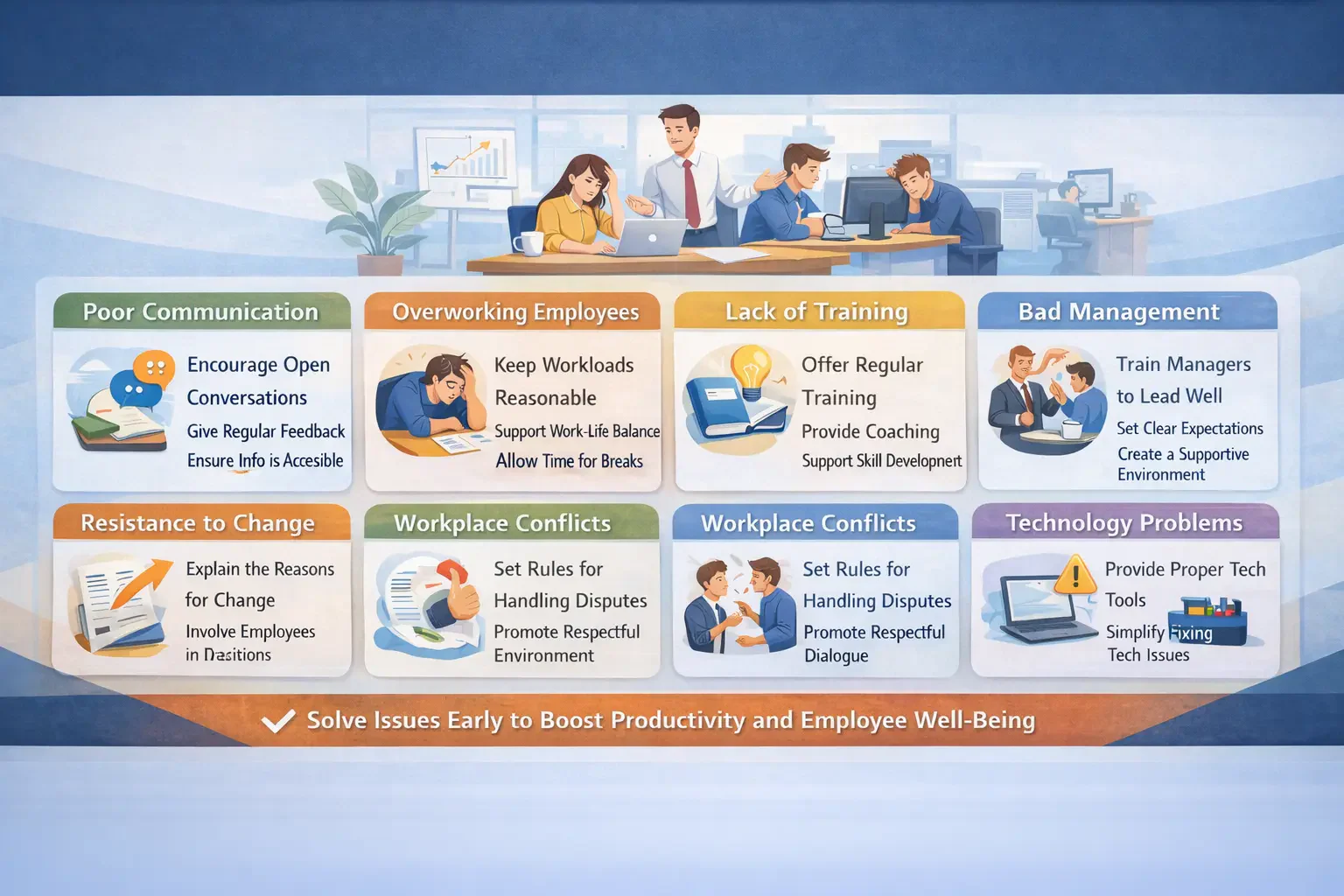
Challenges happen in every workplace, but spotting and solving them early can make things easier for everyone. Here are some common problems that hurt productivity and how to fix them:
- Poor communication causes confusion, mistakes, and frustration. Keep things clear by encouraging open conversations, giving regular feedback, and making sure employees know where to find important information.
- Overworked employees get tired, lose focus, and may even quit. Keep workloads reasonable, support work-life balance, and allow time for breaks to keep energy levels up.
- Lack of training leads to mistakes, frustration, and low confidence. Help employees do their jobs better by offering regular training, coaching, and chances to learn new skills.
- Bad management can make employees feel unmotivated and ready to leave. Train managers to lead well, set clear expectations, and create a supportive work environment.
- Resistance to change makes it hard for teams to grow and improve. Explain why changes are happening, involve employees in decisions, and offer support to help them adjust.
- Workplace conflicts bring stress and lower motivation. Set clear rules for handling disagreements, encourage respectful conversations, and build a team culture based on trust and cooperation.
- Technology problems slow people down and cause frustration. Give employees the right tools, provide training on how to use them, and have a simple way to fix tech issues when they come up.
By tackling these challenges early, businesses can create a workplace where employees stay productive, feel valued, and enjoy their work. Helping employees manage their time, focus on tasks, and maintain a good work-life balance makes a big difference.
Conclusion
Employee productivity is at the heart of business success, it’s what keeps work running smoothly, teams engaged, and growth sustainable. When companies actively invest in it, they tend to see stronger collaboration, better retention, and the resilience to weather challenges without burning their people out. The key is building systems and habits that support employees rather than just measuring what they produce.
For teams looking to act on these insights, having the right technology can make the entire process easier to manage. It’s worth exploring some of the best HR software tools available today to understand how they can support productivity tracking, workforce planning, and employee development in practice.
FAQ Around Employee Productivity
It is a measure of how efficiently an employee transforms inputs, such as instructions and requirements, into completed outputs within a specific timeframe.
Boosting productivity is essential because it leads to higher company profits, more steady revenue growth, and improved employee retention.
Businesses can use specialized HR software to automate performance tracking and provide data-driven insights to help employees reach their full potential.
A major challenge is a lack of clear goals and communication, which can lead to confusion among employees regarding their priorities and tasks.