






Businesses today frequently collect payment long before a product ships or a service is performed, a reality driven by subscription models, SaaS contracts, and annual service agreements. When cash arrives before the obligation is fulfilled, it cannot be recognized as revenue immediately. Instead, it must be recorded, tracked, and released over time through a process governed by strict accounting rules.
Getting this treatment right matters beyond compliance: how a company records and releases deferred revenue directly affects reported profitability, balance sheet health, and the metrics investors use to evaluate growth.
Key Takeaways
|
Table of Contents
What is Deferred Revenue?
Deferred revenue also called unearned revenue is the cash a company collects for goods or services it has yet to deliver. Because the obligation to the customer still exists, this amount cannot be recognized as income on the date payment is received; it sits on the balance sheet until the performance obligation is fulfilled.
Consider a publisher who receives a full year’s subscription payment in January. Only one of the twelve promised issues has been delivered, so recognizing the entire payment as January revenue would inflate that month’s income while leaving the remaining eleven months with no matching income at all. Instead, the payment is recorded as deferred revenue and released monthly as each issue ships.
This concept is the bedrock of accrual accounting, which dictates that financial events must be recorded in the periods in which they occur, regardless of when the actual cash changes hands. Unearned revenue acts as a holding pen on the balance sheet, ensuring that income is perfectly matched with the expenses incurred to generate that income over the appropriate timeline. This approach is central to accrual-based accounting, which requires that income be recorded in the period it is earned, not the period cash changes hands.
The Core Principles of Revenue Recognition

Revenue recognition is governed by two main accounting bodies: FASB, which sets GAAP standards in the United States, and the IASB, which issues IFRS used internationally. Both frameworks share a common goal, ensuring that revenue is recorded consistently, transparently, and in a way that reflects actual economic activity rather than cash timing.
The Matching Principle
The matching principle requires that expenses be reported in the same period as the revenues they help generate. For deferred revenue, this means income is held back until the company actually delivers, ensuring that the costs of fulfillment and the revenue from the contract appear in the same reporting window. Recognizing cash upfront while incurring costs later would cause profit margins to shift dramatically across periods, distorting any meaningful analysis.
ASC 606 and IFRS 15: The Five-Step Model
To standardize revenue recognition across global markets, FASB and IASB jointly introduced ASC 606 and IFRS 15. Both standards use the same five-step model to determine when and how much revenue a company can recognize from any contract with a customer.
- Step 1 : Identify the contract: A valid contract must have commercial substance, be approved by both parties, and clearly define the rights and payment terms of each side.
- Step 2 : Identify performance obligations: Each distinct promise within the contract such as a software license, installation, and support is treated as a separate obligation.
- Step 3 : Determine the transaction price: This is the total amount the company expects to receive, including fixed fees, variable components, and any non-cash consideration.
- Step 4 : Allocate the price to each obligation: The total contract value is split across obligations based on standalone selling prices, so each fulfilled promise unlocks its proportional revenue.
- Step 5 : Recognize revenue when the obligation is satisfied: Revenue is recognized at the point in time or over the period during which control transfers to the customer.
Following this model ensures revenue recognition is tied to actual delivery, not just to when cash arrives.
Is Deferred Revenue an Asset or a Liability?
Because the term ‘deferred revenue’ contains the word ‘revenue,’ and because the company has already received cash, it is easy to assume this belongs on the asset side of the balance sheet. It does not deferred revenue is classified as a liability.
To understand why, we must look at the definition of a liability in accounting: it is an obligation of the company arising from past events, the settlement of which is expected to result in an outflow of resources embodying economic benefits. When a customer pays in advance, the company now owes that customer something. The company is legally and operationally obligated to either deliver the promised product, perform the promised service, or, if they fail to do so, refund the cash. Because this obligation exists, the unearned revenue represents a “debt” of service or product owed to the customer.
Current vs. Non-Current Liabilities
The classification of this liability on the balance sheet depends entirely on the timeline of the expected fulfillment of the performance obligation. Where deferred revenue sits on the balance sheet depends on when the obligation is expected to be fulfilled.
- Current Liability: If goods or services will be delivered within 12 months, the full amount is a current liability. A one-year software subscription paid upfront, for example, sits entirely in the current section.
- Non-Current (Long-Term) Liability: If the obligation extends beyond 12 months, the portion due after the first year is classified as a long-term liability. A $30,000 three-year maintenance contract, for instance, records $10,000 as current and $20,000 as non-current with the long-term portion shifting to current as each year approaches.
Deferred Revenue vs. Accounts Receivable: The Critical Differences
Deferred revenue and accounts receivable both involve a timing gap between cash and revenue recognition, but they sit on opposite sides of the balance sheet. Accounts receivable is an asset the company has fulfilled its obligation and is waiting to be paid. Deferred revenue is a liability the company has been paid but has yet to fulfill its obligation
Because accounts receivable reflects a completed service with a legal right to collect, the revenue is recognized immediately even before cash arrives. Deferred revenue, by contrast, keeps income off the income statement until delivery actually occurs.
To summarize the differences clearly, consider the following comparison:
| Feature | Deferred Revenue | Accounts Receivable |
|---|---|---|
| Definition | Cash received before goods/services are delivered. | Goods/services delivered before cash is received. |
| Balance Sheet Classification | Liability (Current or Non-Current) | Asset (Current) |
| Income Statement Impact | Revenue is delayed (deferred) to a future period. | Revenue is recognized immediately in the current period. |
| Cash Flow Impact | Positive cash flow upfront. | No immediate cash flow; cash is collected later. |
| Nature of the Obligation | Company owes a product or service to the customer. | Customer owes cash to the company. |
Companies with high deferred revenue tend to enjoy stronger short-term liquidity, they are already holding customer cash to fund operations, without needing external financing.
How to Calculate and Record Deferred Revenue: Step-by-Step Journal Entries

To fully grasp how unearned revenue flows through an accounting system, it is essential to look at the debits and credits involved in the journal entries. Recording deferred revenue involves two stages: an initial entry when cash is received, and adjusting entries as the obligation is progressively fulfilled.
Scenario: An Annual SaaS Contract
Let’s assume a fictitious company, CloudTech Solutions, sells a premium enterprise cloud storage package. On October 1, 2024, a client signs a contract and pays $24,000 upfront for a 12-month subscription running from October 1, 2024, to September 30, 2025.
Phase 1: Initial Receipt of Cash (October 1, 2024)
When CloudTech receives the $24,000 payment, their cash balance increases, and their liability to provide the service increases simultaneously. No revenue is recognized at this point.
| Date | Account | Debit ($) | Credit ($) |
|---|---|---|---|
| Oct 1, 2024 | Cash (Asset) | 24,000 | |
| Oct 1, 2024 | Deferred Revenue (Liability) | 24,000 |
Explanation: The debit to Cash reflects the incoming payment. The credit to Deferred Revenue records the new obligation, no revenue is recognized at this point.
Phase 2: Subsequent Revenue Recognition (October 31, 2024)
At the end of the first month, CloudTech has successfully provided one month of cloud storage. They have now “earned” one month’s worth of the contract. The calculation is simple: $24,000 / 12 months = $2,000 per month.
CloudTech must now decrease their liability and recognize the earned revenue on the income statement.
| Date | Account | Debit ($) | Credit ($) |
|---|---|---|---|
| Oct 31, 2024 | Deferred Revenue (Liability) | 2,000 | |
| Oct 31, 2024 | Service Revenue (Income) | 2,000 |
Explanation: At month-end, $2,000 of the obligation is satisfied. The Deferred Revenue account is debited to reduce the liability, and Service Revenue is credited to record the earned income. This entry repeats monthly until the balance reaches zero.
This exact adjusting journal entry will be repeated at the end of every month for the duration of the 12-month contract. By September 30, 2025, the Deferred Revenue account balance for this contract will be $0, and the total $24,000 will have been fully recognized in the Service Revenue account.
Scenario: Percentage of Completion (Construction)
Unearned revenue is not always recognized on a simple straight-line basis over time. In industries like construction or custom manufacturing, revenue is often recognized based on the percentage of completion of a project.
Imagine BuildRight Construction receives a $500,000 upfront payment to build a custom warehouse. The total estimated cost to build the warehouse is $400,000.
- Initial Entry: Debit Cash $500,000; Credit Deferred Revenue $500,000.
- Month 1 Progress: BuildRight incurs $100,000 in costs (materials, labor). This represents 25% of the total estimated costs ($100,000 / $400,000).
- Revenue Recognition: Because the project is 25% complete, BuildRight can recognize 25% of the total contract price. 25% of $500,000 = $125,000.
- Adjusting Entry: Debit Deferred Revenue $125,000; Credit Construction Revenue $125,000.
This method ensures that revenue recognition is directly tied to the actual performance and progression of the contractual obligation, rather than just the passage of time.
The Impact of Deferred Revenue on Financial Statements
Deferred revenue touches all three major financial statements differently. On the balance sheet, it appears as a liability current if obligations are due within 12 months, long-term if they extend further. As performance obligations are fulfilled, that liability shrinks and moves to the income statement as recognized revenue.
On the income statement, only the earned portion of deferred revenue appears in any given period. This prevents artificially inflated revenue in the month cash is received and ensures profitability figures reflect actual work delivered.
On the cash flow statement (indirect method), an increase in deferred revenue is added back to net income in operating activities because cash was collected but not yet recognized as income. This is why subscription businesses often report strong operating cash flow even when net income appears modest.
Industry-Specific Use Cases of Deferred Revenue
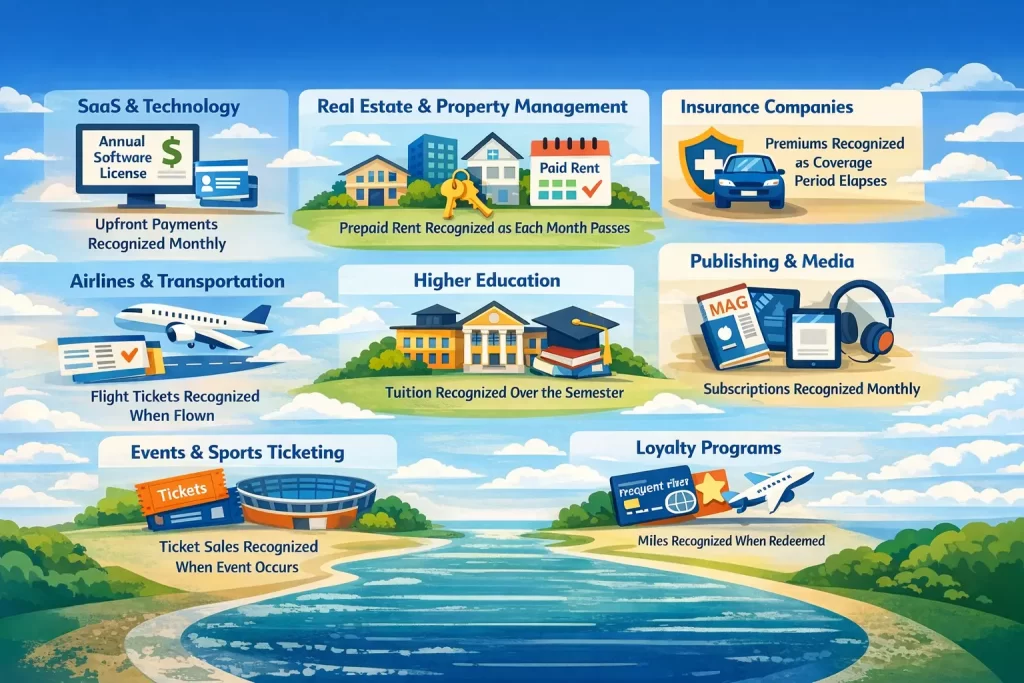
Deferred revenue appears across virtually every sector where payment and delivery don’t happen simultaneously. How and when a company recognizes it depends on what exactly is being delivered and that varies widely by industry.
Software as a Service (SaaS) and Technology
The SaaS industry is perhaps the most heavily reliant on deferred revenue accounting. Tech companies frequently incentivize customers to pay for annual or multi-year software licenses upfront in exchange for a discounted rate. This influx of cash is vital for funding ongoing research, development, and customer acquisition costs. When a SaaS company closes a $120,000 annual contract and receives the cash on day one, that entire amount sits on the balance sheet as a short-term liability. As the software is hosted and provided to the client month by month, the company recognizes $10,000 every 30 days.
Furthermore, SaaS companies often charge one-time implementation, onboarding, or setup fees. Under strict ASC 606 guidelines, if these setup services do not provide distinct, standalone value to the customer independent of the software itself, the revenue from the implementation fee cannot be recognized immediately. Instead, it must also be deferred and amortized over the estimated life of the customer relationship, adding a secondary layer of deferred revenue tracking.
Airlines and Transportation
The aviation industry operates on a massive scale of unearned income. When a traveler books a flight for a summer vacation in January, the airline collects the cash immediately. However, the airline has not yet fulfilled its performance obligation, flying the passenger to their destination. The ticket price remains as a deferred revenue liability for months. Only when the wheels touch down at the destination can the airline move those funds from the balance sheet to the income statement.
Additionally, airlines manage complex frequent flyer and loyalty programs. When a customer earns miles, a portion of the ticket price they paid is allocated to those miles and deferred. This revenue is only recognized when the customer eventually redeems the miles for a future flight, or when the miles expire. This requires sophisticated actuarial estimates to predict “breakage” (the percentage of miles that will never be redeemed).
Real Estate and Property Management
In the commercial and residential real estate sectors, deferred revenue is a daily reality. Landlords frequently collect rent payments at the beginning of the month, or sometimes require several months of prepaid rent in advance. If a commercial tenant pays for a full year of leasing upfront, the property management company must defer this revenue, recognizing it incrementally as each month of the lease elapses.
It is important to note that security deposits are handled differently. While they are also liabilities, they are not deferred revenue because they are not payments for goods or services. They are held in escrow and returned to the tenant, unless applied to damages or unpaid rent later on. Distinguishing between prepaid rent (unearned revenue) and security deposits (refundable liability) is a critical task for real estate accountants.
Higher Education
Colleges and universities experience massive seasonal spikes in cash flow that necessitate strict deferred revenue protocols. Students typically pay their full semester tuition in August before classes begin. If a university recognized all this cash immediately, their August income statement would show astronomical profits, while the subsequent months (September through December) would show massive losses as the university pays faculty salaries and facility maintenance costs. To match revenues with expenses accurately, the institution records the tuition as unearned income and amortizes it evenly over the duration of the academic semester.
Insurance Companies
Insurance providers collect premiums before coverage begins often semi-annually or annually. A $1,200 six-month auto policy, for example, is recorded as unearned premium reserve on day one, with $200 recognized monthly as the coverage period runs. The income is earned only as the company bears the ongoing risk of potential claims.
Publishing and Media Subscriptions
Subscription-based media from print magazines to digital streaming platforms carry deferred revenue for the full prepaid period. A $120 annual news subscription is recognized at $10 per month, matching revenue to the cost of content produced each period.
Events, Concerts, and Sports Ticketing
When a sports franchise sells season tickets in the off-season, or an event promoter sells tickets months before a concert, the collected cash is held as deferred revenue. Revenue is recognized only as each game is played or each event occurs. If an event is canceled, the liability must be reversed either refunded or rescheduled.
Step-by-Step Implementation for Managing Deferred Revenue
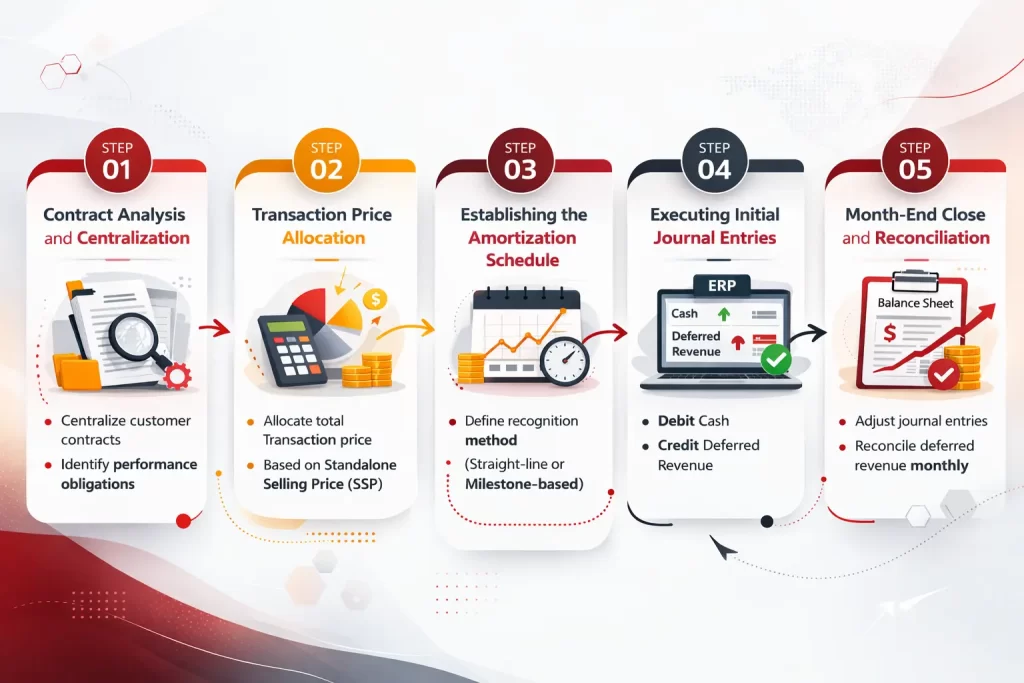
Transitioning from a basic cash accounting mindset to a robust accrual-based system requires a disciplined approach to managing unearned income. For growing enterprises, implementing a scalable and compliant deferred revenue process involves several critical steps that align with the five-step model of ASC 606.
Step 1: Contract Analysis and Centralization
The first step in any robust revenue recognition process is centralizing all customer contracts. Finance teams must review these agreements to identify exactly what has been promised to the customer. This involves pinpointing all distinct “performance obligations.” A single contract might include software access, professional training, and ongoing technical support. Each of these represents a separate obligation that may require its own deferred revenue schedule.
Step 2: Transaction Price Allocation
Once the performance obligations are identified, the total transaction price of the contract must be allocated across them based on their Standalone Selling Price (SSP). If a company sells a bundled package for $10,000 that includes both hardware and a one-year service contract, the finance team must determine the fair market value of the hardware and the service independently. The revenue for the hardware might be recognized immediately upon delivery, while the revenue allocated to the service contract is deferred and recognized over twelve months.
Step 3: Establishing the Amortization Schedule
After allocating the transaction price, the accounting team must establish an amortization schedule for the deferred portion. This involves deciding the method of recognition. The most common method is the straight-line method, where revenue is recognized evenly over a specific period (e.g., $1,000 per month for 10 months). Alternatively, companies might use a milestone-based method, where revenue is recognized only when specific project phases are completed and signed off by the client.
Step 4: Executing Initial Journal Entries
When the cash is initially received, the accounting software or Enterprise Resource Planning (ERP) system must record the transaction accurately. The standard journal entry involves a debit to the Cash account (increasing assets) and a credit to the Deferred Revenue account (increasing liabilities). This crucial step ensures the balance sheet reflects the company’s new obligation to the customer without artificially inflating the income statement.
Step 5: Month-End Close and Reconciliation
The final and ongoing step occurs during the month-end close process. The finance team must review the amortization schedules and execute the adjusting journal entries to recognize the earned portion of the revenue. This involves debiting the Deferred Revenue account (reducing the liability) and crediting the Revenue account (increasing income). Regular reconciliation between the deferred revenue sub-ledger and the general ledger is mandatory to catch discrepancies, account for customer churn, and ensure audit readiness.
Common Pitfalls and Compliance Risks

Managing deferred revenue is fraught with potential errors, especially for rapidly scaling businesses that have outgrown their initial accounting infrastructure. Falling victim to these common pitfalls can result in failed audits, restated financials, and a loss of investor confidence.
Over-Reliance on Manual Spreadsheets
In the early stages of a business, tracking unearned income in Excel might seem sufficient. However, as customer volume grows and contract complexity increases, manual spreadsheets become a massive liability. Formula errors, broken links, and version control issues can easily lead to millions of dollars in misstated revenue. As volume and complexity grow, finance teams typically look toward accounting systems that can automate recognition schedules and flag discrepancies without manual input.
Mishandling Contract Modifications
Customers frequently upgrade, downgrade, or cancel their services mid-contract. A major pitfall is failing to adjust the deferred revenue schedule dynamically when these modifications occur. If a customer on an annual contract upgrades their service in month six, the finance team must recalculate the remaining deferred revenue and adjust the future recognition schedule accordingly. Failing to do so results in inaccurate revenue realization and compliance breaches.
Ignoring Variable Consideration
Many contracts include elements of variable consideration, such as performance bonuses, volume discounts, or right-of-return clauses. ASC 606 requires companies to estimate this variable consideration and only recognize revenue to the extent that it is probable a significant reversal will not occur. Ignoring potential refunds or discounts and deferring a static amount can lead to overstating future revenue streams.
Misclassification Between Short-Term and Long-Term Liabilities
Deferred revenue must be accurately classified on the balance sheet based on the timeline of the obligation. Any revenue expected to be recognized within the next twelve months is a current (short-term) liability. Any portion extending beyond twelve months must be classified as a non-current (long-term) liability. Lumping multi-year prepaid contracts entirely into short-term liabilities severely distorts a company’s working capital ratios and liquidity metrics.
Advanced Practices and Strategic Revenue Management

For mature organizations, deferred revenue is not just a compliance hurdle; it is a strategic metric that informs executive decision-making. Advanced finance teams utilize sophisticated practices to leverage unearned income for business growth.
The Deferred Revenue Waterfall Analysis
A deferred revenue waterfall is an advanced reporting mechanism that projects exactly how the current unearned income balance will “flow” into recognized revenue over future periods. This granular forecasting tool allows Chief Financial Officers (CFOs) to predict future income statements with high accuracy, even if no new sales are made. Waterfall reports are highly scrutinized by investors during mergers, acquisitions, and fundraising rounds, as they provide a transparent view of guaranteed future revenue.
Leveraging Negative Working Capital Models
Highly efficient companies use deferred revenue to fund their own growth, operating on a negative working capital model. By aggressively collecting cash upfront for long-term subscriptions, these businesses generate a massive float of unearned income. Instead of relying on expensive bank loans or dilutive venture capital, they use their customers’ prepaid cash to fund marketing, payroll, and product development. Amazon Prime and major SaaS platforms are masterclasses in using deferred revenue as an interest-free funding source.
Integrating CPQ and Billing Automation
To eliminate friction between sales and accounting, advanced enterprises tightly integrate their Configure, Price, Quote (CPQ) systems with their billing and ERP software. When a sales representative closes a complex, multi-tiered deal in the CRM, the integrated system automatically parses the contract, identifies the performance obligations, allocates the transaction price, generates the invoice, and builds the deferred revenue amortization schedule without a single manual data entry. This level of integration reduces manual entry errors, keeps recognition schedules current with contract changes, and speeds up month-end close significantly.
For finance teams building out or scaling their recognition processes, the right infrastructure makes a meaningful difference. Understanding how various accounting platforms handle deferred revenue recognition particularly for complex, multi-element contracts can help narrow the decision. A comparison of the top accounting tools for revenue management is a practical starting point for teams evaluating their options.
Conclusion
As businesses mature and subscription volumes grow, tracking deferred revenue manually becomes increasingly error-prone. For finance teams looking to scale their recognition processes without sacrificing compliance, understanding which tools align with their contract complexity is a practical next step. Exploring a breakdown of the best accounting software for managing deferred revenue can help teams identify solutions that fit their industry and reporting requirements.
FAQ Around Deferred Revenue
-
What is the difference between deferred revenue and unearned revenue?
There is no practical difference both terms refer to the same accounting concept: cash received from a customer before the corresponding goods or services have been delivered. ‘Deferred revenue’ is the term commonly used in corporate financial reporting, while ‘unearned revenue’ appears more often in educational and textbook contexts. Both are recorded as liabilities on the balance sheet until the obligation is fulfilled
-
Is deferred revenue a debit or credit?
When initially recorded, deferred revenue is a credit because it increases a liability account (Deferred Revenue). The corresponding entry is a debit to Cash. When the obligation is fulfilled and revenue is earned, the deferred revenue account is debited (reducing the liability), and the Revenue account is credited (increasing income on the income statement).
-
When does deferred revenue become revenue?
Deferred revenue is recognized as earned revenue once the company satisfies its performance obligation, meaning it has delivered the promised product or performed the promised service. Under ASC 606, this can happen at a specific point in time (e.g., product delivery) or over a period of time (e.g., monthly software access). The recognition schedule is determined by the nature of the obligation and is typically spread across the contract term using a straight-line or milestone-based method.
-
How does deferred revenue affect cash flow?
Deferred revenue has a positive impact on operating cash flow because the company collects cash before recognizing it as income. On the cash flow statement, an increase in deferred revenue is added back to net income in the operating activities section (under the indirect method). This is one reason SaaS and subscription businesses often show strong cash flow despite reporting lower net income.