









 Limited to 100 registrants

Have you ever faced the challenge of frustrating backorders in your company’s inventory, leading to delays and unhappy customers? Backorders are one of the more disruptive inventory problems a business can face.
They delayed deliveries, backorders can lead to higher costs, lost sales, and diminished customer trust. But don’t worry, there are effective solutions to tackle this problem.
In this article, you’ll explore backorder meaning, seven powerful strategies, including leveraging technology like inventory management software, to help you prevent backorders, ensuring smoother operations and more satisfied customers.
Key Takeaways
A backorder occurs when a business cannot fulfill a customer order because the item is out of stock, often resulting in lost sales, order cancellations, and reduced customer trust.
The three root causes of backorders are poor warehouse management, demand exceeding supply, and human errors such as miscounting or data entry mistakes.
Real-time stock monitoring and advanced demand forecasting are among the most effective strategies to prevent backorders before they disrupt operations.
Creating contingency plans such as securing backup suppliers and maintaining emergency stock reserves is essential for keeping a consistent product supply during unexpected disruptions.
What is a Backorder?

A backorder occurs when a customer places an order for an item that is currently out of stock. Rather than canceling the order outright, the business acknowledges it and commits to fulfilling it once stock is replenished. This condition often occurs in companies that experience high demand or problems in the supply chain.
The backorder situation is not something that the company can underestimate. Quoted from ismworld, 70% of companies in the world lose sales opportunities due to backorders. This can happen due to an imbalance between demand and availability of goods.
Not only that, the occurrence of backorders can reduce customer satisfaction. Customers who have to wait a long time for their goods may switch to competitors. In addition, backorders can also increase operational costs, as companies have to incur additional costs to fulfill pending orders.
What Causes Backorders?
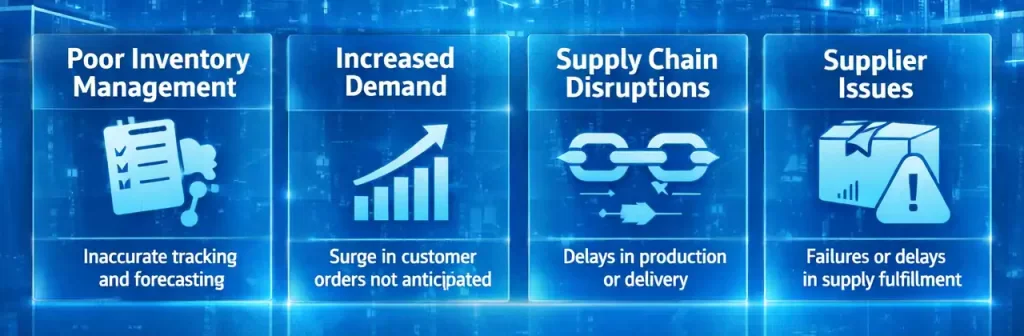
Backorders arise due to multiple factors within the inventory management system, often originating from significant gaps in various operational areas. Identifying these root causes is essential to reducing backorders and ensuring a smooth supply chain.
1. Bad warehouse management
One major cause of backorders is poor warehouse management : disorganized storage, inaccurate inventory counts, inefficient shelving, or issues in picking and packing processes can create a mismatch between listed stock and actual inventory. This discrepancy can result in unexpected shortages, making stock out for fulfillment despite being shown in the system.
2. Demand surpassing supply
Another frequent cause of backorders occurs when customer demand exceeds available stock. This often happens due to inaccurate demand forecasts, sudden order surges, or unanticipated market trends. When businesses fail to properly align inventory levels with changing demand, shortages occur, leading to stock out or backlogged orders.
3. Human errors
Despite advancements in technology, human errors still play a significant role in causing backorders. Mistakes like mislabeling, miscounting, data entry errors, or inaccuracies in order processing can disrupt inventory records, leading to discrepancies between actual and expected stock. These unintentional errors can cause delays in fulfillment, resulting in backorders.
How to Calculate the Right Order Quantity When Backorders Occur

One often-overlooked factor in backorder prevention is knowing exactly how much to reorder and when. The Economic Order Quantity (EOQ) with backorders is a formula that helps businesses determine the optimal order size while accounting for the fact that some level of backorder may be tolerable. Unlike the standard EOQ model, this variation factors in backorder costs against holding costs, allowing businesses to find a balance where carrying less inventory is acceptable as long as the cost of delayed fulfillment stays within a defined threshold.
The formula works on the principle that holding excess stock is expensive, but so is keeping customers waiting. By calculating the point where both costs are minimized together, businesses can make more deliberate restocking decisions rather than reactive ones. This is particularly useful for companies with predictable demand cycles or those managing a large SKU range where tying up capital in safety stock across every product line is not practical.
The Issue of Backorders and How to Resolve It

Backorders pose a complex challenge for businesses, impacting multiple aspects of their operations. Tackling these issues demands a strategic approach, a clear understanding of the causes behind backorders, and the implementation of proactive solutions.
1) Product cost and batch sizes
Balancing product cost with batch sizes is essential for avoiding backorders. Efficiently managing production costs while determining the right batch sizes ensures adequate inventory levels. If this balance is not achieved, it can result in either overstocking or stock shortages, both leading to potential backorders.
2) Ensure effective inventory management
Strong inventory management is crucial for preventing backorders. Accurate demand forecasting, real-time stock tracking, and maintaining optimized inventory levels reduce the chances of shortages, helping to meet customer demand without delays or backlogs.
3) Order cancellations
Backorders frequently lead to order cancellations because of extended wait times. When customers encounter uncertainty or lengthy delays, they may choose to cancel their orders. Reducing backorders helps lower the likelihood of cancellations, maintaining customer satisfaction and loyalty.
4) Loss of customers
Failing to fulfill orders on time can result in customer dissatisfaction and eventual loss. Backorders strain relationships, weakening trust and loyalty. Preventing them is key to retaining customers and building lasting relationships.
5) Decline in market share
Ongoing backorders can negatively impact a company’s market share. Missed sales opportunities due to unfulfilled orders weaken the company’s competitive advantage. Avoiding backorders is crucial for maintaining a strong market position and driving business growth.
Conclusion
In conclusion, Preventing backorders is ultimately about building the right habits around data, planning, and team accountability. When businesses take a proactive stance like monitoring stock levels in real time, training staff on accurate data entry, and setting up contingency sourcing, the disruptions become far less frequent and easier to manage. For teams ready to take the next step, reviewing the best inventory management software options available today can help identify which tools align best with their operational needs and scale.
FAQ Around Backorders
A backorder means the item will be fulfilled once restocked. Out-of-stock may mean no restock is planned. Communicating this distinction clearly to customers prevents unnecessary cancellations.
Resolution time varies by supplier lead times, demand levels, and supply chain conditions. Businesses with contingency plans and backup suppliers tend to resolve them faster.
Extended backorders lead to order cancellations, loss of customer trust, and decline in repeat business. Transparent communication about delays can help retain customers during these periods.
Key strategies include real-time inventory tracking, accurate demand forecasting, stock velocity analysis, regular staff training, and maintaining emergency safety stock.