













Have you ever over-ordered, only to watch your profits vanish with spoiled ingredients? Or run out of a popular dish during peak hours, disappointing customers and losing sales?
A solid inventory management system can help prevent these issues by keeping stock levels in check, ensuring you have what you need when you need it.
Good inventory management directly impacts your bottom line, as every dish and drink starts with your stock. By adopting smarter inventory practices, you can cut costs and provide a better experience for your customers. Let’s dive into how you can do this!
Key Takeaways
|
Table of Contents
What is Restaurant Inventory Management?

Restaurant inventory management involves overseeing the flow of supplies and products to meet customer demand without creating excessive surplus. Additionally, this process ensures your establishment always has the right amount of food, beverages, and supplies on hand.
Key components of effective inventory management include tracking stock levels, predicting demand, ordering supplies, and managing supplier relationships. Furthermore, these elements work together to prevent stockouts and excess inventory which can be costly in the restaurant industry.
Why Restaurant Inventory Management Matters
Effective inventory management is crucial for maintaining the profitability of a restaurant. It not only helps in reducing operational costs but also enhances the efficiency of the kitchen and service areas by ensuring optimal par level control.
By keeping a tight rein on inventory, you can avoid over purchasing which directly translates to increased profitability. Moreover, a well managed inventory system aids in improving cash flowva vital element for the survival of any business.
It ensures that capital is not tied up in unused stock and helps in allocating resources more effectively. This control is particularly crucial in the dynamic and competitive Philippine market, where customer preferences can shift rapidly.
Read More: Top Construction Inventory Management Software
Types of Restaurant Inventory
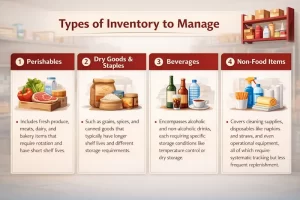 Understanding and effectively managing the various types of inventory in your restaurant is crucial to optimizing operations and reducing waste. Here are the essential categories:
1. Perishables
Includes fresh produce, meats, dairy, and bakery items that require rotation and have short shelf lives.
2. Dry Goods and Staples
Such as grains, spices, and canned goods that typically have longer shelf lives and different storage requirements.
3. Beverages
Encompasses alcoholic and non-alcoholic drinks, each requiring specific storage conditions like temperature control or dry storage.
4. Non-Food Items
Covers cleaning supplies, disposables like napkins and straws, and even operational equipment, all of which require systematic tracking but less frequent replenishment.
Each of these categories has its specific storage needs and turnover rates, making it essential to manage each type effectively to maintain quality and availability, ensuring that your restaurant can meet the varied demands of your customers efficiently
Common Inventory Management Terms for Restaurants
 Familiarity with inventory management terminology is essential for effective communication in a restaurant setting. Terms such as ‘sitting inventory’ refer to items currently stocked and not used, ‘depletion’ measures how quickly items are used up, and ‘Usage’ tracks the amount of inventory used over a specific period.
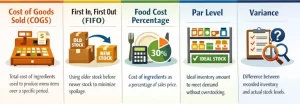
Here are five key terms commonly used in restaurant inventory management:
- Cost of Goods Sold (COGS): Reflects the total cost of ingredients used to produce menu items over a specific period.
- First In, First Out (FIFO): An inventory method ensuring older stock is used before newer stock, critical for minimizing spoilage.
- Food Cost Percentage: Measures the cost of ingredients as a percentage of the sales price, aiding in pricing and profitability assessments.
- Par Level: The ideal quantity of each inventory item that should always be on hand to meet demand without overstocking.
- Variance: The difference between recorded inventory and actual stock levels, highlighting discrepancies due to errors or theft.
A glossary of these terms is invaluable for restaurant owners and staff alike, providing a clearer understanding of inventory reports and aiding in more accurate tracking and management practices. Knowing these terms enhances operational efficiency and financial oversight.
Restaurant Inventory Management Best Practices
To elevate your inventory management, begin by maintaining accurate inventory counts. Organize storage areas so items are easily accessible, ensuring everything is accounted for. Consistently schedule inventory checks and train your staff on these practices to enhance order and accuracy.
Here’s a short approach:
- Accurate Inventory Tracking: Use real-time tools to maintain precise stock levels, reducing waste and improving forecasting.
- FIFO Method: Implement First In, First Out to prioritize older stock, minimizing spoilage.
- Staff Training: Regularly train employees on efficient inventory practices for consistency.
- Leverage Technology: Invest in cloud inventory software to automate processes and provide key insights.
This method ensures that stock is managed effectively, reducing the risk of spoilage and maintaining system reliability through trained staff and advanced tools.
Managing Food Waste and Loss Prevention

In the restaurant and retail industry, managing food waste is crucial for minimizing costs and improving sustainability. Using techniques like careful ordering, monitoring spoilage, controlling portion sizes, and using the FIFO method reduce waste.
Tracking food waste through detailed reports identifies problem areas for targeted improvements. Loss prevention also involves training staff in proper handling, storage, and inventory practices.
Restaurant management software solutions can further minimize waste by automating ordering, tracking spoilage, and predicting demand, reducing over-ordering and spoilage. Additionally, repurposing leftovers into new dishes or donating excess food supports sustainability efforts while improving profitability.
Benefits of Inventory Management Systems for Restaurants
Utilizing an inventory management system can transform how you manage restaurant resources by offering precise tracking, demand forecasting, and optimized stock control. These systems help reduce waste, prevent stockouts, and provide detailed financial insights. The benefits include:
- Accurate Forecasting: Reduces over-ordering and spoilage.
- Real-Time Tracking: Monitors stock levels efficiently.
- Waste Reduction: Automates expiration tracking and order recommendations.
- Enhanced Financial Reporting: Provides clear inventory cost and usage reports.
These systems streamline operations, letting you focus more on customer service while maintaining tighter control over backend processes, ultimately boosting efficiency and profitability.
Conclusion
Effective inventory management is crucial for the success of restaurants in the Philippines. By implementing best practices like real-time tracking, automated reordering, and the First In, First Out (FIFO) method, you can reduce waste and improve profitability.
Using inventory management software can simplify your processes and give you real time insights. This helps you make better decisions and stay adaptable, keeping your restaurant competitive and profitable.
Frequently Asked Questions
-
What is the best inventory method for restaurants?
The best inventory method for restaurants is the First In, First Out (FIFO) method. It ensures that older stock is used first, minimizing waste and spoilage.
-
How to do an inventory list for restaurant?
To create an inventory list that complies with BIR standards for a restaurant, categorize items (e.g., food, beverages, supplies) and record quantities, purchase dates, and prices. Regular updates are essential for accuracy.
-
What do restaurants use to keep track of inventory?
Restaurants frequently rely on inventory management software to track inventory more efficiently. In addition, these systems provide real-time data, streamline order management, and help prevent issues like overstocking or shortages.