










Quiet quitting is back in focus in the Philippines because the workweek debate is no longer theoretical. In March 2026, the national government moved some executive offices to a temporary four-day arrangement under Memorandum Circular No. 114, and Based by the Professional Regulation Commission, workweek shifted to a four-day on-site week with Friday work from home while keeping frontline services open. At the same time, DOLE said private employers may adopt flexible work schemes, including compressed workweeks, if the setup complies with labor rules.
That creates a real management test. If employers compress hours but leave the same bottlenecks, approval delays, staffing gaps, and after-hours expectations in place, employees may stop resigning loudly and start disengaging quietly.
Table of Contents

Key Takeaways
|
What Quiet Quitting Actually Means

In its workplace framework, quietly quitting means employees are psychologically unattached to their work and company, so they put in time but not energy or passion.
For Philippine employers, that usually does not mean an employee has already quit or broken a rule. It usually means the person still does the required work, but stops giving discretionary effort such as volunteering for extra tasks, solving spillover problems, or staying reachable beyond clearly defined hours.
What It Costs Employers
Quiet quitting rarely starts as a dramatic performance collapse. It usually shows up first in slower handoffs, weaker service recovery, more manager follow-up, and heavier dependence on a few engaged employees.
That creates a second risk. Once the most reliable staff absorb the extra coordination burden, they also become more likely to burn out. The company then moves from hidden disengagement to visible turnover, service errors, and weaker team morale.
Why Filipino Employees Pull Back at Work
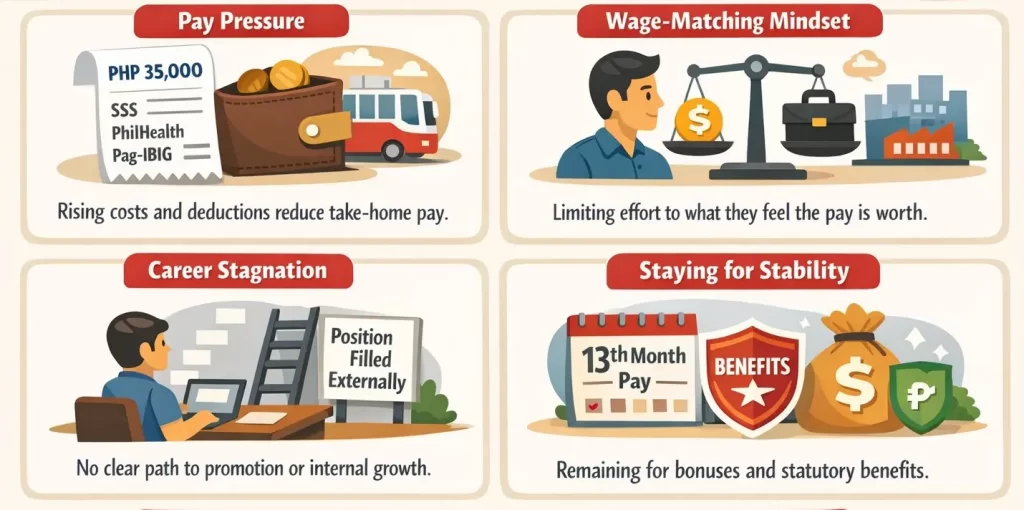
Filipino worker disengagement in 2026 is closely tied to pay pressure. An entry-level analyst in Makati earning PHP 35,000 can lose part of that income to SSS, PhilHealth, and Pag-IBIG deductions before covering rent and transportation. When take-home pay no longer keeps pace with living costs, employees often adopt a wage-matching mindset and limit their effort to what they believe the company is paying for.
Career stagnation also drives withdrawal. Many employees stay in roles with no visible path to promotion, especially when companies fill senior posts externally instead of building internal talent through performance management. That pattern weakens trust in advancement, lowers initiative, and leaves workers staying for stability, 13th-month pay, and statutory benefits rather than stronger commitment.
Why Disengagement Can Rise During Compressed or Flexible Work Setups
Longer workdays can raise fatigue if the company only changes the calendar and does not change the workload. That risk becomes more obvious in the Philippines because employees already report elevated stress and negative emotions in Gallup’s 2026 country data.
DOLE’s Institute for Labor Studies also found that the majority of surveyed workers experienced stress and burnout because of heavy workloads, conflicts with colleagues, and micromanagement. A compressed schedule can ease commuting on paper, but it can also deepen frustration if managers use it to demand the same volume of work in a tighter daily window.
What Managers Can Do Before Disengagement Turns Into Turnover
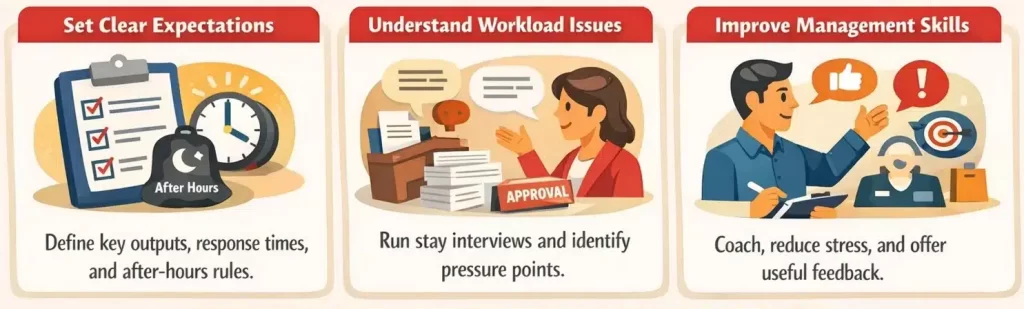
Start with job design, not slogans. Define the outputs that matter under the new schedule, set response-time rules, and make after-hours expectations explicit instead of relying on unwritten habits.
Next, check workload reality. Run short stay interviews, ask what blocks employees from doing good work, and review whether compressed hours are creating new pressure points in approval chains, customer coverage, or transport routines.
Then fix manager behavior. The DOLE ILS research points to heavy workload, conflict, and micromanagement as major stressors, so coaching quality matters as much as policy design. Managers who give clear priorities and useful feedback usually surface quiet quitting earlier than managers who monitor activity but do not remove obstacles.
How HRIS Helps in Monitoring Employee Sentiment

A Human Resource Management System helps HR teams track attendance, task completion, training participation, and other workforce patterns in one place. These records help managers detect early signs of disengagement, such as repeated absences, low participation, or declining output, before the problem spreads across teams. Automation also reduces time spent on routine administration, so HR can focus more on coaching, follow-ups, and employee support.
An HRIS also supports more frequent feedback. Managers can record goals, monitor progress, and document recognition throughout the year instead of waiting for one annual review. That gives employees clearer visibility into expectations and development. It also reduces manual work tied to payroll processing, which is one of the payroll software benefits in the Philippines that helps HR maintain more accurate records and a more consistent employee experience.
Employer Checklist Before Adopting a Compressed Workweek
Use the checklist below before rollout. It keeps the conversation focused on operations, compliance, and employee response instead of treating a four-day week as a trend decision.
| Checklist item | Why it matters |
| 1. Confirm whether the setup is compressed, hybrid, or both | Different models create different fatigue, coverage, and monitoring risks. |
| 2. Document employee consultation and manager responsibilities | DOLE says compressed workweek arrangements should be based on employer-worker agreement. |
| 3. Protect wages, benefits, and service coverage | A schedule change that saves cost but disrupts frontline work will raise resistance fast. |
| 4. Reset KPIs for the first 30 to 90 days | Old output targets may not fit a new time structure. |
| 5. Track stress, attendance, overtime, and errors after launch | Quiet quitting usually surfaces in patterns, not in one incident. |
| 6. Define rollback triggers before rollout | A pilot should have clear stop conditions if service quality or employee strain worsens. |
Conclusion
Quiet quitting in the Philippines is not just a culture topic in 2026. It now sits beside schedule redesign, energy-saving measures, manager quality, and employee stress.
The current four-day workweek push can help some organizations reduce commuting pressure and improve focus, but it can also expose unresolved workload and management problems. Employers that define outputs clearly, protect boundaries, and monitor employee sentiment early are more likely to prevent disengagement from turning into turnover. To support that effort, many businesses are also exploring HRIS software in the Philippines to improve visibility into attendance, performance, and employee engagement before issues escalate.
FAQ About Quiet Quitting
-
Why is quiet quitting happening?
Quiet quitting usually happens when employees feel overworked, underpaid, or disconnected from growth opportunities. It often appears when staff no longer see a clear link between extra effort, recognition, and career progress.
-
Why are employees quiet quitting?
Employees often quiet quit because of burnout, unclear expectations, weak management support, or limited advancement. Some also pull back when rising living costs make them feel their pay no longer matches the effort the job demands.
-
Why is quiet quitting bad for businesses?
Quiet quitting can reduce productivity, weaken teamwork, and slow customer response times. If managers ignore it, the problem can spread across teams and increase turnover, errors, and disengagement.
-
When did the term quiet quitting start?
The term quiet quitting became widely known in 2022 after it gained traction on TikTok and other social platforms. The idea itself existed earlier, but 2022 made it a mainstream workplace discussion.